 JangBoGo
Quite a few details..Karwar getting missile silos?what missile I wonder..;)
…..it has to be the Brahmos. I don’t think it is going to be silos, has to be mobile TELs.
JangBoGoAfter reading these article , it seems to me that true potential of Pr 955 SSBN and Pr 885 SSGN will be truly realised in the upgraded model of 955U and 885M.
it could mean, the 885M would be much better than what the 885 is now. It doesn’t have to mean 885 is somewhat backward.
It talks of new reactors for 4+ and 5th Gen submarine , plus it seems like 955U will have a speherical sonar and 20 Bulava SSBN which is confirmed.
I highly doubt the Pr.955 will get a new spherical sonar. If yes, it would mean a completely new design for the front and mid section. Practically a new class of sub.
JangBoGoU could also be “Udlenyonniy” = Elongated
Makes sense, too.
that makes sense if the future variant of pr.955 is said to carry 20 SLBM.
So Pr.955U might mean an lengthened version in addition to the natural updatation that it could get.
JangBoGo^^^
Its good news as they will not have to depend on the PS-90A2 which had PW inputs and hence possibility of sanctions to customers like Iran. Now they have to promote it and give the initial support a product will need to make a hold in the market. The Govt can initiate some sort of an incentive drive like tax-rebate for Russian airlines who are going to upgrade with the new engines.
But more than the engine or a product as such, what Russian civil aviation needs to do is to create the necessary support network. No matter how good a product is, without the support hubs customers would be reluctant to order the aircraft or engines.
Since Malaysia have already committed for 50 or so MS-21, UAC needs to develop Malaysia as a fully functional hub for its commercial aircrafts. I think it will greatly help in the future.
In terms of engine, I’m greatly looking forward to the success of PD-30. It is a significant product as it will enhance the capability of the An-124, future modification of Il-96 and likely the power plant of the new wide-bodied aircraft that is in the pipeline. Russia lacked an engine in that class where as the western companies moved ahead in that class in the 90s. After the D-18T, the development of higher thrust engine did not progress, so PD-30 is of significant value.
Edited
I’d earlier posted wrong data for D-27. Here is the official figures.
http://www.ivchenko-progress.com/welcome.do?id=46&lang=en
http://www.ivchenko-progress.com/welcome.do?id=168
JangBoGoConcluding part of Gerry Soejatman’s analysis of the Sukhoi-Superjet-100 crash
SSJ 100 Descent: Innocent but deadly – Part 2
I was very unsatisfied with the results I got from the first round of trajectory simulation for the SSJ-100 crash in Jakarta a week ago (blog article here: SSJ 100 descent: Innocent but deadly – Part 1). It does not match the crash site. I tried to find the cockpit photos by my friend Andy D (@infohots) who went on the first flight, to no avail. I felt that extrapolating based on the First Officer’s panel alone is really a waste of time. No matter how I try to find alternatives, I keep coming back to the same conclusion.
All that changed today when Andy turned up again on the net and posted at the SSJ-100 crash topic in Indoflyer, and that he contacted me as well. His photos in Photobucket ran out of bandwidth and he loaded it elsewhere. I asked him to send the originals to me, so he did, along with what he can remember from his flight. It changed everything!
The Captain’s Primary Flight Display showed basically the same thing as the first officer’s, and the detail of the new photos corrects a few errors I made:
Aircraft Indicated/Calibrated Airspeed: 238 knots
Aircraft was passing 7300ft (the difference with the other photo is only a matter of timing)
Autopilot was on, with Heading Select mode and Vertical Speed mode (029° and -1300 feet per minute), Altitude Select was 6000ft (not 2500).
What may have happened:
After completing the orbit, to go back to Halim Airport, the crew would have had to notify ATC of their intention and obtain clearance for it. However, we know that the ATC handling that area is at Soekarno-Hatta Airport (CGK), handling approach and departures through the area to/from that airport, and also covering aircraft going in and out of Halim Airport that is not at the Tower Frequency. At that time of day, it is the beginning of the afternoon rush hour at CGK, and the ATC handling the Sukhoi Superjet could also be handling about another 15 aircraft, in an area from Halim to the north.
The ATC frequencies can be quite busy during the rush hour period, and there is a possibility that the Sukhoi could not talk to the ATC (the radios only permit one station to talk at any one time). If they could not get to talk to the ATC due to the amount of other traffic, the crew would do what others are trained to do, maintain the last heading after completing the orbit. Unfortunately, this headed straight to Mount Salak. The Yellow Triangle with the Red Outline shows the possible path of the aircraft doing that, and we can see that if they didn’t hit the peak, they would be very close to it.
4. So why did they descend during the orbit on the second flight but not at the first flight?
The simple explanation would be, the runway change. As I said before in the previous article, it is a general rule of thumb for jet aircraft to need 3 nautical miles to lose 1000ft of altitude. To descend 10,000 feet they would need a distance of 30 nautical miles. Even with this revised speculation, if they would be too high for the approach if they didn’t descend from 10,000ft by the time they completed the orbit. Again, mental calculations would be going on in the pilot’s head as they plan for the descent. If they would make the orbit at 20 nautical miles from the airport, they can make a 180 turn after the orbit, after complete that turn they would also be at 20 nautical miles from the airport. 6,000ft needs 18 nautical miles, and they still got that final approach segment of 5 nautical miles. So, descending to 6,000ft so you can be at that altitude at 20 nautical miles, is perfectly normal. The runway change from runway 24 to runway 06, shortened the flight by a significant amount.
Conclusion:
Runway changes screws up pilots’ descent planning on a daily basis. These guys were good, very good! Top notch test pilots, they stayed ahead of their game in the descent planning in an unfamiliar situation, but at the cost of additional risks they did not foresee (and not out of carelessness), to which blame-pointers will feast on the dead. In my opinion, it remains that lack of familiarity with local operating conditions, resulted the tragedy. Possible busy ATC and its radio frequency, and its effects in conjunction with the surrounding terrain, was likely not foreseen by anyone involved in the planning.
Again, I will say that unless the investigators find something else, the information currently available to the public, does not indicate any “pilot bravado” or “ATC cover-ups” (in fact, they’re quite open about it but will not disclose anything more than what they need to disclose at this point in time).
This article, is just an objective speculation aimed at answering some of the questions running around everyone. The truth at the end of the day can be close to this, or very far from this. However, it is my hope that this article can provide answers against reckless speculators, and the blame-pointers.
I end this article by saying that the simple question on why they descended and why ATC gave them permission to do so, in my books, is answered; and that one of my flight simulator guinea pigs, tested the above theory. His aircraft didn’t end up in the mountain, but it very nearly did, and at 6000ft he missed the crash site by a mere 500 meters…
JangBoGoHighlights from SSJ 100 crash site: The worst place in the whole mountain!
Following on from SSJ Descent: Innocent but deadly, I theorized on how the plane could innocently made the descent, and how the ATC could also be blameless for authorizing the descent. That article does not explain how it ended up hitting the mountain. In this article I am showing where it crashed, but not how it ended up there. This accident is already very tragic, but criticism on the pace of the salvage efforts, like many other things in this accident, irks me. Let me add to the tragedy a little bit: the aircraft ended up at possible the worst place in the whole mountain!
Why do I say it is the worst place in the mountain?
It is located near the peak of the mountain.
The terrain wall it hit, is amongst the largest in terms of height from top to bottom, in the whole mountain, and it is one of the steepest.
It is in a narrow confined location.
From the previous article SSJ Descent: Innocent but deadly , I wrote about how the crew might not realize that Mt. Salak was there. However, the explanation in that article, makes it extremely difficult to reconcile with the crash site. The trajectory from that analysis, would yield an impact from the north east or from the east. On the photo of the crash site on the cliff wall, it should show a predominantly left-to-right trajectory, but the photo shows impact characteristics that relatively right-to-left, which means, the aircraft had to come from the north and at relatively high speed (300 knots ground speed is just within “high speed impact” category in my books). BUT… details of the crash site, description of the bodies found, description of “engines relatively intact”, etc, all point to a low to medium speed impact.
Therefore, there HAS to be a different theoretical trajectory for the aircraft that is different from my previous article. It looks like I found it just now… but it’ll take time for me to write it as I need to take time to make sure it looks plausible, and doesn’t break my own ethical boundary for “objective speculation.”
Maps (first two) from the concluding part is also arranged in order to give an overall view on how the flight might have entered the area and where they ended up…
Gerry’s revised assumption of the flight path of the first demo flight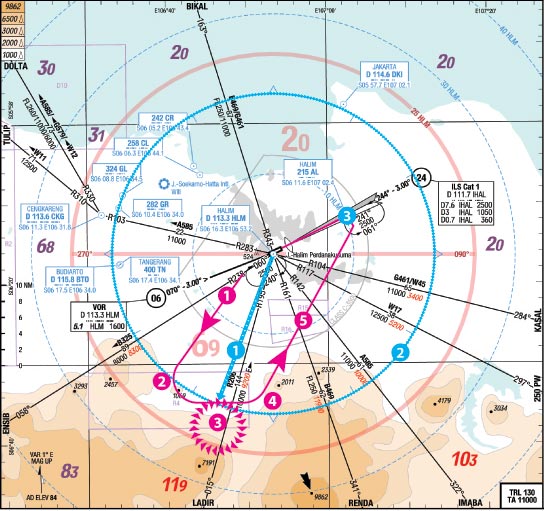
I have decided to not clutter the map with my writing, but marked key items in the map.
For the Cyan coloured items:
1 A line depicting a course of 200° outbound from Halim VOR.
2 A 20 nautical mile radius ring.
3 AL Non-Directional Beacon.The Magenta coloured items:
1 Aircraft took off from runway 24, and made a left turn to the southwest towards Bogor Training Area while climbing to 10,000ft.
2 Entering Bogor Training Area, aircraft turned left to the east.
3 A right-hand orbit (360° turn) was made at position HLM200/20 (20 nautical miles from Halim VOR on radial 200°).
4 After completing the orbit, aircraft leaves Bogor Training Area towards AL01, and begins to descend to 6,000ft sometime after completing the turn.
5 Approximate position of aircraft when the flight deck photos were taken (Near radial 150° at 10 nautical miles from Halim VOR), as aircraft descended towards 6,000ft. Aircraft then descended further along the magenta line until on the ILS for runway 24, and landed.
Gerry’s assumption of the second flight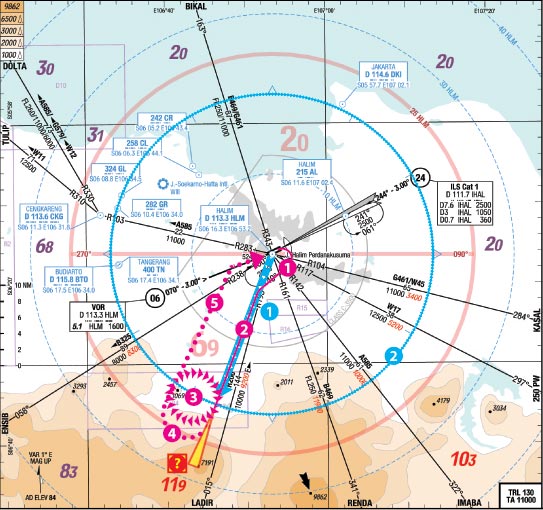
For the Cyan coloured items:
1 A line depicting a course of 200° outbound from Halim VOR.
2 A 20 nautical mile radius ring.The Magenta coloured items:
1 Aircraft took off from runway 06, and made a right turn to intercept the Halim VOR radial 200° whilst climbing to 10,000ft.
2 Aircraft continued on a course of 200° and reached 10,000ft, to enter the Bogor Training Area. The request to descend to 6,000ft and the right hand orbit would be made shortly after this.
3 After entering the training area, a right-hand orbit (360° turn) was made at position HLM200/20 (20 nautical miles from Halim VOR on radial 200°), and the aircraft also descended to 6,000ft. Note: This should keep the aircraft within the training area throughout the orbit turn.What should have happened then:
4 After completing the orbit, aircraft leaves Bogor Training Area on the same heading before performing the orbit, and it is to obtain Air Traffic Control (ATC) Clearance to head back to Halim for the approach to runway 06.
5 Aircraft would continue to descend to 1600 until performing a visual approach to runway 06, or reach the position of HLM250/5 (5 nautical miles from Halim at radial 250°), and land.We know points 4 & 5 never happened because the aircraft never made it back to the airport. But why?
An incoming path from between north and north east, is a lot more likely. There is a lot of space for them to end up hitting the cliff, without too many probable incoming paths.
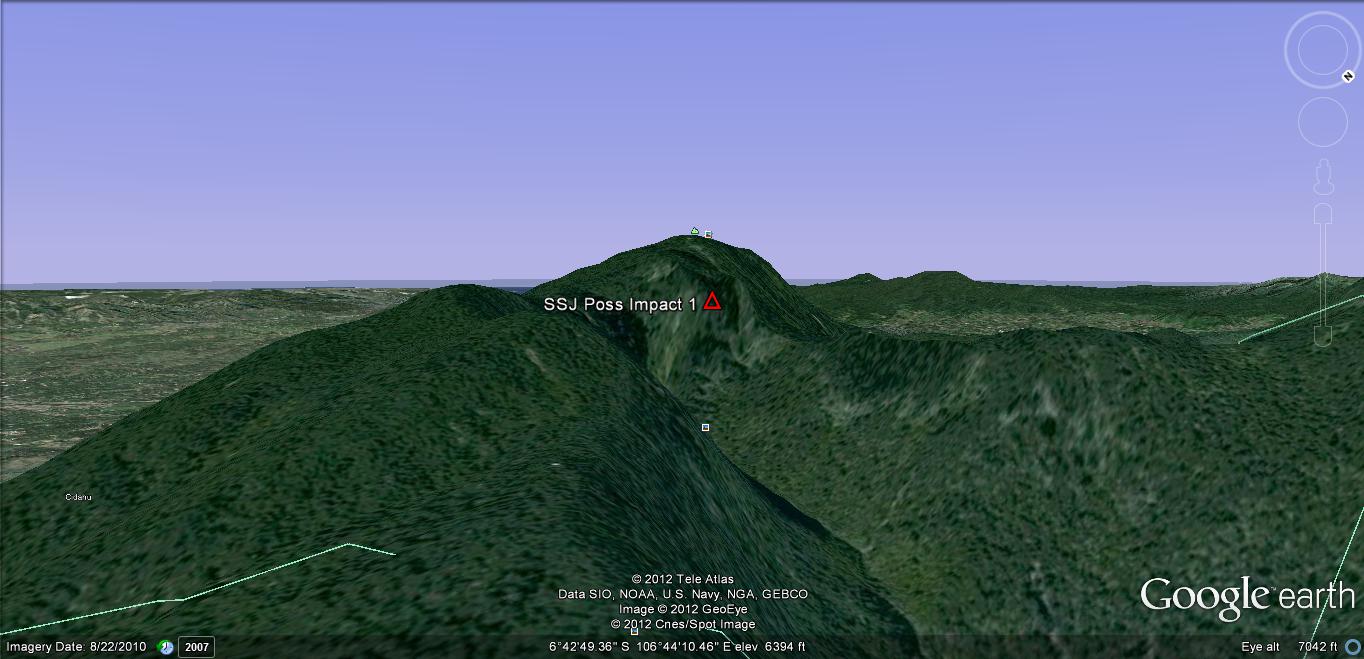
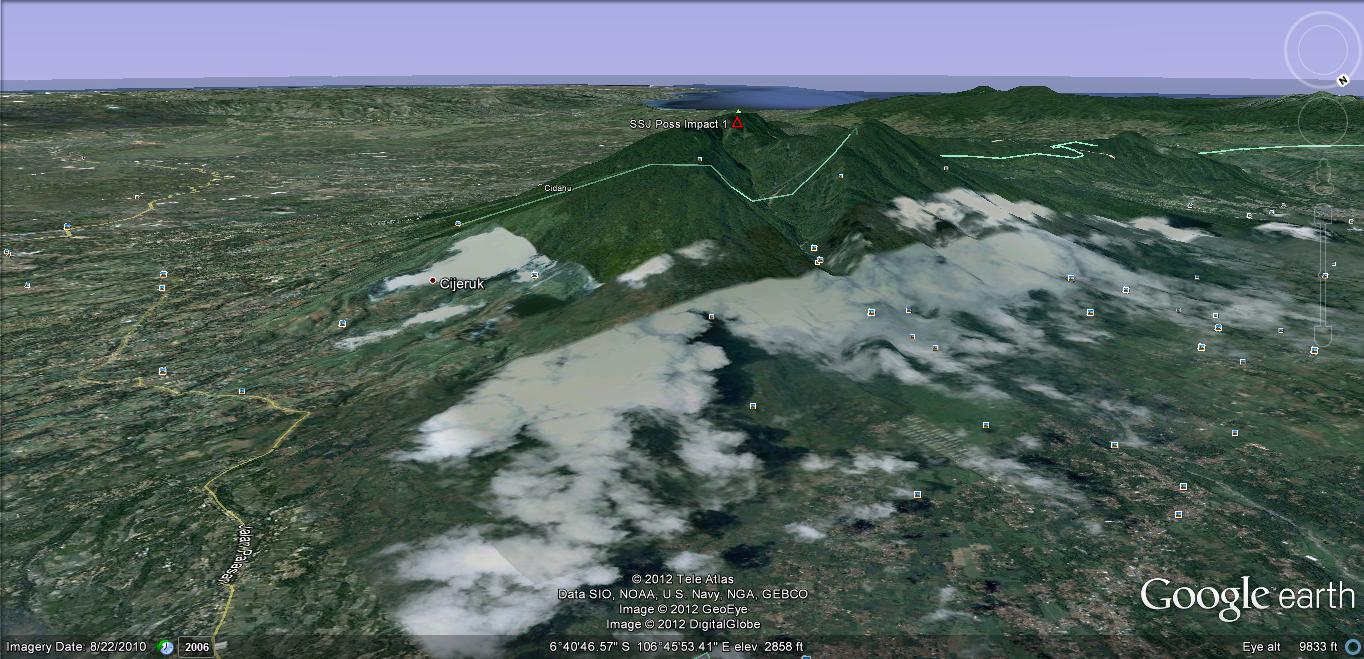
looking at what could have been near to the actual flight that happened, it is so damn to see that of all the available area, they went right into the ridge. And as I mentioned in earlier in the thread, the aircraft probably descended right onto the mountains.. 🙁
From Gerry’s excellent analysis and illustration we see that the SSJ-100 probably descended from 10,000ft into the ridge (?) or at the mouth of that ridge… and then at an air-speed of around 238kts, the aircraft probably did not last long before it crashed onto the mountain…
JangBoGoHighlights from Gerry’s analysis SSJ 100 descent: Innocent but deadly – Part 1
To give a short cut, the second flight that was undertaken by the Sukhoi-100 was from a different runway. Very interesting points, particularly none of them noticed the smaller Mt.Salak
Looking out for Mt. Salak – Flight Simulator fans as guinea pigs
I tested several flight simulator friends, inviting them to “reconstruct the SSJ100 crash.” The ones selected had to have the real terrain mesh, conduct the flight and debriefing was made on each flight. The flights were:
SimFlight 1: Depart runway 24 Halim, proceed to 45 nautical miles on a radial of 195° from Halim, and turn back to land runway 24. Cruise altitude would be 15,000 feet.
SimFlight 2: The same as SimFlight1, but use runway 06.
SimFlight 3: Depart runway 24 Halim, proceed to 30 nautical miles on a radial of 195° from Halim, and turn back to land runway 24. Cruise altitude would be 10,000 feet.
SimFlight 4: Same as SimFlight 3, but use runway 06.On all flights, weather was set to clear skies, to exaggerate the mental picture on what they see and suppress mental clutter.
Each debriefing started with them asking me back, “What’s the point of this?” They thought we were going to simulate the crash, not the factors surrounding it. What was found:
Everyone commented that during climb, the mountain they can see would be Mt. Pangrango and not Mt. Salak.
Everyone commented that during cruise, attention would be given to Mt. Pangrango because the peak elevation isn’t far from the planned cruise altitude.
Everyone raised attention to Mt. Pangrango when and after making the left turn to turn back to Halim (before the descent and approach runway 24).
None mentioned their awareness of Mt. Salak. When questioned, no one can describe the position of Mt. Salak in comparison to their position.I asked several pilots who fly in and out of Jakarta’s CGK, where the SID to the east would take them over HLM VOR. All knew that the were 2 mountains south of Jakarta, but as expected, none could recall the rough distances from HLM to the terrain. Even those who had trained in the Bogor Training Area, cannot recall the distance from area to Mt. Salak. They just took the assumptive prevention of “let’s not go south of the training area.” The pilots, generally agree with my findings on pilot perception from the flight sim tests.
Video of Sukhoi Superjet-100 during its earlier demo flight in Indonesia. Some of whom we see in this video, mainly the crew and representatives, might have perished during the second flight.
http://www.youtube.com/watch?v=gg4B0lXgxXY&feature=player_embedded
JangBoGoRussian Jet Replaced Before Doomed Indonesia Flight
12:09 15/05/2012
MOSCOW, May 15 (RIA Novosti)The Sukhoi Superjet 100 that crashed into a mountain outside Jakarta, Indonesia, killing 45 people on May 9 was a replacement aircraft for one which had been withdrawn due to engine problems shortly before the flight, according to reports in the Russian media.
A Superjet 100 aircraft with the tail number 95005, which earlier performed demonstration flights in Kazakhstan and Pakistan as part of a six-country tour aimed at wooing potential buyers, was the one originally planned to be shown in Indonesia on May 9, the LifeNews television channel said on its website, quoting Alexander Tulyakov, deputy president of Russia’s United Aviation Corporation (UAC).
But an engine oil leak revealed during maintenance on May 6 forced the show organizers to replace the plane with another similar jet, with the tail number 95004, Tulyakov said, resulting in organizers having just a few hours to prepare the plane for the flight.
A spokesperson for the Sukhoi Corporation which designed the plane and is part of UAC confirmed that the plane was replaced, but would not name the reason.
All 45 people on board the Superjet 100 were killed when the plane slammed into a steep side of Mount Salak near Jakarta shortly after take-off on a a demonstration flight on May 9.
Russia’s acting Deputy Prime Minister Dmitry Rogozin said last week that experts believe “human factor” was the most probable cause of the fatal crash, but UAC head Mikhail Pogosyan later said it was still premature to say if pilot error was to blame.
A search operation for the victims’ bodies continues despite difficult weather and terrain at the site of the crash, with the flight recorders of the Superjet 100 yet to be discovered. Indonesian aviation officials have said the investigation of the crash may take up to a year.
The jet is the first commercial plane to be designed and built in Russia since the fall of the Soviet Union two decades ago.
http://en.rian.ru/russia/20120515/173463377.html
Video from Tv1 on the day of crash, around 3.36min Sukhoi’s Chief Test Pilot Alexander Yablontsev can be seen talking to the reporter from the cockpit. This was probably from the 1st leg of the road-show?
JangBoGoCrashed Superjet 100 ‘Black Box’ Recovered – Media
10:34 16/05/2012
MOSCOW, May 16 (RIA Novosti)“A joint team from the army’s Kopassus special force and the Indonesia Rock Climbing Federation discovered the black box at the site of the crash on Tuesday,” ANTARA News quoted a military official as saying.
The Indonesian military said the black box was severely damaged by the crash and only contained the cockpit voice recorder. It did not contain the vital flight data recorder, which is still missing.
“[The two black box parts] are supposed to be side by side, but because the impact of the crash was so powerful, the two got separated,” National Transportation Safety Committee (KNKT) chief Tatang Kurniadi told The Jakarta Post.
“The black box part retrieved was scorched. It wasn’t its original orange color anymore. It was black,” said National Transportation Safety Committee (KNKT) air transport safety head Masruri said.
Yury Slyusar, head of a special commission set up by Russian Prime Minister Dmitry Medvedev to investigate the crash, said the memory bank of the cockpit voice recorder was safe. Experts have already started listening to the recording, he added.
Investigators are now looking for the flight data recorder, which will give them vital clues about the workings of the aircraft’s engines, controls and systems and its speed, height and attitude when it crashed, KNKT chief Tatang Kurniadi said.
read full – http://en.rian.ru/russia/20120516/173478635.html
Indonesia Takes Charge of Russian Jet Crash Probe
22:30 15/05/2012
MOSCOW, May 15 (RIA Novosti)The Indonesian government will take control of the investigation into a Sukhoi Superjet 100 crash, with Russian teams to have their movements limited, vice presidential spokesman Yopie Hidayat said on Tuesday, The Jakarta Post reported.
There are three Russian teams – one to help search for and evacuate victims and wreckage, one to help identify the victims and one to help investigate the accident. The teams comprise 68 personnel including rescue and missions specialists and psychologists for the victims’ relatives.
“All of these teams are under the coordination of relevant institutions of Indonesia,” he said, adding that the Russian teams had not met with any difficulties in carrying out their tasks in Indonesia.
A search team on Tuesday found the plane’s flight recorder, the AFP said. “We found the black box at around 10 this morning (0300 GMT),” AFP quoted Ketut Parwa, the head of the search operation, as saying.
“It was found around 100 meters from where we located the tail.”
A Russian rescue team on Tuesday also retrieved the jet’s crumpled engine and part of the chassis, Sukhoi said.
JangBoGo^^^
You beat me to post Gerry’s blog. I was waiting for his conclusion to come online. He has done a brilliant job with his analysis, but I’d like to put some blame on the ATC because they are a stationary entity of the region where as the Sukhoi pilots were not.
Voice Recorder from Superjet 100 Contains 2 Hrs of Audio
22:19 16/05/2012
MOSCOW, May 16 (RIA Novosti)A voice recorder from the Russian Sukhoi Superjet 100 passenger jet that crashed a week ago in Indonesia recorded the last two hours of conversation in the cockpit, the Russian Industry and Trade Ministry said.
The plane slammed into a steep side of Mount Salak near Jakarta shortly after take-off on a demonstration flight on May 9. All 45 people on board were killed.
Yury Slyusar, the ministry’s deputy head and the chief of a special commission set up by Russian Prime Minister Dmitry Medvedev to investigate the crash, said special equipment needed to decode the cockpit voice recorder will be delivered from Moscow to Jakarta on Thursday.
“If no technical problems arise, the whole procedure [of decoding] will not take long,” Slyusar said, but did not specify when the decoding could be completed.
Earlier on Wednesday, ANTARA News reported that a joint team from the Indonesian army’s Kopassus special force and the Indonesia Rock Climbing Federation discovered the black box at the site of the crash.
The Indonesian military said the black box was severely damaged by the crash and only contained the cockpit voice recorder. It did not contain the vital flight data recorder, which is still missing.
Investigators are now looking for the flight data recorder, which will give them vital clues about the workings of the aircraft’s engines, controls and systems and its speed, height and attitude when it crashed.
The Sukhoi Superjet is the first commercial plane to be designed and built in Russia since the fall of the Soviet Union two decades ago.
The aircraft is considered by many in the industry to be Russia’s last hope for maintaining a commercial aircraft manufacturing capability. Built in partnership with Italy’s Alenia Aeronautica, the aircraft has a high percentage of foreign-built components and subsystems.
JangBoGohttp://mr.shipbuilding.ru/images/docs/645.jpg
Source: http://mr.shipbuilding.ru/magazine/n2/kopanev/ (in Russian)
can you provide a translate to the article?
The site as a whole is not properly displaying the text and some what distorted in my browser.
JangBoGo^^^ thanks man for digging it all. I’d missed that blog entry. But after reading it, I’m little more confused than earlier. 😀
First of all, is EMCCA = MECCA & EMDINA = MEDINA?
From the above this is what I summarize
P15, P16 and P16A have the computer-aided action information system (CAAIS) developed from project MECCA (or EMCCA??). i.e they come from the same family. Also, this MECCA/EMCCA is not a true CMS and only aids the operators by aiding them in taking the actions based on the solutions generated by the computers (?). Where as,
P17, P28 & 15A use/are to use the CMS/CIC developed under the project MEDINA (or EMDINA??) which is a further development from the MECCA family and a true CMS. It also means that CMS-17 on P17 is just one member of this MEDINA family.
Am I right till here?
It still is confusing…
In the below para, it is mentioned that P15 Delhi class only have many ‘citadels’ housing systems like MECCA (?) and the P17 have only one ‘citadel’ which is the CIC, called the EMDINA (or MEDINA??)
Does it mean to say that P15 & Talwar class does not have all the systems integrated into a single combat control room/space like the P17?
All previous warships, including the Delhi-class DDGs and Talwar-class FFGs, do not have CICs, instead they have up to five ‘citadels’ on board, housing systems like the EMCCA. The Project 17 FFG, on the other hand, has only one citadel, which is the CIC, and is called EMDINA
Delhi class is older than the first batch of pr.11356 and the site does mention the Talwar class ships to have CIC. So how he came to the conclusion that CIC is not present in the pr.11356, I don’t know.
Trebovanije-M Combat information control system (CICS) is intended for ship (project 11356) weapons and radio-electronic armament combat control processes automation at the time of prosecution of combat activities both independently and consisting of a group of ships as an escort ship.
JangBoGo^^^ the parade items could be mock-ups, but I guess it has to be based on the real dimensions of the new missile they already have inducted or have planned for induction.
Or should we believe that the North Koreans invested in those capable 16×16 TEL just to carry mockups for parade?
JangBoGoBy the way, What can a Tunguska and Tor do which a Tracked Pantsir can’t?
Pantsir has a better missile than Tunguska:confused:
Tunguskha and Pantsir can be clubbed into the same category as a gun-missile system, where as Tor-M1/M2 is a completely different category in terms of capability also.
Tor-M1/M2 is said to have the capability to intercept PGMs where as its not the case with the other two…
JangBoGoAntony told the parliament today that Kaveri (as it is) would be integrated on Tejas in three years. That is a little later than what I heard from a chaiwalla.
There can’t be bad news than that. I truly wonder if these guys understand the value of time.
Kaveri Engine
The DRDO has not fixed any time frame to full develop the Kaveri Aero Engine for the LCA, Tejas. LCA, Tejas requires 90 kN thrust class engine to meet its operational requirement, whereas Kaveri Engine does not fully meet this requirement. Therefore, it has been decided to use variants of Kaveri Engine to power Unmanned Air Vehicle and also for marine applications.
Two important milestones of Kaveri project have been successfully achieved:-
(i) Completion of Official Altitude Testing for 73 hrs at Central Institute of Aviation Motors (CIAM), Russia.
(ii) Flying Test Bed (FTB) trials for 55 hrs with IL-76 Aircraft conducted at Gromov Flight Research Institute (GFRI), Russia.
Endurance testing for about 2100 hrs has been conducted at Gas Turbine Research Establishment (GTRE).
It is planned to commence flight trials for Technology Demonstration of Kaveri Engine with LCA Tejas Mk-I in about 3 years time.
This information was given by Minister of Defence Shri A K Antony in a written reply to Shri Bal Kumar Patel in Lok Sabha today.
PK/NN
(Release ID :83706)


 Sign In








