Big problem for the true amateur (like me) seems to be lack of support for RAW in Photoshop for many cameras unless you are prepared to stump up for the latest, and very expensive, version. Adobe are pretty ruthless in this respect
Particularly true for Olympus users like myself.
OK, you can use a converter to render it to a jpeg but that seems to be defeating the point !
I shoot RAW only, because it gives me maximum flexibility and quality in post-processing. My advice for initial processing is to use a RAW-converter issued by the maker of your camera (in my case Nikon) and use e.g. Photoshop for aspects which are not covered in the RAW-converter.
Not too expensive alternatives for RAW-processing are the already mentioned RAWtherapee and Capture One 6 Express, which also supports Olympus camera’s.
If it were camera shake, the unsharpness would have been on the same side all over the picture. The detail shots clearly demonstrate the opposite.
Yes, 1969 puts you firmly in the period of Boeing 707, Douglas DC-8, Comet 4, Convair Cv.990. Indeed 1969 witnessed the first flight of both the Boeing 747 and of Concorde. Short haul was progressively being dominated by BAC.1-11, Caravelle, Douglas DC-9 and growing numbers of Boeing 737s, replacing Viscounts, Vanguards, Electras, Britannias, DC-6, Dakotas etc. Piston engined airliners were being relegated to developing countries and freight operations.
Having witnessed the arrival of KLM’s first DC-8, DC-9, B747 and subsequent newer aircraft and having started my career as an air traffic controller in early 1965, all of a sudden I feel very old now …………:)
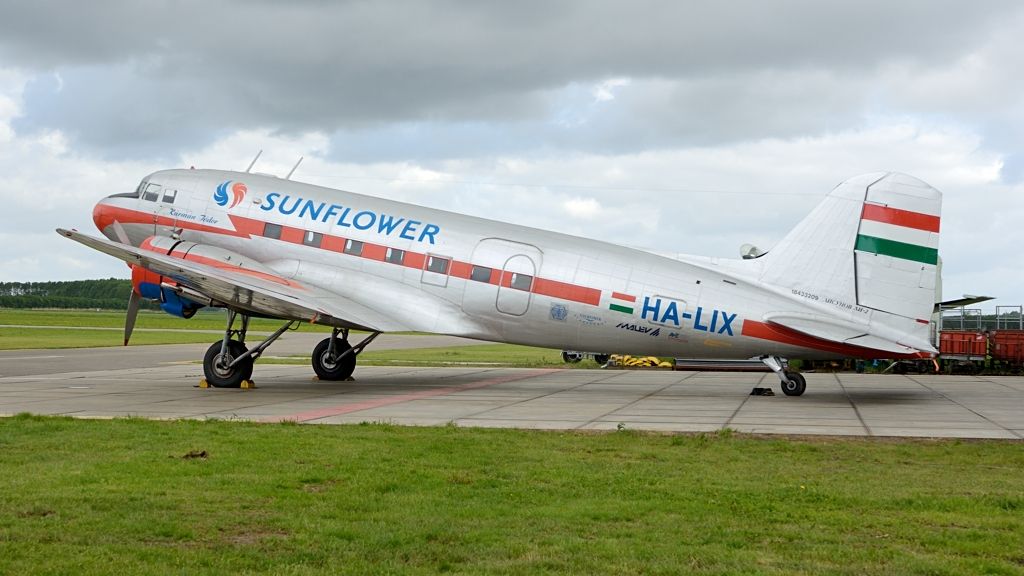
There is still an airworthy Li-2 (HA-LIX) based in Hungary, although she flies in post-war civil colours.
Seen in 2006 at the Aviodrome in the Netherlands.
I would’nt say the Chromatic Aberration is excessive for this lens.
I tend to disagree, as the aberration already is very obvious in a relatively small print. This kind of performance is unacceptable in any modern lens.
Here’s ( http://www.photozone.de/canon-eos/592-tamron70300f456vceosapsc) a review of a Tamron 70-300mm lens. Especially note the positive comments on the level of chromatic aberrations. The performance figures at f/8 and f/11 at the 300m end are almost identical.
Below an example of a good quality 300mm lens at f/8, handheld at 1/500sec.
100% detail
An explanation of Chromatic Aberration can be found here http://mansurovs.com/what-is-chromatic-aberration
Unfortunately the rather extreme chromatic aberration shown in the pictures is not going to be resolved by either a lower ISO and/or stopping down even further.
The performance of your lens certainly is not within acceptable tolerance limits. It looks like one or more lens elements are out of alignment. Has the lens been dropped or knocked?
If the lens has been bought new, I would insist on immediate replacement by another example. Otherwise the lens should be send in for inspection and repair.
In the first, they introduced the prop-synchronised machine gun, and the first monoplane fighter.
Both developments by Anthony Fokker; a Dutchman…:):)
I wonder if Duxford and Shuttleworth know about these airspace restrictions and will have to re-arrange the show’s they’ve organised during that period and change the dates published on their web sites?. :rolleyes:
Brian
Duxford already did for the Flying Legends show! See information on The Fighter Collection site. http://fighter-collection.com/pages.php
I wonder if Duxford and Shuttleworth know about these airspace restrictions and will have to re-arrange the show’s they’ve organised during that period and change the dates published on their web sites?. :rolleyes:
Brian
Duxford already did for the Flying Legends show! See information on The Fighter Collection site. http://fighter-collection.com/pages.php
A few old and a few new
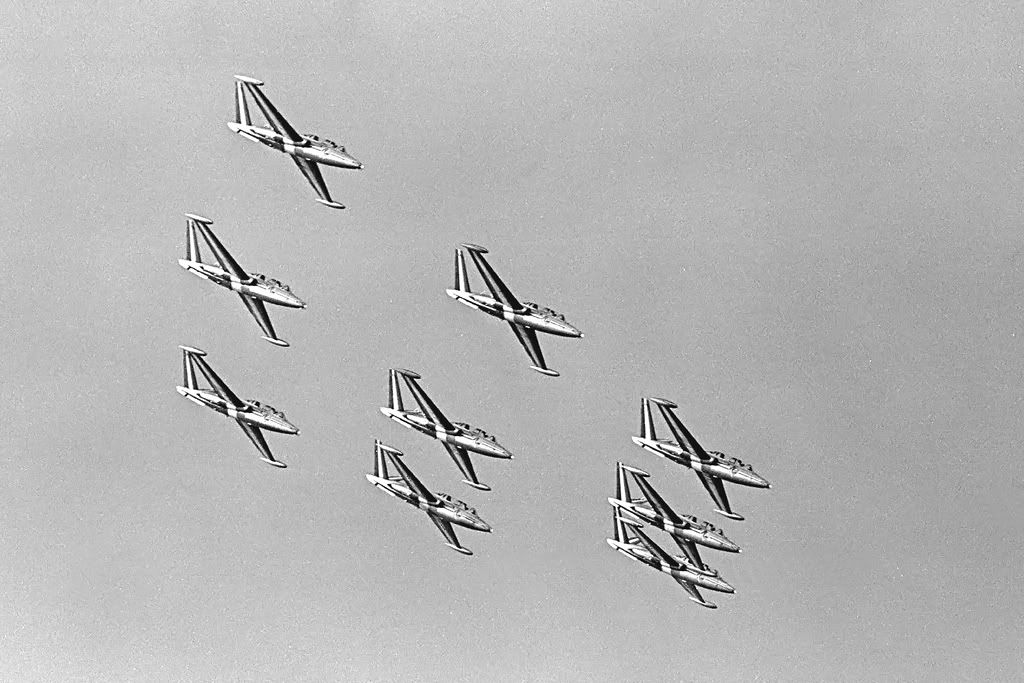
Paris Le Bourget 1967


Oostwold – The Netherlands 2009


Another one ….

“tilt and shift functions”
How does that work?
Will a virtual camera with the same format/focal length be able to make the same perspective corrections with tilt and shift functions produce an image of a 3D virtual cockpit that fits the original photo?
A standard camera with a normal lens doesn’t allow for perspective corrections, because the lens axis is always exactly perpendicular to the film/sensor centre. The lens and film panels of the technical or view-camera’s can be moved upward, downward, sideways and even rotated. This makes it possible to modify the plane of maximum sharpness, which doesn’t necessarily need to be perpendicular to the film plane, and to make perspective corrections, e.g. to correct converging lines in the picture which actually should be parallel.
for more reading:
http://en.wikipedia.org/wiki/Tilt-shift_photography
http://www.luminous-landscape.com/tutorials/focusing-ts.shtml
http://www.youtube.com/watch?v=mbHYhHZeceM
Some modern camera manufacturers, especially Canon and Nikon, offer tilt-and-shift lenses to correct the perspective as well. However, compared to view camera’s, the corrections are limited because the film/sensor-plane will always remain fixed. An advantage of 35mm camera’s and DSLR’s is that the depth of field of the lenses is greater than with a comparable focal length of large format view camera’s.
Tilt-and-shift lenses are very expensive. To a limited degree perspective correction can also be applied in the post-processing of digital images. In Adobe Photoshop you can find this under Filters / Distortion / Lens correction. Also a program or PS plug-in as PT lens enable perspective corrections.
Although top grade wide-angle lenses for DSLR’s, like Nikon’s AF-G f/2.8 14-24mm, offer superb edge-to-edge sharpness and very good depth of field (depending on the aperture setting), it could be desirable to even further improve the depth of field in the final picture. This can be achieved by using the stack-focus technique. With this technique a number of photo’s are made from the exact same position and aperture settings, but with different distance settings. With special software these photo’s will be merged into a single picture with maximum depth of field. If perspective correction would be needed, this should be done to the final merged image.
Some more reading on focus-stacking:
http://en.wikipedia.org/wiki/Focus_stacking
http://gizmodo.com/5529710/59-fiercely-focus-stacked-photos
http://www.wonderfulphotos.com/articles/macro/focus_stacking/
http://www.digital-photography-school.com/an-introduction-to-focus-stacking
With a good DSLR, combined with a very good wide-angle lens and proper technique, it should be possible to replicate the original 1940’s photo. To remove glare and reflections in the dials, it could be desirable to use a polarization filter.