 Deano
DeanoVery nice, so have Olympic leased you guys plus aircraft then ?
Thanks chaps
Yes Ren, 4 x aircraft + crew.
FLY.BUY, no decent shots yet, but when I go again I’ll see what I can do.
DeanoAbsolutely love shot #2
DeanoThis next set was of a trip from Athens to Tirana in Albania. (LGAV-LATI)
On departure from Athens we can see the airport behind us.
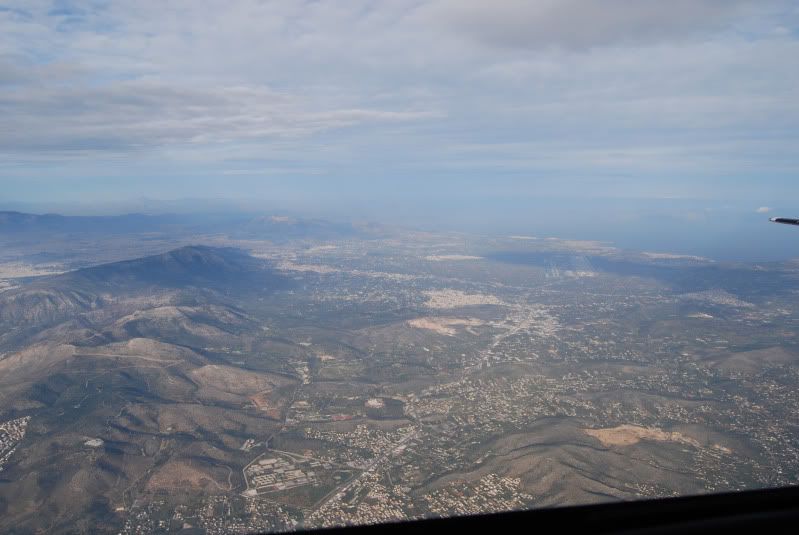
In front of us was a great view of the old airport, our hotel is down there next to the airport on the coastline
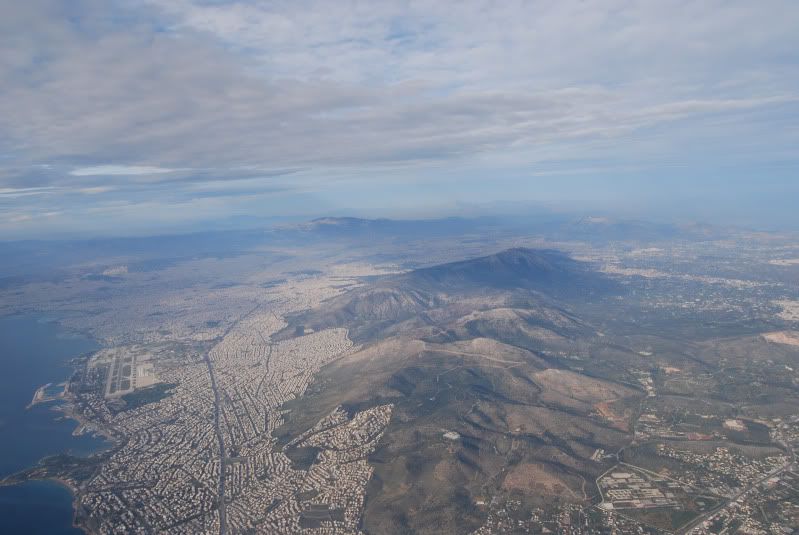
A closer view of the old airport. What is apparent is how populated Athens is. Apparently 70% of of population of Greece live in Athens. All those houses you can see are not your standard 2 story houses, they are 5-6 story apartment blocks which must house at least 40 people each. They stretch as far as the eye can see. It is quite amazing.
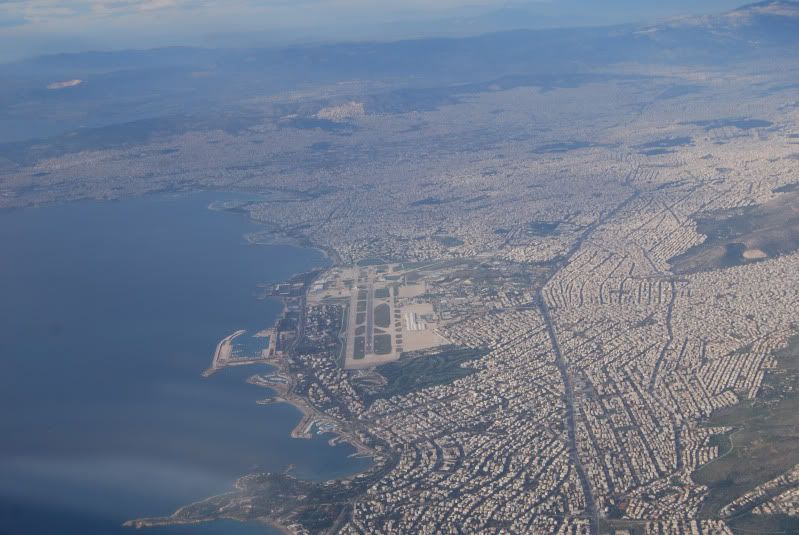
A look back at the new airport.
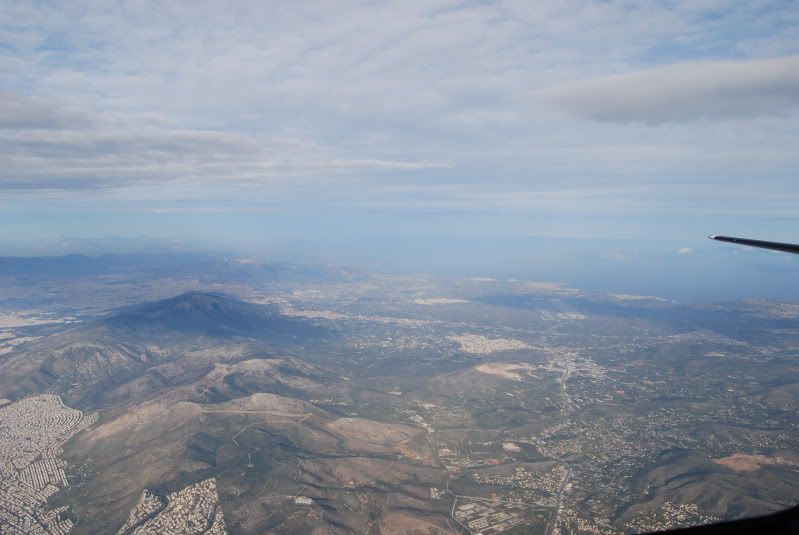
Some snowcapped mountains en-route



Then on the ground I thought I’d open the refuel panel and dial in what we needed, there’s no way the refueler is going to know how to do it, they’ve only just got electricity in this part of the world 😉
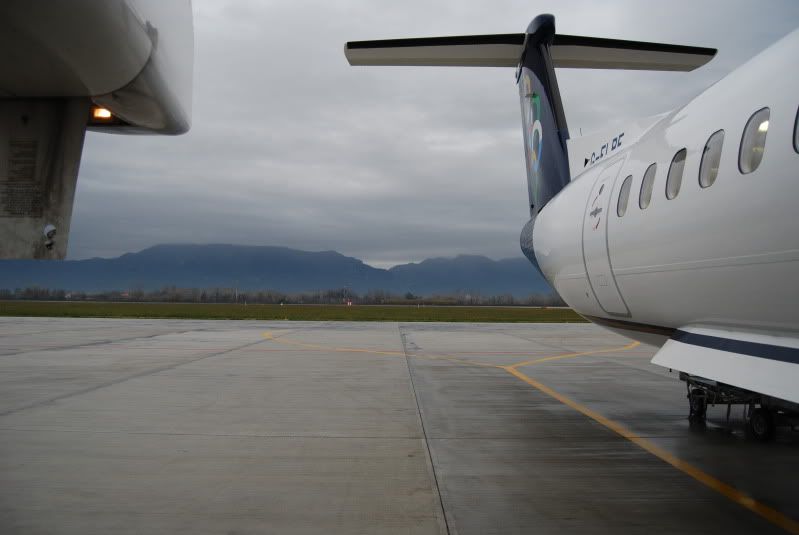
A view of our aircraft in full New Olympic Airways colours
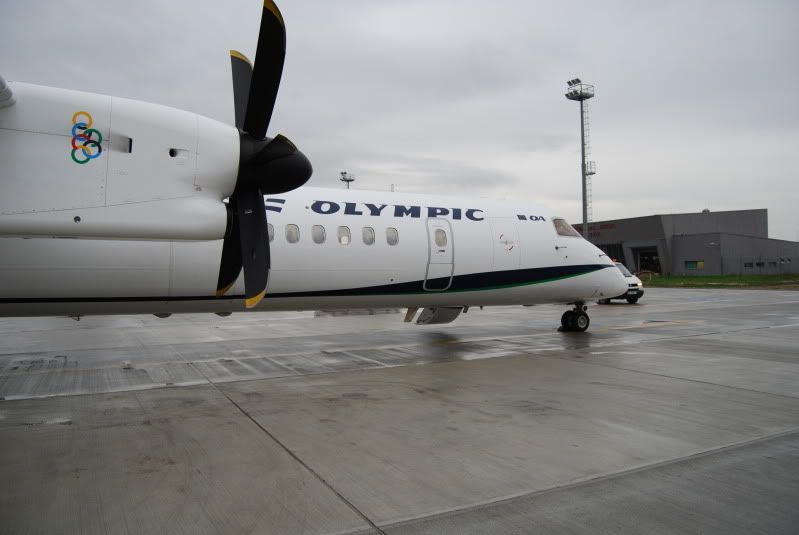
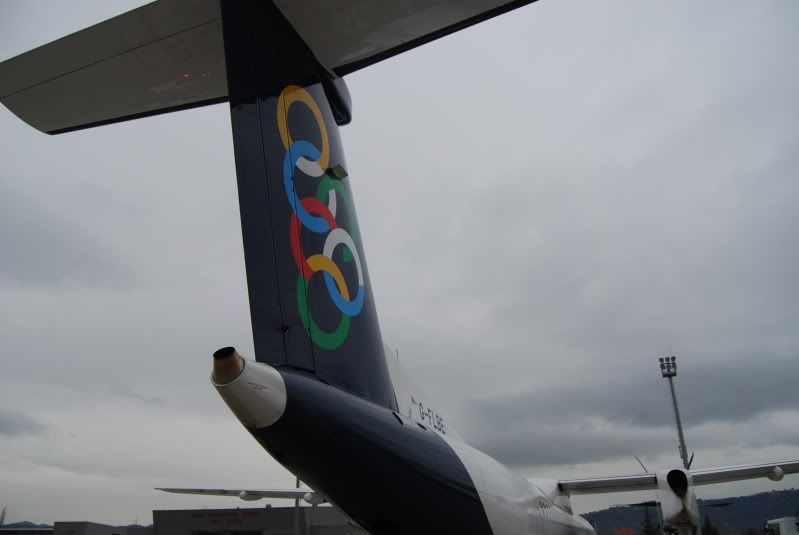

Then when we got back to Athens, and whilst waiting for the engineers I thought I’d take a pic of the baby Dash parked next to us. How cupid.

I’m off out again at the end of Jan so I’ll try and get some more interesting ones of the Greek Islands.
καλησπέρα
Dean
Deano.
DeanoI belive that they actually walked back to the terminal , from the reports that I have seen
They must have refused to pay then, good on em 😉
DeanoGreat photos all
Paul, the last one is simply superb.
DeanoGreat photos all
Paul, the last one is simply superb.
DeanoAs far as me killing people is concerned, I’m more likely to hurt people’s ears than kill them although as I say, we do put a lot of gear in the air above people so we can’t take that lightly.
Rather you than me mate, I can’t stand heights.
DeanoSo what you’re essentially saying is there are fairly major flaws in how the rules work or are made to work by airlines? Admittedly if we’re tired we just have to get on with it (although if I make a mistake through tiredness and 2 tons of PA falls out of the roof, people die which isn’t really very good). How often are you pushed to the limits of your allowed flying time?
Paul
No I didn’t say that, you did :), I’m in no position to start a conversation on this in the public domain, and nor would I want to, for obvious reasons.
In the summer months we’re pushed hard, in the winter months it’s alot easier 🙂
As for making mistakes I guess anyone could make a mistake that ends up with someone dead, I would assume there won’t be that many mistakes you can make that’ll kill people in your line of work, whereas we can make a myriad of mistakes with any one of them killing alot of people.
DeanoThe problem Paul is not flying the odd trip here and there, and working your socks off here and there. The problem is that there was a recognition that pilot fatigue is a big contributing factor in airline incidents/accidents, so the bigwigs in Europe brought us CAP 371 (and it’s European/International equivalent), this is basically FTLs, or flight time limitations. This governs what we can and cannot work on duty over a given day/week/2 week/month/year, but employers do not view it this way. They view CAP 371 to be a maximum that they can operate their crews to. If you work to your FTLs every 2 weeks/month then you can go months working to this limit. This is why flight crew in particular are susceptible to fatigue. It can be very tiring working to FTLs over a long period.
DeanoI think all of us that fly commercially have made a mistake reading analysis from time to time. I´ve done so myself and been found out by the other member of crew.(
Likewise, and likewise for me picking missed info up. So long as there’s human intervention, there will be mistakes.
DeanoDeano, can I question this in a manner that is made understandable to those on this forum not familiar with aircraft weight and balance, and which is no way meant to question or undermine your professional standing.
My confusion lies in not knowing the onboard system used to calculate the desired weights and I stand to be corrected on my assumptions. This incident does however appear to highlight a failure of automated cross checking.
Unless I am very much mistaken, the three main weights used for aircraft operations are Zero Fuel Weight (ZFW) , Take-Off Weight (TOW) and Landing Weight (LW)
During the manual calculation of loadsheets, the ZFW is derived by taking the Aircraft Prepared for Service Weight (APS – Basically, the weight of the a/c as it stands including catering and any spares carried, but without fuel, passengers, baggage or cargo) and adding to it the Traffic / Payload (passengers, baggage or cargo).
To this you add the fuel weight minus the weight of fuel used for taxying to give you your Take-Off weight.
From this figure you then subtract the Burn-Off (Fuel used during flight) to give the Landing weight
In an automated system, the variables that need to be manually imputed as the weights vary are APS, Traffic/Payload, Fuel and Burn-Off. From these inputs the required three weights can be calculated and displayed
During the incident in question we are told that “The investigation has determined that the pre-flight take-off performance calculations were based on an incorrect take-off weight (262.9 tonnes, instead of 362.9 tonnes) that was inadvertently entered into the take-off performance software on a laptop computer used by the flight crew”. It was the Take-Off weight and not the Traffic Load tnat was a hundred tons less than it should have been, but why was the need to manually input this figure and even more so, how is it possible to do so? Doesn’t the system calculate this figure based on the explanation above.
OK, it was a human error that caused this incident but surely it is a fundamental error that the FMS did not pick it up.
Am I being too simplistic and missing something?
Jethro
Yes you are right, but ours calculate the ZFW for us, and our FMS is quite antiquated in relation to the rest of the aircraft.
As galdri has cleared up his FMS seems to work similar to ours where we can enter the APS weight, invariably it is already there but it is cross checked. We enter the Block fuel minus the taxi, then the traffic load and it will automatically calculate our ZFW. I’m sure the newer FMGC on the airbus does this too. The landing weight is determined by a manual calculation of a fuel check in flight using the OFP data. The FMS will give a LW figure but it is not to be relied upon. The arbiter is the OFP but the 2 should be reasonably similar.
Our FMS won’t calculate V speeds either, the Vr & V2 is done by using TOLD cards and Runway Analysis Charts with the V1 being determined by the charts (not the TOLD cards).
Flap settings, flex settings, Acceleration Altitude & RTOM is taken from the RACs
Galdri I am led to believe that the FMGC on the newer Airbus series will calculate V speeds etc, all the temperatures, flex, flap settings etc can be entered and it’ll spit out the V speeds and bug them along with the flap retract schedule on the PFDs.
This type of error is what brought down the MK 747-200 in Nova Scotia a few years ago, using a laptop to calculate performance data and not being cross checked by the crew.
DeanoI personally don’t understand your glee with the unfortunate situation this crew now finds itself in. You must admit that they obviously only came to occupy those seats after many years (in the case of the captain, certainly) of hard won experience and after careful vetting by quite a selective hiring board at Emirates.
They must have demonstrated more than ample aptitude and delivered many years of safe, professional service under varying and occasionally trying conditions in probably a slew of different types before their takeoff that day in Melbourne.
That normally competent and conscientious crews can still somehow manage to sometimes “screw the pooch” so badly as to endanger lives should be a source of puzzlement, sure, or lead to calls for the circumstances to be thoroughly studied to find any possible systemic contributions, if any, to the errors–yes, these are appropriate reactions to a detremination of “pilot error” (and who expected any other verdict, really?). But to mock these men who’ve had years of good work cast aside to be branded by this one incident to the point their careers are essntially at an end (I certainly hope not) is terribly uncouth and classless.
Especially when many on this forum are probably never exposed to anywhere near the level of continuous professional scrutiny in their own fileds that the gentlemen they diegn to denigrate endure (with a fair measure of professional pride, I can attest).
Sorry, this has touched a nerve with me. These guys made an honest mistake but, unlike most other professions, they will probably not be allowed to profit, learn and grow from thier experience and continue to earn their keep. It is sad to add insult to this terrible injury.
Very well said, unfortunately this event further proves the unchallenged thoery that so long as there is human intervention there will be mistakes, all the technology in the world cannot iron this out.
What I can’t understand is why onboard systems didn’t detect the error.
To my mind, and in it’s simplest form, a zero fuel weight is the aircraft weight + payload . To this you add your fuel load to give you your Take-off weight. In this instance, the F/O entered a Take-off weight which was 100 tons less than it should have been.
Now, the onboard software knew the zero fuel weight. It also knew the fuel load. How come it didn’t detect that the Take-off weight was way below the correct figure.
Standing by to be corrected.
jethro, you’ve answered your own question, it didn’t detect it because it didn’t know, the FMS (or FMGC for pedants) is only as good as the person operating it, i.e. you put sh** in, you get sh** out, all computers are the same.
What was missing was the couple of opportunities to cross check the information put in, and the information is was spilling out. One of these would have been a cross check with the load sheet. One other would have been a cross check with each crew member.
If I remember correctly the FMS will calculate a ZFW, and will know what fuel you have on board, but it won’t know the Traffic Load, this will be entered in manually. So it was pretty obvious this was loaded in and not crosschecked somehow.
Hmm… To quote the article linked above:
“Emirates head pilot Capt Alan Stealey said both the pilot and first officer of the damaged jet had said they were “well rested” before takeoff, after a 38-hour layover.”
38 hours sounds like a long enough rest to me, change of time zones or not.
Paul
No Paul it isn’t, fatigue, and/or tireness is cumulative. When they arrived in MEL this would have been on the back of a schedule that could have lasted 6 days. 1½ day’s rest after 5-6 days working and travelling through different time zones is not enough rest, period.
My pattern is generally 5-2-5-2-6-3. This does not include time zone changes as we are back at base every day. But having to get up at 03:30, or getting home at 00:30 during this week will build up tiredness, by the time my 2 days off arrive I am absolutely knacked. These guys have to fly for long periods at a time which is mind numbingly dull at the best of times, this coupled with irregular sleep patterns probably including late nights & early mornings, then having 1½ days to get over it? Sorry, it isn’t black & white.
Dean
DeanoRen, you’re right. Maybe you should contact them yourself, seriously. It’ll sound better coming from the public 😉
AJ, same as you, I may boast about the temperatures but the only downside is I actually have to come back to the UK on Wednesday brrrrrrrrrr, where’s my coat? 🙂
DeanoRen that would be nice. But for this year we’re stuck with the football players (bless their hearts), I’ll mention it to the marketing team though, but I suspect it’s all down to cost.
AJ
You’ll see surprised how many will be airbourne, On Christmas Eve last year I was in the air about 9pm at night grrrrrr.
Luckily I am in Athens working, coming home on Wednesday for 3 days off 😀 (it’s 20° here btw ;))
DeanoWe see santa every year Ren, this year will be no different 😉
Santa is better equipped than us, and he has TCAS, but he struggles during an RA when it shouts “adjust vertical speed”, it’s because of the extra inertia he has due to all the presents he carries. I’ll even tell him to stop off at your house ok 😀


 Sign In







