 Jonesy
For me the comparison that more appropriate in this case is USD 1 bio with the choice of 12 new Block 52 F-16 against 34 Fully Refurbished Block 25 + Block 15 OCU.
In context of the thread, for me, the interesting point is what the money buys. US$750mn for 24 blk25’s or $US490mn for 12 FA50’s are directly relevant to Tempests interest in the feasibility of his ‘Super Hawk200’. Simply these types of package are what his spec would have to offer more than…for the more modest sized airforces to take up interest.
US1bn for 12 new build blk52’s is, of course, an interesting marker in the discussion as it shows where the ‘high-end’ is at in cost terms relative to a representative air force. It demonstrates where the ‘Super Hawk’ would have to be pitched financially to be competitive. If you can have a 6000hr-life blk25 for US$30mn, complete with a vendor support package, is a similar priced ‘Super Hawk’ going to attract interest?.
JonesyAttacking an Iskander battery on a bridge is not CAS. It’s interdiction. CAS involves direct support of ground troops.
…but the SSM battery is in range of your troops?. How is engaging it, by the above definition, not CAS?.
If there was a T-72 on the bridge and that T-72 was firing on your guys, that would be CAS.
So CAS is only CAS when the target is engaging your troops with direct fire?. Plainly nonsense…engaging a battery of 155mm SPH’s 40 miles off is CAS…but not a heavy SSM battery at 200 miles?.
Like I said…debating this is inviting madness…I’ve tried it several times with many different people and never gotten a satisfactory resolution to it…I’m afraid I have no intent of going further down the path!.
As for the rest I think you may be losing the forest for the trees a bit. Effects on target whilst remaining out of the bulk of the opposing threat envelope is the key marker. Anyway you try and spin it low, slow and rugged is not the way to deliver this against even light forces with little more than current gen MANPADS. The paradigm today, and going forward, is to sit above the envelope, peer in with uber-optronics and play whack-a-mole with a merry collection of pgms. Its not as ‘Biggles’ as 400knt strafing runs on Toyota’s but its a damnsight safer.
JonesyNick Richardson’s Sea Harrier was shot down during Operation Deny Flight in 1994 which was provision of air support for UN peacekeepers and to enforce a no fly zone over Bosnia.
Quite true…I made the grievous error of generalisation and should’ve known better!. I was using “Allied Force” to denote the wider FRY operational theatre as we were discussing the viability of legacy CAS types within a general timeframe. My apologies for lack of clarity.
CAS V BAI is simple. CAS is support of troops engaged directly with the enemy. BAI is engagement of enemy targets not in direct contact with friendly forces but in the area of operations. Strike is attack on long range targets. CAS is also always against enemy combatants whilst BAI can be infrastructure such as bridges, railheads etc in which case the goal is to disrupt enemy movement.
OK. I’m glad someone out there thinks this is simple…for me its absurd. In your terminology though you have a bridge 200 miles away…if the A-10 attacks an Iskander battery sat on that bridge its CAS but if it attacks the bridge its BAI and if the bridge is 300 or 400 miles distant it becomes, somewhere at an arbitrary point, interdiction/strike?!. Lunacy!.
You can’t always lob a bomb in CAS as friendly troops could get caught by the explosion or margin of error is too low.
You cant always fly a plane into a SHORADS envelope…does the poor bloody infantry no good to see their air support shot down!. Often easier for troops to fall back a few hundred yards or go to ground to allow an airstrike in than it is to fully suppress a SHORADS environment!.
Different requirements. Indoensia already operates light fighters in the form of Hawk 100/200 and is also acquiring TA-50s to replace Hawk 53s. Philippines on the other hand are looking to restore a capability lost in 2002. An F-16 would be too much of a leap.
True that they are coming from widely disparate positions but I’m not sure the requirement is all that different. Both are after a strikefighter – Indonesia having a primary air superiority type in the form of the Sukhois and the Phillipines, as you say, starting from scratch. In context of the thread we see that neither are interested in a subsonic, austere, manned light striker.
JonesySkyraider?. Boeing were talking about restarting the OV-10 production line a few years back. At least that type has a backseater who can monitor sensors and watch the Igla team that kills them!.
Bit off topic though.
JonesyAt this time there are a lot of big expensive jet burning a lot of fuel doing air to ground work and yes Tucano and UAV’s have come on a long way but for love of flying and aviation there has to be something new in the middle
Hammar covered some of why this is not the case but missed out the desirability, in any force structure, of a single logistics and support chain. He also missed the value of swingrole ‘on the hardpoint’ that a top end jet brings. The advanced type that may seem ‘too capable’ for dropping SDB’s on ‘irregular forces’ positions may suddenly be quite appropriate if an unexpectedly defecting Tor or Buk track appears alongside the target!.
Returning to the logistics point though you have to look at what you detail as ‘in the middle’. Single EJ200/F414 class motor, MIL-STD bus, redundant FBW, top notch optronics/commo kit. Add in a multimode radar, as suggested in the thread, and you’ve got most of the cost elements for supporting a high-end strikefighter. In logistics terms then, if its pretty much the same burden for deploying a high-end capability as this ‘middle’ type, why not use the high-end type and have the extra deployed capability in theatre against need?.
Ananda’s comments on the blk25 deal are also interesting in comparison to the Philippines US$450mn deal for 12 FA-50’s. 34 6000-hr remaining blk25’s for a little over twice the price of 12 new build FA-50’s?. Interesting choice there…but a good illustrator of why there isnt more interest in developing a new lightfighter as per the original spec.
JonesyThobbes,
Other than Gabon (ex-SAAF Mirage F1As) the Mirage F1 appears to have no future sales prospects. Indeed Argentina doesn’t want them either!. As for the second hand F-16s, I guess we’ll wait and see. Personally I don’t see many sales prospects for them.
OK whether or not there is interest is actually irrelevant. Your contention was that airframes dont exist suitable for a cheap refurb and donation on to a 2nd user. Thats just not the case.
Allied Force did not involve CAS – it was pure strike/interdiction. The two are vastly different.
I’m certainly not going to get into a debate on when CAS transitions to BAI with you….for that way lies madness and, for the purpose of the thread, its also irrlevant. Op Allied Force definitely had a CAS component. Friendly forces on the ground called for air and it was delivered. One such instance led to the ‘famous’ loss of Nick Richardsons SHAR.
Furthermore Allied Force did not involve great hit rates on Serbian ground targets due to high altitude tactics.
Not ‘tactics’ more properly ‘limits’. Limits put in place to prevent nutters like Lt Richardson making three passes through the SHORADS envelope and getting his backside shot off!.
You say many flattering things about the A-10 and its hard to argue that it has been a staggeringly useful aircraft…when it finally gets to the contact point. It is yesterdays solution though. Today, in even a moderate threat environment, its going to get hit a lot. Maybe it’ll still fly home, but, its not likely to be flying the next day after taking a clobbering is it?!.
Yet UCAV for light strike has seen very limited sales – Italy and RAF and then not as replacement for existing aircraft.
…and France looking at Telemos and then Franco-Reaper. See http://www.defensenews.com/article/20130217/DEFREG01/302170008/Mali-Mission-Spurs-French-Interest-Armed-UAV?odyssey=mod_sectionstories
Who is even designing a manned subsonic single-role CAS bird today?
For 2013-15 the best CAS is still the A-10 Thunderbolt and AH-64 Apache.
Nope that was the best for 1990. Today its probably an F-15E with SniperXR and configured as shown below:
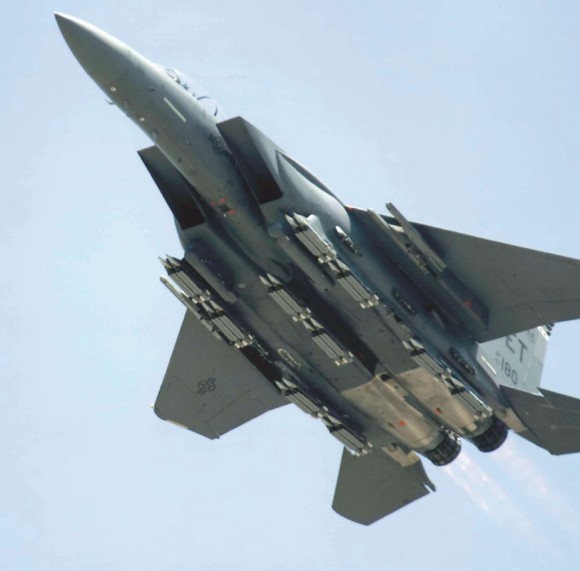
….tomorrow it could easily have been Avenger…though doubtful the US would clear it for foreign sale easily it still might. I’d certainly be happy if the UK bought it.
Actually the proliferation of helicopter gunships and especially Mi-35s is something we have ignored in this
Likely because it has no relevance to the actual thread?.
JonesyThobbes,
The way I see it there are plenty of available 2nd user strikefighter options knocking around. At the bottom end you may have things like the Mirage F1 upgrade discussed here so recently for Argentina. Serviceable launch platform for AASM, AM39 and MICA for very little outlay. Up to things like the block 25 F-16C’s at in AMARC right now. Some there will be 7000hr jobs, but, the average is meant to be around 5500 across the fleet and the early blks could be stretched out to 8000hrs perhaps a bit farther. Scratch out a dozen with 2500hrs left on ’em and you’ve got a decent 10yrs with the ‘make el presidente look pretty cool’ box ticked.
The issue with those European air forces you name is that for the most part they are in decline and can no longer afford single task types.
The assumption is there that it would buy them (single role types) if it could afford them. What you are ignoring is the heavy change in the nature of CAS delivery. Trashfire has always been a risky place to run your primary engagement profiles through. Clearly A-10/A-9/Su-25 were the zenith of the design effort into understanding and, through various means, defeating that environment in order to place ordnance and get the brittle and crunchy nut holding the stick back to base. No-one is designing that aircraft anymore because todays threat environment has evolved from the Romb and Shilka that A-10 (for example) was meant to evade and is now simply too high to operate in succesfully. ROE for ALLIED FORCE had a minimum safe altitude set at something on the order of 10k ft, going from poor memory, and that was a decade and a half back.
I am dubious as to single seat Eurofighter’s ability to replace Tornado with 100% equivalent or better capability.
I dont see the importance of replacing Tornado. The CASOM missions out of Marham during Ellamy showed up that long-range interdictor capability as marginal enough…when Charles de Gaulle started sending off Rafales with SCALP things just got worse. Rapid forward deployment is going to be the more valuable tool in future…we just dont need another noe penetrator optimised to hit eastern Europe!.
France needed some 336 Rafales to replace Super Etendard, M2000C/D/N/-5, Mirage F1 and F-8 Crusaders. It has 180 on order. The original requirement was for 336 and this has been progressively cut to 272 and it is possible 180 is the limit.
No. France needed 336 to maintain its previous, Cold War, force level. It is focussing its efforts on getting all the Rafales it can out of the budget and is looking to get on the development path for UAV/UCAV….hence Neuron, Telemos etc.
Air Forces with money are still buying aircraft with with a primary tasking
No. Air forces with money are buying high end strikefighters. Thats not a point thats at issue here. I’m saying that the high end forces are looking to unmanned for a light strike adjunct….not that anyones replacing their entire fleet with UAV’s. I happen to agree that UAV’s are limited platforms, but, those missions like ISTAR/light strike/Comms that they can do…they do very well indeed.
Aircraft designed around a single task have usually been the undisputed best in those fields – F-14, F-15, A-10, F-106, Tornado strike variant, A-4, A-6 etc. Even F-111 became a world beater when it was retasked to strike only.
So what?. The point under contention is CAS in 2013-15…either way thats peering into an imaging sensor from a platform a long way above the threat systems lethal envelope. Either you believe there will be a manned type to do this….that no-one is building in a recognised sense….or it will be unmanned and one of the number of designs flying or in development.
JonesyWhat I love is if it’s not unmanned it not worth having no one on the UAV side of the debate will entertain that anyone using them will not have air superiority and what will happen if the signal is jammed.
…and what youre missing is that you have the cart before the horse. The aircraft follows the requirement not vice versa. If you dont have air superiority what would happen is likely the same as would happen to an A-10, Su-25, AMX, A-7, A-4, Hawk200 or anything in that class in the face of an opposing air superiority type….it would find it would have limited options to fight and likely none to run. In the case of a UAV you are uncrating a replacement…in case of any of the aircraft listed or a notional subsonic CAS type you are dealing with a much more significant cost.
As for the signal jamming, so far, the extent of EW interference with UAVs has been a few TDL intercepts, no different to the TDL’s used on manned types, and one instance of a GPS-drag followed by a GPS-jam by the Iranians. Both are dealt with by encryption techniques.
to say a new GR type can only ripple off half a dozen brimstone is a cheap slot again we all know that any new GR type would or could carry guided weapons / rockets / free fall weapons / anti-ship missiles / IR A2A missiles / targeting pods / storm shadow all of which would make this type of platform hardy limited.
….and anything but a £20mn vmax ‘cheap’ CAS type. In CAS terms you have a manned platform with a driver or GIB peering through a Sniper pod (or similiar) blatting off precision guided ordnance from 8k ft or so. So its doing exactly what, if you are a developed service, your primary strikefighter is doing. You already have a type to do that…so why are you buying a second?. Even if its 10 or 20% cheaper to run mission-to-mission you’ve still got to set up a second logistic/support infrastructure to support the second manned type…this will more than offset the operational cost difference…especially if you suddenly stop bombing Ahmed and his donkey and suddenly have to look at peer opposition with S-300’s and AWACS!.
When I first opened the thread I said I would look to integrate the targeting pod into the airframe and not fit a radar to keep costs down however some people liked the idea of fitting Vixen 500E and if fitted would give the type a BVR A2A capability and yet more capable this of course would also take it from GR to Multi-role
….and then you are in competition with the already-developed FA-50 and JF-17 scrapping it out for penny-packet orders, of a dozen fighters here or there, from states looking for their sole FJ combat type. That is states who arent going to settle for a dozen blk3x/4x F-16C’s when they start filtering through in numbers in a few years
JonesyThe answer is pretty much no then Tempest. Small airforces need more than just CAS and would go for one of the cheap multirole types like JF-17 or FA-50 if they wanted new. That market, cheap strikefighter, isnt big enough to support many more designs and its doubtful that S.Korea would have developed FA-50 if it hadnt leveraged the trainer. See EADS Mako for proof that even that isnt necessarily enough.
Developed airforces dont want a cheap CAS platform thats manned. Italy, as per Thobbes list, is replacing AMX’s with F-35’s. UK and France are replacing single role CAS types and not with new single-role CAS types. The US is weighing heavily in on unmanned and even the Russian Su-25 replacement, if it happens, is intended to be an LO design and have an advanced sensor fit…not really cheap sounding!.
If you are a, moderately, advanced airforce and you need a cheap adjunct to your high-end multirole strikefighter…its unmanned and does more than just ripple off half a dozen Brimstones.
JonesySo, Thobbes, at what point, in your ‘can barely keep a Hunter up’ view of 3rd world knuckle-dragging airforces, does the OP’s actual design spec enter into things?. That would be the spec that includes centreline Storm Shadows, Brimstones, EJ200 class engines etc.
So, now you note that a developed airforce like the US’s has no place for a manned, subsonic, lightfighter CAS platform and, hopefully, accept that the spec is not to produce a type suited for the Air component of the Cape Verde armed forces you’ll see the point being made earlier. A developed airforce would want this capability unmanned and a developing airforce would want something different altogether.
Case in point the Philippines….12 FA-50’s ordered from South Korea to replace F-5’s…or are you still professing that a “backward airforce” cant handle a type with advanced avionics.
JonesyThey’re going to have to share if they have as I clearly recall many ‘knowing’ forum remarks alluding to a deal that was going to see Backfires going to India as part of the hush-hush deals strung on to the Gorshkov purchase!.
Maybe the deal was that India gets the first few off the new Chinese production line?!.:eek:
JonesyFar greater responsiveness and awareness as well as a smaller C4ISAT/logistics footprint.
Perhaps look at that picture from the highly advanced Ecuadorian armed forces again for that logistics footprint?.
A pilot is on the scene and can evaluate far better than someone who is sitting hundreds/thousands of km away and whose only inputs are electronic imagery.
A pilot who’s on the scene for 2hrs sees far less than a UAV on station for 18 or so!.
Also UCAVs seem a lot more complicated for your average military that doesn’t have the US’ C4ISTAR, logistics and special operations capability.
….and once again Ecuador?
When you look at your average combat mission flown in the developing world, most are not that far removed from WWII CAS and interdiction missions – low level gun/rocket strafing and use of dumb bombs.
…which is fine apart from things like Portugese G.91’s brought down by rebel fired Strela’s in the early 70’s in Bissau, Stinger casualties amongst Soviet forces in Afghan. Etendard, Sea Harrier and F-16 examples being brought down on Allied Force etc, etc. The spec lists an aircraft of roughly US$30mn…you think thats disposable enough to fly into the trashfire envelope?.
Most such countries also don’t have very high levels of training – very often they’re conscripts and training isn’t advanced. In essence they need to minimise number of specialists (and UAVs require a lot of specialists including technicians trained in electronics).
Dont tell the Ecuadorians that…they might get sensitive?!. I think they contracted the manufacturer to assist with setting up the technical support infrastructure…who knew a vendor would do such a crazy thing eh?!!
In reality many operators have not progressed much past the Hunter/Freedom Fighter//MiG-17/-21 level of complexity either.
I’d expect a UAV such as Avenger to be far less complex, in mechanical terms, than a MiG-21 and far easier to keep flying.
In reality aircraft such as Su-25, Mi-25 Hind, EMB-314 Tucano and JF-17 are far more appropriate.
Well, to be honest, I dont see where the view has come from that this is a design intended for an airforce that has barely worked out its opposable thumbs yet….as you seem to suggest. Perhaps I missed that on the thread somewhere?. In fact the only airforces this would seem to make sense for would be the advanced ones looking to find a cheaper CAS alternative to starship-F22 or Rafale etc.
A back-asswards service looking for its sole fastjet type as you say would look more at a type like JF-17 able to give a modicum of air intercept capability…or, at least, the ability to make a thumping good story about supersonic fighter planes for the flypast on Glorious Presidente’s Day!.
I think UAVs for reconnaissance are something a lot of poorer airforces will embrace. But recce UAV’s don’t require extensive ISTAR, guided weapons or ground troops equipped with targeting equipment (which can fail – I remember reading about early SOFLAM operations in Afghanistan where lack of experience led to bombs missing targets by several hundred yards).
You’ve lost me here totally I’m afraid?. A ground station is a ground station pretty much….the same type that services Predator does Avenger. In concept if you can deploy Heron…you can deploy Predator…you can deploy Reaper…you can deploy Harfang or you can deploy Avenger etc etc!. Recce UAV’s provide ISTAR they dont demand it?. When first deployed UK use of Paveway LGB’s led to unspectacular results as the designators were lasing too early on the bombs loft profile causing them to miss apex and fall short….good job we stuck at it eh?.
JonesyWhat is this requirement for other than a low-end light striker though?.
The requirement as written is for the Avenger UAV. Cheap enough that your $30mn manned unit cost buys two. 400kts, 3000lbs load out…enough for Brimstones/SDB/SPEAR in number…plus sensors and endurance to do the important bits that your manned type wont do…generate the target data in the first place.
Range limits are spurious…you have a larger pool of airframes than your manned alternate. Select six airframes and keep a dual-redundant comms-relay capability aloft 24/7 for as long as you want. Your limit is the datalink range to the relay bird plus the distance from relay to ground station!.
As for the complexities of the ground stations themselves:

…this is the ground end of the Ecuadorian Heron maritime patrol capability. The capability is advanced as you make it!
I’d love to know what a manned type brings to the role apart from a nebulous ‘trust’ issue?!
Jonesy
Job done!
JonesyThis article is written by a chap called Lewis Page. It is nonsense. Page was a naval officer…actually a clearance diver. His views on naval issues are a regular source of amusement to those who look from a slightly wider naval experience.
The design for CVF is adaptable. Its big enough, has spaces that can be reconfigured to accept the appropriate equipment and additional power generation units to drive them.
To illustrate the difference this picture…..

…is the Italian Navy’s Cavour class aircraft carrier. It is cheaper than the CVF’s…it is smaller than the CVF’s and it is not adaptable to CATOBAR operations. One can be converted and one can not. If the F-35 jumpjet doesnt work the Italian Navy is looking at a very limited options set for getting return on their investment.
The issue thats ‘big news’ is that it would have been expensive to convert the ship to catapult ops. What Mr Page misses is that the CATOBAR ship would always have been more expensive regardless. The costs of the STOVL ship are actually relatively modest…or were until the Govt forced a programme slowdown a couple of years back which pushed the price up!.
Adding the conversion systems always would have cost. Adding the support, logistics, training overheads would have totted up even more. Further…splitting away from the joint RAF/RN airwing structure currently planned would mean the RN standing up wholly Fleet Air Arm squadrons….likely on an RN Air Station as there would be no reason for the RAF to want to pay to host Navy planes…or train Navy pilots.
Page has latched on to the wrong end of the stick with his traditional fervour and is looking at the wrong numbers. Its valueless to know the price of half the build of the 3 Gorges dam project…its pointless to know the costs of half the Channel tunnel build. Likewise…without incorporating all of the costs of delivering the shift to CATOBAR the figures Page mentions are meaningless.


 Sign In







