 Srbin
SrbinYes probably, considering N011M can engage 8 targets at most, which leaves you with extra two AAMs.
SrbinYes, its mostly the open architecture avionics, money and of course time in testing and such. Some companies like mostly American ones are less willing to customize, infact they are not willing to do it at all, other companies like the Chinese, Russian and Israeli ones are very willing to upgrade and customize, especially the latter two. I consider the Israelis the leaders of upgrading in the World. You can get the Chinese to deliver you the airframe and the Russians the engine and other goodies for the FC-1 for less than a 15mn, give it either Russian or Israeli glass cockpit, radar, weapons(would take modifications with the hardpoints and such I think) and there you got yourself a nice short ranged air defense fighter.
SrbinI was surfing ACIG and was looking at some Aero India exibitions.
“A closer look at the heavy 12 AAM load of the Su-30MKI. While the underfuselage hardpoints are occupied by four R-27R1 (AA-10 Alamo-A), the wing-tips pylons have R-73 (AA-11 Archer) training rounds. Outer and inner underwing pylons have R-77 (AA-12 Adder) rounds while R-27ET1s (AA-10 Alamo-D) occupy the central underwing pylons.”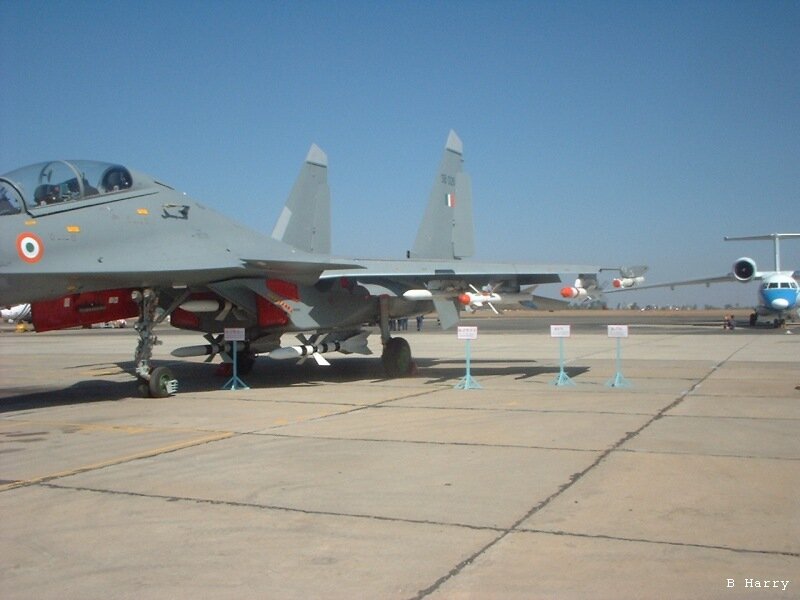
SrbinWell I am talking about the actually SAM complex, it is sopposed to undeploy in something like a very short time, less than 5 mins and then move and deploy again in a similar time. Compare it to a Patriot which takes half an hour and if not more.
SrbinEven if it didnt go through weapons testing, I don’t understand why you are so big on this matter, it going to get integrated sooner or later.
SrbinSrbin, what exactly is “plug and play”? You sure can’t simply go ahead and plug in a new radar and get “New hardware detected” on your MFDs! Any fighter today, should be customisable to the limits of the physical space available. While newer fighter permit some instant recognition of MiL-1760C, Russian and other stores and permit integration with minimum software changes, a wholly different avionics fit is’nt the same. Upgradation takes years and longer to flight test the systems. Imagine if you were doing it from scratch and the stress of testing dissimilar fits simultaneously.
I know it takes space, open architecture, testing, money and time and it all depends on how willing the company is to customize. Some companies are willing to do it but many are not.
SrbinAny info on the Su-22 upgrade? What kind of avionics and weapons?
SrbinIt would be more interesting to see how they came to that conclusion, the article is rather vague and simply stated the conclusion but not how exactly it is superior (although it is probably likely they were unable to attain that information). Furthermore the sole “armed variant” the Yak-130D has not actually begun tests with the weapons it is often displayed with. If you are able to find a more detailed report, please post them here.
Yahh it is vague, but thats merely what I read and wanted to post it since I ran over it on Flug Revue. Anyways as for weapons testing, umm AFAIR the production variant already flew and it is going into slow scale production, it must’ve been tested with weapons.
Srbinglitter do you know where exactly they’d be placed and how much fuel they would hold. any drawings from dassault?
Also where are F-15’s CFTs placed?
SrbinWrong. PLAAF never said it was going to replace every lower then 3’rd gen fighterjet with j10. Let alone think about higher costs and less diversity. And they pumped atleast 150 million usd in the project to let you tell that it is not going to be bought? Please do provide me more info how you come to these conclusions mr Srbin.
I don’t think PLAAF either said that they were going to replace every lower generation plane either with anything. I think they spent money so they could export it really because FC-1 was mostly meant as a export.
SrbinI was playing around some figured for the Yak-130. Lets say you are on an AD mission. It’s range is quoted by Yakovlev as being some 2000km, which should result in an 900-1000km combat radius approximately, thats clean. Load it with lets say 2 fuel tanks each carrying 450kg of fuel(50% more), 2 R-73s(approximately 220kg), and the rest 5 R-77s(approx 900kg), and you got yourself an external load of 2020kg for a combat radius of 600-800km. Not too shabby for a trainer ehh? Although it’s T/W ratio and speed are going to go dramatically down, once the fuel tanks are ditches and a volley of R-77 is fired, it will then be able to dogfight. With aerial refueling it should help it dramatically.
SrbinOk, remember where I said Yak-130 performed better than Su-25….
YAK-130 APPROACHES MAIDEN FLIGHT
By Piotr Butowski/KSEven in difficult times, the Moscow-based Yakovlev design bureau is busy with a whole range of programmes. Yakovlev president Oleg Demchenko puts his company’s success down to the fact that “we are the only Russian company to have learned to sell projects rather than finished aircraft.” For example, Yakovlev collected $77 million from Aermacchi for handing over data relating to the joint development of the Yak-130D/AEM-130 between 1993 and 2000.
Since then the two companies have gone their separate ways and each is now building its own version of the advanced trainer. Their conceptual approaches are different. Whereas Aermacchi has optimised its M-346 for training flights, Yakovlev sees the Yak-130 as a light ground attack aircraft as well.
This additional function emerged in the second half of the 1990s when, against a background of conflict in Chechnya and border disputes between former republics of the Soviet Union, the Russian Air Force put a combat version of the trainer to the test. During the evaluation, the reference model was the Sukhoi Su-25, which sustained significantly more losses in a simulated war scenario than the combat trainer. New operational concepts were tried out using the trainer, with target designation by external surveillance systems.
Precisely because of its suitability for combat missions, the Yak-130 performed significantly better than the competing MiG-AT. It flies faster (at 1050km/h compared with 850km/h), has a better thrust-weight ratio, and its wing loading is lower, making it more agile. The Yak-130 also clearly outperformed the MiG-AT against numerous other tactical and technical evaluation criteria. Apparently, the evaluation board led by Colonel-General Anatoli Maximov awarded it a full 20 percent more points than its rival.
Altogether eight areas were investigated. These included the technical and financial capabilities of design bureau and production facility. In the case of the Yak-130, this involved the Sokol production plant in Nizhni Novgorod, which had been fitted with modern equipment in the wake of MiG-31 production. Once again Yakovlev emerged with full colours as its development team had converted entirely to advanced computer-aided design methods.
Although Yakovlev was the favourite in the competition first started in 1995 against Mikoyan, nevertheless there were repeated attempts to exert influence both in the Russian media and at the highest political level. For example, on 15 March 2002, Industry and Technology Minister Ilya Klebanov told representatives of Thales (which was a partner in the MiG-AT programme) that the MiG trainer had the support of the Russian government. Only one day later (a Saturday) Colonel-General Vladimir Mikhailov, Commander-in-Chief of the Russian Air Force, signed the decision by the evaluation board in favour of the Yak-130! This was then announced on 10 April 2002 at a press conference in Moscow.
Despite this, work is continuing on the MiG-AT trainer, which recently passed the acceptance tests carried out by the Russian Air Force. Notwithstanding this, Mikoyan’s hopes, along with those of its French partners (the Larzac engine is being supplied by Snecma), are pinned on export orders.
Even before the official selection of the Yak-130, Sokol had resumed construction of four pre-production aircraft. These have a number of differences compared with the Yak-130D demonstrator, which has been flying since 25 April 1996. Thus, for example, the airframe is more compact, its span shorter by 94cm and its fuselage by 41cm. The slab tailplane and leading-edge flaps now have a dogtooth.
The cockpits have also been radically altered. They are now equipped with three 15cm x 20cm LCD colour displays produced by Elektroavtomatika of St. Petersburg. The analogue fly-by-wire system has been replaced by a digital one. The avionics are based on two central computers and a three-channel data bus that complies with MIL-STD 1553, so that, if required, new equipment can be easily integrated. The navigation suite includes laser gyroscopes and a GLONASS GPS receiver.
The aerodynamic design of the Yak-130 is geared towards high agility, so as to familiarise pilots with fighter aircraft of the new generation, such as the Su-27/30, Eurofighter or Rafale. For example, the forward location of the wing roots permits angles of attack of between 35 and 40 degrees. Turns can be flown at a speed of 700km/h with a maximum g loading of 5.2g. The digital control system allows different flight characteristics to be programmed.
The Yak-130 can be routinely fitted with a radar, candidate models including the Kopyo from Fasotron, the Osa from NIIP, the Kinchal from Leninets and the Grifo from Galileo Avionica. For combat missions, targeting pods, like Platan or Sapsan can also be carried.
On the production aircraft, the Slovak-built DV-2S of the prototype has been replaced by the 24.5 kN thrust AI-222-25 turbofan developed by Progress in Zaporozhe, which could be built under licence by Salyut in Moscow. With regard to equipment, Yakovlev has complied with the requirement for minimal support at frontline airfields. Thus, an auxiliary power unit (TA-14) and an oxygen generating system have been installed. For training purposes, an in-flight refuelling probe can be mounted.
The Yak-130’s maximum external stores capacity is around 3,000kg The aircraft has been shown with missile pod, cannon pod, light air-to-air guided missiles, laser-guided bombs (KAB-500) and air-to-ground guided missiles (Ch-25M). Operating range with a 1,500kg weapons payload is expected to be around 850km.
Rollout of the first aircraft took place on 30 May in Nizhni Novgorod, just over a year after selection of the Yak-130. It was then shown at the Paris Air Show. The maiden flight is to be carried out as soon as the engines are available in the autumn. This should be in November, according to Demchenko. Towards the end of the year the airframe for the static tests will be finished. The second flying prototype will then follow in mid-2004.
At the rollout ceremony in May, Colonel-General Vladimir Mikhailov was optimistically predicting that the first Yak-130 equipped squadron could be operational as early as 2005. Ten aircraft are to be built for this purpose. The Russian requirement to 2020 is currently estimated at between 150 and 200 aircraft.
The Russian Air Force plans to train its pilots on four aircraft types in the future. Selection of suitable candidates and basic training are to be carried out on a piston-engined aircraft. The aircraft chosen for this purpose in October 2001 was the Sukhoi Su-49, but since then its development has slipped. Then there will also be a turboprop or a light jet trainer. This role will fall for the foreseeable future to the 440 existing Aero L-39 Albatros.
Next in line will be the Yak-130, which is to take over part of the training programme from the L-39 and first and foremost will replace the two-seater fighter aircraft in the three remaining Russian training centres. This should reduce costs by a factor of five or six.
The Russian Air Force will thus benefit in any case from the Yak-130. For Yakovlev however, it will take some time to recoup the development costs, estimated at $200 million, 84 percent of which have been borne so far by the design bureau itself. At least 60 to 80 aircraft will have to be sold at prices of between $12 and $15 million.
Naturally Yakovlev is aiming for some export sales. In Russia and the states of the former Soviet Union it has exclusive rights, whereas on the world market it has to compete with Aermacchi’s M-346. An agreement recently reached with Sukhoi to offer the Yak-130 as part of an integrated training package for Su-27 family fighters should help.
Even before production has reached full swing, Yakovlev already has plans for other variants on the drawing board. These include a Yak-130K for training on aircraft carriers. This would have a strengthened undercarriage and folding wings.
A single-seater version for combat missions designated the Yak-133 is under development and could be flying as early as 2005/2006. For this model, the AI-222-28 engine will provide an additional 1,33 kN thrust. Instead of a radar, an electro-optical targeting system would be installed in the nose. 850kg more fuel should permit an operational radius of 1,000 to 1,100km. Derivatives of the Yak-133 fitted with radar, as reconnaissance aircraft or for electronic warfare are further possibilities. One final idea of Yakovlev’s is to build an unmanned reconnaissance aircraft with a six tonne take-off weight, using the engines and systems from the Yak-130. However, its aerodynamics would be quite different from those of the trainer: it would be a flying wing.
How potent do you guys think the Yak-130 would be with a small radar like the Kopyo in the Air Defense role with R-77? Considering it is subsonic.
SrbinAnd remember the PLAAF never wanted this aircraft, it never asked for it and there is no role for it to fill. The J-10 is replacing everything while the only thing left to replace is the Q-5 at CAS, but something like the L-15 in the future should be suitable enough.
SrbinMaybe so but that will take time.
SrbinI am not sure, but they are operational and in any case if war breaks out I am sure they’d be quickly transported to Cyprus to give those Turkish F-16s and F-4s a beating. If Greece was not planning to deploy them elsewhere permanently they would’ve placed them somewhere more strategic and closer to Turkey, like on those other Islands. In any case Cyprus moved them to Greece because Turkey threatened to destroy them if they were to become operational on Cyprus, which would be hard considering S-300 is very mobile and we know how hard it would be to destroy it.


 Sign In







