aurcov
I see that many here compare the F 35 with Rafale. Is France going to declare war on US or vice-versa?:eek:
A more real scenario will be both against Su 3X. In this conditions, let’s compare these two planes.
OK, Rafale will have better performances when clean. No one argues. But, against the big Flankers, you’ll need every drop of fuel you can carry.
-The F 35 can carry over 8 tons internally.
-According to this: http://www.dassault-aviation.com/fileadmin/user_upload/redacteur/AUTRES_DOCS/Fox_three/Fox_Three_nr_2.pdf, first page, the Rafale can carry 4.557 tons (1519 US gal.) internally. It also has 5 wet points. There are two types of EFTs: “supersonic” (330 US gal. or 0.99 ton) and drop tanks (528 US gal., or 1.58 ton). The Rafale can carry either 5 (unjetisonable) X 330 gal EFTs or 3 (jetisonable) x 528 gal EFTs. In the first case, the rafale will carry 9.5 tons, in the second case 9.3 tons. I think that everyone will agree that the 8 tons of the F 35 will offer more range compared with the ~ 9.5 tons of the Rafale, because of the extra drag of the EFTs.
Put 6 AAMs on each fighter, all 6 internal on the F 35, 2 on wingtips and 4 of them with their pylons on the Rafale.
Now:
-which will have a higher speed?
-which will accelerate better?
-which will have a better inst./sust. turn rate?
PS: don’t start with the “jettisoning the EFTs” BS, if you want the Rafale fight the next day…
aurcovRomanian Bf 109 against German and Hungarian Bf 109, from August 23 1944 to May 9 1945.
aurcovAnd at M 4.0 per AAMS the difference in seconds would be?
What makes you believe that the enemmy would also be able to detect and track the F 35?
The only real difference here is visual capabilties, range of detection of SAMIR is virtualy in the SAME ballpark
Based on…
MIDS equiping Rafale and Mirage 2000s is Thales designed among other things…
All MIDS LVT (the fighter version) are the same no matter the operator.
In April 1997, Thierry moved to the Land & Joint Division and was seconded as Technical Director to the Midsco international Joint Venture in Wayne (New-Jersey, USA) to complete the development of the Link16 Low Volume Terminal MIDS
Wow, so a Frech engineer came into US to participate at MIDS R&D, and sudenly he designed the thing?:p
So, no matter that MIDS is based on JTIDS technology (entirely US), no matter that the MIDS was developed in US labs, tested on US fighters, no matter that the largest part of the hardware for international customers and 100 % of the hardawre for US customers is made by US compnies, no matter that the first platform was the F 18 in 2001 (there are ~ 2000 MIDS in US on F 15, F 16, F 18), no matter that US Navy is the overall program manager for international customers, no matter that an US intelligence agency is providing the cryptography, just because a French engineer (a good one, no doubt) has participate, suddenly MIDS is French designed?:p
NOTE the manufacturer quote. i.e LONG-RANGE ALL-WEATHER
Hey, I just quote you. Under the SAGEM photo, you said: :”For the time being, performances of this generation IRST is enough for classification as long-range/All-weather by the manufacturer and the DGA is looking in this precise direction for actual and future developements..”
As for the manufarcturers claim, of course that all the companies that produce FLIR say that thie product are ling distance, all weather. If you chose to believe that only the french claims are substantiated, it’s your problem.
Many Apaches crashed. What makes you beleive that it was because the IR sensor went bad?
Because it was the case.
Most of this forum posters use to prove statements by puting links, or copy-paste. Do you have anything on this episode?
In short as we say in France, you’re Charriot” by a couple of generations.
As I told you, I am not American. However, somehow i doubt that France has any edge over US in optronics, or, if so, this advancement could be measured in generations…
Kindly asked you how on hearth can anyone bar AdA/MN/GIE/DGA/Thales have this detail in hand?
Than, how do you know that Spectra will work againt AESAs? I agree that such info are not public, but you claimed it as a knowing fact. Did you read in a a magazine, or at least on some forum? Or should I consider it your own assuption? If so I’ve got no comment.:)
Nothing from SAGEM but Thales sold the SIRIUS IRST to the Canadian Navy and a little goody for the USN too.
Canadian Navy still isn’t USN.
aurcovYou arer AGAIN bringing NOTHING new to the debate, and DAS only bring Imagery to the IR MLD function…
What i was saying was the whole spectrum of threat is already covered on a 360* X 360* buble a long time ago…
It’s a diference between a system that worns you seconds before being hit by a missile (SAMIR), allowing you, in the best case, to perform an evading maneuver, and a system (DAS) that warns the pilot that a hostile, dozens of miles away, is heading towards him:
AviationWeek
JSF – “Maneuvering is Irrelevant”
Posted by Bill Sweetman at 10/2/2008 3:01 PM CDTTwo weeks ago at the Air Force Association convention, Northrop Grumman briefed media on the Distributed Aperture System (DAS) that it is developing for the F-35 Joint Strike Fighter. Subsystem briefs aren’t always revealing, but this was different.
As this story in DTI (p40) explains, DAS comprises six fixed, wide-angle infrared cameras that constantly image the entire sphere around the F-35. It’s been publicized in the past for its ability to allow the pilot to “see through the floor” in a vertical landing, and one of its functions is to provide imagery to the VSI helmet-mounted display. Another is missile warning. But one of the DAS’ most interesting capabilities is that it can constantly track every aircraft in the sky, out to its maximum range – which varies but, absent clouds, covers the within-visual-range envelope.
DAS has two vital attributes in this respect: it stares, never looking away from any target, and it has optical accuracy, with megapixel-class resolution. (Northrop Grumman didn’t say “megapixel”, but one of their suppliers did. Bad supplier! The naughty spot for you!) This means that once a target is ID’d, it stays ID’d, and the pilot can see what every aircraft around him is doing.
Moreover, DAS is expected to track with enough accuracy and tenacity to permit a safe high-off-boresight, lock-on-after-launch (LOAL) missile shot with any datalink-equipped missile. Indeed, Northrop Grumman’s DAS business development leader, Pete Bartos – who was part of the initial USAF JSF requirements team – says that this was basic to the F-35 design and the reason that it did not need maneuverability similar to the F-22. Rather than entering a turning fight at the merge, the F-35 barrels through and takes an over-the-shoulder defensive shot.
BOY you’re mystaking your Disneland local workshop for SAGEM and Thales aren’t you???
You meant developed by Sagem or Thales and produced in the US perhaps…
First, it’s not my Disneyland, since I am not American. Second, the idea that MIDS is french designed, it’s a sample of nationalistic wishfull thinking. For your information: the first Link 16 terminal called joint tactical information distribution system (JTIDS), was introduced in USAF in 1974 in command& control platforms such AWACS.
The source of MIDS was the American joint programme JTIDS (Joint Tactical Information Distribution System), developed in 1974, and it retains the same main principles. MIDS and JTIDS are fully compatible network systems for voice and data transmission, using the same spectrum-spreading and very fast frequency-jumping (76,000 times a second) in band L between 960 and 1215 MHz to avoid detection and jamming. The data are encrypted to prevent bugging and intrusion. JTIDS and MIDS operate by the TDMA (Time Division Multiple Access) process, and can take up to 128 participants in a network. Each participant can either transmit at 200 Watts in its own time slots, or listen to the network for messages. It is also possible for a participant to be connected to several networks, because multiple networks can coexist, using the same set of frequencies in sequences which prevent any interference. This gives the MIDS almost unlimited capacity.
Starting from 1980, JTIDS were mounted on F 15 and F 14 and UK Tornados. In mid 90′, RockwellCollins and BAE Systems NorthAMerica (by then still GEC-Marconi Hazeltine) formed a JV called DataLinkSolutions. They introduced a smaller version of Link 16 terminal called MIDS Multifunctional Information Distribution System. Since the Link 16 is the military inter-computer data exchange format of NATO, France, Germany, Italy, Spain joined US and formed MIDSCO consortium to produce hte MIDS terminals for these countries.
MIDS-LVT is a program sponsored by five NATO countries (United States, France, Italy, Germany, Spain) with the U.S. Navy as lead Service for U.S. applications and overall program manager. A contract was awarded to MIDSCO, a consortium of defense contractors from each of the participating countries. GEC-Marconi, a U.S. subsidiary, is the prime contractor. The program is managed by the Navy MIDS International Program Office
The GEC-Marconi group is in charge of organising the MIDS programme. A joint company, Midsco, headquartered in Wayne, New Jersey, was formed in 1989, between GEC-Marconi and a company in each of the five countries involved in the programme. GEC-Marconi has a 41% stake, Thomson-CSF (France) 26.5%, Italtel (Italy) 18%, Indra (Spain) 7.5% and Siemens (Germany) 7%.
Even the crypto is provided by US NSA –National Security Agency.
Already there just in case you haven’t noticed yet, only the imaging capability is missing but NOT for long, NOW since you seems to like taking the Mickey, have a good read on my previous posts and try to default the french developed technologies called “West” or “WORLD FIRSTS” coming our way…[
For the time being, performances of this generation IRST is enough for classification as long-range/All-weather by the manufacturer and the DGA is looking in this precise direction for actual and future developements..
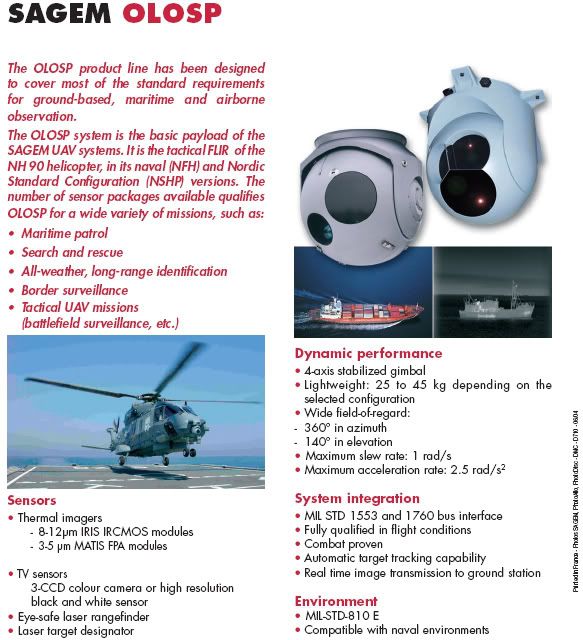
Since when a helicopter FLIR is a “first” in 2009? I can name a handfull of companies in US, Israel, or else that built similar product: http://www.raytheon.com/capabilities/products/stellent/groups/sas/documents/asset/cms04_018915.pdf http://www.raytheon.com/capabilities/products/stellent/groups/sas/documents/asset/cms04_018917.pdf http://www.raytheon.com/businesses/stellent/groups/sas/documents/content/cms04_015191.pdf http://www.lockheedmartin.com/products/Arrowhead/index.html http://www.lockheedmartin.com/products/TargetSightSystem/index.html http://www.rafael.co.il/marketing/area.aspx?FolderID=262&docID=918
BTW, you mix-up FLIR and IRST. FLIR is forward looking infrared, has a narrow field of vue and is for A-G. IRST is for A-A and actually scans the space in front of the aircraft. AAS 42 (F 14D) OSF (Rafale), Pirate (EF) are IRSTs. The system in this Sagem broschure ia FLIR.
Well, bravo for Thales. It still wouldn’t provide a capability to detect a fighter in EMCON behind or lateral.
What’s wrong with your understanding of the words 360* X 360*?
It seems that something is wrong to your undestading of EMCON, i.e. emission control. DAS allows the pilot to locate an enemmy plane even if this one won’t emmit (a plausible scenario, since this one is aware that the ESM on F 35 will locate it, and will prefer receiving guidage from off bord sensors, or from his IR sensor).
Did any customer complained? IRST customers?
The US Army after the crash of TWO Apaches in Bad weather YES.
Many Apaches crashed. What makes you beleive that it was because the IR sensor went bad? BTW an apache has a FLIR not an IRST:diablo:
Why dont YOU ask Thales for a laugh???
Spare the cheap ironies. You said that in a certain exercise, Rafale was able to pick AESA radars. I kindly ask you, what is that radar?
YES they DID and from SAGEM as well if i’m not mystaking
OK, in this case could you name that system USN buy from SAGEM? Because, if you are talking about the US N IRST, this one is built by LM (I already posted the link).
aurcovRight, and when they (SAMs) are set up the Air Force of the aggressor is automatically informed of their location right right?
I hope you are aware that the EW system can geolocate the radar position and show it on the display on the F 35?
aurcovThat’s IR 360X 360* coverage for all sensors i was mentioning and you dont bring anything new here
It’s the third time you posted this image. The IR spherical coverage you mention is offered by SAMIR. It’s a MLD nothing more. It alerts the pilot if a missile is fired upon. I’m sure it’s a fine equipment. However, it does not provide IRST situational awarness 360 deg. (the ability to detect and track the enemmy ~ 30 km, 360 deg., not only an incomming missile).
I know what the REAL world is, i’ve been there and am still very much pluged-in, you guys in the other hand are mystaking standard and history big times…
You didn’t get my point. I didn’t question your sources, or deny that this particular Mirage can do what you said. I repeat, if you know the pilots, please ask them how many times they go over 1M, be in day-to-day training, exercises or war. Moreover, how many times they did it with EFT and weapons.
I ask you this, because a USAF general (F 15 former pilot) and member of F 35 team, said very clearly that in the case of F 15, the time spent in >1M totals a few tens of minutes in each plane, in 30 years of lifetime (~8000 hours) and most af these minutes were in periodic check flights. And we are talking about F15, a plane that probably saw more AA action than all the other 4 gen fighters added.
Reaward firing with Link-16 remote targeting SUCCESFULY demonstrated with a direct hit on the targhet drone situated 180* BEHIND the shooter by a Rafale F2: 11 June 2007.
Gives us 360 X 360* passive (remote) detection and firing capabilities for more than a YEAR….
I’m glad that Rafales have this great piece of US engineering that is MIDS (I hope you know that despite it is assembled by Thales, the technology and components are from Rockwell Collins). However, I was talking about an automonous, on-board 360 deg capabily such as DAS.
Quote:
Full integration of the AESA RBE2 positions the Rafale as the only combat aircraft of its category equipped with active arrays for both its radar and electronic warfare suite. This outstanding system that allows a 360-degree smart antenna array coverage, is a real technological breakthrough on-board the aircraft.
http://www.thalesgroup.com/aerospace…rogramme&dis=1
Well, bravo for Thales. It still wouldn’t provide a capability to detect a fighter in EMCON behind or lateral.
No assumption buit reality: OSF was a world FIRST and the USN buy from Thales for some good reasons, also we’re aiming at long-range/all weather sensors when EOTS is still weather limited…
I’m afraid you are wrong. USN didn’t buy from Thales. At least, not IRSTs. In fact, US has the longest experience in IR. The first IRST was mounted in a F 101 Voodoo in mid-fifites. All the fighters in the series of F 104 , F 106, F 4, F 14 had IRSTs, wich means a few thousands. When was the first French IRST operational? The best US produced was the AAS 42, operational on F 14D in 1996. (When was the OSF operational?) The USN acceptance requiement was to detect a Tu 22 at the kinematic range of the Phoenix. That’s 180 km. Of course, a fighter-sized target is detected a a smaller distance, let’s say 140-150 km. Presently, an enhanced version is on the F 15 K for S Korea and on the F 15 SG for Singapore. http://www.lockheedmartin.com/products/InfraredSearchTrack/index.html
However, you avoided the real point in my post. I was asking about a 360 deg. IR suite (other than a simple MLD), not only a frontal system. I’m still waiting…
BTW, you keep saying about the presumbly bad weather limitation of US IR sensors, compared with French ones. Care to elaborate? Did any customer complained? IRST customers? (S Koreans, US Navy) Targeting pods customers such as Lantirn XR, ATFIR, Sniper, Litening (~20 coutries). Because, I really didn’t hear that.
Thales my friend are making AESA for the US DoD for a long time and they DONT need USAF AESA to know what an AESA signature looks like they actualy have enough ofthem on the range itself for testing SPECTA and other ECMS systems…
What AESA is exported to US (I’m really intersted, because that’s the first time I heard) What are those fighter AESA that French operate, in order to calibrate the Spectra?
Pure lack of interest in your case…
I believe that like Scorpion you’re going to argue that they dont have enough thrust to counter the drag of 4/ 6 Mach Low-Drag AAMs and develop a terminal block on the subject of inlet pressure recovery limits too?
Quote:
Too bad, since up to now, only US-made aircraft did thisSure so a Mirage 2000 flying 0.15 Mach faster than a F-16 while flying at 59.000 ft can’t fly at M 2.0 with 4 MICAs?
No one argue that Mirage has a ~10 % higher max. dash speed, than the F 16. I was talknig about acceleration.
aurcov”
Since the event of SAMIR on the Mirage 2000 all AdA/MN aircraft HAVE a 360X360* IR detection system, SPECTRA adds EM and LASER to it.
http://www.sagem-ds.com/pdf/en/D649.pdf
Do you realize that SAMIR is just a missile detector? Hell, even the old Dutch F 16 MLU have them mounted on the inner pylons. The AN/AAR-56 of F 22 and the DAS of F 35 offer someting else – – IRST situational awarness.
I’m looking for the Doc but i have to remind YOU that F-35 systems were partly developed by European companies in particular BAe systems which, if they are good can hardly claim being better than SAGEM and Thales in this field.
It seems that you don’t know the F 35 programme as well as you pretend. The EW systems of F 22 and F 35 are indeed made by BAE Systems, but not in Europe. They are produced in US by BAE Systems North America in Nashua, New Hampshire, the former Sanders Corp. http://www.baesystems.com/Businesses/EIS/Divisions/ElectronicWarfare/AboutUs/index.htm
Which is the field where French companies have been working and got ahead of the US, in particular in the field of multi-band systems and pixel-powered systems where BTW French DGA programmes manages a world’s first last year…
Interseting R&D stuff. How many of these development are operational (as the F 22 AN/AAR-56) or in testing (as the F 35 DAS)?
Sorry my friend you’re talking OUT of ignorance here.
A Rafale, Gripen or Typhoon actualy supercruise with AAMs and tanks, F-35 doesn’t supercruise AT ALL.
A Rafale, Gripen or Typhoon actualy fly at M 2.0 which is a M 0.4 kinetic advantage over F-35.
A Rafale, Gripen or Typhoon actualy aren’t structuraly G limited the way F-35 is…
A Rafale, Gripen or Typhoon actualy have an operational ceilling 10.000 higher.
[B]You’re mostly uninformed i’m afraid.[/B
It seems that you live in a fantasy world, where fighters (French, of course) travel at 2 M at 75.000 feets. Well, real world is different:
While supersonically the F-35 is limited to a seemingly unimpressive Mach 1.6 in level flight, Davis explains that the JSF is optimized for exceptional subsonic to supersonic acceleration. Transonic acceleration is much more relevant to a fighter pilot than the absolute max speed of the jet, Davis said. Davis, who was previously the program manager for the F-15 Eagle, explains that while the Eagle is a Mach 2 class fighter, it has rarely exceed the threshold of Mach 1.2 to Mach 1.3 during it’s entire 30 year life span. Additionally, the time the aircraft has spent in the supersonic flight regime can be measured in minutes rather than hours- most of the supersonic flights were in fact during specialized flights such as Functional Check Flights (FCF). “I don’t see how that gets you an advantage” Davis said, referring to the Mach 2+ capability. Beesley said that in terms of supersonic flight that the F-35 is still more than competitive with existing designs.
You said that you have some conection with the French AF. Ask those guys how much time they spent >1M in trainoing or execises. French Mirages 2000 were in Iraq in 1991 and in Kossovo in 1999 (I’ve considered only the A-A scenario). Ask them if they ever crossed 1M and if so, for how much.
In the EM dpt SPECTRA does just as well, the IR and laser coverages are there the difference rests in the visual presentation in DAS absent from MIDS but the new generation of IR/OPptical sensors developed in France is much more performant expecialy when it comes to Visual Meteo Condition limits.
MIDS has nothing to do with IR detection. It’s a Link 16 terminal. And the better performances of French stuff in bad weather are just assumptions, since there is no French operationl/tested system similar with DAS or AN/AAR-56.
…SPECTRA is proven to detect LPI radars (NATO MACE-X Exercise), it’s not even a match it’s laughable, limited EM L.O doesn’t compensate for this…
LPI doesnt mean UNDETECTABLE BTW…
In this particulary exercise, did anyone use AESA radars? If not, extrapolating spectra performances against conventional radars to AESAs is wrong.
At this altitude, from Mach 0.9 to Mach 1.85 it beats the ekke of F-16 (flying LOWER) with 120 sec, even better up to 2.17 after 180 seconds.
If both were clean that’s pure imagination.
French aircraft are designed to intercept Mig 25, not Harrier IIs at sea level mate!!!
Too bad, since up to now, only US-made aircraft did this…In the end, we have either believe all the stuff you posted, or oficial LM/AF presentations…
aurcovI don’t think I am being hypocritical. I do not criticize at all and I certainly don’t pretend to know the truth, I only use pretty simple deduction techniques to analyze in detail what the Beesley pilot actually said.
The fact is that the man praised the F-22 being a class of its own in terms of flight performance [let us assume that I believe you even without the source, no problem with that]. Few months later he praises the F-35 being almost as good as the F-22 while [now it comes] being exactly on par with the F-16. That is a logical contradiction. Due to direct comparison of the F-35 with the F-16 (which is in fact the only known in this equation) we can deduct following: either the F-22 is not a class of its own or the F-35 is not close to it. It cannot be more simple.
And that pretty much comes back to my previous statement which said that pilots like Beesley cannot be taken seriously because in first place they repeat what they were told to. Mr. Beesley is surely a very skilled pilot but in terms of his public appearance he appears to me as nothing but an universal praising machine – whatever he tests is brilliant, amazing, unsurpassed and a class of its own. Thanks for the bullsh!t, I got enough of this from the local fanboy club 😉
That’s all I wanted to say..
It’s not fair. Beesley tested the F 22 back in 1997 and the F 35 starting from 2006. So “Few months later he praises the F-35 being almost as good as the F-22” doesn’t apply. Beside, I think you agree, the F 22 is a class of its own in terms of flight performance.
However, Beesley said that the F 35 “almost” matches the F 22 in subsonic. He also insisted that it would be unfair to compare it with the F 22 is supersonic.
As for praising anything he tested, what can I say: he works at LM. Name a bad plane made there…
aurcovWhat a bloody brilliant idea! The enemy are dunces and have their mobile, modern SAM systems in just one spot and glued to the ground!
😀
Yes, they are immobile while they are emitting! Any “modern & mobile” radar, be it Tomb Stone, Grave Stone, Big Bird, you name it, are immobile as long as they emit. Or did the Russians invent a method of using them while traveling on a highway?
aurcovLMAO, nice to see you finally give up your twisting and spining about who you are Sampaix
Isn’t Fonk by any chance? I remember the style…
aurcovI only took one sentence from that article. Here is what Beesley says:
Turning at the higher Gs and higher speed portions of the flight envelope, the F-35 will “almost exactly match a clean Block 50 F-16 and comes very close to the Raptor”, Beesley said.
If we assume he is right, then if F-35 matches the F-16 B50 and is very close to F-22, that logically means means the F-16 Block 50 is, too very close to F-22. Since the later blocks of F-16C are sonsidered a slouch compared to earlier lighter F-16As, that would indicate that Raptor is inferior to F-16A in this particular case. If that is right, then I guess Typhoon (as the said best performer at higher speeds) will probably be rather considerably superior to F-22 on this field. 😉 Ouch, I can’t believe I have just said that 😉
Please, feel free to correct me if you find a logical mistake but I only interpret what your Mr. Beesley has said.
Nope, the F 16 blk. 50 accelerates better than any plane except the EF. That the EF matches the F 22 in subsonic is no secret; the difference between the F 22 and any other fighter is in supersonic.
aurcovThat alone would easily declassify you as analyst.
1. You need to be prepared for all possible situations. The talks about selling few Tu-22Ms to China have been going on for decades, you cannot 100% rule out it happens one day.
2. Meanwhile the Chinese are perfectly capable to invent their own bomber at least in the Tu-22M class. What will you do, then?
In theory, you are right. But I doubt that the Tu 160 was ever considered. So you take one of the most potent strategic bomber, you consider that a country thousands of km. from you will got it and you tailor your defense strategy based on this assumption? Hmm…
aurcovWell, it is simply NOT the case for many reasons, the first it that it was simply NOT designed to out-turn F-16 in CLEAN configuration but in A2G configuration and that appart for the F-16 versions with the lowest TWR it just wont happen.
In terms of aerodynamic performance, the F-35 is an excellent machine, Beesley said. Having previously been only the second man ever to have flown the F-22 Raptor, Beesley became the first pilot ever to fly the F-35 in late 2006. As such, Beesley is intimately familiar with both programs. According to Beesley, the four current test pilots for F-35 have been most impressed by the aircraft’s thrust and acceleration. In the subsonic flight regime, the F-35 very nearly matches the performance of its’ larger, more powerful cousin, the F-22 Raptor, Beesley explained. The “subsonic acceleration is about as good as a clean Block 50 F-16 or a Raptor– which is about as good as you can get.” Beesley said.
The aircraft flies in “large measure like the F-22, but it’s smaller, and stiffer” than the Raptor however, Beesley explained, adding that the aircraft handles superbly. The reason for the similar flight characteristics, explained the test pilot, is because the man who designed the flight control laws for the Raptor, is also the same man who is responsible for the flight control software for the F-35. As Beesley explains, the flight control laws of modern fighters determine to large extent the flight characteristics of a given aircraft. Beesley said that the aircraft is so stable and so comfortable that the test pilots find themselves inadvertently drifting too close to their wingmen in formation.
What Beesley expects will surprise future F-35 pilots is the jets’ superb low speed handling characteristics and post-stall manoeuvrability. While the F-22 with its thrust vectored controls performs better at the slow speeds and high angle of attack (AOA) flight regime, the F-35 will be able match most of the same high AOA manoeuvres as the Raptor, although it will not be able to do so as quickly as the more powerful jet in some cases. Turning at the higher Gs and higher speed portions of the flight envelope, the F-35 will “almost exactly match a clean Block 50 F-16 and comes very close to the Raptor“, Beesley said
.
This is simply forgeting that concurent manufacturers do not stay iddle:
SA in a 360X360* bubble is already in service in Europe, both EM and IR and there are new generation IR systems in the pipeline as capable if not MORE than DASS.
Looking Sci-Fi doesn’t mean SUPERIOR it just mean ADVANCED US design and sometimes as in the case for EOTS “atractive packaging”.Reality lies in the REAL set of capabilties and technologies, in the IR Dpt, europe is ahead of the US not behind, you simply are not aware of this fact.
Really? What systems except symple missile detectors do offer Europeans for spherical coverage? Because DAS is more than a MLD, you know. What are those systems in the pipeline, more capable than DAS? Name a few, please. Also be so kind to name one of those “REAL” systems that is “ahead” US. Either operational or in tests.
We’re talking Air-to-air here…Me too. 4.5 gen planes shoud carry the ~ 6 A-A missiles on pylons. But most of all, EF, Rafale, Grippen shoud also carry 3 EFT in order to be something else than symple point defense fighters. With those, they barelly go over 1M with A/B…
You’re mostly uninformed i’m afraid.
OK, enlighten us, please.
aurcovIt depends. I’d still say that Flanker’s stunts look better on the airshow but F-22 has brought some strong points, especially the tight horizontal turns. Again you missed the point. The Flanker stunts might look better, but no one can argue that it is superior to Raptor because of this. The point is that many said that “stealth will compromise aerodynamics” and other BS…
You only think that. You cannot know. Of course, I don’t deny you the right to suppose whatever you want but you got no evidence to support this claim..
Except the declarations of test pilots (one from LM one from USAf one from RAF). And of course, you got no evidence either that the F 35 is a bad plane
aurcovI personally don’t see his personal preference as a problem as long as he is not ready to falsify the data. I agree with his notion that buying a stealth fighter with actually poor LO characteristics is a nonsense. He seems to be persuaded about that in case of the F-35 and provides very interesting backup for this claim – unlike the rest of us. It’s easy to persuade me on the contrary – simply take his data and prove him wrong.
– taking supposed range of ‘Chinese Tu-160s and Tu-22Ms’ is actually very correct from Kopp – Australia is buying their fighter not just for today, but for future 30 years of service. I don’t know what China will operate in next 30 years but it will be something better than just H-6s. If you call the F-35 a fighter for the future, then you cannot simply get satisfied with it being able to cope with just today’s threats. A point for Kopp here. The Russians may very well sell advanced version of Su 30 and SA 300 to the Chinese. I strongly doubt that they will sell strategic bombers. So, he invents an imaginary threat in order to prove a point. Thumb down for Kopp here
– regarding him taking for granted any Russian claims and considering the lowest public figures for US weapons, this is actually a very sensible worst-case approach. You cannot expect a serious analyst say *hey, the producer of the antiship missile claims 350 km range but it’s just Russians, they are lying like hell, let’s take just 260km and base our entire strategy on that!* Another point for Kopp, I would say, his approach here looks correct to me. You missed my point. I don’t necessary blame him for taking all the Russian claims without a grain of salt, but for the fact that in the same time is bashing anything made in US, with the exception of F 22, of course. Another thumb down for Kopp, I would say, his approach here looks incorrect to me.
– regarding taking wing-loading and range figures of Su-30 vs F-18, I cannot really elaborate without knowing the purpose of the analysis. If he, for example, studied survivalability of RAAF Hornets on a bombing run, then his assumptions would be right. I leave this point open.
No he compared the two planes in A-A. If you take the Hornet and load it with 6 tons of weapons, the wing loading will look bad compared with a Flanker with only AA missiles.


 Sign In