 garryA
If that was the case, then edge alignment or canted tails would make little sense, canards would also only affect the RCS from above and as such would be irrelevant to front aspect RCS..
Canard is often said to be bad for stealth because the canard and the airframe are not one piece, you got some problem with discontinuity echo, since the canard is in front of the main wing , most of the edge scattering wave will came back to the source without anything blocking them (one reason why less control surface is considered better for stealth aircraft and stealth bombers goes for triangular shape ). Moreover, unlike horizontal tail, most canard are above the main wing rather in the same plane.
From one Raptor vs YF 23 report. http://www.globalsecurity.org/military/systems/aircraft/f-23.htm
The YF-23 was stealthier than the F-22 Raptor. The two ruddervators reduce the Radar Cross Signature of the YF-23 significantly.
One of the main reasons I believe the Pak Fa is stealthier than the Raptor.
The rudder vators reduce side aspect RCS of YF-23 compared to YF-22 because when you merged the vertical tail and the horizontal tail, there is no corner reflector anymore. Corner is the worse issue with stealth aircraft. Unless, PAK-FA get rid of its horizontal or vertical tail, the corner still there.
From the front, the Pak Fa has a lower profile than the Raptor. So its not like it didn’t gain anything RCS wise with that design.
I dont think PAK-Fa have lower profile than F-22. Its frontal area is as big, if not bigger than the Raptor,the main different is the wide tunnel between the 2 engines, making PAK-FA looks more flat.
the tone of the thread has always been that the Pak Fa has a higher RCS than the Raptor et al
Because, it has various features that are more kinematics oriented than low observable oriented such as variable intake, engine tunnel, not hidden engine face, a high number of control surfaces, lacks of serrated engine nozzle.
garryAIt’s peculiar why folks are so concentrated on PAK-FA’s intakes (we don’t even know if it’s the final design) but completely ignore Raptor’s huge vertical tails
Raptor huge vertical tail affect side aspect RCS mostly while PAK-FA inlet design affect front aspect RCS. For bow tie stealth design, frontal aspect are more important.
garryAThis is simply untrue. More of the engine face can be seen in the actual F 23 prototype than the Pak Fa
Nonsense, this is the PAK-FA engine face even with LEVCONs in pointed down position, and you claimed that YF-23 showed more engine face ??????.
And the differential in the production blueprint is not great enough for you to conclusively make that claim.
Look at the blueprint again. Production version has significantly more pronoun DSI bump
On your downward pic, you are not accounting for the engine being canted inward. Which it is. So your black line is just wrong and not where the engine is actually pointing.
Engine pointing at slightly different direction doesnot change the fact that a significant frontal area of them is exposed, so no , why black lines aren’t wrong. Why else would you think engineers made S duct or intake blocker if slightly canted the engine is enough ?
garryANot too, they are probably even more crippling, that’s being the reason because both F-35 than J-20 went DSI.
F-35 has S duct , so is F-22 , YF-23 , B-2. Not sure about J-31 and J-20 since there are no blue print of them available. Radar blocked was used first on F-18E , F-117 and B-1B but lesser capability in either aerodynamic or RCS lead to the use of S-duct
The DSI has nothing to do with S duct , especially on F-35 design where its intake has extremely pronoun curve
All I am saying is that the engine face of the YF 23 is not fully hidden.
As with the X 32
The blue print shows that F-23 engine face is hidden from front with significantly more pronoun curve than on PAK-FA. X-32 doesn’t have hidden engine face but there was concern about RCS penalty because of that (and the STOVL capabilities of the design as well, X-32 is not exactly know for its capabilities). Moreover they intended to make a radar blocker for X-32 as well
Yes. None of which supports the stealth absolutist position that “0% of the engine face must ever be exposed, under any circumstances”
No one ever said that. But if the engine face is exposed in certain direction then in that direction there would be RCS penalty.Which is normal, every designs have trade off, they could well choose a straight intake to reduce weight and accept some RCS penalty.Just like the decision to go for variable intake instead of fixed intake.I dont understand why you have to act like PAK-FA have no performer penalty in any aspect.
garryAAll this debate about the engine face makes little sense.. There’s obviously more to it than just hidden/not hidden..
If Boeing/Grumman, after having designed B-2A or BoP, and Sukhoi, after having evaluated S.47, still make a stealth design with engine blades visible, then it has to mean something..
Unlike YF-23 which is alleged to the winner YF-22 in terms of stealth and speed. X-32 is often said to have more problems than its sister X-35. There was concern regarding the exposed fan blade and RCS for X-32 too, and there were various plan to make radar blocker for it.After all it is a losing design, with spec allegedly worse than the winner. Iam not saying that PAK-FA isn’t a stealth aircraft, all iam saying is that its engine face isnot fully hidden, not to the magnitude of others stealth aircraft like F-22 , F-35 or B-2.It is likely that Sukhoi engineers will have to use radar blocker, whether there are RCS plenty in that is up to personal speculation ( personally , i feel like the discontinuties of variable intake will be more of RCS penety than the exposed fan blade) , we dont have any solid data yet so any one guess is as good as the rest
The engine and therefore the engine face is not parallel or square to the air frame and although you can see straight through the intake ducts to the engine face or airflow modulator/radar blocker a radar signal would be reflected to a different path.
I actully draw the line parallel to the vertical stabilizor so the exposed part is parallel to direction of travel. With that being said , iam not saying PAK-FA cant use a radar blocker, in fact i feel like that what the sukhoi engineer will go for
garryAYou cannot see the engine of the Pak Fa from a direct frontal either.
Look at the PAK-FA print you posted
Notice the 2 circles i put in ?
The first circle is the LEVCONs, it is not always in a very pronoun canted down position like in the blue print unless the PAK-FA is turning ( in which case it has more thing to worry about than the exposed engine face), in level flight LEVCONs is either straight ( to reduce drag ) or have very minimal canted down position ( to create a cambered airfoil with the body )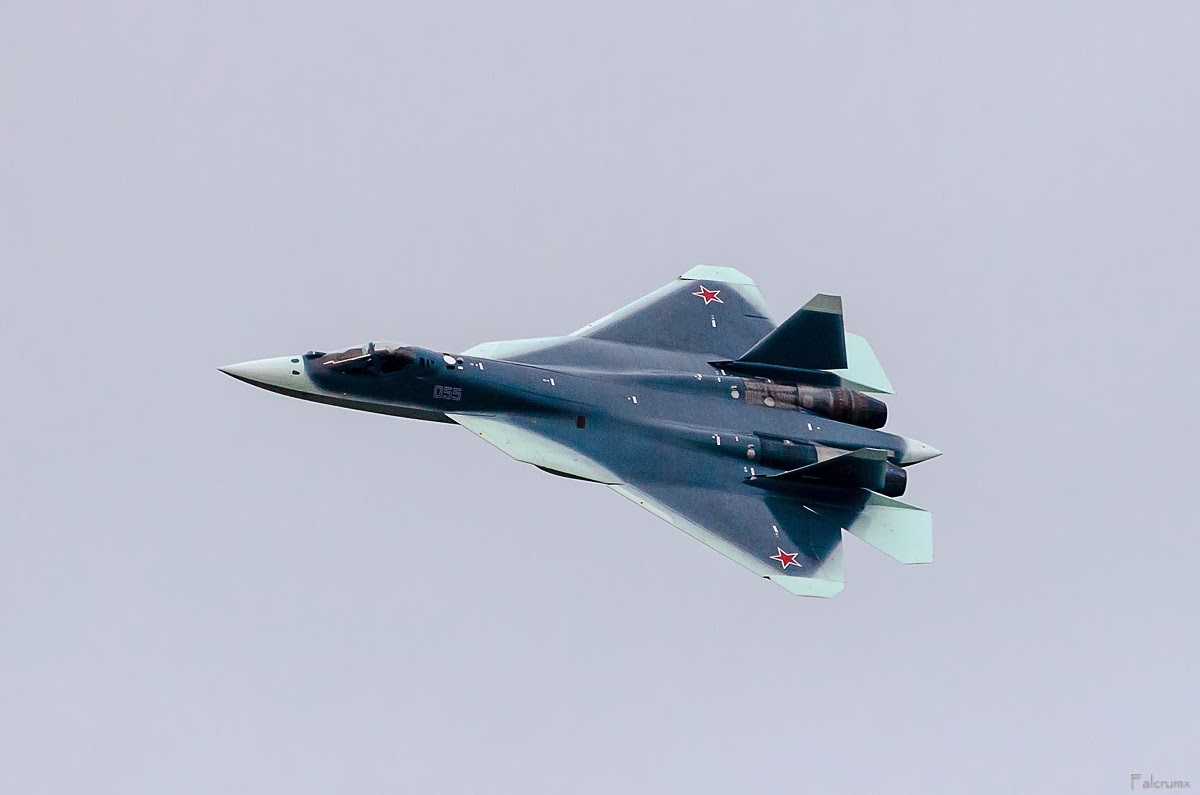
The second circle in the picture is the intake ramp. Used to create shock wave to slow air down.Depending on aircraft speed, they are not always in the down position either.
To be fair though, the ramp would likely be canted down at supercruise speed for pressure recovery
Ok which blueprint do you want this time ? I posted one blueprint. Someone told me that I had to use the prodction blueprint. That is the production blueprint.
So send me on another wild goose chase. What blueprint do you want ?
Look at the blueprint you posted again. The highlight blue area, it is supposed to be the intake throat but it go over the lower lip of the intake.Which is why i said the high light is wrong. The blue print itselft is correct , but your highlight is wrong. Moreover, you should look at the top view blue print of F-23 also, not just the side view one
garryAThe S shaped intake is supposed the shield the engine face from frontal direction, you can draw some very specific line from below the aircraft that can exposed a very small proportion of the jet engine (the only exception probably is the F-35 since it only have 1 engine so hiding the engine face is easier) . However,when direction is from below the whole airframe make up a much larger reflective area in that case. Moreover, the exposed proportion shown in your drawing is the jet engine nose cone, so it will deflect radar wave around the internal intake instead of straight back
the high light of intake sucktion throat dimention is wrong in your drawing too
garryAI already posted the production YF 23 blueprints that show the same amount of engine fan as Pak Fa. So that idea can be scratched.
You mean you posted photo like the one below ? , fan blade are covered by 99% IMHO. Regardless intake bump on F-23EMD was much lower than YF-23 AFAIK
YF-23 blueprints doesn’t mean much, RCS measurement was done on F-23EMD model which is different then YF-23
This ?, seem like F-23 was supposed to have an under nose IRST like F-35
garryAAGAIN!!! Show me where in this post I have made a confrontation between one and the other and not instead between the twotogether, in a same category vs the F-16E (a second one) vs the F-16 A to D and the different versions of the Su-27(third one)
You said there are more different between Su-35 and Su-27 than between F-18C and and F-18E, which is what i disagree with ( and i believed that i have explained why )
The F-16XL and the F-2 are in the same category than Su-35 and F/A-18 E to F because their own frame is greatly or even completely different from the original model.
I can kinda accept that F-2 is in similar category with F-18E and Su-35 in term of change. However, i dont see how you could even put F-16XL in the same basket. Even though, there are many change in F-18E and Su-35, their aerodynamic layout is still the same as the original design ( especially in case of Su-35 with the same wing area ). On the other hand, F-16XL literally have different wing shape and wing area, it even lost the ventral fin. You can deduce CL curve of Su-35 from Su-27 or F-18E from F-18C, the same cant be said about F-16XL and F-16C
For the rest, allow me to use Wikipedia English entry: Technological advancements have produced more compact and lighter hardware, such as the radar, shifting the centre of gravity to the aircraft’s rear. These improvements removed the need for canards and saw the abandonment of the “tandem triplane” featured on several Su-27 derivatives.[33][35] Also omitted was the Su-27’s dorsal airbrake, which was replaced by differential deflection of the vertical stabilizers.[38] Other aerodynamic refinements include a height reduction of the vertical stabilizers, a smaller aft-cockpit hump, and shorter rearward-projecting “sting”.
Now, I don’t know if the abandonement of the canards can be counted in (it’s the Su-35s a direct derivate of Su-27 or is passed through the Su-30 also?) but the dorsal airbrake remotion,the differential deflection of vertical stabilizers and their height reduction made almost three in my book.
It make a very big different depend on what Su-27 model you compare Su-35 with. If you compare the first Su-27 series with Su-35 then i think it only fair for me to compare F-16E and early F-16A.Which mean along with these change i listed earlier, there are also horizontal stabilizor size change, dorsar spine , CFT mounts , station 4/6 wiring , bigger air intake. Later F-16 series also have strengthen landing wheels.
The bottom line is F-16E , Su-35 , Gripen E ..etc even though get alot of change, they are still more or less the derivative of the original version with similar aerodynamic layout, and cant really be considered a completely different aircraft like in F-35 vs F-16 case or F-35B vs Harrier. So to compare their development time is pretty nonsense IMHO
Intakes I don’t know but they seems me just a secondary thing compared to the installation of a new engine with a three axis TVC (that completely change the way to control the plane also)
Fighters get new engine upgrade ways more often than they get intake upgrade
garryALet’s say that while the development that lead from the first F-16 blocks to the block 50 was still an evolutionary one, as the one that lead from the original Su-27 to the SM3, while the E version was a way later enterprise that can effectively be seen as a new plane, like the F-15E was compared to the original Eagle.
Still it’s not IMHO (so to cut all the endless debate) such as deep like it was case of SH or the Su-35 as the frame was modified just in a minor extent.
To reach such a level, let’s look instead to Japanese F-2 or the F-16XL.
I still dont see how Su-27 to Su-35 could be considered having more change than F-18C to F-18E. F-16XL is completely different since it not even the same aerodynamic layout anymore. I still cant find information regarding extended inlet/control surface of su-35
garryALarger Control surfaces.
Larger Air-intakes.
Are you sure about these 2 points ? i haven’t heard about that any where and they look pretty much the same for me
garryAPractically everything applies to the Su-35 vs. Su-27, with the exception of external shape.. the Su-27 already is a large fighter, there was little need to make it even bigger.. that means new engine (Izd.117S vs Al-31F), new radar (Irbis vs N001), added FBW, TVC, glass cockpit, RAM, extra pylons, EW systems, MAWS..
With the exception of TVC and new pylon pretty much everything can be applied to F-16E vs F-16C too
+ glass cockpit
+ MIL-STD-1553 data bus is replaced by MIL-STD-1773 which offer 1000 times increase in data handling capabilities
+ IRST ( from nothing to Falcon Eye )
+ new EW system ( from ASQ-213 to Falcon Edge )
+ new engines ( from F-110 GE-129 to F-110 GE 132)
+ new radar ( from APG-68v9 to APG-80 )
..etc.
If we was to compare F-16E with earlier block 40/42 then there are even more different
garryAActually Su-35 differ from the -27 more than the SH from original F/A-18
I dont think so
Between F-18C and F-18E
_New engine (stronger)
_New wing (bigger)
_New LERX ( much bigger)
_Longer fuselage
_New stabilator (bigger)
_New radar (more powerful)
_New FBW
_New air intake (with radar blocker)
_RAM on various locations
_2 Extra wing pylons
_ different EW systems
I would expect the data bus on F-18E to be different too ( since even F-16E get a different data bus from F-16 block 50/52+)
garryAI don’t know if the Su-35S can carry wetbag on those stations, InFact i haven’t seen Su-35S carry any wetbag on any station before
They scrapped that probably, aircraft with high fuel fraction doesn’t benefit so much from EFT
The Su-35S has a larger air-intake, thus it degrade the top speed performance. But help it increase acelleration
That interesting, are you sure it got bigger intake ? , so they used the same solution as big mouth F-16 as it seem
Pls do not quote JSR. It means i have to read his nonsens.
My bad, will stop.
garryAthose key words are exclusively reserved for Su-35
Not even close.Nothing more than your usual deluded nationalistic attitude
it does. pay attention to news item periodically released
Same top speed, same wing area, same aerodynamic and inlet layout , higher wing loading. It won’t fly higher. You can keep going on and on with your so called keywords and add in your own interpretation of them.But physics won’t change whether you like it or not.
F-16C also carries CFT. nothing special creating a unrefined bulges. I don’t see 900km range increase with 2 ET. all I see is fuel increase not range increase.
If you stop being a morons and start to google the detail in photo, you will see mentioned of range increase.Or at least use some common sense. But as usual, you resort to be a moronic troll instead


 Sign In








