 garryA
Combat load now..:rolleyes: That’s not what he said. But with the SU being a bigger aircraft, it wouldn’t surprise me if it has that covered too. But lets see the data.
I don’t have the numbers in front of me but the SU 30sm has a tighter turning radius than the Raptor. And you can argue about the usefulness of the 3D thrust vectoring all you want. But a jet like the SU 30sm with 3D is simply more maneuverable than the Raptor because of it.
So on one sentence you said let see the data , the next one you said you dont have it ?
garryAIt would be more like 20% incertitude at 5 km range and 1% at 100 km. By virtue of the calculation error on AOA being inversely proportional to range.
I really dont see how can angular accuracy get better with the distance , care to elaborate ?
Not sure how to put it. It is not about computing the difference of motion of the elements relative to emitter, but to exploit its consequences on Doppler shift . This in order to, derive from change in Doppler shift between elements the differentials in radial distance to emitter between those elements.
Are you sure that you are not talking about FDOA ( frequency difference arrival ) ?
Both methods do not care what the emitter does .They both only use the differential in measurements between the array elements of the incident wave property (phase)
I can see that inferiometry method doesnt need to care much what emitter does (assuming pulse from single emitter ) , but i dont see how FDOA doesnt need to care what emitters does, it literally work due to Doppler shift.
. However If both emitter and receiving platform share the very exact same axis of travel, then you will not be able to compute the range , since all elements in the array will have the exact same Doppler shift, hence no change in Doppler shift between any of the elements binoms, making the calculation impossible.
Can you elaborate this part ? what exactly do you mean when you say moving on the same axis
garryAThis is a good paper on the subject : http://ieeexplore.ieee.org/stamp/stamp.jsp?tp=&arnumber=165371
garryAI was talking about bearing accuracy, where incertitude and calculation error weigh more at shorter range than at longer. .
Iam talking abour bearing ( angular ) accuracy too
a 20% angular error at 5 km distance is alot better than 20% angular error at 100 km distance
While elements are on the same platform their radial distances and motions relative to the emitter are different.
Technically speaking if you have 2 receiver on the wing tips , and you keeping yaw left and right , you can have that kind of Doppler shift different , however, i can own see this method working again a stationary emitters , because if you known the emitter is stationary , you know your own speed and you know your yaw rate then technically speaking you will know how much Doppler shift will be induced due to motion of each wing tip. All of these estimation go out of windows if the emitters also moving at an unknown speed ( even worse if it is accelerating or decelerating ).
And to be fair , you probably need several platforms (long baseline) if you want high accuracy for this method ( kinda similar to TDOA )
The Doppler phase interference method ( I think it is its name, or something alike ) exploit the differential in Doppler shift resulting from difference in radial motion relative to emitter, between the elements of the array to compute the range .
Iam quite certain that what you thinking about is Doppler difference of arrival

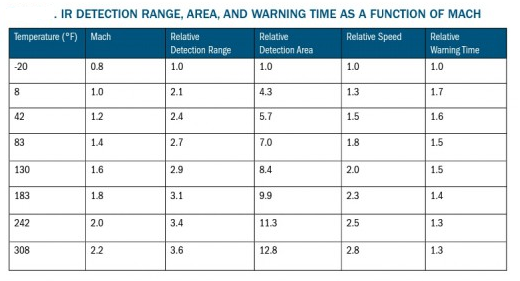
garryAWhat causes this peak in transsonic? Wouldn’t that involve the use of AB in transsonic by chance? .
The chart literally only mentioned skin temperature
The F-35 would also probably go supersonic to launch. The ability to be capable of mach 1.6 and the focus on transsonic acceleration is not there for nothing.
F-35 wont face stealth aircraft all the time either
garryABoth radar and RWR loose accuracy at short range ( calculation error depending on inverse of range distance) ,.
I think you got this mixed up , both radar and RWR will have better accuracy at shorter range
For angular accuracy of radar , obviously the shorter the range , the smaller your resolution cell would be
Range resolution of radar depending on pulse width , shorter pulse give better resolution , so i dont see how its accuracy would decrease as distance get shorter.
The method , is about computing range without factoring light speed , to get less uncertain results.
It is not attempting to measure the Doppler shift of the signal as such , but rather the relative changes in Doppler shift between each antenna elements .
In short, or rather schematically .The phase measured on an element has 2 possible origin : the AOA and eventual Doppler shift on that element. Remove AOA and you end up with Doppler shift change between elements .From this, you can calculate the relative differences in radial distance to emitter between the elements. Knowing the AOA it allows to compute the radial distance to emitter, without having to factor speed of light notalby.
but how can you have the change in Doppler shift between different antenna element if those elements are all on the same platform ?. If you thinking about making some waving maneuver to see the change in Doppler shift then again that would require the operating frequency of the emitter to be constant. If you are talking about using Frequency Difference of Arrival (FDOA) then again that method would require emitter to be stationary or moving along a straigth line with constant speed.
garryAI disagree, going superfast will indeed result in a very high IR signature, flying at about mach 1.4 would not,
It really up to your definition of very high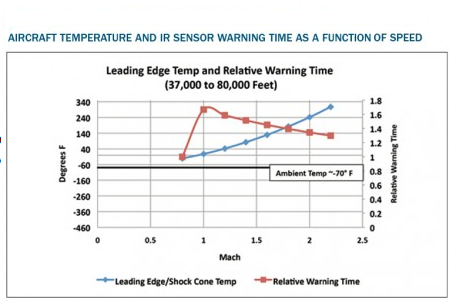
garryAThe canard is higher than the wing, in producing downforce, airflow under the canard speeds up, that air then passes over the wing increasing lift and also reducing separation and the work that needs to be done by the wing itself.
Fair point i guess
garryANo . The technic I am talking about yields an instantaneous direction and more or less accurate range, via measurement of the incident signal instantaneous phase differences at each antenna elements (Delta PHI) of a phase interferometry antenna array.
The phase interferometry Direction Finding method give the incident signal Angle of Arrival using the phase differences measured at each antenna elements and some trigonometric (AOA= f(Delta Phi)) .
From there , the Doppler shift at each elements is calculated and used to compute the differential in radial distance to emitter (Delta r), between each antenna elements (Delta r=f( Delta Phi, AOA, ReceiverElementSpeed )).
The combination gives both direction: AOA and the radial distance to emitter :r on a single measurement (r=f(Delta r, AOA)). .
I know how an inferormetry work , finding direction with it should be simple , monopulse radar use the same principle to improve their angular accuracy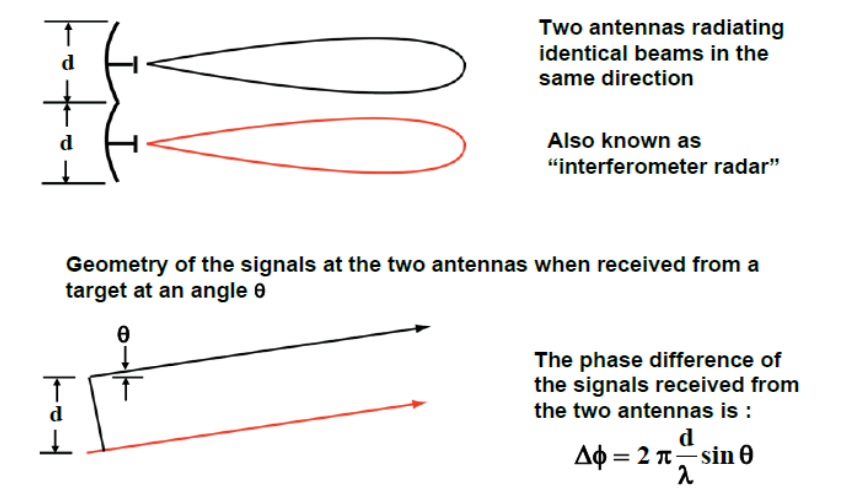
But i dont see how you can deduce range to target through doppler processing at difference receivers , given that all receivers are on the same platform , they would literally move at the same speed , hence create same Doppler shift. Unless you are talking about long baseline Interferormetry with receiver on different aircrafts several miles apart. In which case , shouldnt triangulation be a simpler solution ?. Moreover, if you dont know the transmitted frequency ( before Doppler shift ) then how can you deduce emitter speed ?
Nevertheless the calculation error in AOA ,Doppler shift and ultimately range is related to wave length and the inverse of radial distance to emitter ( Hence it works better at longer rather than shorter range ). More significantly the calculation errors are independent of the emitter and receiver speed and direction or even changes in those.
.
Iam honest dont see how that possible that Doppler processing could be independence of speed or direction
garryAIt’s exactly why there is an improvement, because of control authority of the design. That, and automated flight computers keeping it stable.
Think how easy it would be to tail slide and flip end for end without control authority to hold your CLmax
There is improvement due to vortex too IMHO , just like LERX
garryAWell, its possible, but very debatable. I would be willing to accept a close couple canard would add to Clmax automatically, but on Typhoon, canards are just too far away to provide a meaningful vortex at high AOA.
.
I been thinking about this for a bit , since we know that CL increase with AoA ( to a certain point )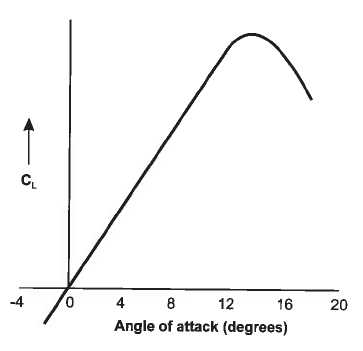
Is there any chance the canard on Typhoon improve CLmax over Mirage design simply because it allow the Typhoon to be controlable at higher AoA ?
So MiG-21 has Clmax of 1,25
How come CL for Mig-21 wing configuration is so high compared to Mirage 2000? , they both use delta wing , both has tube body ?
Increase given by negative stability to calculate effective Clmax of entire airframe (not only the airfoil) is 3-5%
Shouldnt this depending on the size of their stabilizers and wing configuration as well ? , like for example i dont see the point of making canard aircraft negative stable
garryA…and the APG-77 itself can be detected and tracked from even even longer distance by RWR
Then again radar provide you with distance , target velocity , heading , altitude (aka firing solution ), an RWR provide you with bearing only in most case
Hmmm… welllll, that logically means the F-22 is practically dead meat versus the T-50.. (?) and needs F-35s for its protection
Unless F-22 get IRST in future then yes , it will need something to help it locate stealth aircraft.
garryAErrrr.. so once again.. you say that at M1.8 the aircraft has 10x frontal aspect signature compared to an aircraft at M0.8 which means the speed of F-22A is useless versus the F-35 equipped with EOTS or DAS. At the same time, you claim it is still better for bullying 4+ gen fighters, which, purely coincidentally, too are equipped with IRST. In other words, an IRST installed on an Su-35 can’t see it but the same sensor works just great when installed on the F-35.. A fabulous logic, indeed.. 🙂
IRST on 4++ fighter work well too , but themselves have very high RCS , especially in war configuration , so even though they can see F-22 from apar , they can be detected , tracked , targeted by APG-77 from even longer distance.
garryAImpossible… I will explain why..
– an external installation of a podded FLIR would be immediately visible and would require a gimbal mount, complete rewiring and installation of a image output channel in the cockpit (usually an LCD display). Syrians are completely incapable of doing such upgrades, let alone in field conditions.
– using night vision goggles is impossible as neither SyAAF aircraft nor helicopters have NVG compatible lighting.. diodes and dials in their cockpits emit light at various frequencies and this light is getting amplified by the image intensifier tubes (system amplification of over 5,000 times with Gen3 tubes).. the automatic brightness control of the tubes has to constantly adapt to this light which means 1. you can’t see sh!t outside.. 2 . your tubes are experiencing burns, blemishes and other damage
– temporarily using a handheld thermal imager is impossible because it can’t see through glass – Syrian crews would have to fly with open cockpits 🙂In short, this option is BS..
Iam not saying that it must have happened , only said that it is possible option , at the moment we dont have enough evidence to conclude anything.Anyways i dont think the M-24 has load of light and diodes in the cockpit though
garryANo I am talking about using the doppler changing rate equation, to measure the radial distance between emitter and receiver. .
You mean this one ( the last one ) ?
Iam quite certain that for this method you need the operating frequency of the threat radar to be constant for it to work ( and the threat platform need to move at a constant velocity too )


 Sign In







