Apparently a Beech C45 crashed near there in 1967… Google is your friend!
http://sussexhistoryforum.co.uk/index.php?topic=1827.0
Also, on April 14th, 1939 a Sgt George William Read lost his life in Hawker Hart K4431 near Stroud Hill Farm, nearby. The part however does not seem to belong to a Hart?
Is there something you can put on the seals
230 Volts
Shackleton did not fly until the early 1950s………….!!!
March 9th, 1949 is not the early 1950s.
What exactly was the ‘deal’ for the RAF Museum; a seventeen year loan (followed by an option for another seventeen years)? What was in it for the RAF Museum; apart from free storage of an exhibit that there wasn’t room for after it was donated by Spain?
I’d like to see it back in the RAF Museum; it would be a great addition to the Battle-of-Britain hall (if that hall wasn’t being emptied)…
If I remember correctly when it was sent across the Channel in 1991 it received a 2,000 hour maintenance/restoration job including corrosion treatment and a repaint. It has since been on indoor display in a controlled environment, free of charge and well cared for. Which in itself must be a bonus for the RAF Museum. IIRC the RAF Museum also received a considerable number of components from various crash site recoveries to aid ongoing restorations, in return.
Whilst I understand your sentiments re keeping it in the UK, it tells a very important story in the Netherlands. That of the 37 Dorniers in active MLD service before and during World War II in the East Indies. Amongst the many deployments they had, was one to aid the British Armed Forces in the defence of Singapore in December 1941, the evacuation of many hundreds of refugees (both military and civilian) to Australia who went on to fight for the Commonwealth forces from there, and five Do’s serving as a seperate unit in the RAAF (and a sixth on clandestine ops to New Guinea, this being the aircraft represented in the current colour scheme). I would say that as far as British history is concerned, its current location is a very fitting one to tell a story or two…

Apart from the Typhoon is this the first foreign RAFM long term loan?
The Dornier Do24 has been loaned out to the Militaire Luchtvaart Museum (and now its successor Nationaal Militair Museum) at Soesterberg for so long now, people have probably forgotten it is still part of the RAF Museum collection…
Summer 1966 I would say. The L749 (OE-IFE) was broken up for scrap in August that year apparently.
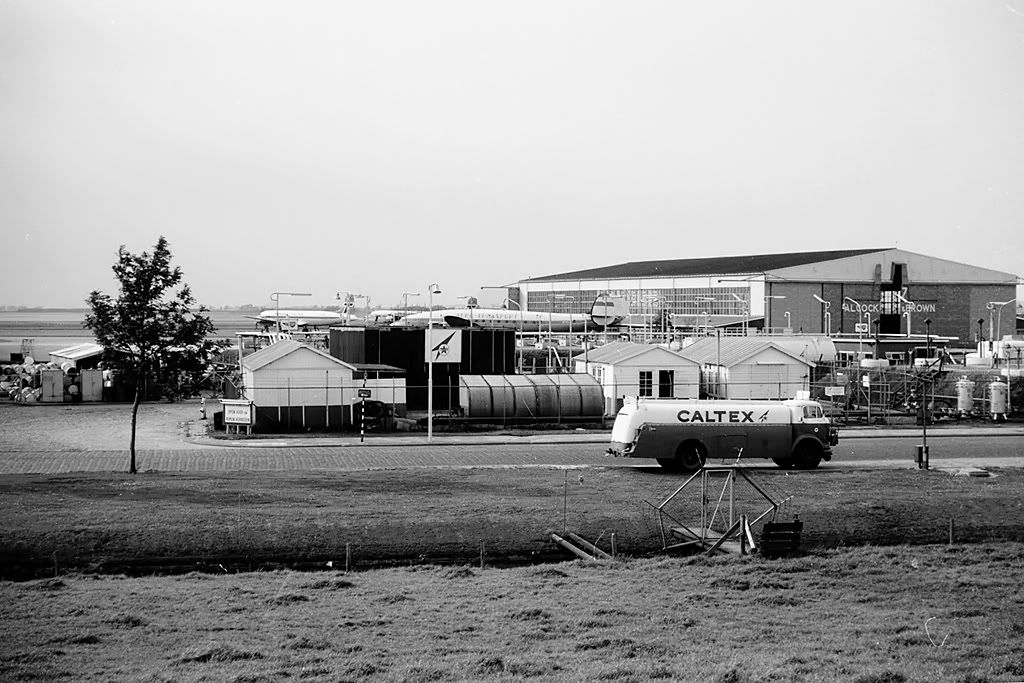
So was Hangar 7 originally the hangar named ‘Hebrides’? It certainly looks like a wartime T2 with modifications, including large side windows.
It was. See https://www.flightglobal.com/FlightPDFArchive/1949/1949%20-%200263.PDF (1949) for a picture when it was reerected at Schiphol. It was renamed at the introduction of the numbering of the hangars later on.
At least some hangars at Schphol are named after aviation pioneers, I think. Current examples include Hangar 10 “Albert Plesman” and Hangar 14 “Leonardo da Vinci”.
It was indeed the hangar’s name.
The DC-7s almost all made it out to fly with new owners. Several of them still exist. The L1049s parked outside the hangar had just been cocooned in the hope of selling them later. Most of them however were later broken up for scrap.
Hangar 7 was torn down in – I believe – the very late 1980s to make room for a new KLM superhangar.
From the very reliable SGLO database:
http://verliesregister.studiegroepluchtoorlog.nl/item2.php?PN=KG417
And a September 12th, 1944 aerial view here: http://www.geldersarchief.nl/zoeken/?mistart=0&mivast=37&mizig=284&miadt=37&milang=nl&misort=last_mod|desc&miview=gal1&mizk_alle=Driel&mibj=1943&miej=1945
Bottom left corner the old brick works at Driel, then moving diagonally to the RH top of the picture there is the Janssen homestead called “Zeldenrust”, the light square would seem to be the football pitch mentioned in several reports. High centre of the photo is the ferry crossing. The works, homestead and football pitch all were demolished in the 1960s to make way for a pass-by channel for the locks installed at the time. There is a good chance the crash site could either have been where the current canal is, or might just still be on the current canal bank (southern bank the the Rhine).
The database in the above link also holds a considerable number of aerial photos taken early 1945.
The last UK Westland Widgeon (monoplane) met it’s end when it escaped and flew into a hangar.
John
A few years ago I was witness to an aircraft escaping out of a hangar through the opened doors flying into a line of trees. Not even nesting season that day either.
Lancs had escape hatches in the nose and canopy. Kinda silly to try to bail out by climbing back over the spar.
Not very silly if the aircraft in question was on fire, out of control, with high G-forces. The nearest exit is not always accessible, or even the easiest way to get out…
And the D VII is in Germany, wasn’t there a dispute a few years ago about it being a Dutch owned example being “stolen” by Hermann G. himself?
Cees
I seem to recall a similar story, but couldn’t find a source just now…
Continental treasures were lost too, mostly around WW2. The early collection of aircraft stored for the planned museum At Schiphol was partially destroyed in German bombardments in May 1940 (a Fokker F.VII among them). Surviving aircraft (including a D.VII and freshly captured G.I, D.XXI and Douglas 8A) were carried off to the museum at Berlin (which itself was destroyed late in the war, a story in itself). The only aircraft to survive was the only original Fokker Spin, which came back to The Netherlands via Poland eventually and is now displayed in Lelystad.
Yes, the one-piece wooden wing is great for strength, but worthless for economical repairs (although from an engineering point of view the repairs are usually pretty basic stuff, just very timeconsuming). Also one of the reasons why Fokker’s pre-war designs went out of date very fast. Any wing damage was very labour intensive to repair, and with the out-of-date Aerovans it was just not worthwhile either I would think. Would you happen to know if they were old school wooden spar and ply, or the fancier monocoque sandwich skin wing with stringers? Just interested…