 eagle
eagleI think a public vote is mandatory if enough citizens ask for a referendum. My take is that a sizeable proportion of the electorate will object to any proposed replacement, sufficient (is it 200,000? – don’t remember) to trigger a referendum.
The Swiss direct democracy basically knows 3 different public votes:
– Mandatory referendum for constitutional changes. A fighter procurement is not written into the constitution so there won’t be a mandatory referendum.
– Optional referendum. This is applicable to federal laws only and only 50,000 signatures are required. But this of course requires the fighter procurement to be written into a federal law which is by no means necessary. It was done this way for the Gripen, i.e. a law at federal level was enacted by then MoD Maurer shifting money from the regular budget into a fund so an optional referendum could be had about the installation of that fund. If there is no federal law f.e. if the money for the jets comes from the regular defence budget, an optional referendum is… not an option.
– Initiative. I quote from wiki: “The federal popular initiative is an instrument of direct democracy in Switzerland. It allows citizens to propose changes to the Swiss Federal Constitution. A votation will be organised for every modification that collected 100,000 valid signatures in 18 months.” This will be the only option if there is no special law. That would mean someone needs to collect those 100,000 signatures (easily done if you ask me) and then there will be a vote whether we want an article in our constition that forbids the government to buy fighter jets… If accepted, and that is by no means a done deal (“A double majority of people and cantons [the 26 member states of Switzerland] is required to change the constitution.”), that would be quite something. I’m not sure what the legal implications of such a vote would be. Like f.e. if there would be a way for the government to bypass the law for national security reasons or something like that. Or if it’s even possible to deal with such a technical matter on a constitutional level.
Personally, I think matters like that don’t belong into the constitution and the gov. should be able to spend the allocated defence budget however it thinks is right. The population must have a say in general defence matters of course, like whether to have armed forces or not, but the way the armed forces are organised/equipped is not something for average joe to decide. Unfortuantely, the precedent has been set in the past with the vote in 93 about the Hornet and 2012 about the Gripen so average joe is under the impression every fighter procurement requires an automatic vote. The media has done little to enlighten the people.
End of excursion into Swiss politics. 🙂
eagleNice pictures.
Here with the new old outer wing pylons: https://twitter.com/MbKS15/status/798799900607528960
For the first time in flight and with stores I think.
eagleWhen the Canadians purchased the F-18 the other contender was the F-16. Even in 1979 the Canadians did not exclude single engine aircraft from the competition.
The other contender? F-14, F-15, F-18L, Mirages and Tornado were in the race aswell, at least initially.
2 engines was I think one the main reasons the Hornet was chosen over the F-16 in the end. Late 70s was a different time though.
eagleWhy would you replace 30+ upgraded Hornets with some Rafale. It doesn’t make much sense unless we talk about a much upgraded block.
If Rafale is let in as a favorite as you suggest, it will have to bring-in something radical with its cost.
Because the Hornets are getting old and will have run out of flight hours in 2030. If the Rafale wins the next eval. it will replace the Hornets no matter how advanced they might be.
On the other hand Rafale sales to India and those ME countries I keep forgetting the names of, may lower Rafale costs somewhat as well.
On verra.
Knowing the French they will increase the price. 1st because they’re not as desperate for exports anymore and 2nd because they want to punish the Swiss for having chosen the wrong i.e. non-French plane twice in a row. 😉
eagleFrom looking at those pictures of the F-35s stationned on the amphib carrier, it looks like the F-35 has a relatively large wingspan. With folding wings, the carrier could have carried more. Maybe if the wing had folded after the first wing pylons, it would have been a good compromise. There would have been just one light station outboard for the AIM-9X. Maybe the LHAs/LHDs could have carried about 4 more planes in aircraft carrier configuration. Depends if they want to use their amphibs as carriers regularly I guess, and it they want to use them in stealth configuration most of the time.
I can think of several reasons contra folding wings:
– Cost, obviously.
– Weight, the F-35B has very small weight margins. Remember SWAT.
– Not much to gain. Look at this nice picture, the wings would fold just outside the outer A/G pylons reducing span by maybe 1.7 m.
eagleThe F/A 18 C / D had been officially supplied from US since 1995 without the capabilities to attack the ground or sea targets even though it were equipped with the APG 73 radar, since that has been replaced the APG 65 in the early F/A 18 , as well as the attack capability has been officially introduced in the F/A 18 C/D from Finland as far I know in the early 2000s.
APG-65 or -73 does not matter, all Hornet variants are very well capable to attack ground and sea targets.
A/G capability for Finnish Hornets was introduced only recently iirc.
eagleIf Rafale were chosen to replace the F-18, that still leaves the need to replace F-5. I can’t see the Swiss public accepting the expense of Rafale replacing F-5.
The public doesn’t necessarily have a say about what is an acceptable replacement. A public vote is not mandatory. Besides, the public didn’t accept Gripen as an F-5 replacement either when asked about it, so…
The Swiss air force might has well go directly to SAAB and give them the contract. The other two are there to make SAAB run for it.
I don’t think so. It’s between Rafale and Gripen, F-35 and EF are not likely, imho.
eagleBring
Another alternative, the USAF could simply upgrade two hundred Vipers and keep them on their sqn´s for (roughly) three more years into the late thirties and divert two hundred F-35A´s to replace the C/D Eagles. It would be vastly cheaper, the Viper airframes are a lot younger and are much cheaper to upgrade.
But aren’t the first Block 40/50 F-16s approaching 8,000 hours, like the F-15Cs? Younger doesn’t mean less flight hours…
Apart from that, F-16 or F-35 can’t do everything the F-15 can do.
eagleWhile I agree that ship-borne aircrafts generally feature some sort of high lift devices, not all of them carry the same level of weight/cost penalty as the swing wing. Look at Rafale-M, which almost exclusively relies on its low wing loading to achieve low speed performance.
As mentioned, the canards are key. But still the Rafale has a pretty high AoA at landing speeds and consequently its nose is rather small for visibility reasons. That would not have been an option if you must carry the AWG-9.
eagleSelling some spares is not the same as selling fighter jets.
You don’t know whether I was born then. And no, they certainly don’t teach at school who sold F-4 spares to whom during the Iran/Iraq war. Not here anyway. Sadly, that war, like basically all that aren’t WWI or WWII or very recent ones, are mostly ignored.
eagleThe US had to cut the Lavi program, the Lavi would have wiped out F-16 sales as no one wants to buy from the embargo-happy US and Israel will sell to anybody including their own enemies. To answer the main question, I think that Chinese fighters would be close to equal to the Lavi or any other 4th gen FBW fighter. People here seem to assume that the eurocanards and F-16 are far in advance aerodynamically, but I dont see it, I think its easier to make a good FBW fighter than most people here are willing to admit.
You realise the Lavi used the PW1120 engine. You know, as in Pratt & Whitney, the US manufacturer.
And do you really think the Israeli would have sold the Lavi to Arab countries or Iran? Not that they would buy anything from Israel, but seriously, get a reality check.
eagleWell, there is some indication of the CG shift, as the glove vanes were deleted in the D model. Partially it was dictated by lower cost of maintenance, but they were also deemed unnecessary for pure aerodynamic reasons.
Well yes, not the glove vanes were deemed unnecessary per se, but the performance they allowed for was no longer required. F.e., the F-14A could pull 7.5G at Mach 2 with the help of the glove vanes. The F-14D could not. If the F-14D would have been required to have the same performance, the glove vanes would have remained. Lower maintenance cost was more important.
Btw. the F-14A manual says maneuver devices on AUTO, F-14D has them disabled. That might have some negative effect.
eagleI was actually not aware of the 303F and Im surprised it performed so poorly compared to the swing wing version although my idea of a fixed wing F-14 would be freezing the wing geometry at mid sweep. Of course part of the idea of VG wings is to compensate for shifting CoL, especially at high speed. But I think that idea has been found to be a non-issue as the drag reduction for super sonic cruise by reducing tail surface downforce has been negligible. So my thought is that an F-14 with wings fixed at mid sweep would would work just as well as the full swing wing design, similar to how the wing angle is set to a stationary angle on a mig-23 for maximum manoeuvrability.
No, it wouldn’t work at all. An F-14 with fixed wings at mid sweep would neither be able to take-off and land on a carrier nor would it have acceptable supersonic performance. In other words it would be completely useless.
Swing wings were a great solution to get high performance and good low speed handling required for carrier ops. The reason swing wings have gone out of fashion is not because of aerodynamic performance but complexity and cost (and stealth nowadays). It also limits the life of an aircraft, though thats not an issue for a carrier jet as its life is limited by the number of landings anyway.
Look at all the carrier borne fighters. All the high performance fleet defenders had some sort of high lift device. F-8 had adjustable wings, F-4 had boundary layer control, F-14 had swing wings. F-18 and F-35 have nothing and consequently their supersonic performance is poor. A fixed wing F-14 would have required some other high lift device, as the book says. Either that or give up on state of the art kinematics and go the F-18E/F route.
eagleSomehow I doubt that. They would have to close Büchel and Jagel air bases plus end the nuclear sharing program.
On a lighter note: A GAF wing of around 30 jets seems to be 100% busy with QRA duty. With only 3 operational EF wings, 2 would be responsible for QRA North resp. South, leaving 1 wing to do all the A/G and recce work. That is of course impossible as one wing can’t handle so many different roles. :very_drunk:
eagleThe PAK-FA is like a woman with a perfect body but a plain face. It has all the right shapes but it’s lacking in details like the canopy f.e. Clear win for the Rafale. I don’t mind the fixed probe. Kinda like Cindy Crawfords beauty spot.
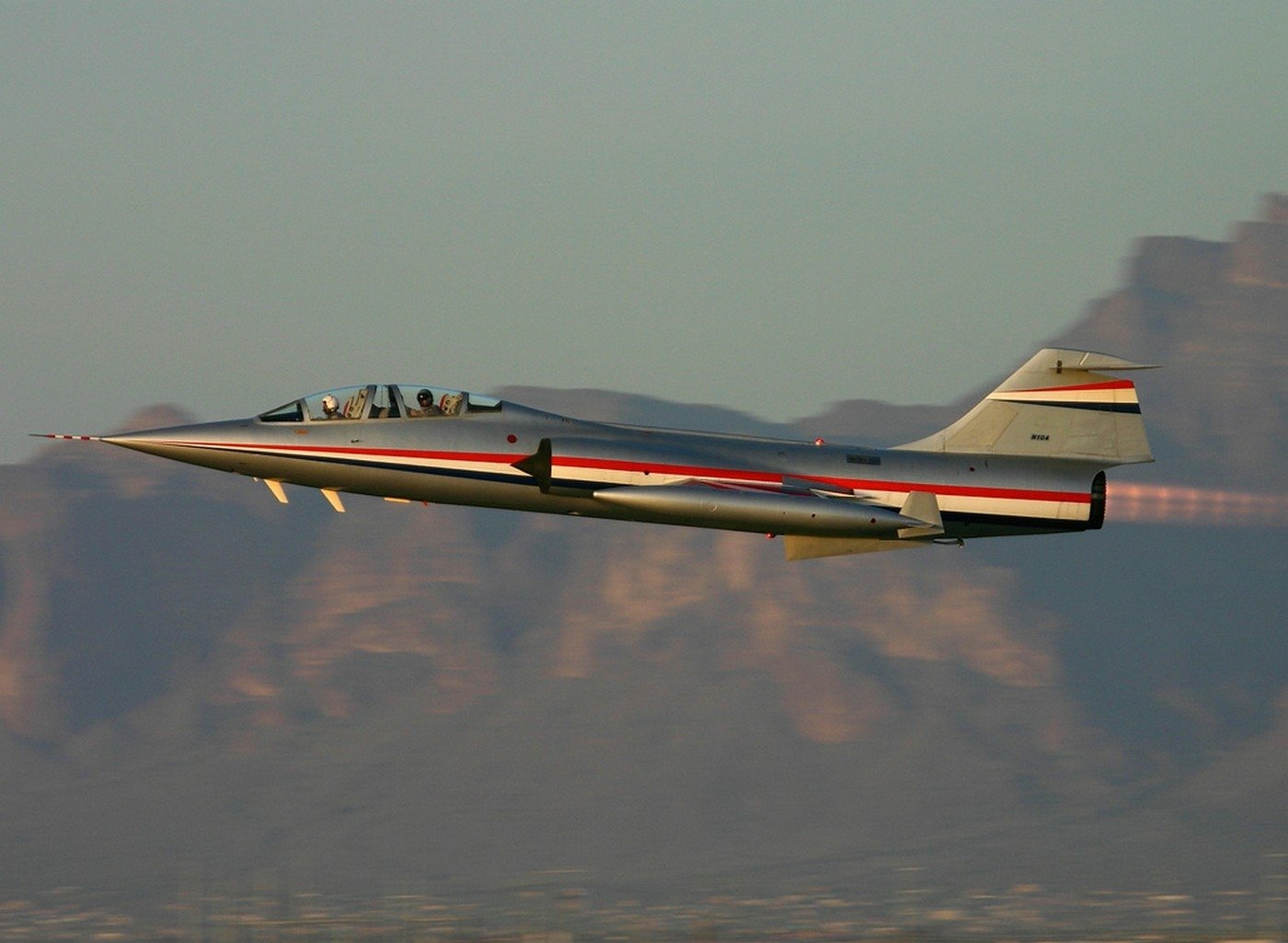
But what about the Starfighter? Not mentioned so far, what’s wrong with this forum?
A shame there aren’t many good pics…





 Sign In








