 mig-31bm
We don’t know that… Frankly, the NAVY guys did not seem to be impressed. If the system really was able to surpass legacy jammers, let alone by a margin that you’re trying to imply, he would have chosen a different wording, IMO
He say it not compatible to NGJ and a purpose buit AESA jammer will be better than an AESA radar that have secondary mode as a jammer, which is obvious.
The emitters usually are far apart. What sense would it make to put two or more in the same place?
This is what people often think of when they talk about how spreading aircraft formation apart will easily negate VLO aircraft detection advantage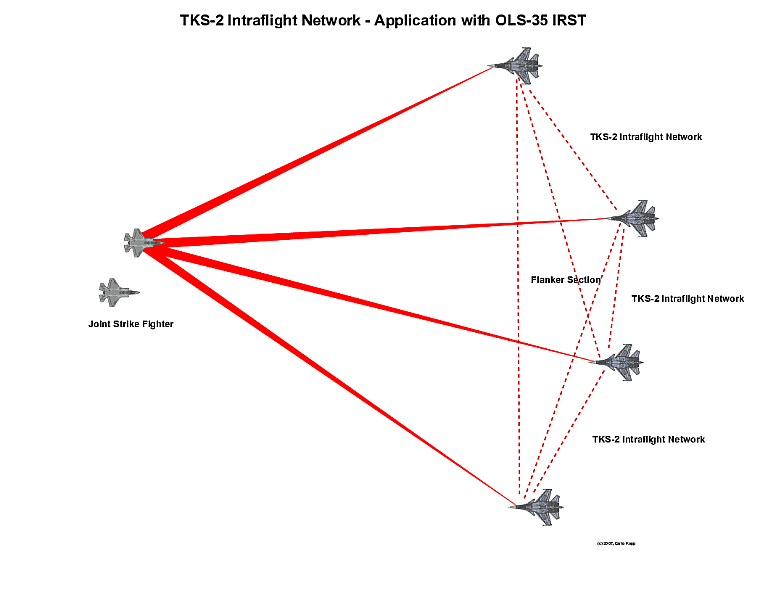
the problem is they dont understand how far apart emitters have to be to negate detection advantage of stealth aircraft.
draw a triangle and you will see. if you want to stay out of the 80 degree frontal cone of stealth enemy , your emitters will have to stay about 424 km from others for 300 km detection range, emitters have to stay 285 km from others if you want to detect stealth fighter from 200 km. Even for 100 km detection range your emitters have to stay 141 km from others
http://www.cleavebooks.co.uk/scol/calrtri.htm
It not so easy to position your fighters that way, and then there another problem, since you dont know where the direction VLO enemies come from before the mission, side to side position your fighter isn’t enough, you will have to position them something look like a square formation. Not only that doing so very hard , it also spread your force apart thus make them more vulnerable
Maybe.. but so far it has paid off.. practically every too-good-to-be-true claim made by LM which I refused to believe turned out being BS, in the end..
Can you listed them
Not talking about RWR rather than systems like SPECTRA or Himalaya or whatever China is going to field on J-20/J-31..
SPECTRA, Himalayas, ALR-94, ASQ-213, ASQ-239… etc whatever are basically all RWR ( you can call them ESM if you want but here we are talking about the passive components ) , they are indeed very modern, alot more sensitive, cover much wider range of frequencies and alot more accurate than previous generation of RWR, but there are some limitations that they still have to share with previous gen RWR due to simple fact that they are still passive system, just like even the most modern IRST still have some limitations that similar to legacy IRST system ( why RWR cant really be used to give firing solutions again moving airborne target have been explained many times before, i dont think it is necessary to repost them again)
mig-31bmAs already said, in Russian the term radiolocator = radar. I don’t know what is there more to explain.
well Google translate say otherwise
anyways let be honest, how often do you see people use the term radio locator ? , i been in discussion with Russian members before, not once they do use that term. And i dont think Grym doesn’t know the word radar either, he just want to use long phase ( that not ecen technical term) because he some how think that make him sound more ” academic ” . To be fair, i wouldn’t be so annoyed if he actually understands what he talking about, but no :p even basic concepts seem so hard for him to grab
Excellent, so we can finally agree on this being nothing revolutionary.. 🙂
it is an after though in the sense that APG-81 wasn’t designed to be a jammer at the start, at start they only intended to make it as a radar, and latter they realise AESA have great potential in jamming capabilities
it is revolutionary in the sense that it can provides 10 times more jamming power than legacy fighter carrying jamming pod
I can imagine that there are scattering RCS graphs available so that the pilots are aware of which angles to prefer and which ones to avoid.. But once there are two or more emitters in the location, this makes no sense, anymore.. In that case, the fighter with the lowest average RCS has the edge.
well, No these emmiter have to be really far apart to actually get into the high RCS spike of stealth fighter, stealth design have pretty low RCS in frontal cone ( around 70-80 degree in azimuth frontal)
I have limited belief in what the makers have to say.. Usually the verifyable data is accurate, even if taken out of context.. the comparative statements are overrated..
well unless you have actual access to the airframe there isn’t a way to vertify the data though
And I don’t trust almost anything coming from LM as they are full of “better than anything else” crap.
that is quite bias dont you think :rolleyes:
That sounds quite dangerous, IMHO. While the aircraft in question might get jammed effectively, for the others the F-35 becomes a nice fat target emitting at full power.
RWR cant really provide firing solutions again moving airborne target as i explained several times before
in theory, the F-35 doing jamming can be attacked by HoJ missiles , however missiles launches in HOJ mode doesn’t have information like range, speed, aspect angle of enemy thus they cant be loft but have to fly direct path
, they cant do lead intercept thus their range and PK is very low
another thing HOJ missiles can be defeated by having 2 or more F-35 take turn jamming
mig-31bmComputer simulation by whom, the student?
simulation by these people below 😉 they sure have more knowledge in the field than people like you
and no they didnt do it just for fun 😉
it interesting to see that, even without any RAM, and the entired airframe are treated as fully reflected metal surface , VLO design still able to achieved RCS of around -20 to – 30dBsm at 70-80 degree frontal cone ( when the observation frequency is 10-12 Ghz)
JASSM, actual cruise missile?
JASSM is 5.4 times less ranged than actual cruise missile, 2 times less if we use the JASSM-ER.
LOL , you claim that you read alot and you dont even know what a cruise missiles mean :highly_amused:
https://en.wikipedia.org/wiki/Cruise_missile
B-2, as of this moment, is devoid of any nuclear stand-off cruise missile capability. The only useful item with some weight in aerial confrontations between world-level power
you just said your self that stealth offer no detection and engagement advantage with the appearance of AWACs and IADS , and now you say B-2 have some weight in aerial confontation :rolleyes: LOL
I read and understand far more than you, which is plainly evident.
No you dont , you fail to understand even the most basic definition , which is very funny i have to say :highly_amused:
One more time.
To jam a a radar, a certain threshold density must be attained. If you not attain, radar will continue to extract your position from the noise. It not matter how radar reflection density is, only the jamming signal noise to radar signal ratio.
It that simple. To maintain same jamming density to prevent extraction of position, at twice the range, you need the square amount of the number of jamming platform.
I do not see the hardness of yours understanding this.
i will be honest , argue with you is like talking to a wall
do you actually understand any words you said ? , or you just see these phrase in a book and decided that repeating it will make you sound smart ?
the threshold you talk about is signal to noise ratio ! , when radar signal density > noise density ( jamming signal ) then the radar can still function , when the radar signal < noise ( jamming signal ) then the radar cannot exact the position of enemy’s aircraft , end of story . The radar signal density we talking about here is the reflection density ( why ? because that how radar work , it send out a pulse and wait for that pulse to reflect back )
Interesting statement by Hostage.
cherry pick information much :rolleyes:
I could have told you that myself
hahahaha
i knew it , when a claim come from someone in Russia , it is professional statement , must be trusted without any doubt , but when a USAF general said something , it have no weight at all , a claim of an internet no body like you will have as much weight :highly_amused:
B-2 was designed to by highly stealth against Soviet IADS, but now it fly low:applause:
really ? evidence ?
the only thing you provided is this
Soviet Forces and Capabilities for Strategic Nuclear Conflict Through the Year 2000″ pag. 367
“In the coming decade ,however, Soviet Strategic air defense will be much more capable to engagé low altitude vehicles. As a result penetration by currently deployed US bombers will become much more difficult in particular in the heavily defended western URSS.
If the B2 bomber and advanced cruise missiles achieve the desired level of reduced observability, using tactics appropriate to stealth vehicles they probably would be capable to penetrate most of the Soviet Union at low altitude. The capabilities of Soviet air defenses will place some limitations on operations of the B2.
according to what you said , it is a declassified document from CIA the information inside it is also super vague , and only prediction for next decade , if stealth trully offer no advantage again modern IADS like you said then why the document only mentioned B-2 and cruise missiles ?why not B-1 ? and aircraft was designed to fly at low altitude ? and do you know how long from the day a classified document is written until when it can be declassified ? very long , i told you , information available to CIA at that times about Russia IADS will be alot less than information available to themnow ,Gen Hostage statement is alot more valid , for the simple fact that it newer , as the time past by they can acquired alot more intel about enemy
mig-31bmSo amusing that you always center yours argument over me being a fanboy, I have not once said that Russia AFAR so superior and make USAF ask for mommy.
I despise the fanboy of both sides, JSR was the true pain to read.
:rolleyes: , i call you a fan boy because you take anything coming from Russia as fact while consider anything coming from USAF or LM as imagination or advertising
I never once the said that frontal RCS is the .4-.5 m2, I cite the average RCS. In the realistic combat scenario, you will never achieve the .001 RCS claim.
i already explained why the average RCS is useless without knowing where the spike located or how high they are
Do not know where you got claim of the reduction of range by 6.25% From which document
:rolleyes: oh i thought you read a lot of book ? :rolleyes: and you dont even know the radar equation ? the most basic thing ? :rolleyes: ( hint : 10 times reduction in RCS reduce detection range by 44% )
Yes, mig-31bm, group of the F-16/15 WITH AWACS do indeed deny the detection advantage, engagement with the AWACS or without is like the day and dark
.
:rolleyes: USAF did use E-2 and E-3 in exercise again F-22 , and they still unable to detect it , oh i know , only AWACs from Russia have ability to detect stealth aircraft :rolleyes: am i right ?
Wide-angle sensor array also do the work of denying, meaning the other fighter have to have huge detection range advantage, truly monstrous array, with serious kinematic performance.
monstrous array :rolleyes: yeah sure , only a few hundred times less powerful than ground radar that VLO aircraft was designed to hide from
And indeed, against the sophisticated IADS, stealth pose no advantage, rather disadvantage as it increase the price, which decrease number of available platforms
:rolleyes: USAF must be so dumb to spend a huge amount of money on F-35 , even dumber that all their future design such as LRS-B and 6 gen all included stealth characteristic :rolleyes: wait , they are not the only one , China also do the same :rolleyes: , even Russian , India , Japan , Korea , ..etc all buy or making stealth design for future :rolleyes: what a bunch of idiot , they didnt realise that VLO are useless again AWACs and modern IADS like you do :rolleyes: may be you should go tell them , your valuable in sight will be greatly appreciated :applause:
You see how B-2 was modified for low flight, when the USAF realize the stealth no work, even at long distances against S-300 elements.
I am proud of you for making connection. Good job
B-2 was modified for low flight ? really ? ,i havent heard about that ,what did they do ? replace the engine ? :rolleyes: modify the airframe ? , oh and what altitude that B-2 was modified to fly at ? :rolleyes: 10 m ? 50 m from ground ?
Very good joke, stealth aircraft in different angles have different RCS, same with 4th gen aircraft, very true.
Stealth aircraft, reduce the RCS at certain angles between 4th and 5th gen aircraft very differently, the frontal RCS will be more decreased than the side or rear.
Average RCS takes this all into account, and is the only relevant figure,
no , as i have explained many time earlier , 2 aircraft that have similar average RCS can have completely different RCS depending on aspect angle , leading to completely different tactic . If overall average RCS is what matter then no one , i repeat it , no one would bother with shaping on stealth fighter , why ? because shaping reduce RCS in one direction while increase RCS in the other direction thus leading to the same average RCS .
forget the -40Bsm figure, they will never be achieved in realistic combat.
sorry mate , repeated your opinion doesnt make it a fact
mig-31bmIt amuse how before peoples touted LPI as the trump card, now it is the magical jammer that makes AESA a true rainbow unicorn
New technology with many different application , what so hard to believe about that , oh i see why , it isnt Russian :rolleyes:
Such tantrum, it ok, I will tell you about the wonders of low observability. I will keep mine words within limit of your vocabulary.
Stealth allow the aircraft that use it, along with aircraft advanced sensor fit of the 5th generation type fighter, to place itself in a position relative to enemy aircraft in favor of itself.
Let give scenario,
1 F-22A vs 1 F-15C, both start 500km, plenty of the space. They start facing each other.
F-22A make the detection, with the very controlled pulsing of the AN-APG-77, of the F-15C, at around 300km.
On F-15C side, the F-15C radar, with AN-APG-63V3, make the detection less than 90km.
The F-22A, with maintaining of the vector tracking of opposing aircraft, with it supercruise ability, and knowledge of F-15C position, can entirely avoid the detection cone of F-15C.
F-22A, then places itself in optimal firing position and releases at close range it payload of munition at high altitude and speed.
Meanwhile, F-15C had no idea.
Now do you see reason why Su-35S and Typhoon combine electronic scanning, along with the mechanical steering to expand hugely field of viewing? Or why PAK-FA or F-35 use the all around sensor
according to you the frontal of F-35 , RAK-FA , F-22 only reduced to 0.4-0.5 m2 :rolleyes: , F-16 have frontal RCS about 1 m2 , 50 % reduction in RCS reduced detection range by 6.25% :highly_amused: so a group of F-16 and an AWACs ( or F-16 and F-15, ) working together can deny any detection advantage of stealth fighter:highly_amused: , also according to your logic stealth aircraft will have zero advantage over legacy aircraft when facing SAM :highly_amused:
according to your theory USA must never use AWACs in an exercise again stealth fighter before :rolleyes: oh wait they did , both E-2 and E-3 lol
I have never gone to any forum and made claims of such device, you go the insane.
You brought the it up first.
I said fan boy like you , and no one can check whether you did say that or not :rolleyes: i guess is you did , given your very biased attitude toward anything related to russian here
I have the made reference to frontal RCS of these aircraft in response to you claim.
Every time I made mention, I cited the average radar cross section.
and i already explained it like a thousands times before . Average RCS value mean nothing if you dont know where the high and low RCS spike distributed , consider this : 2 aircraft ,
First one have frontal average RCS of -40 dBsm , average side RCS of 40 dBsm , average tail aspect RCS of -40 dBsm
The second have average all around RCS in azimuth of 0 dBsm
the first and the second aircraft will have similar average all around RCS , but their survivability and the tactic they use will be completely different because of the different in high and low RCS spike
I am in the full agreeance, that if you irradiate with a pencil beam, the front section of F-22A, at very strict, very critical angle, I will see -30/-40 dBsm.
However, in realistic scenario, even on 1v1 combatting, such figure will be not achieved.
again , that is only your opinion ,computer simulation shown that with shaping and RAM , RCS of around -30/-40 dBsm can be achieved in a cone of around 40-50 degree frontal
Does it hurt? I took that information directly from CIA declassified file.
Read up,”Soviet Forces and Capabilities for Strategic Nuclear Conflict Through the Year 2000″ pag. 367
Then what missile does B-2 use?
From FAS,
enough with the BS , B-2 cant use cruise missiles? really :rolleyes: ever heard of JASSM ?
:No, the EA-18G will not make jam at twice the distance without square of the number of jamming platform. The reason because jamming density at source antenna degrade the quicker than the degradation of reflection of radar.
It not necessary to use picture with me, I have plenty of literature with far more detailed and interesting diagrams,
I thank you for the attempt.
seriously , do you actually read or understand anything or you just keep repeating the phrase ” square of the number of jamming platform” as a habit until people bored and give up ? :sleeping:
how the heck can jamming density degrade quicker than radar reflection density when the radar signal basically have to travel 2 ways while the jamming signal only have to go 1 way ? it is basic physic that even a child can understand , why is it so hard for you to grap that simple concept ?
here is how aircraft using a jammer can protect themselves
so basically to protect it’s self from enemy’s radar, the jamming out put of APG-81 must be higher than F-35’s reflection. Let imagine a hypothetical scenarios :
F-35 stay at 50 km distance from a ground fire control radar, F-35 successfully jam that radar by using APG-81, or NGJ.. etc what ever.
Now you increased the distance to 100 km, sure as the distance get longer, the density of jamming signal at the enemy’s radar place will get lower ( because the jamming signal from F-35 will have to travel extra 50 km) . However, as the F-35 stay further aways, the radar signal from enemy’s radar will also have to travel further to reach that F-35, thus the density of reflected signal will also be reduced, and at much faster rate than F-35’s jamming signal ( F-35 jamming signal will have to travel extra 50 km but the ground radar’s signal will have to travel extra 100 km).
——————————————————————————————————————
Yes it is the professional statement, like again, I only spoke of average, tactically relevant realistic radar cross section figure.
Mine sources have names attached to them, and the professors cited certainly know of what they speak of. Their institutes developed the theoretical understanding used to create low observable aircraft.
You gave me link to LM main site for F-35, with no name attached, was literally advert/brochure.
I give you sources from CIA declassified documents, Federation of American Scientists, professors of leading institutions.
I get the “this how radar work”,”stop using long word”, etc.
alright then, let play it your way :rolleyes:
According to Gen. Mike Hostage, the head of Air Combat Command
“the F-35 is the first US aircraft designed to the requirement that it be highly effective at neutralizing S-400 systems and their cousins”
“But in the first moments of a conflict I’m not sending Growlers or F-16s or F-15Es anywhere close to that environment, so now I’m going to have to put my fifth gen in there and that’s where that radar cross-section and the exchange of the kill chain is so critical. You’re not going to get a Growler close up to help in the first hours and days of the conflict, so I’m going to be relying on that stealth to open the door,” Hostage says.:rolleyes:
http://breakingdefense.com/2014/06/gen-mike-hostage-on-the-f-35-no-growlers-needed-when-war-starts/3/
either F-35 truly have low RCS like LM claim or S-400 and their cousin are very ****ty :rolleyes:
oh wait he is american so he must be lying :rolleyes:
mig-31bmRWR does not emit its own radio waves.. Radiolocator is a term is coined in Slavic languages which indicates where Glyph comes from. Your urge to argue at all cost is quite disturbing, BTW.
again can you atleast read your own link first?
Radiolocation is also used in cellular telephony via base stations. Most often, this is done through trilateration between radio towers. The location of the Caller or handset can be determined several ways:
angle of arrival (AOA) requires at least two towers, locating the caller at the point where the lines along the angles from each tower intersect
time difference of arrival (TDOA) resp. time of arrival (TOA) works using multilateration, except that it is the networks that determine the time difference and therefore distance from each tower (as with seismometers)
location signature uses “fingerprinting” to store and recall patterns (such as multipath) which mobile phone signals are known to exhibit at different locations in each cell
all these method listed are related to RWR way of geolocate an emitter so as i said before radio locator doesn’t necessarily equal a radar.
and your urge to support anyone at all cost as long as they said negative things about F-35 quite disturbing btw, 😉 i bet if he came to Rafale topic and bragging about how Su-35 will defeat Rafale with else your altitude toward him will be completely opposite
It’s sufficient that even the F-35 users (NAVY) don’t seem to think this ability is revolutionary rather than an afterthought..
Bring it on already explained why it is an after thought ( the same way that IRST first purpose when they were designed wasn’t to detect stealth aircraft )
As already said, frontal aspect RCS makes much sense in 1-vs-1 scenarios where you can optimize your RCS value by positioning your aircraft towards the adversary. Such positioning becomes useless once facing a sophisticated enemy with multiple emitters covering the location and even exchanging data (AWACS, SAM, fighters, ELINT..). In that case the average RCS values make the difference, frontal aspect RCS becomes quite irrelevant.
if you can draw a graph of fighter’s scattering RCS, then fair enough, that graph will be alot more useful than the frontal RCS value alone, however, if you only have the overall average RCS value, that help nothing, you dont know where the high, low RCS spike is, you dont know how high, low each spike is, as i have explained earlier, 2 fighter with similar average RCS value can have completely different survivability level and have to use completely tactics depending how their spike distributed
You got no evidence about that.. APG-81 is limited to X-band anyway…
1) i got LM word ( and before you say it is just advertising, remember that, every single characteristics of Rafale, F-22, F-35, PAK-FA… etc that you know about know come from producers, so you either believe LM words or you believe nothing from any producers)
2) an AESA can transmitted it’s signal in a very narrow beam compared to traditional antenna , thus with equal out put, the jamming signal at target location will be alot higher ( high – low gain relationship )
mig-31bm?
Your pictures are pedestrian, your graphs are laughable, your explanations a comedy.
:rolleyes: of course, anything not coming from the “great Russia” are laughable or comedy to you.
i made that statement Since you need the assistance, I will explain to you the actual advantageous factor low visibility aircraft provide
:rolleyes: you are the one who say what matter is average RCS
It allow for circumventing of enemy aircraft sensor footprints. It allow for capitilization of stand-off detection of other aircraft. The same via AWACS.[/QUOTE]
using buzz word will make myself sound very smart tactic :rolleyes:
i said it before and i will say it again, you already made yourself look like a joke because of what you spit out , using long words wont make sound any smarter :highly_amused:
.oo1 RCS? That best definition of comical or imaginary in actual realistic combat scenario.
oh really, do have any evidence ? , i want actual study, measurement , not just some vague word from Russian producer :rolleyes: ( the same way you dont take word from LM or USAF)
Plasma stealth is only feasible on specific platforms with certain kinematic characteristics, however they are of off topic.
:rolleyes: plasma stealth would only work if you have something like a space shuttle, however just before Russian make the PAK-FA, Russia fan boy like you went to every forum and claimed how superior their “plasma stealth” is to USA passive stealth :rolleyes:, and bragging about how it can be putted on anything and the equipment only weight 100 kg , and about how it can reduce RCS by 100 times without any modifications :rolleyes:
:
True master of the comedy, I recommend to do the think on the reason why 4+ gen aircraft incorporate wide angle radar or why PAK-FA incorporate side radar, or why F-35 utilize the DAS.
trying to increase SA of next gen AC have nothing to do with what we are discussing here. You and i are discussed RCS, you said the frontal RCS of F-22, F-35, PAK-FA is around 0.3-0.5 m2, i said frontal RCS can get down to – 30/-40 dBsm
Your rambles amuse me, you do not even understand the advantage posed by stealth aircraft,
:highly_amused: good joke
You also do not know how much Ufimtsevs equations helped creation of stealth aircraft.
yes, his equation help making stealth fighter, but he isn’t the farther of stealth aircraft like Russian fanboy always claimed ( for the reason i already explained in previous post)
The multi-billion stealth bomber, designed to high fly and be undetectable to all of Soviet IADS,
forced to fly low altitude like peasant.(B-2 is not able to employ nuclear cruise missile btw) You could buy the B-52 and do same , you would even attain stand off cruise missile ability, something the USAF rushing to implement with LRSO on B-2.
:rolleyes: B-2 have to fly at low altitude ?, B-2 cant launch cruise missiles? best joke ever lol :highly_amused: man do you even read what you wrote?
It is best joke no? B-2 finally achieving ability that Tu-95MS had in past 3 decades.
keep believe that, :rolleyes: i wouldn’t be surprised though, according to Russia stronk crowd, any weapons from Russian is better than anything from USAF or EU
Me spitting out ridiculous claim?
yes
You seem to have taken demented theories over rational thinking.
Instead, take the time to reach out, and grasp knowledge
.
good advice, if only you could follow your own advice first
“Computer simulation of aerial target radar scattering recognition, detection, and tracking” by Prof. Gorshkov, S., Leshenko, S., Ollenko, V., Sedyshev, S. , Sukharevskiy, O.
Another good literature for you to read, the second edition of
“Detecting and Classifying Low Probability of Intercept Radar” by Phillip E. Pace of 2009
It contain the best section on radar pulse encoding and even decoding techniques of any western open publications.
:highly_amused: listing author name wont make you sound any more smart once you demonstrated that you cant even understand the basic of jamming
I make mine point that I referred to the doubling of engagement range of missile and not radar range
I will explain in one sentence.The jammer must achieve a certain density at source antenna, if you not reach it, the source antenna continues extraction of yours position. To achieve the same density at twice the distance, you require the SQUARE of the previous amount of jamming platforms
.
and i already explained it, if the EA-18G can jam the SAM radar at 40 km then it can also jam that radar at 80 km, and it will be even easier to jam the same radar from 160 km distance..etc. Since you doesn’t seem to understand my word may be due to language barrier, i will use pictures this time.
This is how a radar work :
here is how aircraft using a jammer can protect themselves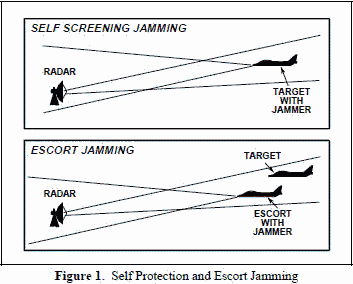
so basically to protect it’s self from enemy’s radar, the jamming out put of APG-81 must be higher than F-35’s reflection. Let imagine a hypothetical scenarios :
F-35 stay at 50 km distance from a ground fire control radar, F-35 successfully jam that radar by using APG-81, or NGJ.. etc what ever.
Now you increased the distance to 100 km, sure as the distance get longer, the density of jamming signal at the enemy’s radar place will get lower ( because the jamming signal from F-35 will have to travel extra 50 km) . However, as the F-35 stay further aways, the radar signal from enemy’s radar will also have to travel further to reach that F-35, thus the density of reflected signal will also be reduced, and at much faster rate than F-35’s jamming signal ( F-35 jamming signal will have to travel extra 50 km but the ground radar’s signal will have to travel extra 100 km).
I give professional statements in interviews from professors of world leading institutions,
you give me the “students’s project using computers software” and the brochure.
:rolleyes: typical Russian stronk attitude 😀
how funny, when it is USAF, LM claim backed up by estimation from third party it is all brochure or advertising :rolleyes: but when it comming from sukhoi or other Russian weapons manufacturer it suddenly be ” professional statement” :highly_amused:
Locate a statement with the claimed 10x EFFECTIVE radiated power with a name to it.
Not a brochure.
then you find an actual study or measurement that shown F-22 and F-35 cant reached – 30/-40 dBsm frontal, I dont care about vague statement from Russian weapon manufacturer :rolleyes:, it’s is any better than brochure, in fact it is worse since he talking about something that he doesn’t actually have access to, while LM talking about their own fighter
mig-31bmRadio locator is an exact term. The term RADAR is just an acronym for RAdio Detection And Ranging.
https://en.wikipedia.org/wiki/Radiolocation
if you look at your own link, it said this :
Radiolocating is the process of finding the location of something through the use of radio waves
which mean a radio locating could also mean a RWR, so No! radio locator isn’t exact term for radar, if you want to use exact term, use radio detection and ranging, otherwise use radar, like a normal person would
F/A-18E/F..
http://www.flightglobal.com/news/articles/fa-18ef-to-use-aesa-as-jammer-208213/
there were plan to give APG-79 jamming capabilities, saidly it still haven’t been done though
And in the future pretty much every fighter equipped with an AESA antenna.
Let say that it true, in some day in future all fighter with AESA can jam enemy’s radar. so what? , does that mean F-35 ability to jam enemy’s by it’s radar isn’t revolutionary today?, by your logic nothing can be revolutionary because in future they will come up with even better technology
Minimum RCS values can only be used in very specific 1-vs-1 cases where the position of the adversary is known in advance. For real-world conditions with multiple emitters covering the target area, the low average RCS is what really helps you.
that is wrong though, at first it may sound very reasonable that average value is what we should consider rather than frontal value, however it not true this time. Why? because aircraft aren’t shape like sphere, or disk, they have very complicated shape, with their different shape , they may have around the same average RCS but very different directions of spike for the high and low RCS
for example :
look at this simplify RCS characteristics of an AC
from graph you can see it have low RCS from frontal, high RCS from the side and behind
. you can imagine another aircraft that have same average RCS all around , but by contrast have lower side RCS and higher frontal and tail RCS, and another one that have low tail RCS and high frontal and side RCS, will they all have the same survivability and offer the same tactical advantage again enemies ? Obviously not. Total average RCS is meaningless to consider
[I]But “any generic AESA” is not the same as a purpose-built jammer, Thompson emphasized. Plenty of airplanes have AESA, not just the F-35 but current Navy Super Hornets and Air Force F-15s. To act as jammers, though, “they need the right processing, waveform generation [i.e. radar frequency, wavelength, etc.], power, cooling,” he said. “To say that the AESA air-to-air radar has the same capabilities as a Next-Generation Jammer is mixing apples and oranges.
The AESA on the F-35, for example, is built to spot air and ground targets, with jamming capability as what Cmdr. Edgarton called a fortunate “by-product.”
“It’s optimized to be a targeting radar; the fact that it can also jam is fantastic,” Capt. Thompson agreed. But the same basic AESA technologywith a differently sized antenna to generate different frequencies and wavelengths, “backed by different processing, different power, different cooling, and purposely built to be a jammerwould have much greater capabilities
Source:
http://breakingdefense.com/2012/12/navy-bets-on-baby-steps-to-improve-electronic-warfare-f-35-ja/
..
read it carefully , what is he talking about?
a purpose built AESA jammer ( aka NGJ) which simply have all the advantages of ApG-81 here again legacy jammer ( focused beam, fast steering rate) while have higher out put and different cooling, work in wider frequency range .
No one here claim ApG-81 is better than NGJ or next gen purpose buit AESA jammer, however it is better than legacy jammer
mig-31bmрадиолокатор=radio locator=radar
according to google translate радиолокатор = radar, you are the only one here even use the term radio locator
https://translate.google.com/m/translate#kk/en/%D1%80%D0%B0%D0%B4%D0%B8%D0%BE%D0%BB%D0%BE%D0%BA%D0%B0%D1%82%D0%BE%D1%80
East German Mig-29 in post Cold War demonstrated interference against the F-16 pulse doppler array, allowing for merge into WVR fight.
source?
The “claimed” figures,(truly epic) on the order of -30/-40 dBSM:highly_amused: allude to the hypercritical reradiating cones, to which the testers came to with pencil beam irradiation.
That is your opinion, and it is wrong, estimation by computer software shown that a stealth aircraft can reached – 30 to – 40 dBsm with a cone around 40-60 degree frontal
Realistically, them do not give any correct representation the tactically relevant radar cross section exposed to enemy radars.
Wrong, low frontal RCS give significant tactical advantage
However, forget the comical ideas and imaginative abilities moving around in public media.
Not comical or imaginary at all, both producer claim, RAM measurement in test and computer simulation shown that these RCS value are achievable, If you want to talk about comical idea and imaginative abilities you should talk about Russian ‘s “plasma stealth” that is the definition of BS
The computed numbers for effective RCS of the F-22A Raptor, from the leading domestic institutes, incidentally where the theoretical understanding originated.
the RCS value of F-22 is from USAF, the simulation of an VLO airframe scattering characteristics are from students’s project using computers software
Vladimir Zagorodny , Chief designer of JSC NIIP Tikhomirov”
“It is interesting to compare the “dueling” possible aircraft systems su-SM (su-35 and F-22A “Dry”, equipped with “snow leopard”, can detect a target with a RCS of 0.1-0.5 m2 (approximately in this range is the magnitude of the effective surface radar scattering stealth aircraft the Lockheed Martin F/A-22A) at a distance 165-240 km At the same time, American fighter sees his opponent with the RCS of 1 m2 at a distance of only 200 km (Jane’s All the World’s Aircraft 2005-2006). Thus, the stealth Raptor with its AESA on the part of the onboard radar complex has no real advantages over upgraded “Dry” in missile air battle on “newsalloy” range.
:rolleyes: of course that why Russian developed the stealth PAK-FA, because stealth F-22 offer no real advantage over the old Su-35 with irbis-e:rolleyes: funny how you critise me for quote LM but yourself quote a Russian weapons manufacturer talking about their asset
Inform me, you are aware of Ufimtsev
yes i do aware of Petr Ufimtsev , you are doing the same **** that Russian fan boy often do, trying to claim he is the inventor of Stealth aircraft because he developed equations for predicting the reflection of electromagnetic waves from simple two-dimensional shapes.
New flash, he isn’t the inventor of stealth fighter, Ufimtsev is a Russian scientists In the 1960s he began developing equations for predicting the reflection of electromagnetic waves from simple two-dimensional shapes.
Development of modern stealth technologies in the United States began in 1958
If you truly want to trade back then the first aircraft with reduced RCS intention is the Ho229 made by the German in 1944
most significant innovation was Reimar Horten’s idea to coat it in a mix of charcoal dust and wood glue which he believed would absorb the electromagnetic waves of radar.
They hoped that that, in conjunction with the aircraft’s sculpted surfaces, would render it almost invisible to radar detectors.
This was the same method eventually used by the U.S. in its first stealth aircraft in the early 1980s, the F-117A Nighthawk
it important to note that while Ufimtsev discoverer the equation, he didn’t actually find it’s application on fighter, saying someone who discovere how to measure RCS for simple shape is also the inventor of stealth aircraft would be similar to say who ever discover Bernoulli’s principle is also the father of aircraft. Which we know he isn’t
A. N. Lagarkov. Director of the Institute for theoretical and applied electrodynamics Russian Academy of Sciences.
If in the 1980s, the aircraft type F-15 had an ESR of more than 10 m2 then modernized aviation complex EPR is 1-1.5 m2, and promising aircraft systems of the fifth generation, such as the F-22, JSF – 0.3 m2
when RCS reduced by 50%, detection range only reduced by 6.25%,
According to your logic USA, China, Russia and many other countries spending billions USD developing or buying stealth fighter for that 6.25% reduction in detect range compare to Su-35 and F-16 :rolleyes: :rolleyes: of course that must be true because some Russian said that, Russian never lie, unlike people from others countries ( especially USA) :rolleyes:
Alexander Davidenko ,Chief designer of OKB Sukhoi
EPR of old generation aircraft (e.g., su-27) is about 12 m2, whereas the F-22A Raptor, it varies in the range of 0.3-0.4 m2. EPR PAK FA ‘will not exceed the figures of the F-22A, it will be very close to them’.
BS nonsense, typical Russian propaganda , there is no way for Alexander Davidenk to even know the kind of RAM that F-22 use or it’s absorbing characteristics, he have no way to know about F-22 RAS either, But somehow you still take what he said as truth:rolleyes: when it is LM or USAF claim about their own aircraft, it suddenly not believable to you :stupid: you are a joke man
I make recommendation of reading material.
“Computer Simulation of Aerial Target Radar Scattering, Recognition, Detection, and Tracking” by Shirman, Y.D., Gorshkov, S., Leshenko, S. , Ollenko, V., Sedyshev S. and Sukharevskiy O.
:rolleyes: oh listing a bunch of books name and authors name will surely make me sound smart, and people will take me serious :rolleyes:, sorry that would only work if you didn’t spit out some ridiculous claim earlier
You make good stand-up comedian, or jester.
. make second attempt, just for you.
:rolleyes:
look at yourself before, you try to make fun of me
You must understand, radar detection range is not decreased linearly in the undergoing of jamming interference.
where did i say it reduced linearly?
Every radar, possess the threshold jamming at where a given target RCS, with given range, the detection collapses. If you do not attain the threshold, the radar will continue extractaction of target precise positional return from the noise.
what part of these below is so hard for you to understand ? , as long as the jammer can send out more power than it’s own reflection it can jam enemy’s radar, as the range get closer and closer the reflection get stronger, up to a point where the reflected signal is stronger than the jammer out put, at that point the jammer fail to protect the aircraft from enemy’s radar, we called it the burn through distance
Here is how a radar work : it send out a pulse, that pulse travel a long distance until it reached enemy’s AC, part of the pulse power being absorbed, part of it being redirect to other direction rather than back to the source, part of it comming back ( reflection pulse) , For a jammer to be able to jam a radar the signal it send out must have higher power than the reflection pulse mentioned above ( so that noise > signal) . Since radar signal have to travel 2 way, the longer the distance, the easier for the jammer to jam
Time for a scenario, something easier to grasp past language barrier.
Imagine, there are three EA-18G Growler airplanes, these Growlers, in conjuction are capable to achieve the necessary density of the jamming signal and cause the detective range of the radar to “collapse” to non-operative range. These Growlers made stand-off jamming on this SAM Radar. Let us made this distance 40km. With the SAM engagement range close at 40 km. And detection range at 80km.
But what if the enemy make better missile allowing full usage of radar, engaging targets at 80 km instead of 40?
1) detection range isn’t the same as tracking range ( the distance where the reflection provide enough information for weapons guide)
2) less reflection = less jamming signal required to jam enemy’s radar
3) And as distance get longer the advantage will always to the jammer, not the radar due to the simple fact that radar signal travelling 2 ways
To achieve the SAME density at twice the distance, you make the SQUARE of the number of platforms making the jamming.
Simple physic
:rolleyes: and an radar will also have that disadvantage , and it is 2 time worse since radar signal travel 2 way, for a radar to be able to see at 2 times the distance, it need to increase power by atleast 16 times
Lockheed..Martin…
Must be a joke no? Interestingly enough, they have not even put anyones name to the publication.
Make note of the word “Effective”.
I make admittance, you show bravery to cite F-35 brochure for the gullible.
:rolleyes: typical Russia stronk crowd altitude :rolleyes: anything said by USAF or LM are just advertising but anything said by Sukhoi and others russian producer are fact no matter how ridiculous it is :rolleyes:, You are worse than JSR
mig-31bmhere are some different RAM and their absorbing characteristics at different frequency :


mig-31bmok, an unnamed pilot saying this :
“An aircraft with small control surfaces intended for stealth cannot produce such fantastical results in maneuverability; a little wing cannot produce a lot of lift period.
wing too small, cant turn, does it sounds like someone very familiar to you? 😉
No offense, but I`m not sure you are looking at the table correctly so I did some drawing:
[ATTACH=CONFIG]239423[/ATTACH]
It seems that YF-22 has slightly more than two times higher rate rolling at 60° compared to F-15 rolling at 30° AoA, and it has about 6 times higher roll rate when it rolls at 30°.
In most cases yes, mainly because of lower inertial forces, but close-coupled two-engined fighters like Rafale can put to shame some single-engined fighters.
)
my bad, i didn’t look very careful at it, still the graph show that F-22 even with 2D TVC and close coupled engine roll quite slower than F-16 with 1 engine, F-35 have 1 engine as well, do you have any evidence that F-35 will roll slower than aircraft with 2 engine stay far apart like Su-35, PAK-FA
btw F-18 also have close coupled engine
mig-31bmI meant the jammer emanated from main-radio-locator.
It not revolutionary, merely a trinket.
it called a radar, why do you keep calling it a radio locator? what the point other than trying to make things sound more complicated than it is?
and if you call it not revolutionary, name one fighter other than F-35 that can use their radar to jam? and even have out put 10 times higher than legacy aircraft
head on, but from below the plane. I would not subscribe to LM claims of .01 sqm RCS, they are from hypercritical reradiating cone. A milliradian deviation will substantially increase RCS.
and where is your evidence for your claim ?, ( not to mention the fact that RCS of normal aircraft will also increased significantly depending on angle)
anyway here is an example :
radar cross section in dBsm of a stealth airplane without RAM estimated by computer software ( the model were assumed to made fully from metal and reflect 100% radar wave comming at it, absorbed nothing )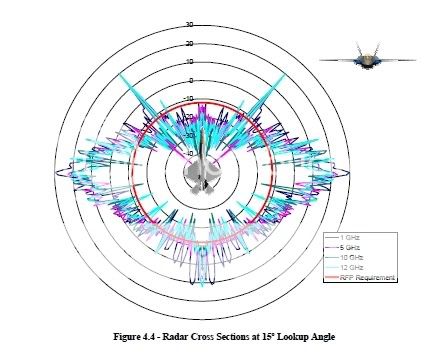
so even without any RAM, stealth airframe have RCS of around -10 to -20 dBsm frontal
here is radar reflection characteristics of a Su-27
even with RAM legacy fighter have RCS of around 10 dBsm frontal, ( without RAM that rised to 20 dBsm
here are absorption characteristics of some different kind of RAM ( as we have no idea what F-22 and F-35 use, it is likely they use several kind of RAM along with RAS )
absorbing characteristics of some RAM when putting together
measurement of B-2 with and without RAM :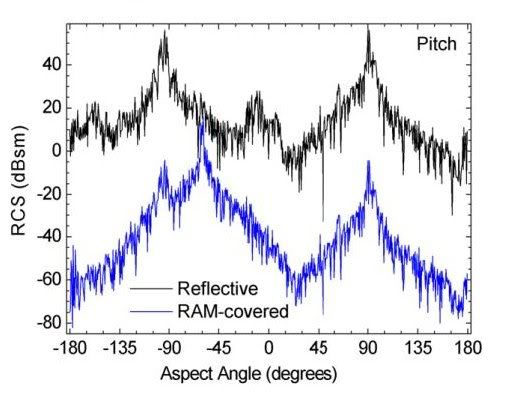
putting the 2 together, it isn’t hard to see how F-35 and F-22 can get down to around – 30 or – 40 dBsm with both RAM and shaping ( or 0.001-0.0001 m2)
avg RCS for stealth aircraft lie in the .2-.5 sqm,
Nonsense claim without evidence what so ever, what exactly the average are you talking about here ? 360 degree all around? 360 degree around in azimuth?
average RCS mean nothing since stealth aircraft try to redirect radar wave aways rather than back to enemy’s source, they may have very high RCS in a few spike, but they have very low RCS where it matter, 2 aircraft have the same average RCS doesn’t mean they will be detected at the same distance by enemy’s radar in normal conditions
I recommend the vertical comedy.
it called stand up comedy, jesus
I mean no offense, but it amusing. I shall explain.
To make easier for I and you, because language barrier, I define a few things.
Maximum detection range for radio locator, is at which the re-radiated power density at the recieving antenna, for a illuminated target, make means for processing extract from the noise a stable and coherent positional data of object at distance.
We can name this the min input signal strength. This already take the two-way coefficient into account.
Let us separate any kind of against and defense techniques that are used to sway the balance of signal noise battle.
ALL jamming platforms, attempting to degrade detection range for a target with specified RCS, must attain a threshold density(W/Mhz) at receiving antenna.
To achieve stand-off jammery, over SAM battery, jam platform have requirement a stable and coherent degradation of the reradiating signal beneath the lower limit of input power for discriminating signal noise performance of the radio locator from outside the range of enemy SAM battery.
It is for this reason that jamming is pointless the longer the range becomes.
again, you use your made up word to make thing sounds more complicated than it actually is ( or try to make yourselft sound smart) , but you actually explained nothing here
.
Here is how a radar work : it send out a pulse, that pulse travel a long distance until it reached enemy’s AC, part of the pulse power being absorbed, part of it being redirect to other direction rather than back to the source, part of it comming back ( reflection pulse) , For a jammer to be able to jam a radar the signal it send out must have higher power than the reflection pulse mentioned above ( so that noise > signal) . Since radar signal have to travel 2 way, the longer the distance, the easier for the jammer to jam
May I have proofs?
here
While F-35 is capable of stand-off jamming for other aircraft — providing 10 times the effective radiated power of any legacy fighter
mig-31bmYou made claim that the ability is unique to F-35, it is not.
what fighter have demonstrated ability to jam by their AESA rather than F-35?
@mig31bm, I hope you realize that average RCS for F-35 is significantly greater that what you write as in your post.
we are discussed situation when F-35 jam enemy’s radar by it’s APG-81 so i assumed head on, from other angle such as side on or tail on F-35 will have bigger RCS, but so is any other aircraft so my point stand
I mean that if I was flying the F-35 at 400km away from S-400, and activate my jammer rammers, the radio locator will continue to extract the position of my illuminated F-35, unless I reach a minimum threshold of jamming at the source antenna.
you misunderstand self screen jamming , the longer the range the better it will work, because as the range getting higher, the strength enemy’s radar pulse get weaker => weaker reflection, while the strength of your jammer remain the same. As long as APG-81 can transmmitting more powerful signal than it’s own reflection it can successfully jam enemy
I will try to sum, APG-81 jamming no game changer.
To give idea, here is Trial MACE XIII result.
– Turkish F-4E fitted with Elta EL/L-8222 electronic countermeasures pod
– Mirage-2000D
– Rafale
– Danish F-16AM
– Nato E-3A
– French E-3F
– Norway Falcon-20
– Slovakian MIG-29AS
– Learjet 35A D-CARL fitted with two Cassidian EW pods, again operating from SliacSum statement:
“NATO concluded that the S-300PMU with a professionally trained crew is capable of effective operations in a complex ECM/ESM environment, with a high level of success.”
All those aircraft versus the export ancient system, surpassed by S-400.
F-35 change nothing.
ok look at the list of aircraft that joint MACE XIII exercise, mostly old aircraft such as F-16A, F-4E, Mig-29AS, Mirage 2000 none of them have AESA jammer that can focused their beam for more jamming power at target place ( F-35 jamming out put is 10 times more powerful than all legacy fighter) , none of them have VLO airframe to effectively reduce jamming power required and burn through range ( all of them are have RCS 1000-10000 times bigger than F-35)
Btw, i dont even know how accurate is your statement, what i heard is that Rafale is actually fly unmolested
If NATO E-3A could not block, then how can APG-81 do so
1) E-3 is an AWACs
2) E-3 have a huge RCS compared to F-35 ( around 100 m2 vs 0.001 m2)
mig-31bmTaking values in favour of F-18E will yield Clmax = 1,69, which is 5% better than F-16’s slow speed clmax, and 12% improvement over MiG-29A.
Compared to F-16 blk50 and MiG-29A when all are clean at 50% fuel, F-18E has 1% higher wing loading than F-16, and 17% higher wing loading than MiG-29A.
So net result is as this: F-18E has only 4,8% higher ITR than F-16C blk50 at slower speeds. In fact, as speed increases and CAT-1 limits F-16, F-18E will start to have increasingly better ITR (not at slow speeds but at medium speeds, before 7,33G limits hold F-18E back)
F-18E has 4% inferior low speed turn rates than MiG-29A. I don’t doubt F-18E has better controllability at slow speeds, but it definately doesn’t turn better than a good old MiG-29A.
In MiG-29A vs F-18E, the choice is obvious; MiG-29 turns better, has ballpark same T/D and 20% higher T/W. Let F-18E pilot play at high AOAs, I would simply turn inside him at relatively conservative 24 deg AOA and kill him.
Personally I would pick still F-16 over F-18E in any slow dogfight; I wouldn’t care if F-18E could turn 9 deg/s instead of my F-16’s 8,6 deg/s at same airspeed, and would use F-16C 10% better T/W and quite possibly better T/D to make vertical maneuvers he can’t follow.
isn’t the F-18 able to turn some where like 30 degree/sec instantaneous at slow speed? or i read the graph wrong?
BTW the new F-414-GE-400 EPE will increased thrust from 22000 lbs to 26400 lbs, 2 engine will give total 52800 lbs of thurst, a loaded F-18E weight 47000 lbs, so with new engine, it will have T/W of 1.123 at loaded weight )
mig-31bmHe wasn`t complaining, they were trying to degrade some F-18 AoA capabilities to make the F-35 look good and he strongly opposed. Can`t find the link now.
No offense , but are you are , you arent just confused it with something else ? :p i never heard about it before
No, the Su-35S is doing the roll at high AoA around its flight path vector. Here are two videos for better clarification:
http://www.mikejamesmedia.com/animation_gallery_01.html
In second link go for the “F-18 rolls around velocity vector.”
.
ok , after looking at this iam even more convinced that Su-35 in the first video wasn’t just roll , but rather doing the scissor maneuver
In essence you can. The difference in height is not that big, and we can see that there is almost no degradation in F-18`s roll rate at 5° AoA. Very fast and crisp response and it is very close to F-18 max roll rate at level flight/low altitude. We don`t know the level of fuel in both jets (though the Su is probably having around 50% according to the test pilots) but unless they have their wing tanks full, there won`t be some major degradation in roll rate.
Also the span of speed you can do 35° and 70° AoA roll is not the same, but my guess is around 0,3-0,4 Mach for 70° roll (similar to “Cobra” maneuver) and with less speed there is less dynamic pressure which means that Su-35S is actually in disadvantage in that regard.
there is too much guess work here to be honest
Su-35 in the video were doing air show , it must fly low enough for the audience to be able to see it clearly , by contrast the F-18 in test have no such purpose , and they are very likely to do that at medium altitude ( so that if there is accident pilot are less likely to die )
Fuel load affected agility of aircraft very significantly ( an aircraft at 100 % fuel is a lot less agile then when it is at 40% fuel )
btw all aircraft have a speed that they turn fastest at , and roll fastest at ( flying faster doesnt necessary mean you will roll faster and so on )
Look at this table at page 14 for example:
http://www.dept.aoe.vt.edu/~mason/Mason_f/ConfigAeroHiAlphaNotes.pdf
YF-22 without TVC is having comparable roll rates to F-15. Look at the difference in roll rate at 30° AoA when YF-22 is using TVC. Few times faster and YF-22 is having only 2D TVC. It is not hard to believe that with multi axis TVC Su-35S can have much better roll rate than F-18 at high AoA (as seen on the videos).
if you look careful at the table : yes F-22 with TVC can roll better than an F-22 without TVC , but it still cant roll 2 times faster than F-15 when it ( the F-22 ) is at 2 time the AoA like what you claim Su-35 can do vs F-18 here
it is interesting to note that single engine fighter can roll alot better than 2 engine fighter , if you look at the graph , F-16 actually out roll F-22 with TVC up until it’s AoA limit .
btw what benefit 3D TVC actually have over 2D TVC when aircraft rolling ?
That is the reason pilot should perform such maneuvers at the right time.
In WVR fight planes with similar performance will most definitely loose speed very fast (just look at the F-22 vs Rafale video) and than the plane with superior nose point capability will have great advantage.
That not true , it depending on altitude , and speed that the pilot perform his turn
at low altitude most aircraft can sustain 9G turn until they out of gas
btw here are some new video test of F-35 at high AoA , i find it a bit weird that some how it seem like F-35 can fly high AoA up side down? https://www.youtube.com/watch?v=ZlFJHWfHaTY


 Sign In







