 mig-31bm
http://www.16va.be/mig-29_experience.htm
Positive side :
when all that is said and done, the MiG-29 is a superb fighter for close-in combat, even compared with aircraft like the F-15, F-16 and F/A-18. This is due to the aircraft’s superb aerodynamics and helmet mounted sight. Inside ten nautical miles I’m hard to defeat, and with the IRST, helmet sight and ‘Archer’ I can’t be beaten. Period. Even against the latest Block 50 F-16s the MiG-29 is virtually invulnerable in the close-in scenario. On one occasion I remember the F-16s did score some kills eventually, but only after taking 18 ‘Archers’. We didn’t operate kill removal (forcing ‘killed’ aircraft to leave the fight) since they’d have got no training value, we killed them too quickly. (Just as we might seldom have got close-in if they used their AMRAAMs BVR!) They couldn’t believe it at the debrief, they got up and left the room!
“They might not like it, but with a 28deg/sec instantaneous turn rate (compared to the Block 50 F-16’s 26deg) we can out-turn them. Our stable, manually controlled airplane can out-turn their FBW aircraft. But the real edge we have is the ‘Archer’ which can reliably lock on to targets 45deg off-boresight.
“I should stress that I’m talking about our Luftwaffe MiG-29s, which are early aircraft. They also removed the Laszlo data link and the SRO IFF before the aircraft were handed over to us, so in some respects we’re less capable than other contemporary MiG-29s. From what we hear the latest variants are almost a different aircraft. I’d like to see our aircraft get some of the updates being offered by MiG-MAPO. The more powerful engines, better radar, a new navigation system, a data link and an inflight refuelling probe. If we got the new ‘Alamo-C’ that would also be an improvement – even a two nautical mile boost in range is still ten more seconds to shoot someone else! We won’t get many of those improvements, though we are getting a new IFF manually selectable radio channels, and improvements to the navigation system, including the integration of GPS. Most of our aircraft will be able to carry two underwing fuel tanks, which will also help.”
Negatives
“The employment of the MiG-29 suffers from severe inherent constraints. The most obvious limitation is the aircraft’s limited internal fuel capacity of 3500-kg (4400 kg with a centreline tank). We have no air-to-air refuelling capability, and our external tank is both speed and manoeuvre limited. We also have only a limited number of tanks.
“But if we start a mission with 4400-kg of fuel, start-up, taxy and take off takes 400-kg, we need to allow 1000-kg for diversion to an alternate airfield 50-nm away, and 500-kg for the engagement, including one minute in afterburner. That leaves 2500-kg. If we need 15 minutes on station at 420 kts that requires another 1000-kg, leaving 1500-kg for transit. At FL200 (20,000 ft) that gives us a radius of 150-nm, and at FL100 (10,000 ft) we have a radius of only 100-nm.
“Our navigation system is unreliable without TACAN updates and is not very accurate (I’d prefer to call it an estimation system). It relies on triangulation from three TACAN stations, and if you lose one, you effectively lose the system. We can only enter three fixed waypoints, which is inadequate. We also can’t display our ‘Bullseye’ (known navigation datum, selected randomly for security). For communications we have only one VHF/UHF radio.
“The radar is at least a generation behind the AN/APG-65, and is not line-repairable. If we have a radar problem, the aircraft goes back into the hangar. The radar has a poor display, giving poor situational awareness, and this is compounded by the cockpit ergonomics. The radar has reliability problems and lookdown/shootdown problems. There is poor discrimination between targets flying in formation, and we can’t lock onto the target in trail, only onto the lead. We have only the most limited autonomous operating capability.
“We don’t have the range to conduct HVAA attack missions – and we’re effectively limited from crossing the FLOT (Front Line of Own Troops). Our limited station time and lack of air-to-air refuelling capability effectively rules us out of meaningful air defence missions. Nor are we suited to the sweep escort role. We have a very limited range, especially at high speed and low altitudes, and are limited to 540-kt with external fuel. We have navigation problems, Bullseye control is very difficult and we have only one radio. So if I talk, I ‘trash’ the package’s radios!
“The only possible missions for NATO’s MiG-29s are as adversary threat aircraft for air combat training, for point defence, and as wing (not lead!) in Mixed Fighter Force Operations. But even then I would still consider the onboard systems too limited, especially the radar, the radar warning receiver, and the navigation system as well as the lack of fuel. These drive the problems we face in tactical scenarios. We suffer from poor presentation of the radar information (which leads to poor situational awareness and identification problems), short BVR weapons range, a bad navigation system and short on- station times.”
mig-31bmMig-29 cruise at 44000 feet, while F-16 cruise at around 42000 feet
42 k feet is around 12 km and from what i understand fighter often climb before launching their missiles to give their missiles more energy, so wouldnt it be more realistic to calculate missiles range when lauched from 12-15 km ( around 50k feet) rather than 10 km ( 40k feet) ?
from the graph we seen earlier for R-77 and Aim-120 the range again target fly at altitude of 20 km is 2 times bigger than again target flying at 10 km ( launching altitude is the same, about 15 km both case) what i understand from the graph is that because at higher altitude the air is much thinner thus the missiles can go further, however, i read an article yesterday about long range air to air missiles, it is said that long range air to air missiles will always climbing to very high altitude and cruise to target ( like an arcs) , for example the Aim-54 climb to altitude of 100 K feet, so if the missiles always climb to thin air instead of flying a direct path, why in the graph it still have much longer range again high flying target? shouldn’t it be opposite? i mean in both case missiles fly in thin air but again low flying target, it have aid of gravity as well
mig-31bmCorrect, but Su-27SK manual states Hl=Ht=0-10 km and gives a usable range limit. Typically, minimum range should apply to S/L, because minimum at 10 km altitude will be greater, and maximum range should apply to 10km altitude, as max range at lower altitudes will be lower. So all these max values given (30 for R-73E or 65,5 for R-27RE) is for 10 km altitude, comperable with graphs from MiG-29 manual as they also state 10 km launch altitude.
However, it doesn’t specifically give a target speed, so its possible there are around +/- 5km variations between them
here the text i can find, it was an interviewed of SD-10 producer, basically talking about a little different between testing conditions of Russia and Western missiles , iam not sure how accurate the article is but any way :
Some translations and points discovered by Hyperwarp in the AFM concerning an magazine published article of an interview with the designer of the SD-10.
“Efective combat altitude 0-25Km.
Ability to engage target 10kms higher or lower than launch altitude.
Range at 10Km altitude at M1.2 target at same altitude =70Km.
No escape zone for F-16 type target = 35-45km
Max overload=38G, Speed =4M
Plans to be also used as SAM system.”“Designer was asked at end to rate BVR AAMs. He rated Meteor as best BVR AAM, then AIM-120C, then his SD-10, then AIM-120A/B, R-77, Skyflash at equal fourth, then Derby, and last of all, MICA.”
“What the designer said is that they used the same way AIM-120 calculated its range. target and launch aircraft flying at each other at 1.2 mach and at 10000 metres. The range is 70 km under such circumstance.
Also interesting is the designer basically said the russians “cheated” with R-77, as they calculated the max range with target and launcher flying at each other at 1.5 mach and at 12000 metres altitude.”A more detailed translation by Dongdong posted in the AFM forums:
“I just bought the BING GONG KE JI magazine with the SD-10 designer interview. The interview is pretty informative. Add my points for translation:
Ahout the max shot range:
The Deputy Chief Designer of SD-10 said: The parameter of max range is determined by the relative position of missiles carrier and the target aircraft. The assumed conditions by various countries are different. So what the Russian said the max range 100Km may not be better than what we said the max range 70Km. The max range 70Km in SD-10 marketing promotion brochure is measured under the condition that both the missiles carrier and the target aircraft are flying at 10Kms altitude, both the missile carriers velocity and targets velocity are 1.2Mach, their flying direction is reverse(head to head). AIM120s test condition is similar to SD-10. However Russians propaganda is a little more exaggerated. For example, R-77s test condition is: carrier and target are flying at 12 Kms altitude; each has 1.5Ms velocity, head to head flying. Under such a condition, the max range is 100Km. The problem is higher altitude means less aerodynamic resistance, plus the faster velocity for both the carrier and the target. The range is naturally longer. So you shouldnt only consider parameters isolated with each other. In fact, our SD-10s range is better than AIM-120A/B, a litter less than AIM-120C, almost same as R-77s.About ranking MRAAM:
Designer : Its not easy to rank ..Various persons have various standards
First of all, Euros Meteor should be No.1. This missiles performance is very advanced, its range reaches 160Km.It belongs to next generation missiles. Next, I think the AIM-120C is more advanced. For original AIM-120 missile, whatever components, materials and craft are world first class. Now it is upgraded to Type C, it makes new progress on range, precision and anti-jamming capability. Following, It should be our SD-10. Then AIM-120A/B, R-77, Active Skyflash at equal fourth. Then Israels Derby, Derby has a comparable overall performance with the above missiles, but its range is relatively short. Last of all, MICA, its tech is not bad, however its a tradeoff between BVR and dogfight, so is naturally inferior to dedicated MRAAM.Reporter asked : Our SD-10 has a good ranking. Why do you say our SD-10 is more advanced than R-77?
Designer: We adopted some technologies more advanced than R-77s, so SD-10s overall performance is better than R-77s. For instance, our strap-down initial navigation system, signal processing system are more advanced than R-77s. Our missile was developed relatively later than R-77.Some new technologies were not mature when R-77 was developed, so R-77 didnt use the new technologies, but when SD-10 was developed, the new technologies became mature, so we adopted the new technologies in SD-10.SD-10s milestones:
Designer: We started the pre-research work for advanced radar guidance air to air missile in mid of 1980 .
Phase1:mid of 1980 to beginning of 1990, key technologies study
Phase2;Started from mid of 1990, sub-systems development
Phase3:Started from end of 1990, missile overall performance verification test
Phase4:After entering 21st century, demo verification test
Now, the development of SD-10 has been completed.”
It isn’t directly related to thickness ratio but the design of the propellant, and/or nozzle and combustor design for liquid
It highly depends on how long the missile travels in the air. 1/3 is more accurate IMHO.
i mean if the design is the same then the thinner missiles will go further while thicker missiles will accelerate faster? , btw in term of design wouldn’t the Aim-120 more suited for long range than R-73?
btw earlier you rated the NEZ of R-73 is 30 km at altitude of 10 km, so if NEZ is only 1/3 of max range doesn’t that mean r-73 will have max range of 90 km? isnt it seem a bit too high for a WVR missiles?
another question : MBDA claim Meteor have more than 3 times NEZ of Aim-120 class missiles, at 10 km altitude NEZ of Aim-120 is around 30-40 km so that mean Meteor NEZ range will be around 90 – 100 km? that seem really high for a missiles size of Aim-120, R-77, if that was correct, would it be correct too to assume the max range of Meteor will be around Aim-54, R-37 missiles?
mig-31bmWell I’ve posted a page MiG-29 flight manual stating just that. If you have nothing more than idiocy to backup your claims, I think I will stick to what flight manual says.
True, but better burn time only improves terminal energy state, not necessarily maneuverability;
Not necessarily as R-73 is not exactly a small missile; A R-73E weigh 105 kg, has only 7,4 kg warhead (7%), and a miniature IR seeker. Rest of the missile is a one big booster.
This compares to an AIM-120B, which weighs 152 kg, has 22,7 kg warhead (15%). it houses much bigger ARH seeker (even bigger relative to missile’s size) plus datalink equipment. I don’t think booster of AIM-120B is bigger than R-73E (talking relative to missile size&weight of course).
Of course design priorities and the technology of rocket motor is different, but as AIM-120B has effective range of 43 km at 10000m, I believe its quite possible for a R-73 to reach 30 km effective range at same altitude.
1) could there be a mistake in translation of the flight manual ? ( for example altitude :km- feet, Nautical miles- km.. etc, max range vs No escape zone) because most source i can found only say the max range of R-60 is only 8 km, if there was no mistake in flight manual then then the Nez is 15 km which mean max range is probably about 30 km that is the significance increase
2) from what i understand, the more energy missiles have, the more it can use to turn thus at long range a sustained motor or a ramjet is preferred compared to fast burn motor of Aim-9, R-73
3) are the condition like altitude, launching speed of fighter, flight speed of enemies aircraft is the same between R-73, R-27 manual vs Aim-120, R-77 manual, i did remember reading some where that some missiles producer when calculate max range for their missiles set both 2 aircraft flying at mach 1.2, at altitude of 12 km, while some other set the condition as 2 aircraft fly at mach 0.8 at altitude of 10 km ( i think that will make significant difference in term of range)
4) from what i understand if 2 missiles have about the same total weight , same motor weight then the longer one will fly further while the thicker one will accelerate faster, i think same case with Aim-120 vs R-73, also if iam not wrong NEZ often about 1/2 of max kinematic range?
mig-31bmWell I’ve posted a page MiG-29 flight manual stating just that. If you have nothing more than idiocy to backup your claims, I think I will stick to what flight manual says.
True, but better burn time only improves terminal energy state, not necessarily maneuverability;
Not necessarily as R-73 is not exactly a small missile; A R-73E weigh 105 kg, has only 7,4 kg warhead (7%), and a miniature IR seeker. Rest of the missile is a one big booster.
This compares to an AIM-120B, which weighs 152 kg, has 22,7 kg warhead (15%). it houses much bigger ARH seeker (even bigger relative to missile’s size) plus datalink equipment. I don’t think booster of AIM-120B is bigger than R-73E (talking relative to missile size&weight of course).
Of course design priorities and the technology of rocket motor is different, but as AIM-120B has effective range of 43 km at 10000m, I believe its quite possible for a R-73 to reach 30 km effective range at same altitude.
1) could there be a mistake in translation of the flight manual ? ( for example altitude :km- feet, Nautical miles- km.. etc, max range vs No escape zone) because most source i can found only say the max range of R-60 is only 8 km, if there was no mistake in flight manual then then the Nez is 15 km which mean max range is probably about 30 km that is the significance increase
2) from what i understand, the more energy missiles have, the more it can use to turn thus at long range a sustained motor or a ramjet is preferred compared to fast burn motor of Aim-9, R-73
3) are the condition like altitude, launching speed of fighter, flight speed of enemies aircraft is the same between R-73, R-27 manual vs Aim-120, R-77 manual, i did remember reading some where that some missiles producer when calculate max range for their missiles set both 2 aircraft flying at mach 1.2, at altitude of 12 km, while some other set the condition as 2 aircraft fly at mach 0.8 at altitude of 10 km ( i think that will make significant difference in term of range)
4) from what i understand if 2 missiles have about the same total weight , same motor weight then the longer one will fly further while the thicker one will accelerate faster, i think same case with Aim-120 vs R-73, also if iam not wrong NEZ often about 1/2 of max kinematic range?
mig-31bmKills? I don’t know, never bothered to look at it. We are trusting charts to conclude R-27R has 35 km kill range at 10000 m, or R-27RE has 60km, AIM-120B has 43 km kill range at same altitude. I don’t believe WVR missiles deserve any less, so I will post this for R-60MK, from MiG-29 manual:
[ATTACH=CONFIG]235304[/ATTACH]
Technically, even R-60MK can reach 15 km effective range at 10000m altitude.
As for R-73, Su-27SK manual gives for equalized altitude, R-73E has 30 km effective range head-on, and 13km effective range tail-on. So, 12 km is not only a kill zone for R-73, its also a no-escape-zone. It also gives 1.5 km minimum range for head-on shots. so 6 km is actually at the low end of the firing envelope, and 12 km is pretty much in the middle.
Unfortunately, I couldn’t find my AIM-9 charts right now, I will post them if I can. IMHO its safe to say speaking of ranges, AIM-9M is between R-60MK and R-73E, and AIM-9X has better than R-73E, and R-73M is possibly better than AIM-9X.
I think you are missing the point. IF those F-15/F-16 didn’t carried any BVR missiles, at 6-12 km, they could have easily used AIM-9M to shoot down their targets. Having already stated the ranges above, the MiG-25 could have easily used an R-60M at 6 km, or MiG-29’s could have easily used a R-73 at 10-12 km, with some luck, even at 25 km.
Visibility would not matter at all, an F-16 pilot could easily switch to CAC, and fire his missile when he has the tone.
So whats the real benefit of carrying a BVR missile here? I am not questioning the BVR missiles in general (its fine if you use them at 40-50 km and hope for a kill), but at 12 km, they aren’t any more useful than a R-73 or an AIM-9. In fact, they have inferior kinematics, have much more weight&drag to degrade aircraft’s kinematics, and exponentially more expensive. If this shot misses, its even more useless after the merge, due to a dozen obvious reasons.
Nonsense. If an F-16 used radar acquire to track its target, and shoot it down with an AIM-9, is this a BVR shot? Or if an Su-27 used IRST to shoot down a bomber with R-27TE from 50 km is this a WVR shot because the lack of radar?
R-27, Aim-120, R-77, Meteor, Mica in general have much better burn time and flight profile for long range engagement compared to R-73, python-5, Aim-9x so at distance > 15 km they probably have much better end game agility
btw i dont think your statement that R-73E have effective range of 30 km head on at 10 km ( 30 K feet) is accurate, that sound too high for R-73, 30 km probably more like max range, I mean if 30 km is the effective range of R-73E at 30 K feets then Aim-120D probably have effective range of at least 60 km, Meteor may have effective range of 90-110 km
mig-31bmthe gist of it is that we wont need to hear “AMRAAM range is 165 km”, thankfully,
as if that were anywhere near actual engagement range vs a fighter.
keep up the good work @Andraxxus
it really depends on the altitude of the attack aircraft and target, as you can see in the graph Aim-120B can reach around 100 km again target flying at 20 km ( 65 K feet) altitude, while only have range of around 30 – 40 km again target flying at 10 km ( around 30 K feet) , faster target also mean that you can engage from longer range, it seem that we won’t need to hear ” flying higher, faster will always reduced enemy’s missiles range” any more
mig-31bmWhat is your problem exactly? That you feel insulted because I called 1700 km radius of Rafele unrealistic?
Well with CL EFT, MiG-29 has 4231 kg usable fuel. Its optimal cruise fuel consumtion is 4.8 km/nm, translating to 881m, assume missiles launched at the middle, and end up with 795 km combat radius, Of course you will brag about climb etc, but then, more careful calculations which includes reduced drag from dropping EFTs etc will reveal something similar. Now how this 795 km theoratical radius compares with real life radius of 290 km (which involves dogfighting, reserve fuel and keeping station)? Shrinks to 36%.
MiG says their MiG-29 has 1430km combat range on internal fuel. Flight manual says with 3131 kg internal fuel, it needs 3.9 kg/nm fuel consumption, translates to drag equivalent of 2 archers and 2 empty pylons, thats it..
With similar circumstances, your Rafale’s 1700 km theoratical combat radius will shrink roughly to its 1/3rd just as well. Your test pilot is an idiot if he claims othervise, then yes I will say I surely know better than him. But I am sure he knows this difference, he is just simplifying or doesn’t telling about it.
You are very much sounding like the fanboys BlackArcher mentions:
On an overly simplified comparison;
Rafele has 20% more wing area than MiG-29, assuming cd0 stays same, increase drag as much.
Rafaele has 5% less weight when fully fueled, induced drag -assuming linear relation- decreases as much.
M88 has 6% higher SFC than RD-33, fuel consumption will increase as much.So ballpark specific range of Rafale will be (1.2*0,95*1.06)^-1 = 82% of MiG-29
This reveals, with 5x EFTs, its theoratical combat radius should be 230% of MiG-29’s CL EFT, 1828 km on utmost theoratical circumstances, and 660 km in the realistic circumstances as MiG-29’s 150nm.
This reveals, with 3x EFTs (2×1500 + 1×1250), its theoratical combat radius should be 190% of MiG-29’s CL EFT, 1510 km on theory, and 550 km in the same realistic circumstances of MiG-29’s 150nm.This approximation on actually favours Rafale, as it ignores extra drag from various several EFTs Rafele carry.
Can you calculate the combat radius of F-15E, F-16, F-35, Eurofighter, Gripen, F-18E/F, PAK-Fa using the same method?
mig-31bmif it only have fuel for a few seconds then it will lose to any modern aircraft ( because it cant sustain turn or sustain climb with them) or any smart pilot ( because they will simply climb when they see the E. 381, after a few second they will have an easy kill
mig-31bmthe F-35 would appear to be nothing like a match for the PAK-FA. Which leaves these other nations in somewhat of a quandary giving up both the numerical advantage that a Gripen may bring and the qualitative edge (or parity depending on your POV I guess) in the arena of aerial combat that an F-22 would bring.
*I accept that this is very much based on conjecture at this time, but given the alleged range, speed and range at speed advantages of the PAK-FA, then assuming anything like functional sensors and off-board parity, it will be able to dance an F-35 out of fuel, or to a low energy state for an uncontested long ranged missile launch, or even just run it out of ammo (2/4 long range AAMs vs 6), or if the F-35 must hide at low altitude to avoid optimal IRST conditions, then its exposed to all sorts of trashfire and SAMs.
assumed F-35 wont be a match for PAK-FA just because the PAK-FA can fly faster and longer is some what overly optimistic, we dont even know how the Radar, RCS, jamming of the 2 aircraft interact with the other yet ( and F-35 alleged to have better jamming and stealth than PAK-FA so it somewhat balance out the kinematic advantage of PAK-FA)
and no i dont think PAK-FA can some how magically dance the F-35 out of fuel to attack it, to hide from IRST you dont really need to hide at low altitude, there are thick cloud layer at around 20-30 k ft, occasionally 50k ft as well, and as soon as you fly into the cloud IRST lose track,
given the fact that both are stealth aircrafts, IRST are quite useless if one side decided to hide below or in cloud layer, the 2 aircraft will likely engage each other at relatively close range like 10-15 km ( distance well within missiles NEZ range but long enough that a little advantage in turn rate wont matter as much) , PAK-FA can carry more missiles ( assume that no missile like CUDA in future) , but F-35 can carry DIRCM so the kill ratio is likely to be very close
mig-31bmAll right sandiego89 !
It was really small.
still bigger than stealth missile like NSM, storm shadow
mig-31bmIs radar able to detect a small craft like that Arado E.381 ?
yes, easy
mig-31bmgraphs compared maneuver abilities of F-16 vs Mig-29 , and mig-29 vs Su-27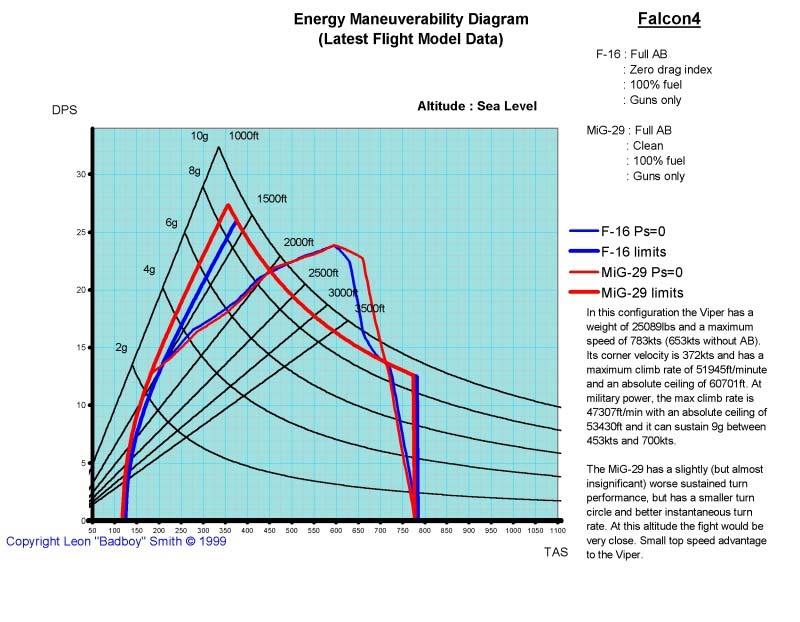


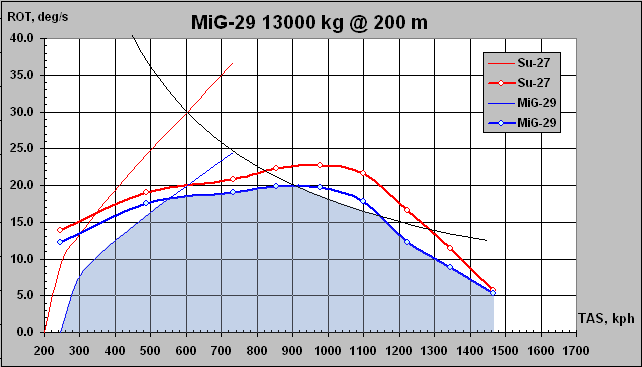
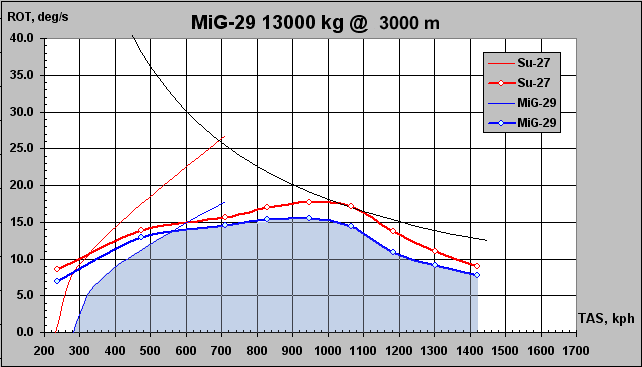
mig-31bmfrom this graphs , if i understanding it correctly , air to air missiles launched from fighter flying at around 15 km will have longer range again target flying at equal or higher altitude (like 25 km ) than again target flying at lower altitude (like 10 km) ? which mean to shorter enemy AAM range you should fly at low altitude like 5 or 6 km instead of 20 or 25 km is that true ?
mig-31bmOf course, realistic numbers are way less then what is quoted but combat radius depends on mission. Our german pilots clear it much better;
So we understand 150nm combat radius is for CL-EFT MiG-29 for 1 min dogfighting, and 15 min station. By using his numbers, MiG-29 can reach 250 nm without waiting on station, and carrying EFT.
Just out of curiosity; I wanted to cross-check his claim with MiG-29G flight manual:
Now what MiG-29G manual suggests;
-Total fuel with CL tank is 4658 kg, but 4231 kg usable.
-Manual doesn’t mention about taxi or take-off fuel usage I will take his word and use 400kg
-MiG-29 has 800kg bingo-fuel limit, not 1000kg; he possibly counted some of the non usable fuel.
-MiG-29 consumes 9.2 kg/sec at Full AB at 5000m, M1.0, taking this as average means 552 kg, for combat
-MiG-29 consumes 38 kg/min at max endurance at 16000 kg weight. 570 kg for staying 15 minutes on station, not 1000kg.
-MiG-29 consumes 200 kg for military accelerations between max endurance and max range, which he didn’t mentionSo for travelling, MiG-29 has 4231-400-800-552-570-200 = 1709 kg remaining.
So MiG-29 consumes 4.8 kg/nm at optimal cruise at 20000 feet (yields M0.68 speed) which gives 356 nm flight range, or 178 nm combat radius.
Of course, this is all for optimal points, ~150nm looks pretty reasonable. I may make similar calculation for F-16 to see how much range could it travel..
why the combat radius here look so short compared to the one on google ? (from your calculation it look like mig-29 combat radius is only 1/3 of F-18E , 1/4 of F-35 and 1/7 of rafale , is it’s range really that bad ?)
nternal fuel was increased from 3,340 kg to 4,560 kg, to give a combat radius of 850 km (531 mi). The combat radius can be increased to 1,300 kilometers with 3 underwing fuel drop tanks. The maximum weight of the aircraft grew from 19.5 to 22.4 t, to allow for increased payloads.
btw wasn’t the mig-29 able to fly with full afterburners for 55 minutes at 50k feets ? with top speed of Mach 2.25 that translate to much longer range
also why fighter cruise at 20-30k ft rather than 50-60k ft? (mig-29 have ceiling of 59,100 ft but often cruise at only 30k ft , why is that ? wasnt higher altitude mean less fuel consumption ?


 Sign In







