mig-31bm
so basically it better for cannon to be inaccurate ?
but wasn’t the F-4 gun pod and GPU-5/A on F-16 was criticized for vibrate too much making it in accurate ?
mig-31bmAegis systems: AN/SPS-49, AN/SPY-1/2/3, SM-2/6/3, ESSM, RAM, CIWS Phalanx vs Ashm (Anti-ship missile): Harpoon, Exocet, YJ-82/83/Noor, Kh-31/YJ-91, Moskit, Yakhont, Kh-22/Kh-SD, Brahmos I/II, LRASM, Granit, Bazalt, DF-21D….
The weakness of the SM-2, ESSM is dependent on the radar AN/SPY, they use SARH mode, so this is possible weaknesses when many ashm attacking at once
http://www.ausairpower.net/Analysis-Regional-ASCM.htmlAnother important thing, shipborne radar can be affected by the sea clutter. Although not to the degree of risk than airborne radar
http://books.google.com.vn/books?id=vAkFCnbHKw0C&pg=PA268&lpg=PA268&dq=radar+clutter+sea+look+down&source=bl&ots=UzOZ_7AR2r&sig=snshekPW6QP_jh8NfwQZCoAS8i0Here we use only 1 ashm to attack DDG
Platform
DDG-51 Flight IIA (DDG-79) vs Type 45, Horizon, Type 052C/D, F-14A/F-4 (Iran), JH-7, Su-30, Sovremenny, Tu-22M3, Su-30MKI, DDG-51 flight III, Kirov, Slava, vehicle base….and a few submarine platformFor DDG-1000 no top radar / radar tower (AN/SPS-49) should be completely eliminated in this match
Results:
Aegis systems vs Harpoon: Aegis (very easy), because of Harpoon speed is slow, its lowest range is only 124km, SM-2/6 is easily shot down it (first stage)
Aegis systems vs Exocet: Aegis (aleatory), but with difficult routes and low altitude Exocet Block 3 (180km), aegis will need ESSM and CIWS to beat it (Last stage)
Aegis systems vs YJ-82 & variants: Aegis (risk), because the scope of Exocet clone has improved more than the French Exocet, YJ-82/83 is 120-220 (surface-launcher) /250km (air-launcher), low ceiling 5m, improved Speed (Mach 2 for YJ-83). Was beat the Phalanx system (using variations Hezbollah export C-802 assault ship INS Hanit in 2006).
Aegis systems vs Kh-31/YJ-91: Aegis (hard), because of the Kh-31 speeds up to Mach 3 range 70-250km, YJ-91 (50-120km) speed is Mach 4.5. U.S. Navy failed each test SM-2 interceptor version bought from Ukraine or Russia Kh-31/MA-31 ago. But ESSM, Phalanx can be a lucky shot with a Kh-31 or YJ-91 mean with Kh-31/YJ-91 attack alone
Aegis systems vs Moskit: Aegis (very hard), similar to the results of the Kh-31, but it will be difficult for ESSM, RAM, CIWS because P-270 has great maneuverability up to 10G and 7m in height for the last phase of the attack.
Aegis systems vs Yakhont: Aegis (difficult) or Yakhont , similar to the results of the P-270, 300km range, Mach 2-2.6, will also cause difficulties for ESSM, CIWS
Aegis systems vs Kh-22/SD: Aegis or Kh-22 similar to the results of the Yakhont
Aegis systems vs Brahmos I/II: Aegis (extremely difficult) or Brahmos I, Brahmos II certainly defeat aegis. Because BrahMos II (range 300km) reach Mach 7 speeds, radar AN / SPY can not continuous tracking targets such speeds, the ability to intercept SM-2/6, ESSM, RAM, CIWS absolutely zero, time to prepare to intercept it can not match the ESSM or SM-2ER mach 4 Blk 4 Mach 2.5-3.5. Ramjet engine maintains the speed of Mach 7 at any altitude and flight journey Brhamos I / II
Aegis systems vs LRASM: Aegis or LRASM. Supersonic speed, low RCS, guidance multi system and complex way, LRASM is the answer to BrahMos and is a threat to any ship, similar BrahMos
Aegis systems vs DF-21D (first ASBM): Multi guidance systems (Satellite, UAV, radar active of warhead, optical, INS) , multi-warhead, the warhead strength of 500kt, max speed mach 10-11 (terminal phase), 3000-5500km range. Aegis + DDG absolutely no chance of survival. SM-3 Block IA / IB / IIA / IIB is the only hope.
To against missile Ashm high speed, need to use the AEW / AWACS or top radar similar MR-331 Mineral (support OTH mode). And the defense system efficient operation together (radar AN/SPS + AN/SPY + SM-3/2/6 + ESSM + RAM + CIWS) . Some weapons platforms like Klub (3M54, 3M14) anti-ship missiles for submarine Kilo, torpedoes supersonic VA-111 (Aegis can not against torpedo, Cheonan is a prime example)
high speed doesn’t always equal shorter reaction time adam
again SPY-1 radar height of about 17 meter above the sea
P-270 Moskit in sea skimming mode fly at 20 meter above the sea thus the radar horizon is 35 km , Moskit reaches Mach 3 at a high altitude and its maximum low-altitude speed is M2.2 , so in sea skimming mode it take 47 seconds from detection until missiles hit
http://fas.org/man/dod-101/sys/missile/row/moskit.htm
P-500 BAZALT in sea skimming mode fly at about > 10 meter above the sea thus the radar horizon is 30 km , P-500 reaches Mach 2 at high altitude , while low-altitude speed is Mach 1.5
so in sea skimming mode it take 59 seconds from detection until missiles hit
http://www.vectorsite.net/twcruz_7.html
P-700 GRANIT in sea skimming mode fly at about > 10 meter above the sea thus the radar horizon is 30 km , P-700 reaches Mach 2.5 at high altitude , while low-altitude speed is Mach 1.6
so in sea skimming mode it take 55 seconds from detection until missiles hit
http://www.vectorsite.net/twcruz_7.html
also BrahMos according to their officials website can reached mach 3 , however cruise altitude is 15 km ( only at terminal phased it reduced to 10 meter)
thus the radar horizon is 522 km so it take 513 seconds from detection until missiles hit
http://www.brahmos.com/content.php?id=10&sid=10
AS-16 Kickback climbs to an altitude of about 40,000 m (130,000 ft) and then dives in on the target, accelerating to a speed of about Mach 5 , thus the radar horizon is 841 km so it take 496 seconds from detection until missiles hit
http://www.globalsecurity.org/military/world/russia/as-16.htm
Kh-22 In low-altitude mode, it climbs to 12,000 m (39,000 ft) and makes a shallow dive at about Mach 3.5, making the final approach at an altitude under 500 m (1,600 ft) thus the radar horizon is 468 km so it take 394 seconds from detection until missiles hit
http://www.fas.org/nuke/guide/russia/bomber/as-4.htm
Kh-20 Flight ceiling 20 km thus the radar horizon is 600 km, it have Speed of Mach 2.0 so it take 885 seconds from detection until missiles hit
http://en.wikipedia.org/wiki/Kh-20
http://www.testpilot.ru/russia/mikoyan/kh/20/kh20_e.htm
http://www.globalsecurity.org/wmd/world/russia/as-3.htm
DF-21 will give aegis like 30 minutes of warning because it a ballistics missiles
NSM ,JSM ,RBS-15 block III , EXCOCET block III , Harpoon in sea skimming mode fly only 1 meter above water thus the radar horizon is 21 km , with speed of mach 0.95 it take 65 seconds from detection until missiles hit , in reality the ship may not be able to detect the stealth missile by radar and have to wait until it come to visual horizon about 18 km aways thus they only have 55 seconds to react
http://books.google.co.uk/books?id=4S3h8j_NEmkC&pg=PA529&lpg=PA529&dq=mach+0.95+nsm&source=bl&ots=hJSsPU2Zd_&sig=7N5SfMaK-fmvAiIDXqzhQ4mtvUo&hl=en&sa=X&ei=XyY1VI_BLJPIggTypIDwBw&ved=0CCoQ6AEwAQ#v=onepage&q=mach%200.95%20nsm&f=false
http://members.home.nl/7seas/radcalc.htm
http://forum.keypublishing.com/showthread.php?131952-Which-is-the-best-anti-ship-aircraft/page4&highlight=
many other point you missing such as BrahMos II not existed yet and ramjet doesnt mean you can fly mach 7 at any altitude ,Aegis is an anti ballistic missiles defense system , it was designed to deal with mach 15-20 ballistic missiles so mach 7 is really nothing significant
P-270 was never rated for 10 G , it would be miracle if it can do 4G
MR-331 Mineral is not a OTH radar, it can see over horizon when super refraction effect occurred due to special weather conditions ,but all radar can do that , that doesn’t really gave them any advantages because super refraction is very very rare to happened and super refraction doesn’t allow you to get fire solution so it can only served as early warning
mig-31bmthe faster a/c have better missile range as a result of higher initial speed,
true , but the faster you go the longer enemy attack distance is when head on (because of the closure rate) , and also when your speed > aircraft corner speed then your turn rate will reduce significant , turn radius increase , so speed can be a 2 edge knife
the more agile a/c with better acceleration reduces the effective range of opponents missile.
i don’t really think so , no aircraft can out accelerate a missile or bullet especially at close range it the reason why boom-zoom tactics are not common anymore in dogfight
effectively the better performer can stay outside effective range of the inferior performer,
all the while having firing solution on the inferior performer
mig-31bmthe aircraft is moving, it’s in moving air, the gun mounts aren’t perfectly rigid, shells are subjected to air friction, air movement, their balance isn’t perfect either, and so on…
plenty of reasons that all together make sure that, regardless of the precision of your aim, your projectiles get more or less dispersed
wasn’t these can be calculated by computer , thus negate it ?
i mean CIWS on ship suffer from exact same problems and they still seem able to destroy much smaller target moving at faster speed
mig-31bmYes, but why are stealth aircraft equipped with low observable nozzles then? Lowering the exhaust temperature has to make a difference.
to reduced enemy IRST detection range = first look , first shot
mig-31bmok the event wasnt real, but how about boeing CHAMP project, could it possible for sth like that in future?
mig-31bmi was thinking the story probably more BS than truth but then again could it be something similar to CHAMP ?
http://www.boeing.com/Features/2012/10/bds_champ_10_22_12.html
http://www.gizmag.com/boeing-champ-missile-test/24658/
http://www.nature.com/news/microwave-weapons-wasted-energy-1.11396
mig-31bmamong 4.5-5 gen fighters , F-35 sell very successful despite it’s high price
countries buying F-35 : USA , United Kingdom , ITALY , THE NETHERLANDS , TURKEY , AUSTRALIA , NORWAY , DENMARK , CANADA , ISRAEL , JAPAN , SOUTH KOREA
countries buying Eurofighter : GERMANY, United Kingdom, ITALY, SPAIN, AUSTRIA , SAUDI ARABIA
countries buying Rafale : FRENCH , INDIA
countries buying Su-35 :RUSSIA
countries buying F/A-18E/F: AUSTRALIA , USA
countries buying F-15E : ISRAEL , SOUTH KOREA , SAUDI ARABIA ,SINGAPORE , USA
countries buying MiG-29K : RUSSIA, INDIA
countries buying F-16E/F : UAE
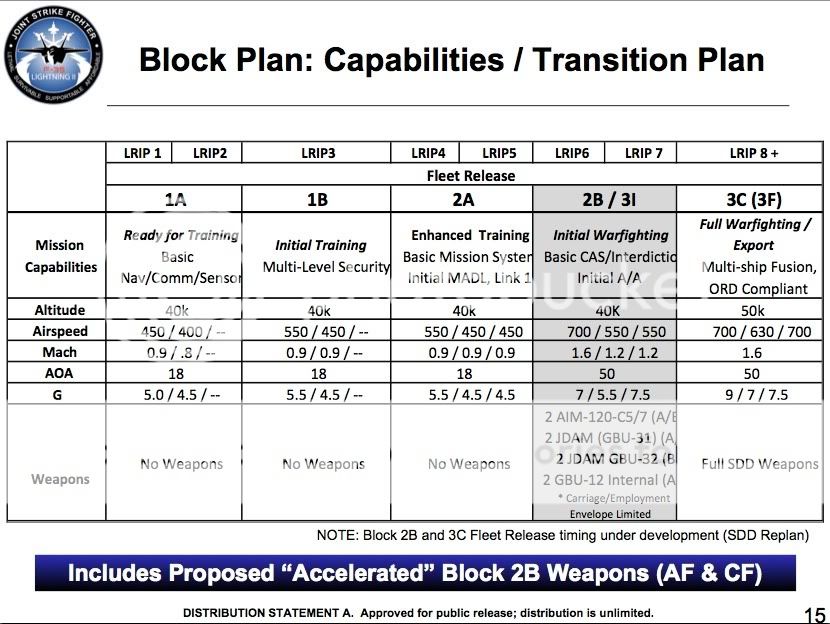
mig-31bmwhat has been disclosed was that its A2A capabilities went down, not up, as it progressed
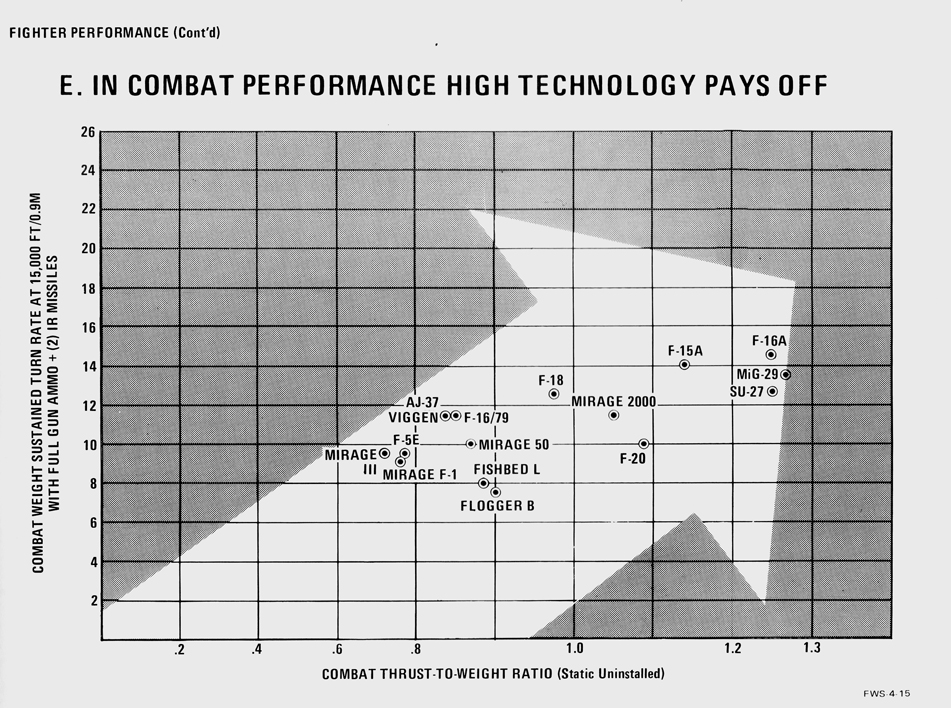
acceleration at 30k feet
Side notes:
F-16 blk50 (2xAIM-120s or AIM-9s), data is taken from flight manual; but linearly interpolated for required weight and mach number.
F-15E PW229 (4xAIM-7s), data is taken from flight manual acceleration graph; but linearly interpolated for required altitude.
F-18C (2xAIM-7 2xAIM-9) and F-18E (AIM-120, 2x AIM-9) data is directly taken flight manual.
F-5E data is taken from flight manual, interpolated for required altitude.
Mig-29 (2xR-60+4 pylons): acceleration values deviated from excess power graphs as the manual suggests.
Su-27 (2xR-73): acceleration values deviated from excess power graphs same way MiG-29 manual suggests.
Mig-23ML (2xR-23): acceleration taken from manual, interpolated for altitude.
mig-31bmMy understanding its because of how the MBT HKS (Hard kill systems) works–Arena is my example-, they are almost like primitive reactive/reflex kind systems.
They implement constant-not scanning- monitoring of possible threat directions by basic radar projecting radiation beam/s of radio waves with Doppler effect . They actually more like a road traffic speed camera -the fixed type- .With a number of pre set role to initiate the reflex -ejecting a projectile-, these include mainly threat speed and direction. as soon the threat inters the radiation beam and its fast speed reflect its singture in clear shift in frequency of radio , all the computer has to do is monitor the frequency shift and if its indicate a possible fast target heading towards -direction of the threat is done simply through Doppler effect ,red and blue shift in light- the tank ,it tireger the charges associated with direction of the activated beam.
So the MBT HKS stay passive most of time waiting for threat to get into its beam with two main parameters to be watched :
https://www.youtube.com/watch?v=E8MbMiBbdtY
https://www.youtube.com/watch?v=GduLj65DwNM
i dont quite understand it , the hard kill protection on tank still need to know threat direction , speed , heading so how does it any different from Ciws or SAM ?
hard kill protection on tank also need to distinguish between RPG round, KE round , AGM and bullets which is arguably quite hard
-Speed (pre set to today mostly subsonic AT missiles)
they can defense again tank KE round with speed around mach 5
https://www.youtube.com/watch?v=62jzAupr044
–Direction of the threat (only reacts to ones heading directly towards the tank)
both can be easily calculated through Doppler effect in the reflected frequency .
as you can see by this system will not activate if the projectile if it was not headed towrds the tank it protect, and will not react to a passing by vehicle as its not in the speed limit.
This totally opposite to CIWS/SAM ,these are complicate systems with multipliable level of search/identify/track/control procedures requiring different kind radars and elements , needed very powerful computer systems to calculate fire solutions and continue to guide the missile or gun barrel towards the target until it distraction.
i dont get it , doesnt the CIWS also only need to know the direction , distance and speed of the threat (exactly like tank HKS)?
and from my understanding hard kill active protection on tank also need to different kind of target such as bullet vs tank KE rounds
My extreme apology for my clumsy English
it fine dont worry:D
mig-31bmi’m assuming tank protection does not have to calculate trajectory and aim accordingly, but merely ignite a counter-charge
but they can
example : https://www.youtube.com/watch?v=OtMgnRMIspQ
https://www.youtube.com/watch?v=E8MbMiBbdtY
no, you cant dodge bullets, it well enuff to dodge missiles
why ?
mig-31bma bit delayed response, but I just had some time to read the thread.
I do not disagree with all you stated. You are downright 100% correct on some of them.
Seeing things with a cool level head and from a different perspective is helpful sometimes though.
The whole thing has been derailed completely. Personally I do not know how good the F-35 is going to be, I do however have significant concerns about it and about all the “theoretical” advantages it brings. I will name a few so you can see where I am coming from.
* Currently all of the western front line fighters are extremely expensive. I never said the Rafale or the EF2000 are cheap. I actually always believed they are way too expensive. You now have : Rafale, Typhoon, F-35, F-22 and Grippen/Grippen NG. NONE of which is affordable in any meaningful sense of the word.
*Stealth for me is a complicated and somewhat alarming issue. When only one side has Stealth then that is OK even if the benefit is marginal (claims are that it isn’t).
What if both sides have stealth? The fundamental flaw in that reasoning is that proponents of the F-35 feel that only US radars will be able to pick up other stealth planes. A flawed and dangerous logic. If the rhetoric is true and radars of any design are useless in picking up VLO targets in reasonable for BVR and safe distances, then what is the benefit of stealth in a world where both sides have it? You are effectively returning air combat back to WWI when pilots had to do visual interceptions (IRST in our case).
If you argue VLO is good for strikes and deep bombing runs then you must think that air defence radars (L-band) may not have resolution sufficient enough to direct missiles at a VLO target, but can bloody well tell you someone is coming and indeed from a good long distance away, enough to scramble fighters, just as one always did even before good VLO, so we are back to square one..
VLO is like having a gun or a sword in street fight, sure, if both sides have it equally then neither side have advantage, but the thing is if enemy have VLO aircraft and you dont then you have really big disadvantage, so your suggestion in using normal fighter instead of VLO fighter is unreasonable, what you said like saying if we have gun and enemy dont then we have advantage but if both side have gun then neither side have any advantage, so what the point of having a gun
and everyone say Lband is more effective again VLO aircraft, but to what extent? if F-35 have RCS = -40 dBsm in Xband then what will be it’s RCS in Lband? , if that is
-30 dBsm then i have to say Stealth still very effective
and yes F-35 is less maneuverable than EF-2000 or Rafale or Jas-39 but by how much? it sustain turn ability is worse but how about roll rate?, roll acceleration? , turn acceleration?, nose authorities… etc and not to mention HMD and HOBS missiles make agility much less relevant in WVR
( btw there was a test done with F-5 vs F-15, it show that in WVR gun dogfight when number of both side increase, then the performance of each individual aircraft matter much less)
mig-31bmthe problem, however, is that your aircraft wants to be stealth, and, as such, doesn’t want to go around radiating (and saying everybody with a decent RWR “heeey, I’m here!!!”
so your positioning will be done rather with data coming from an AWACS, ground-based radar or your passive detection suite
on AESA radar because of certain transmission characteristics that are out of bounds (ex : frequency hoping , irregular search pattern…) as originally programmed when the system was designed, those seeking transmissions are dismissed as part of the background clutter spectrum. Thus make them very hard if not impossible to detect by RWR . also due to the fact that an aircraft is flying , moving , thus it impossible for RWR to measure range to flying radar ( you still know the angle and directions though )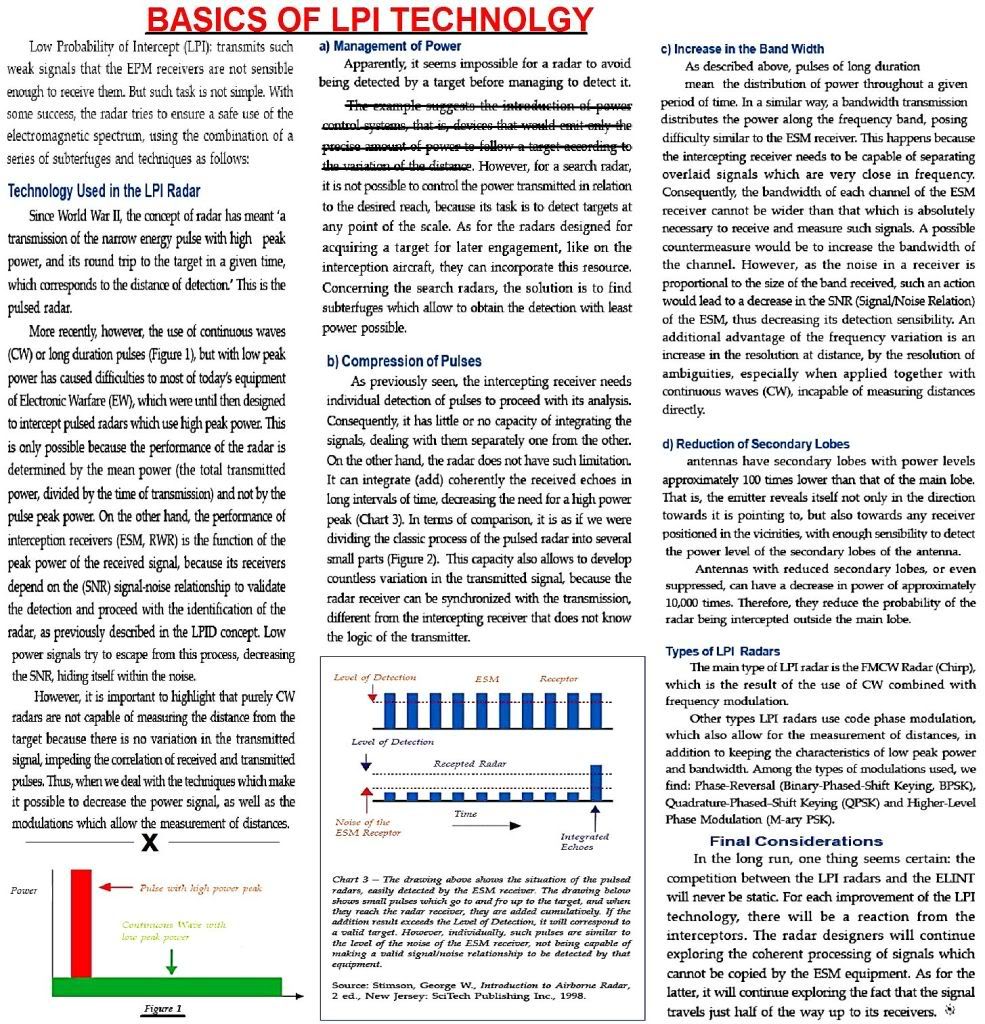
http://www.mar.mil.br/caaml/Revista/2007/Ingles/10-Pag40.pdf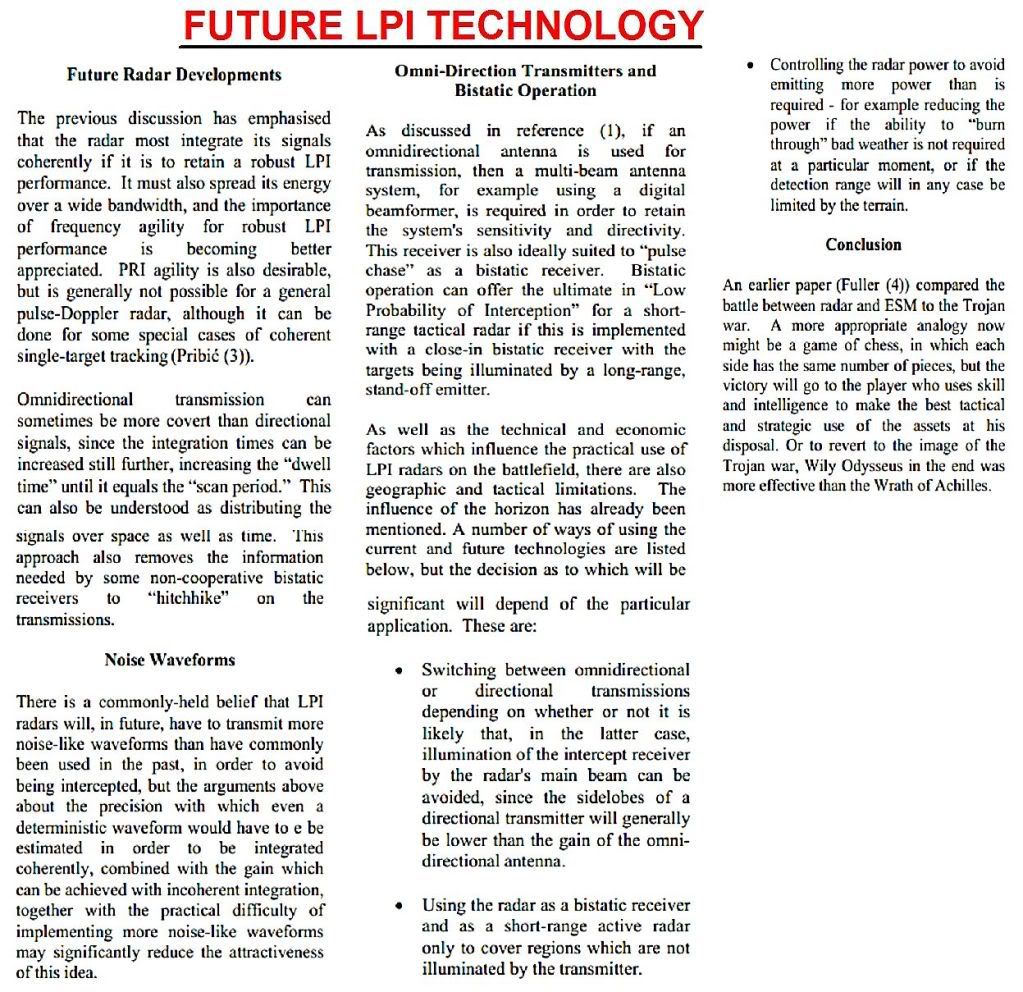
http://www.emrsdtc.com/conferences/2004/downloads/pdf/tech_conf_papers/A14.pdf
[ATTACH=CONFIG]234422[/ATTACH][ATTACH=CONFIG]234423[/ATTACH]
mig-31bmThat line of reasoning is similar to a claim that 400 km/h top speed of a sports car is better than 320 km/h. Hard to argue with that… That logically means everyone should be buying only Bugattis and Hennessey Venoms from now on.. Nevermind the fact that highways in most countries are restricted to 130 km/h.
BTW, got your Veyron yet?
not the same though, radar in real war conditions will almost always have to faced jamming, clutter, low RCS targets
the sooner you detect enemy = sooner you can climb up and accelerate to faster speed which is always true, very different from your sport car example
mig-31bmYes. The practical difference will hardly be ground-breaking.
Yes, I am suggesting it can be pretty useless in most situations.. Especially if
1) carrier aircraft is carrying weapons with kinetic range not exceeding 30% of the max. radar range
2) practical useful range of using your weapons is less than half of the kinetic range
3) you’re backed by AWACS or other force multipliers with even much more sensor rangeYou won’t sell a single fighter without AESA after 2030. I dare to say that the sheiks don’t even know what is it good for but they will want it, anyway.
I don’t have access to any such data.. Please provide. Thank you..
1) longer range, more powerful radar will always better again target with lower RCS
2) stronger radar = more resistant to jamming, clutter
3) useful range of weapons could be almost the same as kinematic range depends on kind of target and weapon you are using, for example there is no reason why air to ground weapons are not useful at their max range, air to air to air weapon can be launched when distance between 2 aircraft larger than the weapons’s kinematic range if the enemy approaching very fast ( let say if the target approaching at mach 2 it probably closed the gap alot by itself)
also longer radar range = more time to prepare to get in position to attack = accelerate to faster speed or climb to higher altitude =better kinematic for weapon


 Sign In