WD are the initials for my first and middle name. Rather than keep it short as WD I decided to use the phonetic words for the abreviation. There isn’t any particular reason I decided to make a derivative of my initials. That’s about it.

Pressurization outflow valve?
6000? Wow, that’s a lot of posting. 🙂
It took me a while but I finally have a few pictures to share. The ground photos were taken in West Palm Beach, Florida on a gorgeous day last week. 31C with a light wind and low humidity. Very nice. 😀
1. A close up of our Rolls Royce AE3007E engine. It’s not a true Rolls though.
2. Looking up at the tail.
3. For me this picture of this particular BE-1900D is very interesting. All of our 1900D’s were sold to Gulfstream International Airlines back in 2000. We started delivering them to Gulfstream in Fort Lauderdale, Florida in the late part of 2000 with our last 1900D flying down in October 2001. I happened to deliver this specific BE-1900D to Gulfstream on October 10th, 2000 from Cleveland to Fort Lauderdale. It was a 3 hour and 45 minute non-stop flight without a bathroom. ugh. I was the last Continental Express pilot to land her before we handed it over to Gulfstream. Obviously it’s had its livery changed since I flew her.
4. I had to resort to using the digital zoom on my camera to get this picture. This is a picture of the Vehicle Assembly Building and launch pad at NASA’s Cape Canaveral facility. We did everything we could to get vectored closer both on the way south and on this flight back north but we didn’t really get what we’d hoped for.

Ah, another training cycle. 😉 Congradulations on the move and best of luck with training. I’d be interested in hearing about the course outline for a new hire at Virgin to see how it differs from what I’ve seen on this side of the Atlantic.
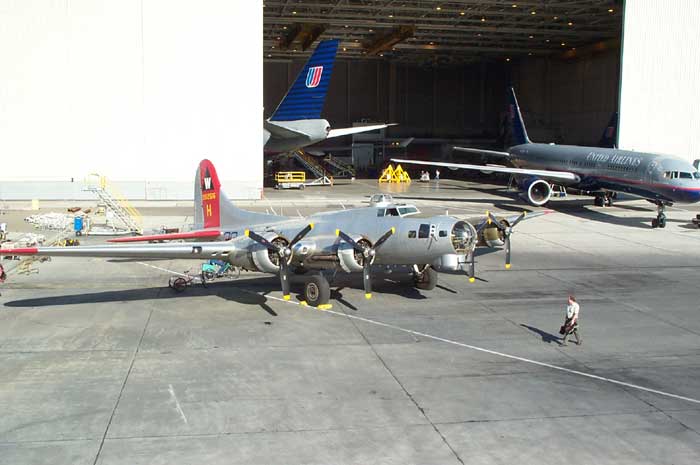
I’m jealous. I’ve often wondered what the Peacemaker sounded like with all those engines. Oh the irony of calling that machine anything with the name “Peace” within it. 😀 “Screaming Loud Aluminum Tube” doesn’t really roll off the tongue. 😀
Perfectly acceptable approach wouldn’t you agree WD?
As you said, due to the swept wings that is the proper approach method. Straight wing turboprops have quite an advantage in strong crosswinds since you can establish your crosswind correction earlier where you left to a last second transition in swept wing aircraft.
The “unlevelled” runway is also normal. I can’t think of a perfectly flat runway that I’ve ever operated from. Some are worse than others. At MAN for example, at the end of 24R you can’t see over the hump to the end of the runway!
I’ve had more great landing ruined by the runway than I can count. 😀
…We now return you to your regularly scheduled Commercial Aviation Thread…. 😉
By Alloy Overcast do you mean “Aluminum Overcast”?
![]()
There’s a gentleman about 30 miles north of me that has a B-36 in his backyard among many other aircraft. Sadly do to failing health he doesn’t allow visitors. I took some pictures from an airplane a few years ago but that was as close as I got.

Here’s a link with a few more pictures of his collection. The Twin Mustang has since been removed from his collection.
http://www.aircraftresourcecenter.com/Fea1/101-200/Fea182_Walters-Farm_Williams/part1/Fea182.htm
Amazing pic !!
Have you seen the wheel in the flesh, Whiskey Delta ?
Yes. It is very, very big. 😀
An example of the B-36 tire is on display at the USAF Museum in Dayton, Ohio. It’s one big tire. Apparently that tire ate asphalt for lunch so they changed it as turbo_NZ mentioned.
The main reason for numerous/smaller tires is weight distribution. To lessen the impact per tire you install more tires. More tires lowers the requirement for larger tires as each is required to withstand less impact.
1 Million+ pounds striking the asphalt at 150+ knots is quite a Force to absorb. You want to spread that over the greatest surface area. Larger tires don’t have that much more surface area in contact with the ground than a smaller tire. So you can get away with a smaller tire.
I’m curious if there is a weight savings or how much it is. A bunch of smaller tires requires larger more complicated landing gear where a couple large tires would have a much smaller/more simplistic landing gear system. I guess I’m curious what the difference would be between a landing gear with one large tire or a bogie with 4 smaller tires.
The recent edition of an aviation magazine here in the US had that question as one of their trivia questions. They gave this as the answer:
KLM was formed on October 7th, 1918 and began service on May 18th, 1920. Australia’s Quantas is the second oldest.
I think with a lot of the other stated airlines they can trace there roots back quite far but they’ve changed ownership, merged, changed names, etc… KLM has done none of that in their 96 years of existance.
That sure is quite a crosswind there. 🙂
Perfectly safe wee contraption is the ERJ. If your flying CO, maybe you’ll get WD :DD
It won’t be me as I’m on VACATION!!!!! 😀