 Y-20 Bacon
china probably wins this one
Y-20 BaconSo, the T50 is so badly made that the Indians are complaining …..
But the Indians have been takingtheir time, raising objections, criticizing the workmanship of the aircraft
and have evinced alarm about the reliability of the F-50 engines…. and yet it is so good that it will wipe the floor with all the opposition….
When the PAK T-50’s get to Iran, Israel, Saudi Arabia and Jordan will face a formidable problem. The Russian plane has the latest radars and weapons
packages and its stealth will make it hard to defeat the T-50 with stand off weapons.Which is it ???
Ken
not supporting their claims.
but the two things you point out are not the same. first is about reliability and quality, the other is about performance.
you can have an unreliable product that kicks ass
see F-14, Tiger I tank.
Y-20 Baconthose crazy Israelis. look what they are writing
http://www.imra.org.il/story.php3?id=67903
Tuesday, July 21, 2015
Iran expected to buy Russian Sukhoi PAK FA T-50 stealth fighter bombers
The Iran Deal Will Help Russia Have A Stealth Air Force
Stephen Bryen July 15, 2015 World News ?
http://www.business2community.com/world-news/the-iran-deal-will-help-russia-have-a-stealth-air-force-01277064
The Iran deal will boost Russia’s arms industry and make it possible for
Russia to replace its older aircraft with newer stealth models.
Thanks to the deal approved by the U.S., the allies and by Russia, the arms
embargo on Iran will “officially” be lifted in 5 years. But the rush to sell
arms to Iran has been on for some time and defense companies from Europe
along with the Russians, Chinese and North Koreans have been flocking to
Tehran offering their wares.
The biggest single need for Iran is fighter and bomber aircraft. There have
been many reports that iran has already made deals with China and Russia,
but the big deals are still ahead of us. That’s because until now Iran did
not have the cash. The nuclear deal is pouring cash into Iran most of which
will be spent on arms.
Iran’s Air Force is dilapidated. It has old F-4 Phantom Jets (64, the number
in service not known), F-14’s (44 out of 80 remain in service) and F-5’s (60
out of 140 operational) from the United States. Iran has 30 MIG-29A’s of
which 24 are in service and 24 Mirage F1’s that were evacuated from Iraq and
never returned. Iran has some 20 Sukhoi-24 bombers and some Sukhoi Su-25’s
both of which were formerly Iraqi aircraft. Reportedly Iran sent 7 of the
Su-25’s back to Iran to use against ISIS. Iran also has around 20 Chinese
F-7M fighters it bought in the 1980s.
None of the aircraft in Iran’s inventory can stand up to US made F-15’s and
F-16’s let alone deal with the F-22 or the forthcoming F-35. For Iran to
claim regional power it must upgrade its air force radically. Most of all,
to stay abreast it needs a genuine stealth fighter bomber.
That is why the lifting of the arms embargo is fortuitous for Iran since it
allows the Russians to offer their new Sukhoi PAK FA T-50 stealth fighter
bomber. The T-50 is a fifth generation air superiority and attack aircraft
that uses stealth technology, has a supercruise capability and is regarded
as far more maneuvreable than the F-22 or the F-35. In fact, the PAK FA T-50
is the Russian Air Force answer to the F-22.
The F-50 is not yet in production. There are many problems on the Russian
side, but the biggest one is lack of cash.
That is why the Russians have been working hard to convince India to be the
first international customer for the F-50. But the Indians have been taking
their time, raising objections, criticizing the workmanship of the aircraft
and have evinced alarm about the reliability of the F-50 engines. In turn
this has created a major delay in the Russian ability to finance the F-50
for its own air force. Initial production has been delayed and pushed into
2016, with many experts suggesting it will even be delayed further.
Iran, therefore, can bail out the Russian Air Force by helping to finance
the PAK-T-50 program. Helping to finance based on future deliveries probably
is consistent with the deal struck by the allies, since it is not quite a
sale and the aircraft won’t immediately be transferred to Iran.
When the PAK T-50’s get to Iran, Israel, Saudi Arabia and Jordan will face a
formidable problem. The Russian plane has the latest radars and weapons
packages and its stealth will make it hard to defeat the T-50 with stand off
weapons. The entire theory of the F-35, for example, is based on the idea of
knocking the enemy out before the enemy detects the F-35. But if Russia’s
stealth system turns out to be good, that advantage is liquidated.
For the western countries, most arms sales to Iran are likely to be
electronics and spare parts instead of major systems. Iran will want parts
for its F-5’s and F-4’s, perhaps for its F-14’s, and may also seek
improvements on those platforms such as better radars or electronic warfare
pods. But for sure the big potential benefactor is Russia.
One other significant impact is that the opening up of arms sales undermines
the sanctions on Russia put there because of Russia’s military adventurism
in the Ukraine. For the most part this deal makes those sanctions largely
superfluous because, other than the export of its mineral wealth, Russia
productivity is largely focused on its military industry. That is why the
Russians are pushing so hard on the Ukraine, because a significant share of
their military manufacturing is in Ukrainian hands and the Russians want it
back.
While Congress will look at the nuclear deal primarily from the point of
view of its adequacy and enforceability, the fact that the deal will boost
Russia’s arms industry and help it rapidly build its Air Force’s stealth
capability is a major strategic concern that should not be swept under the
table.
======================
Dr. Stephen Bryen is a Washington DC -based leader in both the public and
private sectors. He served in a senior position on the US Senate Foreign
Relations Committee, as Deputy Under Secretary of Defense, as the founder
and first Director of the Defense Technology Security Administration, and as
the President of Finmeccanica North America, Italy’s largest defense and
high technology company. Dr. Bryen also served under a Congressional
appointment as a Commissioner on the U.S.-China Security Review Commission.
Dr. Bryen specializes in security technology. His company Ziklag Systems is
focused on security solutions for mobile platforms. Dr. Bryen is a prolific
writer and his LinkedIn profile contains links to papers and articles, as
well as book contributions, over more than 30

Y-20 BaconArent you the same chap who keeps hounding me and calling my posts some sort of a joke?
the difference is, I am obviously not being very serious about asking him to find a duck to place into the intake.
however you’re actually serious about your claims and actually believe in them. lots of them to be found on Grand strategy!
Y-20 BaconI stumbled across a rebuttal to the CSBA report that’s probably worth saving as a reference:
http://john-golan.blogspot.com/2015/07/review-of-csba-study-on-future-air.html?m=1
To summarize the author’s arguments:
- The CSBA report neglected to differentiate between radar guided (BVR) missiles fired from beyond visual range, and those fired from within visual range.
- USAF statistics show that prior to the 1991 Gulf War, missiles fired from beyond visual range accounted for no more than four air-to-air kills, worldwide.
- In the 1991 Gulf War, 58% of all air-to-air kills were made within visual range.
- The supposed cost savings for unmanned aircraft fail to materialize when comparing aircraft of similar roles and capabilities (such as Global Hawk and the legacy U-2 spy plane).
My own conclusion is that jet fighters, as we know them today, evolved out of decades of experience. They will not be so easily discarded by some think-tank projections.
thanks for following up on this.
but couldn’t it also be argued that since the Gulf War… the US hasn’t really had much opportunties for A2A combat aside from 1 or 2 incidents in the former Yugoslavia?
Much of its fighting has been against guerrillas and gorillas.
Y-20 BaconSanem, have to hand it to you, you’ve kept the UCAV flame alight for a long time. I think you may get your wish at least partially if Israel attacks Iran. Something tells me UCAVs just may play a role.
http://www.grandestrategy.com/2011/05/jf-17-block-ii-final-thunder-fc-20.html
hey, where are the block 2 jf-17s with aesa and all that wang bang biz stuff? its supposed to be out by now lol
Y-20 Bacon
The laying down ceremony- the sailor the ship is named after is on the poster.
that guy died so young.. must:ve been 18?
for those who don:t know..
the kid died trying to put out a ship fire only a few years ago. he was the only casualty.
Y-20 BaconIf MiG-1.44 is on display, for God’s sake people, do a proper walk around.
yes take a good pic of an intake, find a duck nearby and put it in. then we can say s-duck!
Y-20 BaconTurkey trolling Greece by making them spend more on interception flights
http://www.politico.eu/article/turkey-buzzes-weakened-greece-military-airspace/
Y-20 Baconhttp://thediplomat.com/2015/07/revealed-details-of-indias-second-indigenous-aircraft-carrier/
well probably well known already
India’s second indigenous aircraft carrier (IAC-2), the INS Vishal, the second Vikrant-class carrier, is slowly taking shape. Recently, the Indian Navy outlined the specifications of this carrier in a letter of request issued to shipbuilders worldwide. Many of the details, including the tonnage and the physical dimensions of the carrier, are in line with older expectations. For example, the Vishal will displace 65,000 tonnes—25,000 tonnes more than the first indigenous carrier, the INS Vikrant.
The Indian Navy’s Naval Design Bureau clarified other features: the carrier will travel at 30 knots, a hair above the Vikrant, and come in at a length of 300 meters, longer than the 262 meter Vikrant. The Navy’s letter of request also outlines plans for the carrier to field between 30 and 35 fixed-wing combat aircraft and 20 rotary wing aircraft. In many ways, though this carrier will be the second in the indigenous Vikrant-class, it represents a significant upgrade over the first carrier, which was bogged down in delays ahead of its successful undocking in early June 2015. The Vishal and Vikrant, along with the modified Kiev-class Vikramaditya, will form the carrier backbone of India’s Navy, and, with the decommissioning of the INS Viraat, the longest-serving aircraft carrier in the world, the total Indian Navy carrier count will stand at three.
The Navy’s letter of request states that that carrier will be the first in the Indian fleet—and first non-Western carrier—to field a catapult launched but arrest landing (CATOBAR) aircraft launch system. There is a possibility that the CATOBAR system could incorporate General Dynamics’ new electromagnetic aircraft launch system (EMALS) technology, pending a feasibility study with the United States. As I detailed in April, EMALS carries several benefits that could given the Vishal an edge over its regional competitors, notably China’s Liaoning.
As I wrote in The Diplomat earlier this year, U.S.-India cooperation on advanced aircraft carrier technology, including nuclear propulsion and EMALS, could prove to considerably alter the naval balance of power in Asia. Indian carriers could become the first in Asia to field a CATOBAR capability, drastically improving the rate at which carrier-based aircraft could take off in an operational scenario. In addition to operational benefits, EMALS would also reduce the airframe stress of CATOBAR launches for carrier-based aircraft, reducing maintenance costs over time. (For a demonstration of EMALS, check out this video posted from its preliminary testing phase aboard the first Ford-class U.S. carrier.)
According to Indian reports, defense firms from four states received the letter of interest regarding the IAC-2 project. These include Russia’s Rosoboronexport, the United States’ Lockheed Martin, France’s DCNS, and the United Kingdom’s BAE Systems. Lockheed could stand to win the contract given the broader conversation around carrier technology cooperation between the United States and India. Strategic considerations in both New Delhi and Washington may lead to heavy U.S. involvement in the IAC-2 project. Even if EMALS falls through due to feasibility considerations, the issue of nuclear propulsion alone leaves considerable room for cooperation.
Y-20 Baconactually I’m having a blast reading all your crazy ideas. not just me but most of this forum lol.
by the way
[ATTACH=CONFIG]239352[/ATTACH]
F-5 firing R-Darter.. where’s your J-7 and SD-10?
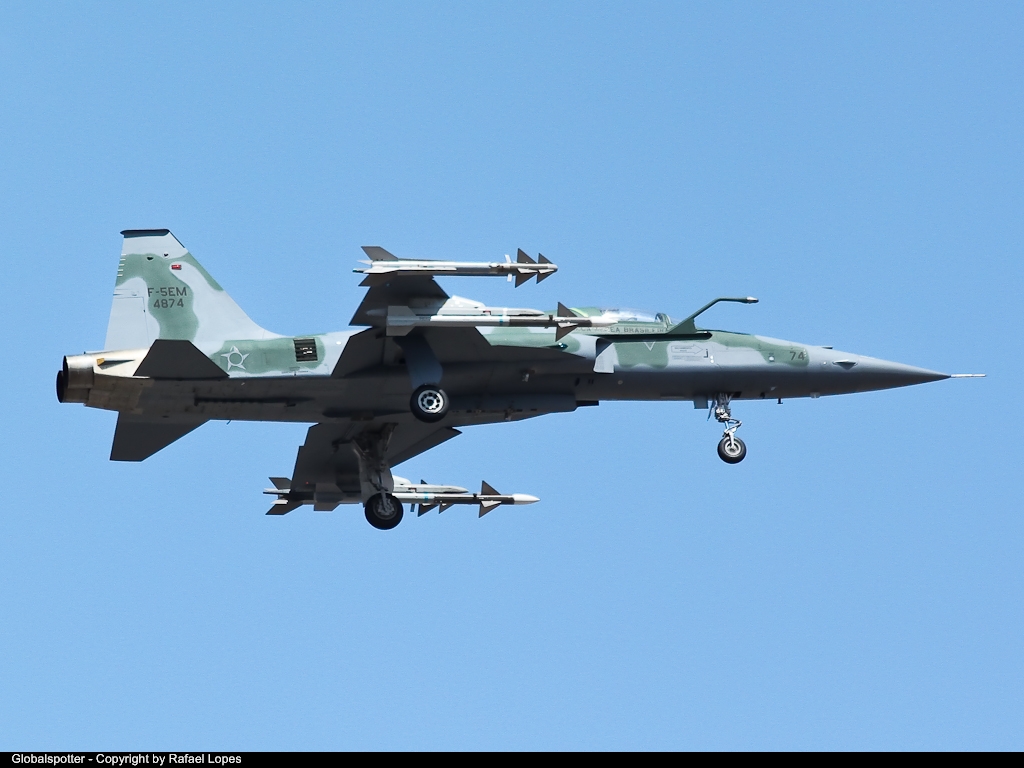
look, another upgraded F-5E with python 4. do you prefer your j-7 to be destroyed far away or upclose?
Y-20 Bacon
Y-20 Bacon
Y-20 BaconHi Tomcat,
How does a comparison of the leading edges of F-5A, T-38 and F-5E somehow close the debate? The thread is about the F-5E vs the J-7G…
yet you immediately follow it up with a link to the J-7PG as well as ranting about all these capabilities proposed for OTHER variants that are not the J-7G.
any more moving of the goal posts?

Y-20 BaconWell my nutty friend, I definitely support Sunnis over Shias as its the latter trying to take over the Sunni majority countries and regions, initiated genocide and tyranny on a scale that has not been seen in a long time. However, I definitely do not support ISIS from an intra-Sunni political perspective. If I had a dollar to give and had a choice of groups to support it with, I’d go with either Harkatal Hazm or Jaish Mujahideen, they being far closer to the brand of Islam I understand than the Jihadi Salafis (i.e. ISIS / JaN)
I’m talking about a rebel air force, one your governments are also, by and large also supporting. So my nutty friend, do your patriotic duty for your country and strap yourself to that plane above for a test flight, your mother Israel calls you to it, as does your daddies in Scandinavia. Between, I’ve never seen such a contraption, most curious and interesting.
or in other words, you wish ISIS just focused on killing Shias right? we see your racial agenda more and more lol
– your scandinavian israeli or whatever you want to believe, friend.


 Sign In








