 JSR
JSR1-use google
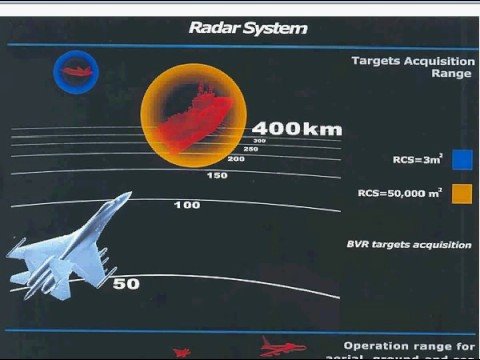
2-acquisition range = detection range # track range
3-ship in the pic of AWACs is a destroyer , in the pic of Irbis-e = aircraftcarrier
4-AWACs use L-band = target RCS is bigger than in case of Irbis-e use X-band
I dont see anwhere 1sqm standard?. Re read the pix. Ships detection range is limited by horizon not RCS. since Su-35 fly higher it has greater detection range against ships.
L-band AESA you can put on fighter also.
http://www.niip.ru/index.php?option=com_content&view=article&id=22:-l-&catid=8:2011-07-06-06-33-26&Itemid=8
the weight may be the same but the missiles clearly more drag than the raised cockpit and canards
so missiles have more drag than raised cockpit, more weight, 15% less powerfull engines. as i said your not good in estimation.
Su-30 with Kh-31 missiles (50% heavier than RVV-BD) and wingtip pod. i dobut it is creating that much drag.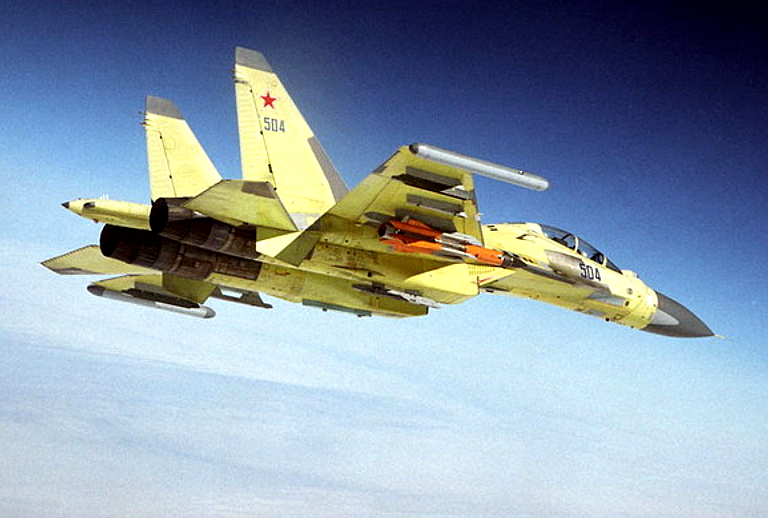
JSRAnyhow kill an AWACS it’s not as easy as JSR said, have an LO fighter capable to approach an AWACS and fire a missile at long range without be detected it’s a big advantage.
Smaller AWACS will have hard time against low rcs combat aircraft at safe distance.
JSRJSR: your argument is one of the most convoluted and nonsensical I’ve had the misfortune of reading. It seems entirely circular but diminshingly so and about issues that have nothing to do with the original points raised by you or the quite sensible responses to those points.
For example, Meteor was mentioned as an advantage for Rafale, you questioned the range, awacs support was mentioned and the fact the the range of the missile wasn’t representative of the testing done on the gripen, you mention the vulnerability of awacs, the ongoing usefulness of awacs was mentioned, you mentioned rcs, the lower rcs of the rafale was mentioned, you say but not compared to the awacs. None of your comments actually related back to the previous comment and we end up trying to nail jelly to a tree.
So congratulations, you have actually managed to make BlueWings seem like a sensible and coherent poster.
how is Meteor advantage for Rafale?. it increases rcs of Rafale, increase drag. hence slow speed for Rafale.
JSRThats the inability of Russians in making smaller missiles. In terms of range, mission, seeker head they are equivalent.
Thank you!
Inability of smaller missiles? have you looked at other products of ktrv and compared there ranges/weights with MBDA products. Start with newest Kh-35.R-73 lesser range is because it was deployed 12 years ahead of Mica. and there is no incentive to improve its range beyond 40km. there is no reason to do that.
JSRstandard western fighter RCS use for calculation is 1m2
it obviously that AWACs will have big RCS
1sqm standard?. never heard of that standrd. how about ships in the same pix. Irbis is target acquisition range. not just search.
1-why su-30 is much draggier than su-35 ????
2- missiles externally is very draggy
3-top speed in full afterburner without weapon doesnot mean anything
missiles are not as much draggy compared to raised second cockpit, exta weight of canards, 10% extra weight, 12% weaker thrust of Su-30.

JSR1- 380 km track range against fighter with rcs = 1m 2 is not bad
2-this is the smallest AWACS ( clearly smaller than all the other AWACs like E-2 , E-3 , A-50 ,Wedgetail ..etc ) and also it use L-band which required more power for the same distance compared to X-band radar , however in L-band aircraft stealth characteristic is reduced a lot which mean Su-35 even with RAM treatmeant will have very big RCS ( 10 m2 for example :rolleyes: )
do you see those fighters as 1sqm. and what will be the RCS of AWACS.
AWACs have more processing , radar power
Not all AWACS.
but if you carry 6-10 missiles your performance will be reduced alot , it as simple as that , mach 1.5 is when it only carry very light weight , small drag :dev2:
2 ton extra weight is not degrading that much Su-35.. for example Su-30 is 10% heavier and alot draggier than Su-35 with less powerfull engines. but still Mach 1.9 rated. You have serious problem with estimations.
JSRI do not understand your passion for Pods? You know that aircraft like the F-22/F-35/Rafale/PAK FA are integrating their RWR/iRST/ECM/LRW/jammer… in the airframe just to avoid to take a Pods ? And you know why ?
btw the rail on the wingtip of the Rafale are not just a missile rail but a part of the SPECTRA, they are just better integrated in the airframe than the “Pods” on the SU-35.
Stealth is not the only solution. There are big pods on Su-34 and EA-18G. so this size of pod matter.
JSRsay who :confused: you ? , you dont even kown the radar range of small awacs
SAAB has put the approximate pix.
http://www.saabgroup.com/Templates/Public/Pages/PrintAllTabs.aspx?pageId=817
su-35 rcs isnot low
it is certainly lower than AWACS.
so ? su-35 may be able to reach that speed with 1-2 kh-31 in full afterburner , but not with 5 kh-31 and dry thrust
one or two Kh-31. does this big fighter is designed for 1 or 2 missiles at a time?. it is big becasue it is designed for 6 to 10 missiles in real mission sortie all the time and hence all performance figures are with that much missiles on minimum.
JSRreally ?
su-35 empty is 3 m2 , rafale empty is 0.1 m2 , we dont know how much meteor rcs is but it seem much smaller than rvv-bd
su-35 altitude is only 2 km higher (and we not even sure if it can reach that altitude with rvv-bd
su-35 also twice the weight of rafale
your point about small awacs is nonsense , they clearly have much much more space for electric equipment and power compared to fighter like su-35
is there official measurement of 3sqm for Su-35 and 0.1sqm for Rafale and from what angle?. are they really empty or with AAMs as Knaapo measured Su-35 range with 4AAMs. Su-35 is not twice the weight of Rafale.
THis was 2004. Now consider the scale of investments in rcs techniques by Sukhoi (Sukhoi has 3 factories running) and Dassualt in Rafale.
JANE’S INTERNATIONAL DEFENSE REVIEW – JANUARY 01, 2004
Russian stealth researchers have developed materials and techniques that can reduce the head-on radar cross-section (RCS) of a Sukhoi
Su-35 fighter by an order of magnitude, halving the range at which hostile radars can detect it. The research group – working with Sukhoi, but based at the Institute for Theoretical and Applied Electromagnetics (ITAE) at the Russian Academy of Sciences in Moscow – has performed more than 100 hours of testing on a reduced-RCS Su-35 and has also experimented with the use of plasmas – ionized gases – to reduce RCS.
US and European aircraft manufacturers have used specially developed materials to reduce the RCS of basically non-stealthy aircraft for many years. Notable examples include the Have Glass and Have Glass II modifications to the F-16. However, Russian work in this area was undisclosed until ITAE researchers presented a paper to a conference on stealth in London in late October 2003, which was organized by the International Quality and Productivity Centre.
According to the ITAE presentation, Russian researchers have developed mathematical tools that can calculate scattering from complex configurations, such as an Su-35 carrying a full external missile load, by breaking them down into small facets and adding the effects of edge waves and surface currents. The antennas are modelled separately and then are added to the entire RCS picture.
“A problem of huge size” is how the researchers describe the Su-35 inlet, with a straight duct that provides direct visibility to the entire face of the engine compressor. The basic solution has been to apply ferro-magnetic radar absorbent material (RAM) to the compressor face and to the inlet duct walls, but this involves challenges. The researchers note: the material cannot be allowed to constrict airflow or impede the operation of anti-icing systems and must withstand high-speed airflows and temperatures up to 200ºC. The ITAE team has developed and tested coating materials that meet these standards. A layer of RAM between 0.7mm and 1.4mm thick is applied to the ducts and a 0.5mm coating is applied to the front stages of the low-pressure compressor, using a robotic spray system. The result is a 10-15dB reduction in the RCS contribution from the inlets.
The modified Su-35 also has a treated cockpit canopy which reflects radar waves, concealing the high RCS contribution from metal components in the cockpit. ITAE has developed a plasma-deposition process to deposit alternating layers of metallic and polymer materials, creating a coating that blocks radio-frequency waves, is resistant to cracking and crazing and does not trap solar heat in the cockpit. The plasma-coating process is then carried out robotically in a 22m3 vacuum chamber.
ITAE and its partners have also developed plasma-type technology for applying ceramic coatings to the exhaust and afterburner. The conference video also showed the use of hand-held sprays to apply RAM to R-27 air-to-air missiles.
ITAE has studied at least three techniques for reducing the RCS contribution of the radar antenna, in addition to the simplest method of deflecting the antenna upwards and treating or shrouding other components. One of these is to design a radome that can be switched from RF-transparent to RF-reflective. The interior of the radome would be coated with a cadmium sulphide or cadmium selenide thin-film semiconductor material which changes conductivity when illuminated with visible or ultra-violet light.
However, the problem of making such a film has not been solved.
A second technique that is also described in Western literature is to place a frequency selective surface screen in front of the antenna. This is a foil-like metal screen etched with small apertures which allow RF energy to pass within a narrow waveband, corresponding to the radar’s own operating frequency. This reduces RCS, according to ITAE, but at the expense of radar performance.
However, ITAE has flight-tested a more exotic technology: the use of a low-temperature plasma screen in front of the radar antenna. The screen hardware is mounted in front of the antenna and is transparent to the radar when switched off.
When activated, the screen absorbs some incoming radar energy and reflects the rest in safe directions over all RF bands lower than the frequency of the plasma cloud. It switches on and off in tens of microseconds, according to ITAE.
In principle, this is the same as the ‘plasma stealth system that was reportedly developed by the Keldysh Scientific Research Center (also part of the Academy) in 1999.
At the time, it was claimed that the system, using a 100kg generator, could reduce the RCS of any aircraft by two orders of magnitude, or 20dB. ITAE has not attempted to develop a whole-aircraft system, but researchers expressed the view that it would be difficult to apply except to a high-altitude, low-airspeed aircraft because the airstream would dissipate the plasma faster than it could be generated.
The ITAE paper also gave some indications of the direction of stealth technology for future aircraft. Test facilities include large compact indoor RCS ranges for large-scale models and outdoor ground-level ranges with short pylons that can be used to test full-size aircraft (rather than the models used for US pylon tests).
In future designs, one emphasis is on large, complex skin panels, reducing the number of gaps and mechanical fasteners in the skin
JSRnor does tight near conformal mica storage on the rafale. You have no idea how the rcs if affected within the gap between the intakes, who is to say the combined effect magnifies any radar return, certainly not you.
pods on the wingtips are huge rcs reflectors when viewed side on, specifically the circler cross-section!
Anything of substance sticks out of the su-35! what kind of retarded argument are you making haha? 😀
The last sentence deserves some kind of key publishing forum moronic statement award.
MICA is not Meteor. we are here comparing BVR combat at extreme ranges. when full engine and electronic power will make a difference.
JSREverything comparatively sticks out of the su-35 as well? Your always imposing initial conditions of altitude as a given :confused:
You can put 4 R-77 between engines in Su-35 and it wont stick out. after launching RVV-BD from wing tips at greater range.
it has pods as given on wing tips. On Rafale anything of substance attach to it sticks out. Su-35 is like MIG-31 and certainly not like Rafale. otherwise whats the point of putting more power than Su-27.
JSRI agree the B-1 claim seems highly suspect.
Along the same lines common sense should prevail that the rafale has a usefully lower rcs than the su-35.
Infact what are the factors that the su-35 utilises to reduce the rcs so much opposed to rafale? What turns a whale into a mouse?
1. canopy treatment—-as rafale
2.ram intake coatings, compressor stages, leading edges etc..—-as rafale
3. I cannot establish more for the au-35, but the rafale has a few more additional airframe mods.Plus IR signature of the su-35 must be comparatively huge? Large metallic engine coverings radiating heat like no-ones business combined the the inherent heat sig by the larger mass of efflux. Also I thought the m-88 has much reduced IR signature by re-heat concealment nearly entirely within the expansion nozzle?
Su-35 has canopy treatment. and Rafale has afterburner glow from distance. you wont see this much Su-35.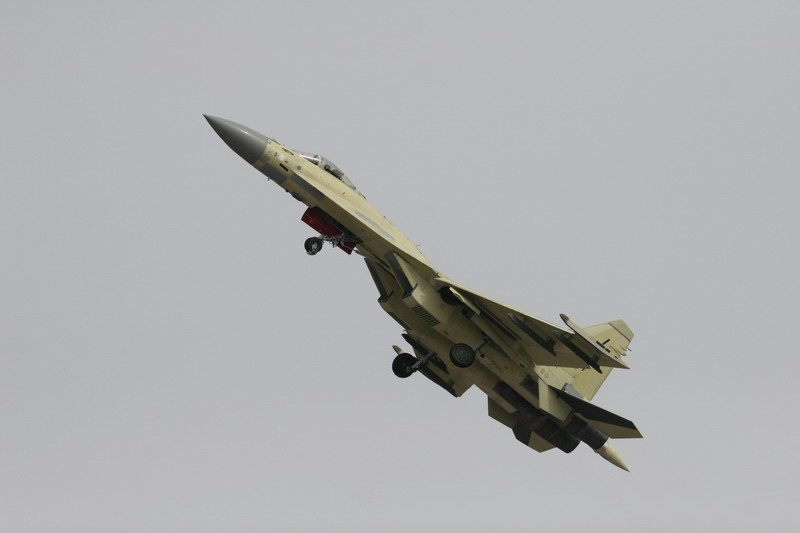

JSRI agree the B-1 claim seems highly suspect.
Along the same lines common sense should prevail that the rafale has a usefully lower rcs than the su-35.
thats the problem. Rafale does not have usefull rcs advantage. There is no electronic pods integral of Rafale design. how much smaller R-77 is compared to the pods.
Every things sticks out from Rafale. and Rafale will be flying at lower altitudes than Su-35. the same disadvantage smaller AWACS.


JSRstop trolling , come on you yourself understand that AWACs have much greater radar , processing power ,the consoles are basically computer that it self show how much greater processing power of AWACs is compared to normal fighter , and why you think AWACs need alot of crew if not to process the information that it can have from it’s radar 😎
Only if its big AWACS like A-50EI class. than there is advantage.
this only true if you have very low RCS like F-22 or F-35 while Su-35 have RCS ways bigger than that
Even AWACS will have difficulty against low rcs target like Su-35 at distance greater than RVV-BD firing solution.
it can carry 6 KH-31 but when it carry 6 KH-31 it’s performance will also be reduced greatly ( even the F-16 can carry max load of 18 mk-82 , but that doesnot mean it’s performance will not be reduced with small bomb , missiles , yes i do agree that the bigger the fighter is , the less it be affected by the same load weight but again RVV-BD is 2 times heavier than Meteor )
Kh-31 is rated at Mach 1.5 launch speed. RVV-BD two times heavier than Meteor is carried by an aircraft that is twice as powerfull.
JSRSo for you it’s not a problem for the SU-35 having a bigger RCS than Rafale because SU-35 have more powerful Radar, but for an AWACS it’s not an advantage over the SU-35 to have a more powerful Radar because they have bigger RCS ? 😀
Su-35 rcs is not much bigger than Rafale when both are loaded with Meteor class AAMs. I am excluding possibility of fuel tanks.
Su-35 has twice the engine power of Rafale and fly at highter altudes.
Small AWACS like Erieye, E-2, Wedgetail does not bring that much to interms of power and rcs will be multiple times Su-35.


 Sign In







