Abhimanyu
I may add to my previous post, that the AAD has thrust vectoring in its Kill Vehicle, that is powered by solid propellant.
The following were described by Dr. Saraswat in an interview :-
Q. What is the configuration of BMD?
A. In a typical battery, you have the long-range radars, missile launchers, mission control center and other ground systems.The complete network of radars, launch batteries, missile control centers, launch control centers. These are geographically distributed and are connected to a very potent secure communications network.
The radar is looking at a particular elevation and detects incoming ballistic missiles. This information is sent to the mission control center(MCC), which then decides whether it is a missile interceptor or a satellite or any other projectile, and it does target classification within a few seconds. When the target is classified, the MCC also calculates where the impact point of the target is likely to be and where it is going to fall.
After the target is classified, the MCC also finds out the trajectory profile and the speed it is going to travel. Based on that, it assigns a target to a particular battery. This is called target assignment.
Once the target is assigned, the data goes to a particular battery, then control goes to the launch control center (LCC). LCC keeps on getting data from radar directly, and then it decides when to launch the interceptor. This is decided based on the data received from radar, on the speed of target, altitude, flight path. A ground guidance computation is done. It’s a very complex computation from ground computation when to launch the interceptor. All this is done in an autonomous fashion.
Q. How does the MCC work?
A. MCC is completely a software-intensive system for BMD, and this works on about 10 computers simultaneously. It receives information about the target from different sources. It could be ground-based radars, satellites or our own technical intelligence system. MCC is connected to all the elements of the weapon system through a wide area communication network. It does target classification, target assignment and kill assessment.In addition, planning for deployment of radar and other weapon system elements is also done by MCC. It can also simulate all the types of track profiles and also simulates the interception using our interceptors, and then select whether interception will take place or not. It can also indicate how many missiles should be launched to intercept an incoming threat to give an assured kill probability. It acts as a decision support system for the commander.
Q. What is LCC?
A. It is the basic hub for launch of the interceptor. After a target has been assigned to a particular battery, LCC starts computing when to launch the interceptor based upon the information received from the radars, about the target. It carries out the checking of the health of the missile. It prepares the missile for launch in real time, carries out ground guidance computation.After an interceptor is launched, the interceptor is provided information about the target through an uplink. The target real time data is transmitted through a very robust communication network.
The most important part may be the uplink from the LCC to the missile in flight. It gives real-time information to the interceptor about the instantaneous and predicted location of the target and directs the interceptor accordingly. With Thrust vectoring in the Kill Vehicle, the interceptor can also counter the target’s maneuvers.
Hence, MIRV targets may also be handled by this system. In phase II, the interceptor system for targets having ranges more than 2000 kms are to be developed.
AbhimanyuThe radars involved in ABM early warning and threat tracking cover a fair range of the spectrum. In general terms the early-warning in done at the lower frequencies, and threat tracking at the higher.
For example:
Pave Paws – UHF band (0.3 to 1 GHz)
Cobra Dane – reported to be L band (1 – 2 GHz)
Green Pine – L-Band (1 – 2 GHz)
Aegis AN/SPY-1 – S-band (2 to 4 GHz)
GBR-P – X-band (7 – 12.5 GHz)
THAAD – X-band (7 – 12.5 GHz)
Mercurius, your post was very informative and interesting. As per the above data, the Indian BMD system uses 1-2 Ghz range, as its ground radar is the Israeli Green Pine radar (also known as Swordfish). The targets can be intercepted at an altitude of 50-80 kms. Thus, by this confirmed frequency-altitude information, may get a rough estimate as to how much frequency range may be required to intercept at a given altitude.
An RV is a fairly difficult environment in which to implement RCS-reduction technologies. An RV must be designed primarily not only to withstand the effects of re-entry, but to have the minimum of trajectory perturbations during re-entry. Ideally, stealth measures would have to be effective from VHF to X-band, but this range could be narrowed by concentrating on the frequencies where they would prove most disruptive to the defensive systems of the target nation. They could also pose a penalty by taking up a portion of the missile’s throw weight.
The Indian BMD system uses not only the ground radar, but also collates information from ground radar, and other mesh of sensors. All this data together is subject to computation, and the incoming target’s path is predicted. This data is fed to the interceptor to orient its path appropriately and used to home onto the target missile.
BTW – Japan conducted its first SM-3 engagement of ballistic-missile target yesterday. The firing was from the Japanese destroyer KONGO (DDG-173).
The news report for the above is here. It was actually a joint effort between the US and Japan.
Earlier I stated that M-9 and M-11 missiles may be countered by this system. As per Dr. Saraswat, exactly these 2 kinds of missiles were simulated in the tests of the BMD, which and I quote him, “are with our adversaries”. In another interview he stated that this system can target missiles having ranges upto 2000 kms. Thus, all missiles in the Pakistani arsenal will be rendered ineffective by this system.
References :-
1) http://www.hindu.com/2007/12/07/stories/2007120761241800.htm
AbhimanyuI think there may be no benefit in arguing over the extent of defence provided, or how many years it will take, or how rudimentary all current BMD systems are, etc. because all that is known to all of us.
It is a matter of perception only; I may see the “glass as half full”, that even if not completely “fool-proof”, India can field atleast something against incoming ballistic missiles, and which can help prevent the loss of millions of lives.
What may be clear from these recent BMD tests by India is that India’s BMD systems are next only to Russia’s in Asia. They will atleast guarantee the defence of major Indian cities and installations against most Chinese and Pakistani ballistic missiles for the forseeable time.
Also, as per Dr. Saraswat, this system will also incorporate the capability to target low-flying cruise missiles also, making it an “all-round” missile defence system. Sensor fusion for this purpose will be achieved by AWACs and ground radars. This has been done after taking into account Pakistan’s development of the Babur cruise missile, which is expected to have a 1000 km range.
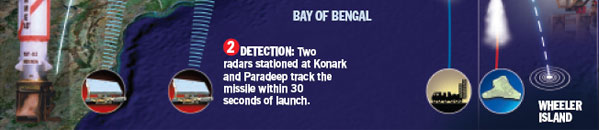
AbhimanyuThe following is an impression of the working of the Prithvi Air Defence* :-



sferrin and sealordlawrence, whatever be the case, atleast some rudimentary defence is preferable than absolutely none at all. Even then, citizens in Pakistan, Iran, N. Korea whose governments have taken very offensive stances, are not at an increased risk, because the BMDs of India, Israel and S. Korea are in keeping with the commitment of declared No-First-Use policy of these nations.
Hence India for example, is likely to fire ballistic missiles with conventional warheads at will, but nuclear ones will not be fired unless a Pakistani or Chinese nucler tipped ballistic missile, evades the BMD defence and does damage.
* rudranath, from bharat rakshak board
AbhimanyuSecondly in your post you have said China would need 1 Lakh (100,000) missiles to overwhlem India’s ABM system. Are you for real mate :confused:
If each BM interception requires one endoatmospheric and one exoatmospheric interceptor then that means India is going to have 200,000 interceptors deployed? :confused:
Farooq, suppose Indian BMD had a success rate of just 50%. Hence, to maintain the current threat, China would have to double its arsenal. If the success rate were 10%, China would have to increase it by 1/10 and so forth.
Assuming 1000 ballistic missiles in Chinese inventory that can strike India, a success rate of 99% would imply China increasing their arsenal by 100 times to maintain the same threat level as it was before the BMD.
AbhimanyuPAC-3 is only 1 part of american BMD and very limited. THAAD will form the second one.
broncho, I agree as the THAAD will form the layer at 150 kms above the surface, whereas the PAC-3 will be used to intercept missiles in the 45 km range.
However, both are separate systems, use different ground radars and use overall different missiles and tracking technology.
The Indian BMD however, has combined the endo and exo modes that can be countered by the same type missile, using the same ground radar and tracking.
The following are excerpts from an interview by Dr. Saraswat, head of DRDO :-
Q. Please describe the homegrown ballistic missile defense system. How many missiles will it have for different layers of threats?
A. Our missile configuration is a three-layered missile defense configuration. We are planning to engage ballistic missiles at the exo-atmospheric layer, i.e., the layer where it enters the atmosphere, and the endo-atmospheric layer, where there is a thermally sensitive atmospheric layer. This configuration gives us the best probability of killing a ballistic missile coming to us. To increase hit probability, we can plan to launch two to three missiles each for exo- and endo-atmospheric.The missile that demonstrates our capability to intercept ballistic missiles at exo-atmospheric altitudes is called PAD. It is a two-stage missile. The first stage is liquid, and the second is a solid rocket motor with many additional features, which are leading to an interception or engaging the ballistic missiles. For example, it has seeker guidance, divert thruster which can generate a lateral acceleration at more than 5 Gs at 50 kilometers altitude.
Q. What is the speed of the air defense missile?
A. It is between 4.5 and 5 Mach. The same system has the capability to engage 300-kilometer to 2,000-kilometer classes of ballistic missiles.Q. What is Phase II?
A. The same missile interceptors cannot cover all threats. Threat targets of longer ranges — 2,000 kilometers — will make our phase-II development.During Phase I: Endo-atmospheric interceptor is AAD. This interceptor will engage targets at 25 kilometers. AAD is superior in terms of coverage area compared to PAC-3, which is 15 kilometers. You can see the difference. AAD’s equivalent is the Israeli Arrow, which intercepts at 40 kilometers. PAD is 50 to 80 kilometers. America is building a missile, THAAD — Terminal High Altitude Area Defense — that intercepts out to 120 kilometers, but it is still in development. However, a lot of failures have taken place during THAAD development.
Reference :-
http://www.defensenews.com/aero/story.php?id=2524130
AbhimanyuYeah but what is the target set those two missiles are designed for? PAC-3 is designed for up to 1300km ranged missiles (PAC-3 MSP will expand on that) with THAAD and SM-3 designed for up to 5500km ranged missiles and GBI for ICBMs.
The Indian BMD system destroyed a Prithvi ballistic missile in tests in the endo as well as exo atmosphere. Thus, Chinese missiles similar to Prithvi like M-9, M-11 and DF-3 can be currently neutralized by this system. Pakistani missiles from Hatf-I through Hatf-IV can be countered by this system. Possibly Hatf-V (or Ghauri) and Hatf-VI (or Shaheen) can also be targeted. The latter are roughly equivalent to India’s Agni-I and 2 and should be simulated in further tests of the BMD.
I think(from memory) both China and Pakistan conducted MIRV tests in 2002. One japanese daily had reported “successful” test for Chinese MIRV system on DF-21(??). Also, India has MIRV on it’s Agni is i am not wrong.
I would think all three countries have MIRV as well as some form of decoy technology incorporated in their RVs by now.
China has probably conducted a MIRV test, but Pakistan has not reported to have conducted such a test. Agni-3 is reported to have decoy and maneuvering capability.
Overall, India’s BMD system is unique in that unlike Patriot-3 and Arrow, the Indian BMD employs a 2-layered defence mechanism thus ensuring a high probability of intercept. As per the head of DRDO Dr. Saraswat, the accuracy would be 99%.
AbhimanyuThat is completely incorrect. How many interceptors will India have compared to its potential opponents warheads, how effective will they be against increasingly effective and sophisticated warheads and counter-measures. One also has to consider the security of the ABM system to other forms of strategic attack, such as speed long range cruise missiles. As for this system being 99% effective………….very unlikely if not impossible.
sealordlawrence, to counter only Chinese threat, 200 such exo-endo missile pairs may have to be developed. Presently, most ballistic missiles do not have an ECM facility and China and Pakistan are not known to possess MIRV missiles. Thus, the BMD will be effective for the long-term.
Regarding cruise missiles, they can be countered by the Barak in India’s inventory and possibly Akash. As per Dr. Saraswat’s statement, the BMD system will also be designed counter cruise missiles.
AbhimanyuHaving spent all that money to deploy this system India would still not be the better for it as I am sure China has enough missiles in its arsenals NOW to saturate any BMD India might put up in the future to come.
matt, the argument of “something is better than nothing” may be put forth to counteract the above.
Besides, the Pradyumna-Ashwin system is itself a saturation BMD—if the exo-atmospheric system Pradyumna fails to intercept the incoming ballistic missile at 50 kms altitude, then the endo-atmospheric Ashwin will ensure to intercept the same.
As per the statement of Dr. Saraswat, the accuracy of this system is 99 %. Hence, in order to maintain the same threat level against India via a brute-force saturation attack, China (and Pakistan) may have to increase their arsenal by 1 x 100 = 100 times. This implies a Chinese arsenal of 1 lakh ballistic missiles that too dedicated only for India.
AbhimanyuIn the 90s the Marines had modified Hawk to do the job even better. Still though, it’s a start. It is amusing though to hear people go on about how Pakistan needs to worry because India now has missile defenses, but at the same time the US’s is ineffective. 😉
sferrin, as per the head of DRDO, Dr. Saraswat, the Pradyumna BMD missile has slightly better performance than the Patriot PAC-3 :
The AAD-02 was slightly better than the PAC-3 (Patriot Advanced Capability) of the U.S. in terms of range and altitude. The direct hit compared very well with the PAC-3 in terms of accuracy.
Avinash Chander, Director, Advanced Systems’ Laboratory (ASL), Hyderabad, said, “I don’t think any country [other than India] was able to achieve a direct-hit in the first attempt” in endo-atmosphere.
Reference :-
http://www.hindu.com/2007/12/07/stories/2007120761241800.htm
AbhimanyuThe Akash missile is being tested for acceptance in the IAF. Its use is to counter incoming fighter planes, UAVs and helicopters. A medium SAM like Akash or LLRQM like Trishul cannot be used for BMD. For that purpose, dedicated BMDs like Patriot, Arrow and [u]P[/u]rithvi [u]Air[/u] [u]D[/u]efence or Pradyumna and Ashwin are required.
AbhimanyuThere is nothing in the LCA design that would suggest it being superior to the Gripen. The Gripen obviously has a more slender fuselage, if it offers lower drag compared to the fuselage of the Tejas, I don’t know. However, the Gripens main wing in conjunction with its fully movable canards allows for an optimal L/D ratio for all cg positions, Mach and AoA. A luxury the Tejas doesn’t have.
As we have discussed earlier, the slenderness of Gripen’s fuselage is negated by its wide-angle wings and much more by its canards, which generate severe drag (profile and induced). Tejas does not have canards and so avoids that much drag, but yet generates a vortex above its wings by having cranks on its wings. Thus it is a unique design.
It has not been proven that canards provide optimal L/D ratio. They are a European adaptation only; all frontline US and Russian jets have avoided canards throughout all generations.
Gripens inlet design also allows for a lower drag compared to the Tejas. The SAAB 105 at first had “armpit” located intakes similar to the Tejas, but they eventually changed it in order to lower the drag, and to get a better airflow to the engine.
Tejas’ almost double wingspan in comparison to the Gripen, may make up for the loss of airflow due to its intakes.
Really? Highest, in what way? The lower fuselage doesn’t blend with the wing at all.
The Tejas actually does have one of the highest wing-body blends in the world. As may be seen from the schematic, it has been more fused with the fuselage compared to other fighter jets.
It’s not blended. The vertical fin is placed on top of the spine. The F-8 Crusader and F-5A Freedom Fighter for example had their vertical fins blended with the spine. The F-9 Panther had its fin blended with the fuselage though.
The above is true. Earlier, I had incorrectly mentioned as fuselage blending, whereas the tail-fin is the first globally to be a monolithic honeycomb piece.
AbhimanyuFrom this* comparison of schematics, it may be seen that the Tejas has relatively fewer joints and contours as compared to the “cluttered” schematic of the Gripen. This shows the high blending involved in the Tejas vis-a-vis an acclaimed combat jet.
As mentioned earlier, but noteworthy to be repeated, Tejas’ wings are at a far more acuter angle than Gripen, making the former more streamlined. Further that the external load of the Tejas is almost the same as Gripen, all these and previously mentioned facts may be sufficient to atleast suggest that the Tejas overall is a superior design to the Gripen.
*courtesy, robban.
AbhimanyuI’m not so sure that angle proves it has any bottleshape to it. It looks like blending between the wing and body at the wingroot. Perhaps the cross-sectional area of the Tejas’s body is distributed effectively, but from that photo one cannot honestly say that is the case.
Actually, Tejas also has the record of having one of the highest wing-body blends in the world. It is the only fighter to have a blended vertical-fin with the fuselage. It has one of the lowest part counts also, on account of composites and modularity (only 7000 individual parts are present in Tejas TD-1).
Besides this, it is said to the only cranked, cropped and double-delta combat jet. Thus, it is clear that the Tejas has incorporated many meticulously planned design features.
Just looking at how the air will flow across the plane’s shape in the line art leads me to suspect that supersonic drag is more of a problem than raw power of the engine. It should have power to spare at this point in the program. Convair had a very streamlined design that couldn’t get supersonic when smarter shaping allowed it to boost the speed by 25% with a modest 7% boost in thrust even though it weighed two additional tons by the end of the change. Guess what, that plane was seventy feet long, 700 square feet of wing, and weighed 15 tons when loaded yet did that stunt on less power than what the Tejas uses.
Tejas’ body is also streamlined as is evident from the line drawings. Tejas also has an unstable design, that ensures stability by the shifting of the CG at the crossing of the sound barrier. Its Flight control system keeps the plane optimally stable by using the forward slats and other movable parts, while simultaneously keeping the pilot commands “in the reckoning” too.
Thus, it may be unclear as to how the IAF finds the Tejas “underpowered” (note that there are no aerodynamic problems). It may be so that the Tejas has reached only 1.4-1.5 mach in testing so far, and hence the IAF may have commented on that aspect, which the media may have misinterpreted as a general criticism.
AbhimanyuYou haven’t looked very closely at the Gripen if you did not see the bottle shaping. The Gripen is merely three feet longer in length yet a half foot shorter in height,
As per specifications given in wikipedia, Gripen is taller by 10 cms. It may seem less in daily usage, but aerodynamically it may make for non-negligible difference. Similarly, Gripen has more wingspan than Tejas.
As we have discussed earlier, the Tejas is lighter, shorter and less wider than even the T-50 Golden Eagle trainer of S. Korea and hence it is the smallest combat jet currently, and smallest amongst the 4th to 4.5 G jets of all time.
And the Tejas has 400 square feet of wing compared to the 275 square feet of the Gripen, so I have no idea what you are trying to say as far as Tejas body to have less drag.
That may be neutralized by the Gripen’s canards that are not in the plane of the main wing and thus add to drag.
The Tejas just doesn’t have classic aerodynamic shaping like its contempary counterparts. The Tejas enjoys a one ton weight advantage under the Gripen, so it does have that in its favor.
Tejas’ design is quite contemporary. It has followed the western design instead of Russian hooded designs.
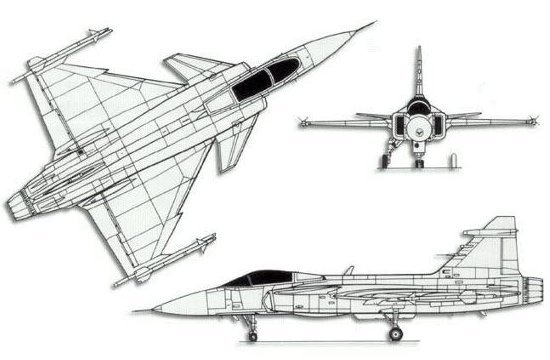
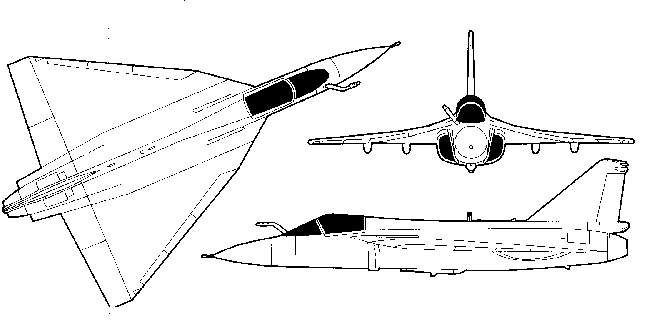
The following are the schematics of Gripen and Tejas respectively* :-
Looking at them, the fuselages of both taper towards the engine exhaust; slightly more so for the Gripen. But the Tejas has a compounded wing (i.e. leading edge actually are two edges), compared to Gripen’s straight leading edge. Tejas’ wing angle is also more actue than Gripen. These 2 features allow for more streamlining.
As for the “hooded” look – the leading edge root extensions on Russian/Soviet designs – they are not strictly found on their aircraft. LERX has been around for decades.
By hooded I meant the characteristic obtuse angle at which the cockpit is at the highest level and the nose and the rest of the fuselage behind it are at a distinguishably lower angle. Western designs are straighter.
* One can also refer to the much better schematic posted by robban.


 Sign In