 talltower
talltowerhow bout sending a fake freighter into these waters to bait the pirates, and when they come close, to reveal that they are heavily armed?
You mean Q-ships?

talltowerThere you can see how expensive LRIP really are: almost $230 million per unit. :rolleyes:
That’s way too much! More expensive than the Raptor! Unbelievable!
Article excerpt from Domain-B
Japan hedges its bets on Lockheed Martin’s F-35 fighter
Rajiv Singh
23 November 2009
The Japanese ministry of defence has selected the Lockheed Martin F-35 Lightning-II as its next mainstay fighter jet but will sign a contract for 40 of these ‘high-tech’ fighters only in 2011, in order to ensure that the much-talked about stealth jet actually delivers on its performance parameters.
Japanese agency reports say the defence ministry will seek fiscal allocation only in the 2011 budget for the purchase of 40 of these advanced ‘stealth’ fighter jets.
The Lockheed Martin F-35 Lightning II is a fifth-generation, single-seat, single-engine, stealth, multirole fighter that, currently, is estimated to cost 9 yen billion ($101 million) each.
According to a Kyodo news agency report, the ministry will launch a full acquisition process in December 2010, but make budgetary requests for the stealth plane only in the fiscal 2011 budget. This is so, for there is a view in the government that contracts should not be finalised until fiscal 2012, by when the jet’s actual capabilities, as against stated capabilities, should be evident.
Read more about the Japanese acquisition of the F-35 from Domain-B.
talltowerJapan reportedly requested technical information on the F-22A during a 2006 industry trade show in Singapore. Loren Thompson, defense analyst at the Lexington Institute, told Dave Hirschman of the Atlanta Journal Constitution on March 15, 2006 that Japan is the only realistic F-22A buyer. The plane is probably too costly for Israel, he said, and “Israel doesn’t have the greatest track record when it comes to technology security.” Britain and other European allies are committed to buying similar but less capable F-35s or non-stealthy fighters made by their own consortiums. “Japan has a big wallet,” Thompson said, “and its neighbors are some of the biggest threats in the world. Japan is completely trustworthy, and it’s in a location where the planes are needed.”
With China and Russia capable of mounting an air-to-air threat against America and its allies, having extra squadrons F-22s bedded down in Japan would make strategic sense to the Air Force. Japan is interested in purchasing the F-22A as a replacement for its aging fleet of F-4 aircraft. The Japan Air Self-Defense Force has four fighters in service: F-15J/F-15DJ Eagles, its F-4EJ “Kai” and RF-4EJ reconnaissance Phantom IIs, the Mitsubishi F-2s (a Japanese variant of the F-16C), and F-1s. The F-1,, which entered service in 1978, is is being replaced by F-2s; the JASDF introduced the F-4EJ in 1973, and will begin retiring them within the coming decade. If Japan makes an F-22A purchase, it would probably buy about 60 airplanes. This would equip two active squadrons of 24 airplanes each as well as spares and a few planes for training. Such a 60-plane sale in either 2007 or 2008 would add three years to the F-22A assembly line. About 2,200 workers build F-22As at Lockheed’s 7,800-employee plant in Marietta. Without additional sales or new authorization for production, F-22A production would end in 2012.
Over the two decades years that the F-22A was in development, the world changed and the capabilities the US Air Force once needed and planned for the F-22A no longer satisfy today’s needs. The F-22A was developed to replace the F-15 air superiority aircraft. The continued need for the F-22A, the quantities required, and modification costs to perform its mission have been the subject of a continuing debate within DOD and the Congress. Critics argue that the Soviet threat it was originally designed to counter no longer exists and that its remaining budget dollars could be better invested elsewhere. Paradoxically, Japan now faces in Asia much the same threat that the F-22 was initially projected to face in Europe: large numbers of Su-27 Flankers, in the hands of Chinese rather than Soviet pilots.
Source: http://www.globalsecurity.org/military/systems/aircraft/f-22j.htm
talltowerThe first flight will take place in Zhukovsky before New year
http://www.zhukvesti.ru
And the military delegation, defense minister, national media and aviation fans would be attending the spectacular rollout ceremony.
talltowerUAE Orders PC-21 Turboprop Trainers
Article from Defense Industry Daily
UAE Orders PC-21 Turboprop Trainers
19-Nov-2009 20:42 EST
During the 2009 Dubai airshow, the United Arab Emirates signed a contract with Pilatus to buy 25 PC-21 intermediate trainer aircraft, in a package worth $511 million. That package also covers several training simulators and associated systems and services. The UAE will join Switzerland and Singapore as PC-21 operators; earlier PC-7 and PC-9 designs are widely used around the world. Pilatus | Dubai Airshow 09.
UAE Air Force flight training takes place at Al-Ain near the Omani border, beginning with basic training on Grob 115s. The PC-21s will replace the existing Pilatus PC-7 fleet. An expected contract for Alenia’s M346 advanced jet trainers will replace the BAE Hawks, and possibly the Alenia MB-339As, that are currently used in the lead-in-fighter trainer (LIFT) and instructor trainer roles. Staff Major General Pilot Faris Mohammed Al Mazrouei, Chief of Logistics Staff, United Arab Emirates GHQ Armed Forces:
“These [PC-21] aircraft will be used for basic and combat operational training which will help train pilots in modern systems, such as navigation, radar, early warning, night vision, thermal cameras and data link systems. They will also help in training them in launching munitions, bombs, air-to-air and air-to-ground missiles.”
Source: http://www.defenseindustrydaily.com/UAE-Orders-PC-21-Turboprop-Trainers-05962/

talltowerChina Struggles To Build An F-22
Article from Strategy Page
China Struggles To Build An F-22
November 17, 2009
The Chinese Air Force has announced that it has a F-22 type aircraft ready to make its first flight within a year. The Chinese believe this aircraft will enter service within ten years. U.S. intelligence believes the Chinese are nowhere near this kind of capability. But given the quantity and quality of data Chinese hackers have been stealing in the past five years, it’s possible that they have much of the American technology that makes the F-22 and F-35 possible. Some believe that the Chinese also have a F-35 type design in the works as well.
American intel analysts believe that Chinese aviation technology (both design and manufacturing) is not yet capable of producing F-22/F-35 class aircraft. Given the experience with the first two Chinese designed and manufactured jet fighters (J-10 and JF-17), there is much doubt that China is capable of making the leap to F-22 class fighters. The big bottleneck is jet engine technology.
For two decades now, China has been developing the manufacturing technology for aircraft engines, the key component of any high performance aircraft. So far, China has been unable to create the manufacturing technology and personnel skills that are needed to make the engines for their most advanced jet fighters. For example, China is a major customer for Russian RD93 engines (originally designed for the MiG-29), and has bought over a thousand of them. The RD93 engines currently cost about $2.5 million each.
China has been developing a similar (apparently identical) engine to the RD93, the WS-13. Actually, this effort is being aided by Russia, which is selling China technology needed for the manufacture of key engine components. Russia isn’t happy about this, because they don’t want competition in the low cost jet engine market. Then again, China has a history of stealing technology it cannot buy, so the Russians are making the best of a bad situation. China says the WS-13 is nearly ready for service. Maybe, maybe not. Recently, China ordered another hundred RD93s. Building high performance military jet engines is difficult, and China has had problems mastering this kind of stuff. Not that they will not eventually acquire the skills, but until they do, they need the Russian made RD93s. Officially, more RD93 are being bought because China cannot produce enough of their WS-13s.
Chinese engineers also thought they had managed to master the manufacturing techniques needed to make a Chinese copy of the Russian AL31F engine. This Chinese copy, the WS10A, was meant for the Chinese J-10 fighter, which entered service two years ago. But the Chinese Air Force was not satisfied with the reliability or performance of the WS10A, and have ordered another hundred AL31Fs from Russia, in order to continue building J-10s. Meanwhile, Russian efforts to build an improved AL31 for their own F-22 competitor, have run into serious problems. Will the Chinese suddenly do better than their tutors?
The J-10 is the first modern jet fighter designed and built in China. The aircraft is an attempt to create a modern fighter-bomber that could compete with foreign designs. The experiment was not completely successful. Work on the J-10 began over twenty years ago, in an attempt to develop an aircraft that could compete with the Russian MiG-29s and Su-27s, and the American F-16. But the first prototype did not fly until 1998. There were problems, and it wasn’t until 2000 that the basic design flaws were fixed. By 2002, nine prototypes had been built, and flight testing was going forward to find, and fix, hundreds of smaller problems. It was a great learning experience for Chinese engineers, but it was becoming apparent that the J-10 was not going to be competitive with the Su-27s/30s China was buying from Russia. The J-10 looks something like the American F-16, and weighs about the same (19 tons). Like the F-16, and unlike the Su-27, the J-10 has only one engine.
The 13 ton JF-17, which uses the RD93, is meant to be a low cost alternative to the American F-16. It was developed in cooperation with Pakistan. The JF-17 is considered the equal to earlier versions of the F-16, but only 80 percent as effective as more recent F-16 models. The JF-17 design is based on a cancelled Russian project, the MiG-33. Most of the JF-17 electronics (in the Pakistani version) are Western, with Italian firms being major suppliers. The JF-17 can carry 3.6 tons of weapons and use radar guided and heat seeking missiles. It has max speed of nearly 2,000 kilometers an hour, an operating range of 1,300 kilometers and a max altitude of 55,000 feet. China has not yet decided on whether it will use the FC-1/JF-17 itself. This is apparently because China believes its own J-10 (another local design) and J-11 (a license built Russian Su-27) are adequate for their needs. The J-10, like the JF-17, did not work out as well as was hoped.
Source: China Struggles To Build An F-22
If the PLAAF does field a 5th Gen fighter, sometime between 2015-2025, how many do you think they would induct into squadron service? Most likely they would be reserved for their top guns, or aces, or honchos, or whatever you wanna call ’em.
By that time, the USAF would have been fielding the F-22C variant of the Raptor. Japan, Israel and Australia would have been foreign Raptor operators by then.
talltowerIndia & Israel’s Barak SAM Development Project(s)
Article excerpt from Defense Industry Daily
India & Israel’s Barak SAM Development Project(s)
12-Nov-2009 17:03 EST
Despite a development timeline measured in decades, India’s indigenous “Akash” and “Trishul” programs for surface to air missiles have failed to inspire full confidence. Trishul was eventually cancelled entirely, and Akash is now slated for limited deployment only. India still needed advanced SAMs to equip its navy and army, however, and decided to try to duplicate the success of the Russian partnership that had fielded the excellent PJ-10 BrahMos supersonic cruise missile.
In February 2006, therefore, Israel and India signed a joint development agreement to create a new Barak-NG medium shipborne air defense missile, as an evolution of the Barak-1 system in service with both navies. In July 2007 the counterpart MR-SAM project began moving forward, aiming to develop a medium range SAM for use with India’s land forces. Both missiles would now be called Barak-8. In between, “India to Buy Israeli “SPYDER” Mobile Air Defense System” covered India’s move to begin buying mobile, short-range surface-to-air missile (SAM) systems for its army, based on the Python and Derby air-to-air missiles in service with its air force and naval aircraft.
These projects offer India a way forward to address its critical air defense weaknesses, and upgrade “protection of vital and strategic ground assets and area air defence.” In Israel, the Barak-8 is slated to equip its next-generation frigates, and may find its way to other roles. Beyond those 2 countries, export prospects beckon for a missile that may offer a value-priced alternative to the popular Standard-2 and Aster-15. This DID FOCUS article will cover the Barak-8 pograms in India, Israel, and beyond. The latest development involves additional reports that a firm $1+ billion contract has been signed…
Source: India & Israel’s Barak SAM Development Project(s)

talltowerWhy do you think that something like the X-45, X-47, Neuron, Taranis, Barracuda, or something developed from them, would only be useful for killing insurgents? Do you think that they’re designed to be stealthy to hide them from the radars of insurgents?
These projects are all designed for first day of war strikes against high-grade air defence systems, & the things they are defending. They or their derivatives aren’t in service yet, but what has been shown so far makes me think that they’re entirely practical, & that they will lead to stealthy strike UCAVs in the fairly near future.
You remind me of the general who said a few years before WW1 that aircraft were an excellent tool for reconnaissance, but that they’d never be useful for anything else.
talltowerThe Russkies have a tradision to do test flight in Jan-Feb month..
Why the hell not, if the test flight goes well in -25 deg with icy a runway it should do fine in the summer month too;)
Thanks
Maybe it’s testing the ruggedness of the PAK FA in harsh climates.
talltowerthis ******** me off what are they going to do when theres nothing left to cut? why don’t we just send out a email to the rest of the world that the UK has gone soft and we are ready to role over and become a no body on the global stage. i don’t care what any one says in future wars will be won by air power and we are throwing ours away.
Damn right.
Have a good read at these articles.
talltowerX-45C UCAV

X-45C UCAV
Perhaps a UCAV like the X-45C would be useful for Wild Weasel missions, punching holes in an adversary’s IADS so conventional non-stealth aircraft can safely penetrate, or a dogfighter against an adversary’s elite squadron of Su-35s or PAK FAs.
One major conclusion bandwidth and jamming is a big issue for UAV!
Also look at the recent American and British purchase of Beechcraft King Air with “special fit”
talltower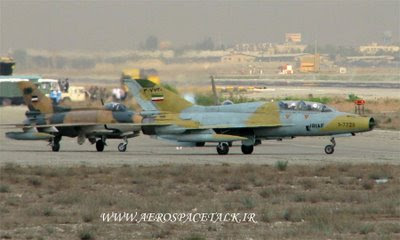
Iranian F-7
talltowerPakistan Buying Chinese J-10 Fighters
Pakistan Buying Chinese J-10 Fighters
11-Nov-2009 22:11 EST
Pakistan and China have been cooperating for a number of years on the JF-17/ FC-1 Thunder, a low-medium performance, low-cost aircraft that has attracted interest and orders from a number of 3rd World air forces. In November 2009, a long-rumored deal was announced for China’s Jian-10/ FC-20 4+ generation fighter, whose overall performance compares well with the F-16C/D Block 52 aircraft that Pakistan has ordered from the United States.
The J-10 has been reported as a derivative of the 1980s Israeli Lavi project, and reportedly incorporates an Israeli fly-by-wire control base that was transferred in the project’s early years. The change in relations that followed the Tienanmen Square massacre hurt the J-10 project badly, however, forcing the replacement of planned Western avionics and engines with Chinese and Russian equipment. The required redesign was very extensive, affected all areas of the airframe, and took over a decade, amounting to the development of a new aircraft. The first operational J-10 unit entered service with the PLAAF in July 2004.
China has reportedly ordered 100 J-10s to date. The initial Pakistani order is for 2 squadrons, but could expand as technical cooperation and orders increase. The $1+ billion sale represents the J-10’s first export order… but almost certainly not its last.
Contracts and Key Events
Nov 11/09: Widespread reports surface that Pakistan has signed a $1.4 billion contract for 36 of CATIC’s Jian-10 fighters, which will be known as FC-20 in Pakistan. The deal is described as a preliminary agreement, and there are reports that Pakistan may eventually be interested in acquiring up to 150 of these aircraft. Retired Pakistani general Abdul Qayyum is qoted as saying that:
“The agreement should not simply be seen in the narrow context of Pakistan’s relations with China…. There is a wider dimension. By sharing its advanced technology with Pakistan, China is … also saying to the world that its defence capability is growing rapidly.”
The UK’s Financial Times echoes this theme, noting that the $21.7 billion Aviation Industry Corporation (AVIC) group is rapidly emerging as a big military goods exporter. The group is also involved in China’s civilian aircraft program, and gives only total revenue figures, but the Financial Times quotes industry sources who believe a recent remerger of 2 split-out groups late in 2008 was aimed at creating a bigger and internationally competitive player.
It is not clear whether Pakistan’s FC-20s will carry Russian Salyut AL-31FN turbofans (17,130/ 27,557 pounds dry/afterburner thrust) that are similar to the engines in many SU-27 family aircraft, or the larger Chinese WS-10A derivative (reportedly a lesser 16,523/ 24,729 pounds dry/afterburner thrust) developed by China’s AVIC Aviation Engine Institute and Shenyang Liming Aero-Engine Group.
Source: http://www.defenseindustrydaily.com/Pakistan-Buying-Chinese-J-10-Fighters-05937/#more-5937

talltower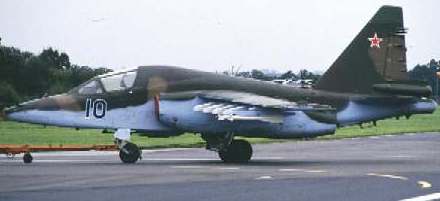
Ethiopian Su-25 Frogfoot


 Sign In







