 Dr. John Smith
Abandoned Airframes
A great set of photos, lots of stories to be told.
OK, so let’s start telling ’em!
First picture – captioned “West Sahara” is the easy one: its SAAF Shackleton 1716 which is still where it crashed on 13 July 1994 (see http://www.flyafrica.info/forums/showthread.php?12783-SAAF-Shackleton-Accident-(1716)-13-July-1994-Sahara-Desert for the background story)
Second picture – captioned “Canada” is Douglas C-47 45-1037 (or “51037” as it appears on the fin) which crashed at Haines Junction in the Yukon on Feb 7, 1950 during a search for a C-54 that went missing Jan 26, 1950. All 10 on board survived and were rescued. (background story here: http://www.ruudleeuw.com/dc3_mystery.htm
Third picture – captioned “Canada” is very obviously a Bristol Freighter. I presume this it is this one: http://aviation-safety.net/database/record.php?id=19740531-0 That is CF-QWJ which crashed on May 31 1974
Fourth picture – very obviously a Curtiss C-46 Commando (which which one – and when did it crash?)
Fifth picture – captioned “Mexico” is, I’d agree, probably a Catalina
Comments in the sixth and seventh pictures would be welcome.
Eighth picture – is a nother shot of the smae Bristol Freighter referred to above, albeit taken from a different angle
Dr. John SmithAbandoned Airframes
A great set of photos, lots of stories to be told.
OK, so let’s start telling ’em!
First picture – captioned “West Sahara” is the easy one: its SAAF Shackleton 1716 which is still where it crashed on 13 July 1994 (see http://www.flyafrica.info/forums/showthread.php?12783-SAAF-Shackleton-Accident-(1716)-13-July-1994-Sahara-Desert for the background story)
Second picture – captioned “Canada” is Douglas C-47 45-1037 (or “51037” as it appears on the fin) which crashed at Haines Junction in the Yukon on Feb 7, 1950 during a search for a C-54 that went missing Jan 26, 1950. All 10 on board survived and were rescued. (background story here: http://www.ruudleeuw.com/dc3_mystery.htm
Third picture – captioned “Canada” is very obviously a Bristol Freighter. I presume this it is this one: http://aviation-safety.net/database/record.php?id=19740531-0 That is CF-QWJ which crashed on May 31 1974 at Rankin Inlet
Fourth picture – very obviously a Curtiss C-46 Commando (but which one – and where and when did it crash?)
Fifth picture – captioned “Mexico” is, I’d agree, probably a Catalina; the layout of the engines makes the wreckage look like one (high wing, 2 x radial engines close together)
Comments in the sixth and seventh pictures would be welcome. It’s hard to see what the aircraft is in the seventh picture, captioned “USA” due to the density of the trees! (Perhaps a Fairchild C-123?)
Eighth picture – is another shot of the same Bristol Freighter referred to above, albeit taken from a different angle
Dr. John SmithChipmunk T.10 WZ869 Cat.5 Crash 20th May 1968.
From Category Five by Colin Cummings.
20 May 1968 WZ869 Chipmunk 1FTS Rufforth
The pilot was demonstrating an engine failure after take-off and then opened the throttle but there was no response from the engine. The pilot then asked the student if the switches were on and he replied that they were. The pilot then attempted again but without success and so a forced landing was made short of the airfield. In the subsequent investigation, it transpired that the student had misunderstood some comments made by the instructor pilot so had closed the ignition switches and only put them back on when asked if they were on by the pilot. The exercise had not been briefed beforehand and the student’s inexperience was a contributing factor.
After this crash: Aircraft deemed to be beyond economical repair, and struck off charge as Cat.5(G/I). To Ground instructional airframe 8019M with 391 ATC Handford, Cheshire as PAX trainer (cockpit section), sold 28/07/2007 to South Moulton, Devon, to Bruntingthorpe 18/07/2008, to Leicester 18/08/2008
And I found this on flickr.com:

Caption: “The fuselage of former RAF Chipmunk T.10 WZ869 at Handforth 28/04/1985, kept in a shed on the premises of 391 Sqdn ATC”
Dr. John SmithHawker Hunter XL603 was constructed by Hawker Aircraft Ltd at it Kingston-upon-Thames factory. It was flown on its first flight by David Lockspeiser on 6th December 1958, and was handed over to the Fleet Air Arm at RNAS Lossiemouth the following month. Following preparation for service, it was issued to RNAS Yeovilton’s Heron Flight on 12th February 1959 and coded ‘950’ with a VL shore code applied on the tail fin. It remained at Somerset for the next three years, until it was moved to RNAS Belfast for extensive maintenance in March 1962. Re-introduced to service in May 1963 with 764 NAS (Navy Air Squadron) at RNAS Lossiemouth, XL603 was soon on the move to 759 NAS at Brawdy, where it was assigned the fleet number ‘659’. In November 1964, it was moved to RAF Kemble for storage with 5 MU (Maintenance Unit), but its stay was brief, as it was returned to Heron Flight at Yeovilton in May 1965 as ‘949’ originally but was later re-coded ‘738’. Four years of service with the Unit, interrupted by the occasional re-finish or downtime for maintenance was ended in August 1969 when it was re-issued to 764 NAS as ‘677’.
On 21st July 1972, XL603 was moved back to Kemble for maintenance and subsequent long-term store.
XL603 was transferred to MoD(PE) (Ministry of Defence Procurement Executive) charge at British Aerospace’s (BAe) Brough plant on 30th June 1975. It was to be converted to T.8M specification for the Fleet Air Arm, where it was fitted with the Blue Fox radar as used in the Sea Harrier FRS.1, and also had half of its cockpit modified to that of a Sea Harrier. The aeroplane was operated on radar trials at RAE (Royal Aircraft Establishment) Bedford between October 1978 and April 1981, moving on to BAe’s Holme-upon-Spalding Moor airfield the following month.
Its trials work complete, XL603 was issued to 899 NAS at Yeovilton, the Sea Harrier training squadron on 8th March 1983. Assigned the fleet number ‘718’, the aeroplane received the 899 NAS winged fist emblem on the tail fin by the end of the following summer. It was re-coded during 1984 as ‘720’ and then again during 1988 as ‘724’, and continued in 899 NAS service until it was ferried to Hurn for a comprehensive overhaul in 1990. It subsequently retired to Yeovilton in the new dark sea grey colour scheme. It flew for the last time with 899NAS on 25th June 1993, and was placed in open store shortly after, acting as a spares ship for the active FRADU aeroplanes. It was offered for disposal at the November 1994 Sothebys auction
The aeroplane was hammered down for £2,600 to Clive Forshaw, and it was moved by road to Bruntingthorpe airfield in Leicestershire. The aeroplane was placed on static display and was a popular attraction at the airfield’s regular open days given its unusual appearance.
During 1999, XL603 was sold to Global Aviation Inc, based at Tulsa in the USA and was dismantled at Bruntingthorpe and shipped over to its new home by sea during March 2000. A restoration programme was begun to bring the aeroplane back to flying condition, but little progress was heard and the aeroplane was placed in open store, alongside Hunter GA.11 WV267.
During 2010, ownership of XL603 passed to Jaime Pinto and the aeroplane is currently for sale. Although not in flying condition, the airframe is complete and has an engine fitted. It is registered on the FAA registry as N419ZS.
Source Mark Russell at http://www.fradu-hunters.co.uk/fraduhnt/724xl603.html
By the way, the highly regarded UK serials website at http://ukserials.com/ gives the c/no of XL603 as “41H/694514”
but http://www.airfighters.com/photo/26310/L/UK-Navy/Hawker-Hunter-T8C/XL603/ gives the c/no as “41H-695926” (!)
My point beintg that XL603 has been rebuilt extensively – and more than once – over the past 54 years; due to the “modular” construction of the aircraft, then, as described above, this aircraft has more than a touch of “my grandma’s broom” – which is totally original (except that it has had four new broom heads, and two replacement handles…).
In other words, the various quoted c/nos are correct for that wing or fuselage section, but not a lot of XL603 today is what was there when it left the factory in 1958…
Dr. John SmithCulham Airfield
I visited Culham in the late 1970’s on business and noted the rear fuselage of a Hunter stored inside one of the buildings.
The Hunter in question was GA.11 WV381 ‘732’. There is a 2007 thread about it on this very forum at http://forum.keypublishing.com/showthread.php?t=71728

source http://www.flickr.com/photos/egwu/5334043512/
“On 1st November 1972 while taking off from RNAS Lee-on-Solent having visited there for the fitting of a Harley light to the nose, the pilot aborted his take-off (due to an instrument malfunction) and then ejected when he realized he was going to overrun the runway end – the aircraft went through the fence, over a road and beach and ended up in the sea.
The pilot thankfully survived despite the seat being used out of its guaranteed performance envelope (Hunter seats are not zero/zero models). The airframe was recovered from the sea two days later but her flying days were over and she ended up with the UKAEA Lightning Studies Unit at Culham (as a fuselage only), being used to study the effects of lightning strikes on aircraft and suffered further as a result.
Her new owner, David Webb, removed the nose from the remainder of the fuselage and has spent 30 months restoring it with the help of a small team of helpers. It is currently lodging at RAF Benson but can be seen at occasional local events”
source http://www.thunder-and-lightnings.co.uk/hunter/survivor.php?id=644
Very relevant to this thread IMO, as WV381 was the last aircraft to be “based” at Culham…and even more appropriately, it was a Royal Navy aircraft.
Dr. John SmithSea King Programme
Sea King ZA298 got mentionted “by name” (well, OK, serial number) several times, so I hope that it does eventually get preserved one day – the FAA Historic Flight perhaps?
After being shot down more than once, and still getting up to live and fight another day, ZA298 deserves to be spared, not reduced TO spares…

(Royal Navy Sea King ZA298 at Yeovilton Air Day 2012 – sourced from Flickr at http://www.flickr.com/photos/20998733@N04/7430266716/)
Oh, and the incident referred to in the programme was this one http://www.dailymail.co.uk/news/article-2084998/Royal-Navy-Sea-King-ZA298-war-downed-Taliban.html
ZA298 is up there with Chinook “Bravo November” as a long serving, long surviving chopper, and has earned a place in a Museum (FAAM perhaps?)
Dr. John SmithNeil Williams Zlin G-AWAR
Short answer – Neil Williams Zlin G-AWAR crashed a long time ago. To be exact, crashed at Hullavington, Wiltshire on June 3 1970. During practising aerobatics the port wing failed due to fatigue failure.
Official AAIB report can be found at http://www.aaib.gov.uk/cms_resources.cfm?file=/15-1971%20G-AWAR.pdf and some notes on the registration document at http://www.aaib.gov.uk/cms_resources.cfm?file=/15-1971%20G-AWAR.pdf
(Which states “P.W.F.U. 3.6.70, notified 13.10.70”)
source http://aviation-safety.net/wikibase/wiki.php?id=18912 (which I may have had some input into…)
At this point, I did not pursue the matter further into what happened to the wreckage of G-AWAR. The above mentioned AAIB report states that the wreckage was examined where it crashed at Hullavington, and the defective wing/fuselage joint was sent to RAE Farnbrorough for further analysis including being X-rayed.
Since the crash was non-fatal, perhaps it was not as thorough as a fatal one…
Dr. John SmithViscount…
Just a Suggestion, but could “Hullavington” possibly refer to 10 MU, which was based at Hullavington from March 1939 until disbanded on 31/12/1959?
Source http://en.wikipedia.org/wiki/No._10_Maintenance_Unit_RAF and http://www.controltowers.co.uk/H-K/Hullavington.htm
Post #4 suggested “It was with the A&AEE in 1964 and was coded “3””, so
18/3/1957 – allocated to C(A) MoA
mid-1957 – 10 MU Hullavington (stored)
c.31/12/1959 – A&AEE Boscombe Down (certainly by 1964)
None of the above is definite, just a suggestion (in the light of any other ideas…)
Dr. John SmithMeteor T.7 VW453
I have a history, well bits of history:
18.3.57 allocated to CA (no decode for this abbreviation)
I’d suggest the “allocated to CA” was in fact C(A), as in Controller (Aircraft), Ministry of…Supply/Aviation/Defence (Procurement Executive), as the department was successively named over the years
In other words, 18.3.57 was the date the VW453 was struck off charge by the RAF as non-operational, but the airframe had a further life “off the books” (as far as the RAF were concerned) as a test flying aircraft. As others had suggested, probably with the A&AEE at Boscombe Down
Re-classified as Cat.5(GI) as 8703M when it became a ground instructional aircraft (at least in theory: in reality, the gate guardian at RAF Innsworth). Wonder how long she’s been on the gate at Innsworth? Must have been since the early 1970s at least…
“Wrecks & Relics” gives the potted history of VW453 as “Innsworth: 8703M, ex Salisbury Plain, Hullavington, Ta Qali, 604, 226 OCU, 203 AFS. On Gate.”
.
Dr. John SmithChipmunk G-AOTM (Bristol aero conversion)
Well, to get things going, THIS is a picture of the Aircraft in question
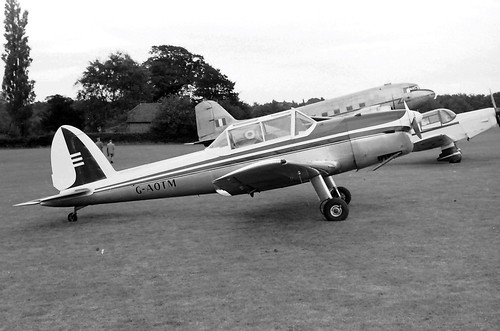
G-AOTM: DHC-1 Chipmunk 22A, To N65312 1976), taken at Wisley 15-9-57, Tony Clarke Collection (source http://www.flickr.com/photos/dwhitworth/7090618951/in/set-72157626917257590)
Built for the RAF as c/no C1/0862. Delivered as WP988 on 7/4/1953. Became G-AOTM 11/7/1956 (see http://www.caa.co.uk/docs/HistoricalMaterial/G-AOTM-1.pdf for history 1956-1969)
To N65312 on 26/4/1976 (see http://www.caa.co.uk/docs/HistoricalMaterial/G-AOTM-2.pdf for history 1969-1976)
Later became N122DH. This is what she looked like at Oshkosh, Wisconsin on 24/7/2012: http://www.abpic.co.uk/photo/1359935/. Oddly wearing incorrect RAF makings as “WD288” (c/no C1/0227) and still currently registered as such to a private owner in Cloquet, Minnesota with a C of A to 31/5/2015
Dr. John SmithSAAF Buccaneer ditching 1965: what happened to the crew?
Couple of other links that may be relevant/of interest
http://www.saairforce.co.za/the-airforce/history/saaf/attrition-summaries (but remember to manually select the year – 1965 – and scroll down the page as, by default, it will come up with 2013). Also, http://www.saairforce.co.za/the-airforce/history/saaf/attrition-summaries/17 lists ALL Buccaneer S.50s lost in SAAF service 1965-82
http://www.saairforce.co.za/forum/viewtopic.php?f=14&t=4924 (photo of SAAF 417 in Portugal on delivery flight)
http://www.ejection-history.org.uk/Aircraft_by_Type/Buccaneer.htm and http://www.ejection-history.org.uk/Country-By-Country/South_Africa.htm
– which states that the “brick” ended up in the drink “500 miles south of the Canary Islands”.
Is that correct? I always thought that the crash was much further south than that (i.e. off the coast of Angola – or at least in the southern hemisphere, somewhere south of the equator)
Dr. John Smithjan leeming and ian reed filming at air museum
Last line of the report reads “Searching for Rene will be screened on BBC1 on February 28”
Would it be correct to presume that it will be part of the BBC “Inside Out” series, that presents three short items of local interest?
(Previous such reports have been on the Thor ICBM sites – and one about digging up a P-51 Mustang in Lancashire)
If so, then please do post a link to the BBC iPlayer when it gets shown.
Dr. John SmithAuster AOP.6 VF582
Also there are photos of the aircraft as 7595M being picked up by helicopter at an airshow probably at Middle Wallop. Perhaps other Forum contributors can help.
Edskarf – the photo you refer to is here: http://www.arborfield-september49ers.co.uk/aac_helicopters.htm
No date or time info in the caption, but VF582/7595M is seen underslung a Whirlwind HAR.2 “F” of the JEHU sometime in the late 1950s. I would suggest 1959, as VF582 was Struck off Charge as Cat.5 (GI) in December 1958 and became 7595M (http://austerhg.org/prod_list/pages.php?page=2440 refers)
Just to confuse matters, Auster AOP.6 VP628 (later C-FLWK) is painted up and “pretending” to be VF582. See here:

credit http://www.flickr.com/photos/96002349@N00/3900712405/
So, any history of “VF582” will need to allow for the fact that VF582 isn’t VF582, it’s VP628!
History of Auster VP628 is almost entirely Canadian:
RAF serial VP628 (c/no. 2558) assigned for first flight tests in UK (Presumably at Auster Aircraft at Rearsby, Leicestershire. Assembled at No. 6 Repair Depot 15 May 1948. To MacDonald Brothers Aircraft in Winnipeg, Manitoba on 25 November 1948 for radio installation. Operated by Canadian Army from 1949 with Canadian serial 16651. Returned to RCAF on 24 January 1955. Stored at RCAF Lincoln Park (Calgary, Alberta) on 10 November 1955. Struck off charge 8 August 1957. Sold to Sigurdson Aircraft Ltd. To civil register as CF-MMY. Off register by 1976. Appears to be later registered as C-FLWK, and now is owned by the RCAF Memorial Museum in Trenton, Ontario.
Dr. John SmithSpitfire MK297
OK, presumably you mean BEFORE the fire. In which case, a sensible answer is this one:
MK297: Spitfire LFIX C/no CBAF.IX.1514. Built at Castle Bromwich. To 6 MU 30-1-44, 411 Squadron 12-2-44, 66 Squadron 17-2-44, Air Service Training Hamble 12-2-45. Sold to Royal Netherlands Air Force 27-9-46 as ‘H-55’ later ‘H-116’. To Belgian Air Force 16-6-52 as ‘B-15’ later ‘SM-43’. To COGEA and civil registered as OO-ARB in May 1956. As such, appeared in the 1962 movie “The Longest Day”
To UK on 28-4-64 with civil registration G-ASSD. Registered to Film Aviation services Ltd Horley, Surrey. Re-registered 11-3-65 to Reginald Wale, Cambridge. Registration G-ASSD cancelled 1-9-65 as “to USA”, but restored 20-5-66 to John Crewsden of Cambridge. Re-registered 29-9-66 to Graham Rich, Fakenham, Norfolk.
UK civil registration canceled 18-4-69: to USA as N1882 later NX9BL then with Confederate AF Breckenridge Texas as N11RS. Destroyed in hangar fire, Hamilton Ontario (Canada). Airworthy prior to its destruction in hangar fire, 15 February 1993
Source: http://www.spitfires.ukf.net/p069.htm
and http://www.caa.co.uk/docs/HistoricalMaterial/G-ASSD.pdf
and http://www.strijdbewijs.nl/birds/spitfire/registraties.htm
and http://www.fleetairarmarchive.net/Aircraft/Preserved/Spitfire.html
Never went anywhere near Douglas Bader, as he was a “guest” of the Third Reich at the time (August 1941 to April 1945). The confusion stems from the code letters applied when with 411 Squadron – it was coded “DB-S”, and Douglas Bader’s Spitfire had the “personal” code “D-B”
And here’s some footage of MK297 in the 1988 TV series “Piece of Cake” http://youtu.be/6R7pDoBSrKg
Dr. John SmithOur Strikemaster: Anyone have pictures or history?
As XF382 points out, your Strikemaster was briefly on the UK civil register as G-AYHS. Due to this, it has some details dated 1970 on their database, G-INFO:
See here http://www.caa.co.uk/docs/HistoricalMaterial/G-AYHS.pdf
It briefly carried a civil registration for (presumably) test flying and demonstration purposes, before moving on to a “Class B” civil registration as “G-27-…” (sorry, cannot recall the last three digits at the moment). “Class B” registrations are used for test flying of “foreign” military aircraft in UK air space, especially when “live weapons” are carried.
Oh, and by the way, the serial XR-366 was actually carried by the fifth production Short Belfast C.1 – a very different aircraft to the Strikemaster! The “real” XR366 looked like this:

(Belfast XR366 at Luqa, Malta in 1971 – photo by the Aviation Photo Company, on flickr.com)
For more info on your Strikemaster’s days with the Singapore Air Force, have you contacted the Singapore Air Force Museum? They can be contacted at: [email]afmuseum@starnet.gov.sg[/email] and their webpage is at http://www.mindef.gov.sg/imindef/mindef_websites/atozlistings/air_force/about/museum.html


 Sign In







