santiagorivas
Excellent map. I think that it’s possible that they encountered the ships huntig for ARA San Luis. Now the problem is what happened to Nogueira’s plane wing. He said he was almost hit by a missile and that the explosion was what damaged his wing.
I think that it’s difficult the airframe resists an impact with the water with the wingtip. But I don’t know, maybe this is possible.
santiagorivasThanks for the information about the aircraft used for long-range merchant-shipping attacks; I had no idea that so many aircraft were involved or that so many operations were mounted.
I did not mean that there would be any problem for the Italian crew in Argentina but rather, in Britain anyway, both Italian men and the women of Rio have reputations…
…I cannot comment on the accuracy of these reputations but these reputations persist.
I knew that the Hercules had stopped at Rio on the way down from the Virgin Islands (but I’m not sure why) possibly that was the reason that she chose to return there…..after all the damage did not make her unseaworthy.
es I heard about these reputation and I think maybe it’s right.
At last, it’s possible that they decided to go to Río because it was the last stop, but I think it’s very risky to do so long trip with an unexploded bomb.
santiagorivasWhy not? The Argentine government or military have official versions of every other attack during the conflict.
Urgently needed spares (and personnel) for the Task Force were dropped from C-130 by parachute into the sea and recovered by RN warships. Perhaps what the Brazilians saw were spares for the ship itself; it would not be uncommon for merchant ships of this size to carry quite a lot of spares aboard.
There is an interesting account in ‘Ordeal by Exocet’ by Lieutenant Commander Ian Inskip who was the navigator of HMS Glamorgan that states:
“…that Hercules, after being bombed, had turned round and headed for Brazil. Three hours later she was called by an Argentine station using her own call sign and told that if she did not steer for Argentina she would be attacked again. Hercules kept on towards Brazil and fifteen minutes later came under rocket attack…”
I have to say that there are many errors in ‘Ordeal by Exocet’ particularly regarding the types of aircraft lost and things of that nature (not sure when it was written) but it is a very interesting read and I’m sure it is accurate regarding the first hand experience of Lieutenant Commander Inskip (and others) aboard HMS Glamorgan.
His account of the attacks on Hercules put a different slant on the ‘offer’ of an Argentine port. Now I am not totally convinced by this account either but I think any master of a neutral vessel that had just been bombed may take the view that he would prefer to go to a neutral port. Apparently the crew were Italian so that may be another reason that they wanted to go to Rio de Janeiro!
I would be very interested if you had any information about what aircraft were involved (other than Canberra B-105), what weapons were used (some accounts talk of rockets) and the timing of the attacks.
I have also read that the ship was insured for war loss and that at the time there was a surplus of oil-tankers of this size and that the owners came to an agreement with the insurers to ‘write-off’ the ship for a sum lower than the insured value but higher than the current sale value of the ship. This may explain why a ship that was clearly repairable was scuttled in such a way.
As you say we may never know the whole truth about this incident but I certainly don’t think that it was carrying supplies for the British; logically this would make no sense. And why would the British not admit it if it was?
I’ve tried hard to think of some other covert or clandestine reason why this ship could have been operating for the British but haven’t been able to come up with anything plausible.
Although there were some books written by military, like the case of Carballo, Palazzi and Moro’s books, they are not the official version of the force. Also on the book done by the Dirección de Estudios Históricos of the FAA, which pretends to be the official version, they only put the account of the missions and have a lot of mistakes. When they did it they preffered not to talk about the C-130H Hercules serial TC-68 bombing missions, in which the tankers British Wye and Hercules were hit. They only stated those missions as Surveillance ones. This plane made seven flights equipped with bombs and I have details of only three of them, the ones in which the shipos were hit and one in which they detected a possible target and when they get closer they realize it was a fighting ship. For the date and location I think it was the Glasgow returning to England.
Now there is a plan to do a new version of this book, but I can see that most of the Argentine bibliography about the war has a lack of investigation and most of it is based on the accounts of the veterans shortly after the war and the reports of the missions, but they never checked most of the information until now.
Also in the FAA “official” book there are a lot of information missed, like a complete account of the civil airplanes used, the FAA order of battle at the beginning of the war, some missions are not reported and most of the reports are the same published in other books in the first years after the war. The first text of this book was written by comodoro Pio Matassi in the late eighties and includes a lot of information from comodoro Rubén Palazzi book about the air bridge to the islands and from Carballo´s books. All of them are based on investigations done from 1982 till the end of the eighties.
By then, there was also still the problem about the Hercules on the US court, so they didn’t want to talk about it.
In internet you can find the text of the final declaration of the US Supreme court about the attack and there is an account by the ship’s captain of what happened. http://www.altlaw.org/v1/cases/385424
The tale about the rockets is interesting as none was fired against the ships.
The planes involved were:
Boeing 707 TC-91 and TC-92 for surveillance
C-130H TC-68 as bomber with twelve 500 pound bombs on two Multiple Ejector Racks below the wings.
Canberras B-102, B-105, B-108 and B-109 as bombers with two Mk.17 1000 pound bombs in the wing pylons and extra fuel tank on the bomb bay
BAe 125 LV-ALW for navigation aid for the Canberras.
When they started to return, I don’t know why they didn’t go to Uruguay, which is closer than Río de Janeiro. I don’t think that there is any problem for the crew in Argentina for being Italian as a big part of the population here is of Italian origin.
I agree on what you say about the insurance, as I heard also that story and I think it’s possible. Asking with Argentine Navy officers they said the damage was easily repairable and that the bomb could be dismantled relatively easy.
Sadly It’s not possible to find how the Argentinians get the information about the Hercules activities.
santiagorivasI’m not convinced that the British urgently needed an empty tanker!
The oil-tanker Hercules was coming from the oil refinery on the Virgin Islands not from the US, which she left on 25th May, and was on her way (empty) to Alaska via Cape Horn (she was too big for the Panama Canal).
Are you suggesting that essential, urgently needed supplies were loaded in the Virgin Islands and then sailed the 6000 miles to the Falklands on the deck of a huge, slow super-tanker?
And how did these supplies get to the Virgin Islands; were they flown there? Wouldn’t it have been quicker to fly them to Ascension Island which is 2000 miles closer to the Falklands?
A ship that had a least one unexploded bomb on board…..maybe that was a reason to deny press access?
Now why would Argentina make that offer if the ship was a legitimate target?
So if Argentina was convinced that the ship Hercules was carrying supplies for the British and it was deliberately (and successfully) targeted why was this attack not celebrated as a success?
Sorry, but that sounds like a cover-up to me.
I don’t think it’s a cover, as this is not an official statement by the goverment. The Argentine government has no official version of this. Also there are no war secrets. Also is important to note that the ship was sunk in July, when the war was over and Galtieri’s government had fallen. The demand against the Argentine government in the US was started when a democratic government has arrived to Argentina and they were investigating all that was made wrong in the war and this ended with some of the highest rank military in jail, including Galtieri. So that government had no need to cover the Hercules attack.
Is interesting to note also that the US government stated they will not accept any attack to their merchant ships (with US flag or owned by US companies) and they gave regularly the position of their ships in the zone, and this included the Hercules, but the US government never protested the attack of this ship.
About the press access, they don’t have access to the crew.
I don’t where or when they loaded the cargo and where the cargo was being carried, it was a very big ship. As the Brazilians stated, they didn’t saw any very big cargo, but a lot of small spares and supplies.
Argentina offered to dismantle the bomb after the ship’s owners stated they were not participating on the war. So there was no reason to deny the Argentine offer, made after the war, if the ship was only an empty tanker. After the attack, when the captain declared by radio that the ship was bombed and decided to go to Rio de Janeiro, the Argentine Navy offered them to go to an Argentine harbor to dismantle the bomb. But this will led to an Argentine inspection of the ship.
Is interesting that, having an unexploded bomb inside, with the big risk of of this, they decided to sail more than 3000 kilometers to Río de Janeiro, instead of less than 1000 for an Argentine harbor. Why they didn’t stop at Uruguay? Maybe because it’s very close to Argentina.
At last, why they didn’t make any claim directly to the Argentine democratic govenrment (which was investigating the errors during the war), or in an Argentine or international tribunal.
Sadly I think we will never know the complete true about this. The way the ship’s crew and owners actuated was very strange for a civilian ship with nothing related to the war. The Argentine intelligence information indicated the ship was carrying supplies and the Brazilian information from the inspection stated this was true.
There wasn’t any pressure against the Argentine government, political or in the press, for this action, so to cover it wasn’t necessary. Officialy they didn’t want to talk because of that demand and because they didn’t have nothing to prove the ship was participating on the war. But oficially there is no classified information about this. The Canberra B-105 also had for a while the kill mark of the ship and when the plane was placed as monument at Mar del plata air base, to commemorate this attack, in 2000 she received again the kill mark.
The Canberra pilot who drop the bombs to the Hercules said he don’t want to talk about it because of the demand, but when I replied the demand was finished in 1988, he answered he don’t want to publish completely the attack bythe moment, but this is his own decision.
santiagorivasWithout wishing to cause offence this sounds suspiciously like an Argentine invention to cover the embarrassment of attacking a completely neutral ship.
I don’t think there is any conspiracy here; the British used plenty of civilian supply ships, with British civilian or volunteer crews and some really were put ‘in harms way’ but unfortunately the Hercules wasn’t one of them.
Frankly almost nobody in Britain knows (or cares) about the bombing of this ship, there are plenty of other things that have brought the Government controversy over the years, the sinking of the Belgrano, the loss of Sheffield, the bombing of the Sir Galahad and Sir Tristram; why would a ‘cover-up’ have been needed here?
The problem here is that the ship was of Liberian flag (a neutral country) and operated by a US company (although they supported the British, they only send supplies to Ascension, not directly to the Operations theatre because this could led to more support to Argentine by other Latin American countries and a worst relationship between Latin America and the US (except Chile and Colombia, all the other Latin American countries supported Argentina, some of them very fiercely). The owners of the ship made a claim to the Argentine government to pay the ship in the US court, by the claim was denied by the US Supreme court and the case was finished in the late eighties. It’s interesting that they demanded a payment for the fuel the ship was carrying on her tanks for the trip to Alaska, bu the Brazilian navy said the fuel was left at Río de Janeiro to avoid the fuel going to the seas. they only kepot a minimum fuel to go to the place where the ship was sunk. I don’t know how she was sunk, as in the photos of the ship sinking it’s no evidence of this.
I think the ship was carrying supplies from the US as seh was coming from the USA and never stopped in any British harbour, but she was going directly to the Operations theatre and the information the Canberra pilots were given was that the inteligence stated the ship was carrying supplies. It’s important to state that the ship wasn’t accidentaly bombed, the mission stated that they have to attack “this” ship, the Hercules, not any ship they encounter, so some information they must have.
Argentina received a lot of intelligence information from a lot of sources, most of them were never revealed.
I think the US sent this support directly to the operations theatre because they were needed fast, so to carry them to Ascension and then to British ships will take a lot of time. They used a civilian ship to try to avoid Argentine detection and also for not showing they were participating directly on the war. Some days before, Brazilian president Figueredo, on a visit to the US, told Ronald Reagan that the Latin American countries will not accept any British attack to the mainland nor an open involvement of the USA on the war. The USA needed the support of Latin American countries on the war against communist guerrillas on the region.
The commander of the Brazilian Air Force by 2002 was one of the officers who inspected the ship and told the pilot of Canberra B-105 on that mission, about what he saw. In the same day he was noticed about that (we were in Brazil at Canoas Air Base for the first Cruzex exercise) he told me what the Brazilian had told him. Sadly the FAA doesn’t authorize the official publication of the attacks against British Wye and Hercules, I think it was because of the use of TC-68 as a bomber, as the FAA released some information about the Canberras but none about the Hercules bomber until now. All that was seen was non official.
Ofically, the Argentine Armed Forces never talked about those attacks, so there is no Argentine cover about this operation, oficially this never happened and the ship owners also didn’t want to talk about it. For Argentina this wasn’t embarrasing, as there was no official accusation against the country except this claim at the US court that led to nothing. The press around the world didn’t gave much importance to the attack, so there wasn’t too much need to cover the operation.
Another interesting thing is that, because Argentine acussed the ship for carrying supplies for the British, the operators of the ship didn’t want to show the press that they were not carrying supplies. They forbid the access to the press to the ship and decided to sunk her, when she was completely repairable and Argentina offered to dismantle the bombs. It’s strange that they denied this offer and preferred to sink the ship.
All I know is non official and was told by the participants of those missions and information also given by some Brazilian friends and what the Brazilian newspapers published then. The Brazilian press was concerned because it was impossible to interview the crew of the ship and that a lot of political pressure was put for not talking about it.
santiagorivasThis is a good question posed by Creaking Door. On the surface it seems the raids were rather ineffective in the sense of actually accurately hitting their troop targets on night missions. I think a set of burst eardrums from a nearby 3 Para man was the only injury I’d read of reported from the British side, but there were apparently some unknown injuries from the raid by B-105 and B-109 on ‘Eagle base’ when they went for 846 Sqn Sea Kings.
Either way, it appears they (fortunately) didn’t kill anyone. Now, it does however seem that these night raids caused some unknown degree of psychological concerns among UK troops, to the point where the Canberras were apparently referred to as ‘vampire bats’. I have yet to hear that substantiated from the Brit side, but it is interesting nonetheless.
Regarding whether the Argentine command knew the (lack of) effectiveness of their night missions, that is a very good question. Whatever the case, it appears they were prepared to continue till the end, even after supplies of Mk.17 bombs were low. I can’t possibly fathom why they would want to return to anti-shipping missions. Perhaps Jualbo or Santiago can explain. My only guess is that they expected a loss from one of the night raids sooner or later and preferred to keep the bombers in reserve for such anti-shipping ops against some kind of mainland incursion?
BTW, as a brief side note, the attack on the VLCC Hercules was mentioned, for those interested, here’s a little further reading, including the dispute I’ve heard before about in which a C-130 did the bombing rather than the Canberras: http://www.histarmar.com.ar/HYAMNEWS/HyamNews2005/HY32-HerculesVLCC.htm
It’s interesting to ask why there was so much interest in shoting down the Canberras if they were causing no effect on British troops.
About the VLCC Hercules, the Canberras also participated. The Canberras attacked first (for planes, B.105 hit the ship with at least one of the two bombs dropped), they flew together with BAe 125 LV-ALW of Fenix Squadron. After that bombed the C-130H TC-68. The TC-68 made seven bombiong missions during the war, but not too much is known about that, only that they hit British Wye and the Hercules, but the bombs didn’t explode in both cases.
A good source from the Brazilian Air Force, who was one of the men who inspected the Hercules when she arrived to Rio de Janeiro confirmed the ship was carrying supplies to the British, he remember he saw spares for tracked vehicles, communication equipment, spares for other equipment, tents and other material. Possibly the ship was carrying stores from the US directly to the task force and that’s why they used a civilian ship. It’s also interesting that when Argentina offered to dissarm the bomb at an Argentine harbor, the crew refused the offer and preffered to continue to Rio de Janeiro. The Brazilian press wasn’t allowed to contact the crew or visiting the ship. Argentine technicians said to disarm the bomb wasn’t very hard and that could be done to save the ship, but the owners preffered to sink the ship.
At last after your question of the yellow markings on the Canberras, I found a picture on a book in which a line up of Canberras during the war can be seen and all have the yellow markings. I can identify B-111, 101, 102 and 104 in the photo.
santiagorivasApparently HMS Invincible and HMS Brilliant headed to a position ‘south of Falkland Sound’ (Brown – The Royal Navy and the Falklands War) on the nights of 6th and 7th June to intercept Canberra or C-130 transport aircraft. Commander ‘Sharkey’ Ward states in his book that CAPs by single Sea Harriers from HMS Invincible were flown 120 miles ‘west of Cape Meredith’. It is not always referred to as Operation ‘Canbelow’ but it seems that this operation and the inshore activities of the Type-42 destroyers were part of a strategy to tighten the not-so-effective air blockade of the islands.
Excellent, thanks!
santiagorivassantiagorivas,
From memory Cardiff was about a thousand miles or so from the TEZ when the 707 incident occurred. I had heard that Coventry had tried to engage the 707 the same day also.
We arrived in the TEZ on the morning of 26 May. Why are you confused my friend?
Hi Ken, I asked you because on the Coventry website they said they tried to engage a Boeing 707, but the only Boeng 707 flight on that day was the TC-92, engaged by you, so I don’t knbow to what the Coventry fired a Sea Dart as there was no big Argentine airplanes on the TEZ on May 22.
About Cambelow Operation is stated on the Canberra historical book made for the 25th years of Canberra operations, but I see that doesn’t appears in any British records. The only known record of Invincible going to the west was on Operation Mikado, on May 18th when they launched the Sea King lost in Chile.
Something interesting but never confirmed were the detections of helicopters heading to the mainland during the war on the night. In some ocassion a Pucará pilot stated he saw helicopters with navigation lights but they turned off the lights when the Pucará approached. I don’t know if they were really British helicopters and if so, from where they were operating. Maybe they were dropping special forces to watch the Argentine aviation operations.
One last question for all. Does the Nimrod equipped with Sidewinder was effectively deployed south?
santiagorivasOn the website of HMS Coventry they seate the following on May 22:
Coventry locks on to an Argentine Boeing 707 reconaissance aircraft. A flash door fails and the missile launcher goes into fail safe mode, preventing the launch. Later in the day HMS Cardiff also attempts to down what may have been the same aircraft – they have more luck in that their missile fires successfully and is seen to explode near the target, but the aircraft’s crew had seen the incoming missile and successfully manouevred to avoid it, returning to base safely.
It’s strange, as TC-92 very far from the islands. How far from the islands was Bristol group on May 22. They have some mistakes, as they also state that Exeter and Cardiff arrived to the TEZ together with the landing force on May 20. It’s interesting as is obvious they didn’t fire against a Boeing 707 on May 22, but to whom they fired that day.
santiagorivasKen, what information do yuo have about Operation Cambelow, I only have info from Argentine sources and it’s not very complete. Also the information states that Cardiff was one of the ships involved but I see nothing about this on the records of the ship you posted.
santiagorivasThey had luck on their side that night. Saw the missile and it self detonated as well.
I wonder why our command did not place us off the west coast at night? Surely with our radars looking toward Argentina with open ocean ahead of us we would have managed to detect and engage these aircraft a lot easier. As it was we were positioned where our radars would be blinded by all the high ground on the islands.
Maybe because they were closer to the coast for an Exocet attack? I don’t what could happened if the Argentine Navy send their four fast patrol crafts to the islands (two Higgins class and to TNC 45). They could be an interesting threat to any ship operating close to the coasts and they could be hidden easily as they were small and well armed. Although the two TNC 45 had torpedoes, they could be armed with Exocet, as t was done some time ago with one of them. a good idea was to have two at Puerto Argentino/ Stanley and two at Port Howard or Fox Bay to protect San Carlos
santiagorivasThe plane engaged on June 7 was the C-130H TC-65. I flew on that plane in 2003. Thew saw the missile and turned, returning to the mainland. Behind them was arriving to the islands the TC-64, that also turned and headed for the mainland.
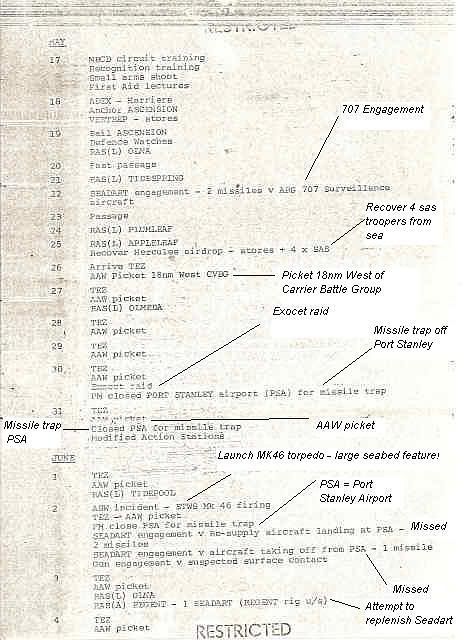
santiagorivasI’ve been looking for this document for ages now and screamed with delight when I found it!
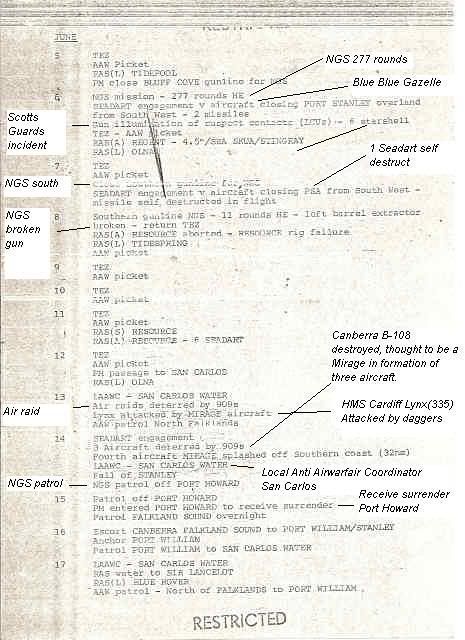
It is the Report Of Proceedings (ROP) submitted by HMS Cardiff at the end of the conflict (as did all warships). It is a bad copy so I have helped you with key incidents.
Take your time reading it because I do not think there are many official documents like it available. The Royal Navy did not release this.
Let me know if you need help with abbreviations etc.
The firing on June 2 was against COAN’s Fokker F-28 serial 5-T-21, as no Hercules flew to the islands on that day. The Navy made a lot of flights with their F-28s and one with an Electra (29th of May) to the islands during May and June. The FAA only operated with Hercules to the islands from may 1st.
santiagorivasI’ve been looking for this document for ages now and screamed with delight when I found it!
It is the Report Of Proceedings (ROP) submitted by HMS Cardiff at the end of the conflict (as did all warships). It is a bad copy so I have helped you with key incidents.
Take your time reading it because I do not think there are many official documents like it available. The Royal Navy did not release this.
Let me know if you need help with abbreviations etc.
Excellent material! I think that no Argentine account tells about those Sea Darts fired against the Hercules landing at BAM Malvinas.
There’s no evidence of a detection of the Canberras except on the B-108. I see also that on June 13th an attack from a Mirage to a Lynx is stated. Do you have more information about this?
I’m very interested to state your accounts about the 707 and B-108 actions in my articles, let me know by PM if this is possible.
Thanks
Santiago
santiagorivasI think this is another case of aircrew exaggerating their post combat reports, let me explain. With reference to the night Canberra missions my ship HMS Cardiff constituted 50% of the Type 42 contingent on the dates quoted. HMS Bristol had Seadart but was not tasked with inshore night missions throughout her time down south and only one of the Type 42s were detached from picket duty at any one time.
4 June: Cardiff on NGS gunline Bluff Cove – no Seadarts fired.
12 June: Cardiff in San Carlos – no Seadarts fired.
Without looking to see where Exeter was on the other nights in question , how do you explain the airborne Seadarts on the 4th and 12th June?
Do you know if the Canberras were detected? or why you didn’t fired against them? Do you know if the Hercules landing on the airport in the night were detected?


 Sign In