 TinWing
The MRH-are to be used to transport troops and to conduct anti-terror missions. The order is valued at roughly 1,5 billion dollar. Deliveries will be made between 2007 and 2015.
$44 million for each NH-90?
How about 10 Mi-17s or 3 S-70s for the same amount?
TinWingUnicorn, thanks for the great find.
Does anyone know anything about the earlier CODOG 1,800 ton “General Purpose Escort” that was proposed for the RAN in the early 1960s?
Conways is the only source that I’ve ever seen.
TinWingHere is an amazing image of the ship:
It is obvious that the topsides have been painted recently, although the hull looks like it’s been neglected since the Soviet era.
It also appears that most of the lifeboats have been stolen – not a good sign, but typical of Russia.
TinWingIts good to see the PLAAF getiing this type, despite its drawbacks it is still a very capable design and a great strike bird. I would love to know what the production rate is for the JH-7A???
I think that the entire world would like the answer to that question?
My best guess is that the J-10 is being produced at a far greater rate than the JH-7.
Of course, who knows?
Does anybody really know if all of those “new” Xian H-6s are rebuilt or new production?
TinWingThat doesn’t necessarily mean there is any “shifting away from supercruise”. They needed more power and less cost out of the F135 when compared to the F119. That entailed a reduction in TET so they could use cheaper materials and in increase in airflow for more power. They increased the bypass ratio rather than completely resdesign the core as that would have meant more $$$$. Those factors make the F135 a less efficient engine for supercruising. Also supercruise was never a requirement for the F-35 as it would have increased the cost. So it isn’t like they wouldn’t LIKE the ability but they can’t AFFORD it.
The shift away from supercruise occured well before the JSF requirement. Remember that the cancelled A/FX would have been barely supersonic.
Beyond the JSF – which is possible the last manned fighter to be developed by an Western power – all of the coming UCAV requirements seem to emphasize subsonic endurance, not supercruise. “Loiter time” is the new watchword.
TinWingPerhapbs I should clarify. In comparison to other turbojets, the ‘raw’ figures on the R-35 look very impressive. Same weight as the J-79 but much more powerful. I’m aware that the J-79 is an earlier generation engine, but then if you compare the later models with what is essentially ‘ a warmed over R-29’…I also see that it is smaller than the R-29, so if anybody could explain if they are essentially the same engine I’d appreciate it.
The R-35 was typically installed in late model Soviet MiG-23s while the R-29-300 was used in export models. Were the two engines interchangable?
A better question is whether a R-35 MiG-23 was any more credible as a fighter than a R-29 MiG-23?
By best, I didn’t mean just raw thrust. I’m aware the West started concentrating more on turbo fans in the sixties, so the Sov Union perhaps developed the turbojet a little further. The J-75 was a big beast weighing in at around 6000lbs for less thrust. It was an earlier engine as well. The olympus was not used operationally on a jet fighter to my knowledge. As also explained earlier, the different models used in the Vulcan and those meant for the TSR2 were very different engines.
It is wrong to equate Soviet engines directly with their Western counterparts. The Soviets lagged far behind in terms of military engine technology technology until the 1980s, and never came close to catching up in terms of servicablity or durability. In the same way that the Soviets stuck to Nene developments long after the British went on to the axial flow Avon, the Soviets missed the entire first and second generation of military turbofan development while continuing the design and production of obsolete turbojets.
I’m trying to establish the various figures of TBO, SFC etc. to find out if the increase in thrust achieved was a lower life, or more advanced design and materiels. I also would like to know if the R-35 was installed in lets say a Mirage F1, would it supercruise? The external dimensions of the R-35 are a lot smaller than the Atar…With a renewed emphasis on supercruise, wouldn’t a turbojet make sense as opposed to a turbofan?
If a low bypass ratio (.2-.4:1) turbofan can supercruise, why revert to a pure turbojet?
Of course, a shift away from supercruise might already be underway. Compare the F-35/F-135 with the F-22/F-119. Think about it.
Either way, it is a very impressive turbojet, and probably the most powerful ever put into a production fighter jet.
I’m not entirely sure how impressive the R-35 really was, but it is certain that it isn’t (or wasn’t) “the most powerful ever put into a production fighter jet.”
TinWingEveryone always seems to forget the Olympus.
The Olympus 593 managed to complete 25 years of commercial Mach 2.0 service aboard the Concorde – a feat that has never been matched. It is fair to say that Olympus 320 would have been equally successful in military service if the TSR.2 hadn’t been cancelled.
TinWing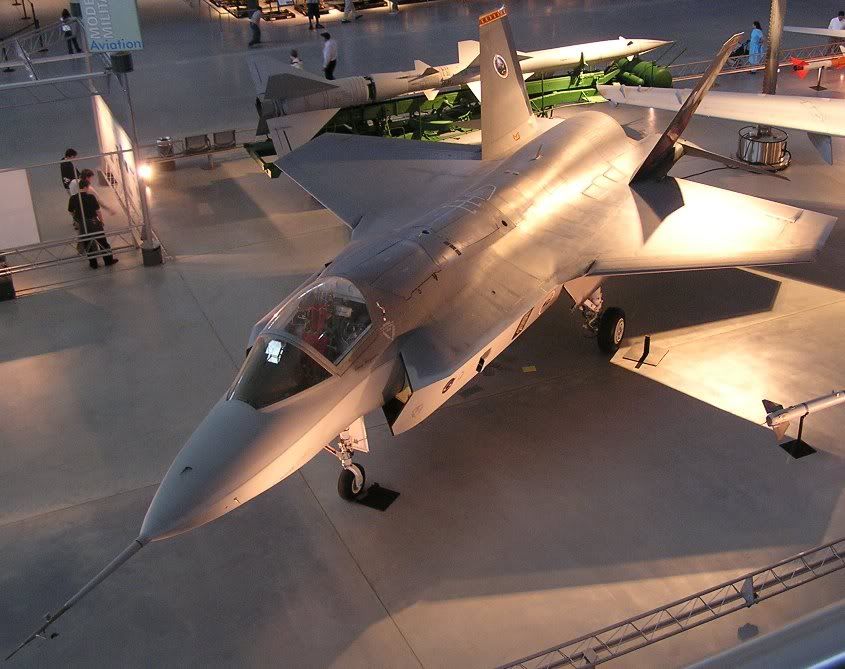
Now this is actually a very good X-35 photo – especially when you consider how damned dark it is at the Udvar-Hazy.
TinWingConsequently, the results of this excursion have reinforced my intention to find a digital SLR camera to get rid of a lot of the issues I’ve been having. Anyone have a good recommendation? I’m looking for something that can take clear pictures in low light conditions, and can also capture very fast moving objects without blurring (think dark museums and airshows, basically).
What do you already own for lenses? This is the important question.
Yes, the lens is still more important (and more expensive) than the camera body, even in the age of the digital SLR.
If you can live happily with only the lousy 18-55mm lens that comes with most digital SLRs, then you probably shouldn’t buy a SLR to begin with.
You can buy a digital SLR body for $500 and up, but you should plan on spending $1,000 and up for decent lenses.
Of course, your pictures at the Udvar-Hazy are actually pretty darned good. This dark hell-hole of a hangar is a terrible place to photograph. Could you tell us what camera you are using currently?
TinWing4 are ordered now but the plan is building at least 10 ships for patrol duties and another 4 for other mission (AGI, Oceanographic).
In light of the planned oceanographic/survey tasked variants, the slow 20.5kt top speed and unusual CODOE propulsion plant seem to make sense.
TinWingIt appears that the BAM “frigates” have completely different dimensions and performance specifications than the Venezuelan ordered Economic Area Vessels – despite being very close in overall size and role?
Economic Area Vessels:
Length: 96.60 m.
Width: 13.60 m.
Depth: 7.20 m.
Displacment: 2,300 t.
Speed: 24 knots
Autonomy: 3,500 miles
Crew: 60 + 32
TinWingI have scanned the drawing fron Conway’s here:
http://s22.photobucket.com/albums/b336/Bager1968/misc%20ships/?action=view¤t=PA-58Verdun.gif
The Conway’s drawing is wrong about some details. For instance, the artist substituted the short 50m catapults from the Clemenceau class.
TinWingThat is true but lets first admit that the YF-23 was a better design than the YF-22. I think everyone can agree to at least that.
The USAF certainly didn’t judge the YF-23 to be the better design.
It seems that the YF-22 performed better in flight trials, wining the ATF fly off in the same way the X-35 beat the X-32.
TinWing:rolleyes:
Here we go again, *sigh*The SH-2G was selected for the OPV’s and the Anzacs because these ships had smaller decks then the FFG’s currently in service. Since the cancellation of the OPV it has been proven that the Seahawks can operate off the deck of the Anzacs.
I know full well that the SH-2G fiasco was put in motion by the abortive attempt to build up to 12 OPVs for Australia and 27 for Malaysia. In reality, the plan was poorly conceived, as was the actually OPV design, and Transfield Shipbuilding (now Tenix) couldn’t compete with Blohm und Voss for the Malaysian order.
Is it ironic that Freemantle class patrol boats will finally be replaced by patrol boats of similar size? Perhaps irony is the wrong word.
I probably shouldn’t mention that the 81 meter Aussie OPV had an astoundingly small flightdeck, even for a 1,400 ton ship. I also should mention the stupidity of operating a specialist anti-submarine helicopter like the SH-2G or Lynx from a ship that would only perform a coast guard function.
Read up on Air 9000 and it will tell you mate, most of the current helo fleet in the ADF are to be replaced with a new single type offering commonality and logistical support on a scale never before seen in the ADF. S-70’s are to be replaced under that same article (phase 7 IIRC). The MRH-90 offered the best deal of upgrading the amount of personel/cargo over larger distances whilest still operating off the current sized decks. All the other contenders could not meet these critical goals (SH-60 Battlehawk not enough range and not enough troops/cargo, EH-101 far too big to operate off the deck of an FFG). This is why we went for it.
I’ll be first to admit that the S-70 has a small cabin. However, the 3:1 cost differential between the S-70 and the NH-90 more than makes up for this shortcoming.
I should also point out that the NH-90 might very well be out of production by the time that Australia actually seeks to procure naval S-70 replacements
Ummmm ok well we have spoken about this before as well mate, go look in the thread on the Modern Military Aviation section at the thread on the Rooivalk currently running. Basically we chose the Tiger because it being the newest kid on the block, offered the most amount of design growth potential over it’s rivals. Which would you have prefered we got (please don’t tell me the AH-64)?
The Tiger is the European equivilent of the cancelled RAH-66 Commanche – and RAH-66 cancellation was right on the money.
I would have argued in favor of the Hellfire equipped S-70, for the sake of fleet commonality, or even the AH-1Z – an excellent choice for amphibious deployments from the upcoming LHDs.
Australia bought the Tiger because Eurocopter was willing to build to Australian specifications. Buying a small number of bespoke attack helicopters is an expensive proposition.
Mate seriously, what are you on? It is questionable if the CH-53K program is ever really going to get going. Australia is happy with the Chinook and to give them up for the CH-53 is insane to even think of because it is adding a new type to the inventory that we are trying to cut down on, I mean didn’t you just say:
And here you are talking about a new helo, no way. We’ve had the Chinook in service for a long time, we love them and know them in-side-out. More of the same type is acceptable, converting them over to a new machine and more of them is insane.
As previously stated, the CH-47 is unsuitable for sustained amphibious deployments. I could ennumerate the many shortcomings of the Chinook, but that might be better material for a non-naval thread.
TinWingWow only $804 million a piece. Good thing those Typhoons are cheap huh? (That’s how everybody calculates the cost of the Raptor so I figured I’d apply the same metric.)
Including all development and life cycle costs, the highest estimate I’ve seen for the F-22 is “only” $350 million per unit – or as little as $130 million if you just include direct production expenses.
I have to admit that the unit costs of the Saudi Eurofighter order make the B-2 look cheap. Sure, the B-2s might have cost $2.1 billion each, if you factor in R&D, but Northrop-Grumman once quoted a cost of just $650 million per unit for a follow on order.


 Sign In








