TinWing
.. and surprisingly both Gripen and T-50 can Super cruise with the available thrust of F-404, but LCA well…:(
The LCA has a far greater wing area than either the Gripen or T-50. Low wing loading might be beneficial in terms of maneuverability or airfield performance, but it is entirely detrimental in terms of drag. Keep in mind that the LCA stems from the same BAe P.106B study as the Gripen, but after Dassault’s entry into the program, the configuration increase in wing area and dropped the canards. My guess is that the canard was dropped to reduce production costs while the increase in wing area was meant to offset the loss of the canard.
TinWingThough corrected earlier, the above from Flight International issue dated around 1990, is inaccurate. As mentioned in various public articles (official and unofficial), the equivalent of the above amount in Indian rupees was spent from 1983 to 1989 in the set-up of the ADA itself, hiring personnel, Project Document (for which Dassault was chosen), and CFD testing, and wind-tunnel testing of 1/7 scale mode.
No, Dassault’s collaboration was far greater, involving the selection of the current configuration of the LCA. In truth, BAe was involved in the LCA even earlier, with the BAe P.106 forming the basis of the first canard-delta LCA configuration.
TinWingIt is Rosoboronexport it is part of the April news of course you need another excuse in fact they are part of the archive news of 22 and 24 april and if you look in the Russian version old news you will find them.
http://www.roe.ru/news/lenty/lenta_08_04_24.htmland the proof is the home page for rosobooexport is http://www.roe.ru see how both pages start with http://www.roe.ru
The deal is not like you are saying the J-11B is not more than a copy and illegal copy of the Russian technology illegally and treacherously copied.If you remember the F-15 deal Japan never sold or built more than what was allowed by the contract who does not know about international law is you.
When you have a product and you buy the license it does not mean you own the product it simply means you are allowed to build a limited number of examples only that and all the examples of Japan, India, Germany, US show they always respect the number of examples allowed.
Did the US build more Harriers than the number allowed by England?
Did Norway, the Netherlands, Denmark and Belgium build more F-16s than the allowed by the then General Dynaics now Lockheed Martin?
Did Italy build more speys than the allowed by Rolls Royce when they built the AMX?
Did India build more Jaguars or MiG-27 than the allowed by Russia, France and England?
Did Japan build more F-4s and F-15s than the allowed by the US?
Did England build more AH-64s than those allowed by the US?
Did Chile build more C101 Mirlo than the allowed by Spain?
Does Brazil build more Eurocopter helos than the allowed by Eurocopter?
Does Mexico build more Fuselages than the allowed by Bombardier or MD helicopters?
Did Turkey build more F-16s than the allowed by the US?
Did Israel build more J-79s than the alllowed by the US?
Did Sweden and Saab build more Pratt & Whitney JT8D engine than the allowed by the US to power their Viggens, or GE F404 for their Gripens?
Did India build more MiG-21 than the allowed by Russia?
The answer is not because in the west as in many other countries the norm is respect the license
The Su-27/J-11 stems from the Soviet era, and quite frankly, the status of Soviet era intellectual property is entirely uncertain. Moreover, in this case, it is hard to say whether a government-to-government treat, a Soviet era contract, or a post-Soviet era contract governs the continued Chinese production of the Su-27/J-11. In short, it is wrong to use provocative language, or to make anti-Chinese statements, because, after all, China might be well within its rights to continue production of the Su-27/J-11.
You can cite any number of Western licensed production deals, but the fact remains that the same rules don’t apply to Soviet, or even post-Soviet, deals because of fundamental differences in the rules of property and commerce. It might be entirely possible that all of the intellectual property pertaining to the design and production Su-27 now belongs in the public domain, and that any corporation or entity outside of Russia has every right to it.
TinWingSukhoi super jet first flight 2008 May 19th
Of all of your examples, this is the only aviation project that doesn’t date from the Soviet era. Keep in mind that almost all of the Russian projects with first flights after the fall of the Soviet Union were conceived and partially completed during the Soviet era.
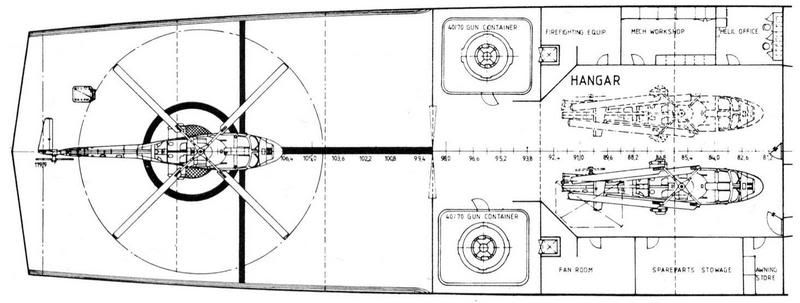
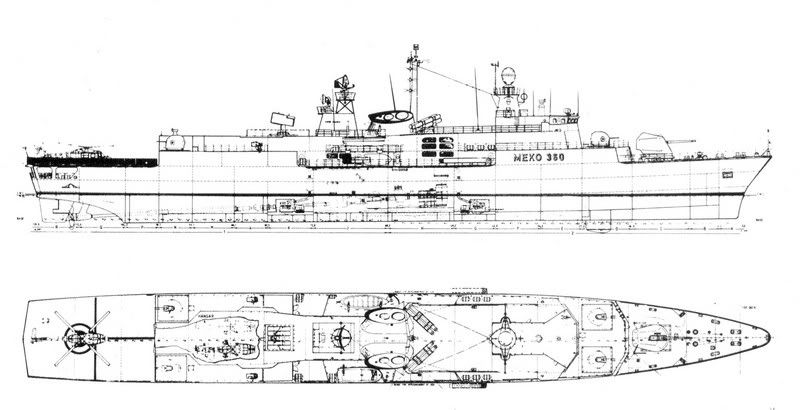
TinWingThat is the MEKO 360 Mod 3, offered around 1985.
The hull was stretched (how much I do not know) to allow for a VLS missile group to be added forward. Another displaced the previous mechanical SAM launcher amidships. Propulsion was CODAD. A model that made the trade show circuit at the time showed an armament fit similar to the drawing above: Mk 45, 2-channel Seaguard CIWS, 2×16 VLS SAM, SSM, etc. The electronics fit was slightly different with SMART-S (then just called “SMART”) and Dolphin sharing the foremast but still with LW-08/2 aft. The fixed phased array in the illustration is not APAR – far too early for that. It does not represent any Signaal project of the era that I am aware of. It may represent RCA’s FARS radar, or possibly the illustration does not represent any specific sensor planned at that time.
The standard MEKO 360 is BTW some 8 meters longer than an ANZAC so there is a reason why the 360 seems so much more powerful.
Here is a drawing, with two 32-cell VLS – although I don’t know if they are Mk48 or Mk41. Most of the proposals leading to the F123 seem to have been CODAD, with Germany and France sharing the same enthusiasm for all diesel propulsion in this era.
TinWingAnyway just a correction, Aradu has a single helo where as the Argentine vessels are actually a two helo carrier, the last pic is how this works, rather interesting.
Here is the overall plan:
TinWingI really love it too 😉 …. but is more and more difficult to find some hidden pearls.
Fine those Meko iterations!That is a good image of the “Navire de Transport Belgo-Luxemburgois” proposed by Izar in 2003.
… and the hi-res version:
http://www.infodefensa.com/ediciones_especiales/imgs_grande/infodefensa_01.jpgCheers!
Here’s the brochure for the 21,500 LHD from the Navantia site:
TinWingI agree, I like this configuration. A mix of Aster-30 and Mica seems like a good combo for the AAW mission. In that scenario is the Aster-15 really required? I would be interested to know how the French and Italian Horizons VLS cells are loaded out as there are rumors that T45 will only get Aster-30?
It all depends on how great the gap is between the minimum effective range of Aster-30 and the maximum effective engagement range of Mica VL against a likely threat, taking into account detection range and reaction time. In short, it’s time the Europeans started firing multiple MA-31 supersonic targets directly at PAAMS/SAAM equipped vessels under realistic conditions.
TinWingIf memory serves, its main limitation was in terms of defensive aids and hardpoints, meaning that in later life combat missions necessitated carriage of chaff/flare and ECM pods on the two wing hardpoints. This meant that the centerline hardpoint was the only one available on some missions. I suspect the slim fuselage caused some of these difficulties, i.e. not providing room for the added equipment.
Actually, almost every European combat aircraft of the era lacked internal ECM and was forced to result to podded self defence measures, in contrast to American aircraft of the same era. In reality, European air forces lacked immediate experience with Soviet-style air defenses, unlike the Americans, and the obvious funding and industrial constraints worked in favor of podded, rather than built in defensive measures.
TinWingPlease elaborate.
I would refer you to the service history of the F-14A to relate just how unsuitable the TF-30 was for a high performance fighter. Similarly, the Spey 202 was very problematic in RAF Phantom.
TinWingThat is the same arrangement that I have always asked whether it is possible also for Horizon. Whether a case if the Oto 76 has been placed on starboard side of Doria’s hangar?
The same sort of split VLS design was considered for a “late CNGF design,” according to RP1, not to mention a similar hangar side VLS depicted in an unofficial 1994 study.
TinWingArtist draw of Italian FREMM
I only see 16 VLS cells forward, and if I remember correctly the front most cells are the longer Sylver A70s?
Does this mean that Italy is shifting from Aster 15 to Mica VL, in the same arrangement as the proposal to Greece?
TinWingPerformance wise, however, it was a very good aircraft, albeit limited by its Atar engine, where something more modern like the Spey would have been a benefit. Add in room for the ECM gear and chaff/flare dispensers, and you have an excellent fighter.
The Mirage F1 was always meant to have the M53 for advanced derivatives, but the sales success of the YF-16 put paid to the F1-M53 and lead Dassault to develop the all new Mirage 2000. The ATAR was inferior to the J79, but superior in serviceability to all of the contemporary Soviet turbojets. In hindsight, the ATAR was a far better choice for a fighter engine than many first generation turbofans such as the early TF-30 and Spey 202.
The Mirage F1 was a very good multi-role fighter, a relatively cheap alternative to the late production F-4E, and altogether superior to any comtemporary Soviet fighter before the MiG-29.
TinWingAs stated above I think they need to look at their programs again. I think the Italian San Giorgio is perfect for the Turkish requirement for the LPD and LST replacement, accepting that the LST requirement is in need of some modification, and going with one design for both is just good sense. To my mind 3 San Giorgios is by far the better option than a Dokdo and a pair of LSTs.
The San Giorgio is obsolete and due for replacement in the next decade – hence the Italian Navy’s LHD program. In any case, the bow doors have been sealed on the San Giorgio for many years, which serves to prove the point that a LST/LPD hybrid is a bad idea, a point that further indicated by the scrapping of two out of the three Ivan Rogov class.
At this point, the Dokdo represent the most economical and flexible alternative for a mult-role amphibious platform. South Korea has lower shipbuilding costs than France, Spain or Italy, not to mention the possibility that the Dokdo class might latter be retrofitted for the operation of the F-35B. Turkey is interested in the F-35, and having a potential STOVL capable LPD, no matter how long term that potential might be, is a tremendous selling point.
TinWingFirst drawing of the new frigate Gorshkov – http://forums.airbase.ru/2006/06/t39646,3–Fregat-~Admiral-Gorshkov~.html
I’ll be thankful if anyone from Russia could download the larger version of the picture and post it here 🙂
This is the link to the Pr. 22350 drawing – which only works for Russian IP addresses:
http://balancer.ru/forum/punbb/attachment.php?item=97868
Anonymizer.ru no longer seems to work, so I don’t have a clue as to how to view the full sized image? Can anyone help by attaching the full sized image in this forum?


 Sign In