aerospacetech
Erm.. Rapier is a command to line of sight system, initially with a basic optical sight, later with radar and EO options. Even with the latest radar version, if all else fails you just put the optical crosshairs on the target and fire.
I’ve played around with a Blowpipe SAM at an airshow and found it hard to keep the crosshairs on target. As a SAM system, optical CLOS seems best suited to helicopters and transport aircraft.
aerospacetech[wrong post]
aerospacetechMcDonnell-Douglas deliberately chose not to use FBW or relaxed static stability for the F-15, even though the technology was there to use, to reduce risks.
aerospacetechSOC, the RD-36-41 engine was derived from the earlier VD-19 turbojet, considered initially for advanced Tu-128 versions.
The Rybinsk-based OKB-36 design bureau launched its work on the VD-19 engine as early back as in the autumn 1958 under the supervision of chief designer V.A. Dobrynin. In late 1960, the engine saw the beginning of its bench tests. It had a takeoff thrust of 13,000 kgf in afterburner, with its maximum thrust with reheat totalling 8,400 kgf at an altitude of 14,000 m and a speed of 2,230 km/h as well as 2,350 kgf at 20,000 m and 1,600 km/h. When in the subsonic cruising non-afterburner mode, the engine featured a specific fuel consumption of 0.97 kg/kgf*h.
aerospacetechSean, you should know better than to believe Janes :dev2:
aerospacetechSOC
Its a cute theory, but I think the reason why all the engines are RD-36-XX is that they are products of OKB 36 (originally Dobrynin, later Koliesov).
Likewise the R-13-300, R-25-300, R-29-300 are products of OKB 300 (Tumansky).
aerospacetechActually, I think an Imaging Infra-red seeker is ideal for a long range AAM. Typical ranges for a current active radar seeker are in the 15-25km range, so all long range missiles rely on inertial/datalink guidance to get them close to the target. A good IIR seeker should be able to reach at least 15-20km. If a two way datalink was fitted, then the seeker image could even be relayed back to the launching fighter for final confirmation of target identity though this would clearly increase cost.
aerospacetech1) If you choose to believe everything I said above is “rumor” you really are stupid. Every instance of copying I mentioned above is 100% confirmed, documented, and real, freely admitted by Russian sources. They had no respect for intellectual property rights; that was a capitalist notion.
2) I have no idea what point you are making here.
3) Yes, that is called design evolution. You’ve seen the early MiG-29 test models, right? That doesn’t mean that the first MiG-25 sketch wasn’t a Vigilante-alike.
4) See 3)
5) Ok. You believe that. I’ve been researching Soviet/Russian aircraft since before you were born.
aerospacetechThe Soviet Union spent vast amounts of time and effort stealing US technology. That’s really not up for debate. They happily cloned the Sidewinder (K-13), they reverse engineered AIM-7E Sparrow (K-25) and then never put it into production, they stole J-79 technology and used it in the AL-21F engine, cloned Paveway and Walleye seekers, etc, etc, etc. Soviet agents photographed every square inch of the F-111 at Paris Airshow, and produced reams of documentation from open and classified sources on the F-111’s variable geometry wing. Mikoyan was fascinated by the Jaguar’s landing gear, and modelled the MiG-23’s landing gear on its design. They didn’t use this information uncritically, though, or the Su-24 and MiG-23 would be straight F-111 clones.
Like it or not, the US always had the technological edge in most areas. This came from the vast wealth they had to invest in research and development. Rather than invest billions of rubles reinventing the wheel, where possible the Soviet Union would steal what it could.
aerospacetechFirst:
The testbed shown above is fitted with an experimental AL-31F derivative created by Salyut. Salyut was the first factory that built AL-31F and were quite instrumental in productionising the design. They have created an in-house design bureau, and are pursuing their own development path for AL-31F upgrading. They have licensed Klimov’s RD-33 thrust vectoring nozzle, which is a fully 3D vectoring nozzle design, to fit to their upgraded AL-31F.
UMPO is the other factory building AL-31F. They are part of “NPO Saturn” along with the Lyulka design bureau. Saturn regard the new Salyut developments as unofficial at best or even illegal.
aerospacetechSFerrin never claimed it was a copy! Try reading his post. He just made the point that there were some general similarities between MiG-25 and F-15, justlike there are similarities between MiG-25 and A-5.
aerospacetechMiG-25 uses similar air intakes and general layout to the A-5.
http://avionsdechasse.free.fr/chasse/a5/a-5vigilante.jpg
Mikoyan allegedly returned from the 1959 Paris Airshow and told someone to sketch a new layout similar to the Vigilante but without the “all too complex” boundary layer blowing system.
Oh, and the images earlier of something like an FA-22 are fan art, nothing more. In fact I think they are overpainted over an FA-22 photo.
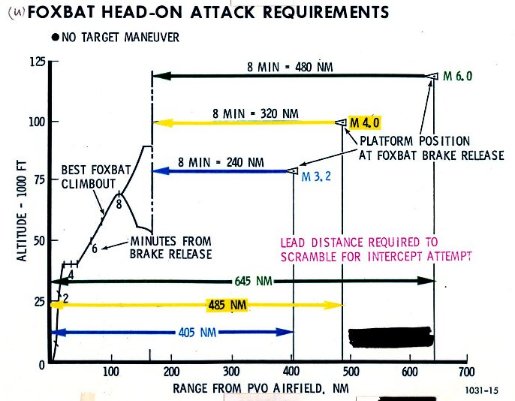
aerospacetechThe diagram is supposed to show that intercepting a Mach 3.2 aircraft is difficult. You need adequate warning time to actually climb to an altitude where you can fire your missiles at the SR-71. Didn’t the USSR have spies outside Mildenhall, phoning warnings when the SR-71 was taking off from England? Thats the kind of warning time you want if you are going to try and intercept the SR-71.
The 1968 SA-2 incident shows that even if you can lock onto the Blackbird, its high speed, reduced RCS and onboard ECM systems mean the missile never stood a chance of intercepting it.
I wouldn’t say SR-71 was a “stealth” plane. Its combination of reduced RCS, speed, altitude and electronics was pretty much invulnerable to SAMs and interceptors though, and it routinely flew over Vietnam, Korea, and dozens of other countries.
Yes, the USSR would probably have eventually shot one down somehow if overflights had continued by one means or another. However, the reason overflights stopped was political, not operational.
aerospacetechaerospacetechOn 26 July 1968 #976 was piloted by Major’s Tony Bevacqua and RSO Jerry Crew in an operational mission over Hanoi, North Vietnam. This flight was the first time that a SAM had locked on and fired upon a Blackbird. The crew knew they had been fired upon by two missiles and after flying a return track over the same area, no additional SAM’s were fired. Landing was uneventful at Kadena. The Terrain tracking camera recorded the SA-2’s launches and later evaluation revealed the nearest missile exploded about one mile behind and away from #976.


 Sign In