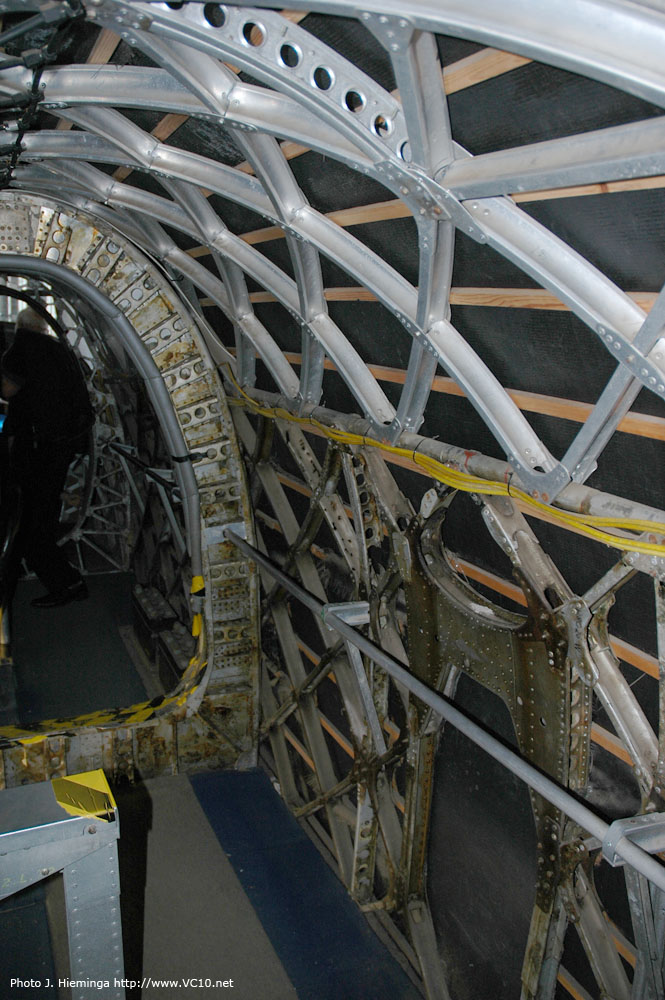
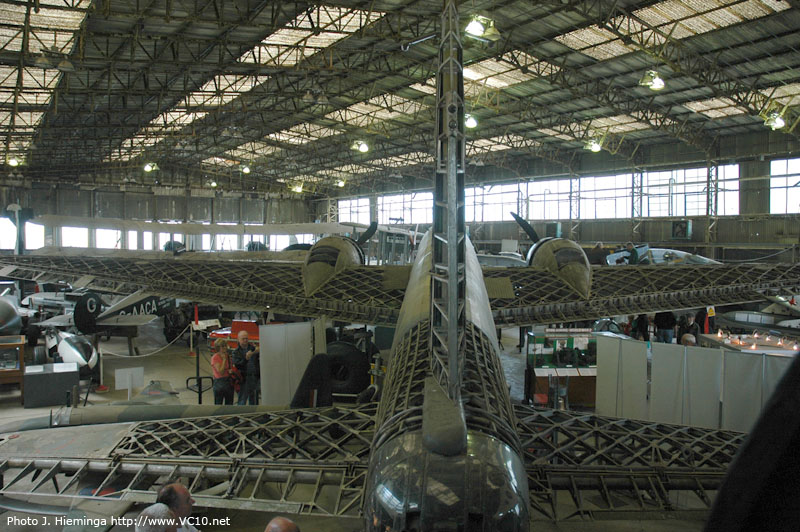
This is the inside of the walkthrough-Wellington:
And I’ve posted these before, but they show the structure. I think that most of the new tubing is in the covered section of the rear fuselage.

When R for Robert was restored, several fuselage sections needed to be rebuilt. New geodetic sections were produced for this purpose and once R was complete, there was enough left to create the forward fuselage mockup. I seem to recall that the Fury replica also used some tubing that was left over from Robert.
Front up with your Guilders and buy her back?
I would if I could, but since guilders are not accepted as currency anymore… 😉
I don’t mind her moving on but the purpose of the sale was to get money for other acquisitions and seeing as the museum went bankrupt a year or so ago, they didn’t manage their funds all that well. I don’t doubt that she will look great once restored but right now she is still a fairly complete time capsule from 40 years or so ago. That is something that we will lose. Anyway, back to the happenings at Duxford!

She’s still missed in Lelystad! I wonder what’s happened to the prop, looks like delamination on those blades. There are some items missing too, I do hope they’re not using her as a Christmas tree.
With all due respect to Vickers, it seems like a silly thing to do.
If you’re going to make a commercial aircraft, it should be reasonably modern for better performance and economics…
I don’t think that Vickers would have disagreed with you on that, but I think that it was more a case of getting back into producing airliners as soon as possible. And as the information seems to show, they did manage to improve a bit over the DC-3/C-47 which was going to be its main competitor. Designing a completely new wing takes time, and they must have decided to avoid that delay by using a known wing design.
And I must say that I like the idea of having the Hurricane visible during the upcoming festivities there. Well done!
“…as long as proper airspeed is maintained…” What, in the Flare?
Kenneth is correct in stating that you need to approach with the correct airspeed and maintain this until the flare. While flaring the airspeed will decrease, so in that regard you might have a point, but when approaching from a glide with the engine stopped or at idle, you aim to maintain your glide speed until the very last second. If you misjudge and start flaring too soon, you may find yourself approaching a stall or at least a descent with increasing vertical speed, without any option left. Your only way of increasing the speed at such a point would be to lower the nose but you may have run out of room (height-wise and speed-wise) for that as you need to trade altitude to get more speed.
Full scale model of an aeroplane I guess…
From ‘Britain’s Airlines volume 2’: “The Viking was significantly faster than the Dakota although it had slightly higher operating costs and needed longer runways. When the German charter airlines began taking to the sky in the mid-50s, over twenty Vikings were used, their higher speed proving a real benefit on the longer sectors to Spain and the Balearics.”
Thanks for that Multirole! I was going to dig out my copy of Arthur Whitlock’s ‘Behind the Cockpit Door’ from which I copied the image that you’ve photographed. I supplied that copy to the Viking team at Brooklands sometime in 1999 or 2000. Good to see it again 😉
Edit: the image was originally posted by PeteP, on this thread in the CBFSim forums: http://www.cbfsim.co.uk/cbfs_bb/viewtopic.php?f=9&t=7830&start=10 in November 2006.
On the Viking/Valetta you’ve got a wing spar running through the cabin which is not very handy when loading cargo. This is a major plus for the DC-3 design as that has a flat cabin floor. On the other hand, the seats near the spar were popular with male travellers on Vikings as there were some interesting views when the cabin crew clambered over the spar.
As mentioned before, the Viking design wasn’t built in the same numbers as the DC-3, I guess that there were just too many C-47s available second hand.
I don’t know what the difference in approach speed is with and without flap but I imagine it definitely makes one concentrate a lot harder on keeping the speed high enough to prevent a stall.
(From the Duxford thread)
When you’ve got power available then there is a difference in approach speed, but without power you’ll be aiming for the glide speed of the airframe and this stays more or less the same whether you’ve got flaps set or not. Flaps do tend to increase your glide angle though, so selecting them down means that the ground will come up a lot quicker than before. Because of that you only use flaps during a glide approach when you need to shorten your approach. I’m not sure of the type of flaps on the Buchon but you might find that with these out the glide angle approaches that of a brick. Good reason to keep them up if not really needed.
You could start with this list: http://www.theguardian.com/books/2008/jan/11/bestukbookshops
If you’d like to stick to the UK then this might help: http://www.theguardian.com/books/bookshop/independent-bookshop-directory
Have a look at this article as it is a bit more comprehensive: http://www.birminghammail.co.uk/whats-on/food-drink-news/brum-chef-opens-indian-restaurant-7190927
It’s a temporary setup in ZD241 for a charity event.
What’s the story behind the Tristars at Bruntingthorpe?
Are they being stored? I didn’t count them all but there must be 6 or 8 of them.
They are currently in storage but due to fly out to the US sometime soon. They’ve been sold to a broker over there. See here: http://www.csdsaircraft.com/aircrafts_available.html