 mark_pilkington
I’m always interested to read Tigars latest extrapolations from nothing to something, and in this case we at least have something that seems likely to be from an aircraft.
Tigar has examined military aircraft at the NMUSAF and concluded the Artifact 2-2-V-1 is not from any of the military types known to have been lost in the area, but of course flotsam in the Pacific Ocean can travel quite a distance.
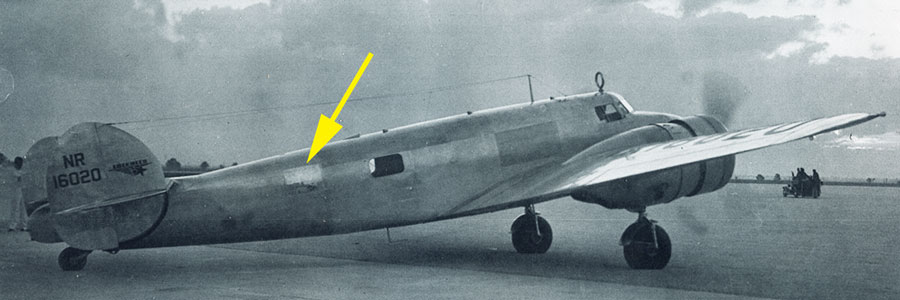
Tigar has also examined a Lockheed 10 under restoration and focused on a field patching of a custom window that the Earhart aircraft had fitted in its toilet compartment that was later covered over in Miami.
http://tighar.org/Projects/Earhart/Archives/Research/Bulletins/73_StepbyStep/73_Step_by_Step.html

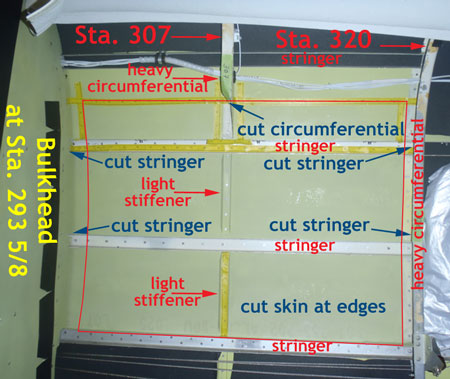
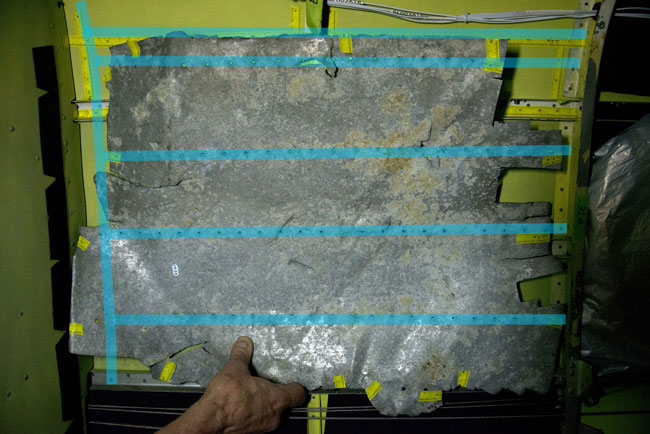
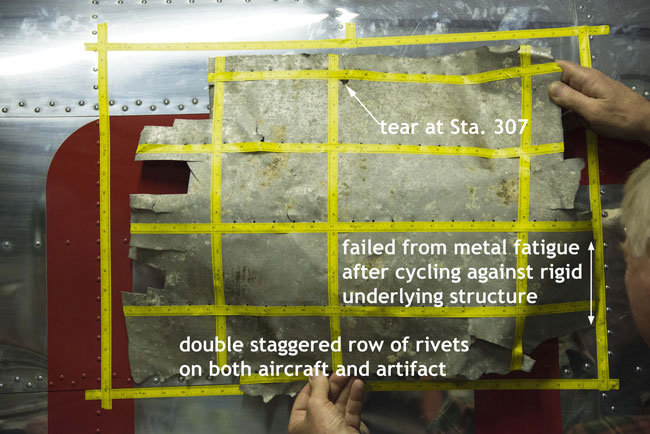
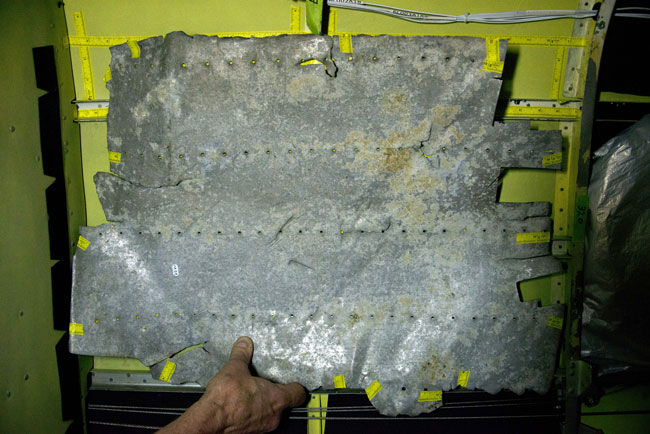
Overlaid against the structures added to Earhart�s aircraft to accommodate the window and later the patch, the rivet lines on the artifact match the rivet lines on the patch. The tear in the artifact at top center coincides with the heavy circumferential structure at Sta. 307.
The bottom right edge of the artifact failed from metal fatigue after cycling back and forth against a straight rigid underlying structure. If the artifact is positioned longitudinally so that the bottom right edge abuts the underlying structure evidenced in photos of the patch, the tear in the metal on the top edge of the artifact aligns with where the patch was riveted to the stub of the heavy circumferential stiffener at Sta. 307. The bottom edge of the artifact tore along a double staggered row of rivets. The matching row of rivets on the Model 10 is a double staggered row
.
Yet that claim that the tear on the bottom edge of the artefact is along a double staggered row of rivets does NOT seem evidenced from the artefact itself? there is no double staggered holes?
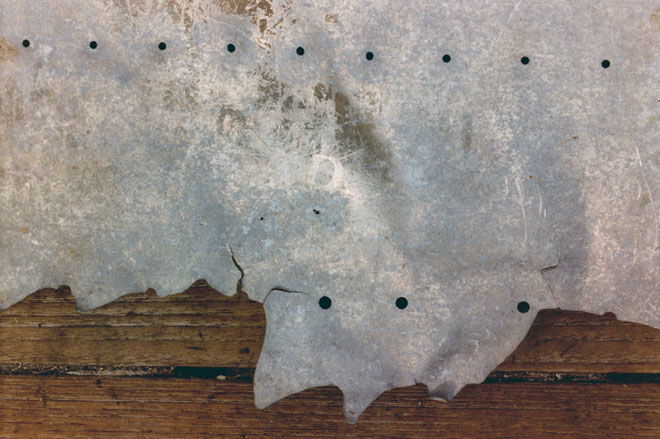
The rivet lines in Artifact 2-2-V-1 do not line up with the original stringer lines in that area of the fuselage and obviously may reflect the custom construction of the patch repair, but they also don’t seem to line up with the “taped” rivet lines in the Tigar “re-construction” photo above as there are implied vertical lines with holes to mount stiffeners?, that are not apparently existant on the Artifact?
I cant see ANY evidence of vertical stiffeners or related vertical rivet holes to suggest there were “3” rows of vertical stiffeners, – there isn’t even evidence of one to line up with the original vertical frame that existed in that area before the window was fitted?
The Null Hypothesis
Although many questions remain to be answered about Artifact 2-2-V-1, it is instructive to consider the alternative explanation. If the artifact is not the scab patch from NR16020, then it is a random piece of aircraft wreckage from some unknown type involved in an unknown accident that just happens to match the dozens of material and dimensional requirements of the patch. This incredibly specific, but random, piece of debris just happened to end up on Nikumaroro, the atoll where so much other evidence points to Earhart.
I agree that Artifact 2-2-V-1 is small enough to have been a scab patch over the custom window, but I cant see any evidence that the rest of its “material and dimensional requirements” meet that of the patch?
[B]
This incredibly specific, but random, piece of debris just happened to end up on Nikumaroro, the atoll where so much other evidence points to Earhart.
[B]
What other evidence?
1. Various islander interviews that seem so unreliable and inconclusive that they are hardly evidence of any note?
2. A skeleton identified as a short male via autopsy at the time, which they claim was incorrectly identified and is more likely a Caucasian woman?, and that Earhart was a Caucasian woman?
3. A womans shoe and a bottle that looks similar to a freckle cream? and that Earhart wore woman’s shoes and had freckles
4. A bone fragment that turned out to be turtle? – Earharts bones were not turtle
5. A sextant box? – Noonan was a navigator and owned a sextant
6. A cargo ship is wrecked on the beach?, which had crew fatalities (and is therefore unlikely to be the source of the skelton, the shoe, the bottle and the sextant box?)
7. A blurry photo taken by someone in a dingy shows an object sticking out of the water near the wrecked cargo ship, and therefore is most likely the undercarriage and wheel of the Lockheed, (and therefore unlikely to be something from the ship wreck, and clearly un-interesting enough not to cause the person in the dingy to row closer and investigate it at the time?)
8. A piece of aluminium sheeting washes up on the beach after a storm
Of these, the ONLY” evidence that has any credibility is the piece of aluminium is clearly from an aircraft wreck and not the wrecked cargo ship.
Conclusion
TIGHAR finds the hypothesis that Artifact 2-2-V-1 is the patch installed on NR16020 in Miami to be strongly supported. Research will continue to seek answers to remaining questions about this wonderfully complex artifact, including defining and quantifying the type and magnitude of the forces necessary to cause the damage exhibited by the artifact. Those answers may strengthen or weaken the artifact-as-patch hypothesis but they will certainly inform our search for the rest of the aircraft.
Im not sure its “strongly supported”, and certainly isnt the “Smoking Gun” its claimed to be?
But I am pleased they are putting more serious rigor into this only relevant item of evidence they seem to have ever found.
Edit: Having just read the media reports of this situation I do have concerns as to how the media is briefed and encouraged to report such things by Tigar.
Mystery of Amelia Earhart Solved? Fragment From Missing Plane Identified
Researchers at The International Group for Historic Aircraft Recovery (TIGHAR) revealed that a piece from Amelia Earhart’s vanished aircraft has been identified in Nikumaroro, an atoll in the southwestern Pacific republic of Kiribati. This is the first time that an artifact from the wreckage has been directly linked to Earhart’s last expedition, in which she was attempting to circumnavigate the Earth at the equator, and sheds new light on the 77-year-old aviation mystery.
The 19-inch-wide by 23-inch-long piece, found by researchers in 1991, is strongly believed to be a metal fragment installed on the window of Earhart’s Lockheed Electra aircraft during her eight-day stay in Miami, which was her fourth stop on the journey. A photograph on TIGHAR’s site from The Miami Herald, dated July 1, 1937, shows the aircraft intact with the metal patch.
Once the patch was identified in the photograph, researchers compared the patch with that of the Lockheed Electra aircraft at Wichita Air Services in Newton, Kansas, according to Discovery News. It matched the plans and the Electra’s structure. According to TIGHAR, the patch was a field modification whose “complex fingerprint of dimensions, proportions, materials and rivet patterns was as unique to Earhart’s Electra as a fingerprint is to an individual.” The sheet’s purpose was for the pilot to be able to take in “celestial observations” from thousands of feet in the sky.
You “could” blame the Media for in-accurate reporting, but the article has a link the Tigar website page I linked above, and its opening lines are:
The Window, the Patch, & the Artifact
Is TIGHAR Artifact 2-2-V-1 a piece of wreckage from Amelia Earhart’s aircraft?
Abstract
During Amelia Earhart’s stay in Miami at the beginning of her second world flight attempt, a custom-made, special window on her Lockheed Electra aircraft was removed and replaced with an aluminum patch. The patch was an expedient field modification. Its dimensions, proportions, and pattern of rivets were dictated by the hole to be covered and the structure of the aircraft. The patch was as unique to her particular aircraft as a fingerprint is to an individual. Research has now shown that a section of aircraft aluminum TIGHAR found on Nikumaroro in 1991 matches that fingerprint in many respects.
What respects?
its smaller than the apparent custom sized window, hence it “may” be from that patch?
The rivet lines, and skin thickness doesn’t line up with the original structure at all, and there are no details as to the riveting of the patch?
Its 32 thou’ alclad, with is thicker than the original structure, and there are no details of the patch to confirm its skin thickness?
Claims it lines up with a staggered double row of rivets on the bottom edge doesn’t seem evidenced by the facts?
The only “respect” in which it “matches” is that this sheet of aluminium is smaller than an aluminium patch known to have been fitted to the aircraft.
So is it just the media reading too much into it?
Here is the Tigar Media Release:
http://tighar.org/Projects/Earhart/Niku8/Oct2014pressrelease.html
Increasing confidence that a piece of aluminum aircraft debris found on a remote, uninhabited South Pacific atoll came from Amelia Earhart’s Lockheed Electra has bolstered speculation that a sonar anomaly detected at a depth of 600 feet off the west end of the island is the lost aircraft.
In June 2015, TIGHAR will return to Nikumaroro to investigate the anomaly with Remote Operated Vehicle (ROV) technology supported by Nai’a, the 120-foot Fiji-based vessel that has served five previous TIGHAR explorations. During the twenty-four day expedition, divers will search for other wreckage at shallower depths and an onshore search team will seek to identify objects detected in historical photographs that may be relics of an initial survival camp.
Having “announced” the “find” the Press Release quickly focused on the next trip!
During Amelia Earhart’s stay in Miami at the beginning of her second world flight attempt, a custom-made, special window on her Lockheed Electra aircraft was removed and replaced with an aluminum patch. The patch was an expedient field modification. Its dimensions, proportions, and pattern of rivets were dictated by the hole to be covered and the structure of the aircraft. The patch was as unique to her particular aircraft as a fingerprint is to an individual. Research has now shown that a section of aircraft aluminum TIGHAR found on Nikumaroro in 1991 matches that fingerprint in many respects. For a detailed study of this important new development see The Window, The Patch, and The Artifact, Research Bulletin #73 on the TIGHAR website.
As I said – what are the MANY respects?
The Dimensions don’t MATCH, the artefact is simply smaller that the patch was, which allows the possibility of it being from the patch?
The Proportions? ie height to length?, are meaningless, the artefact is a torn remnant, you cant determine what its original size was, from what is left?
Pattern of rivets? – I cant find anything in their 2 page research, that evidences the pattern of rivets matches original Lockheed structure or the original patch?
The new research on Artifact 2-2-V-1 may reinforce the possibility that the anomaly is the rest of the aircraft. The artifact is not, as previously suspected, a random fragment from an aircraft shredded by the surf, and its removal from the aircraft appears to have been due, at least in part, to human action. That could only happen if the patch was broken out when the aircraft was on the reef surface – but when and by whom? Somehow the patch/artifact ended up on the island, so it must have either washed or been carried ashore.
If Artifact 2-2-V-1 is from the Earhart aircraft, as it appears to be, it seems to have had a different history from the rest of the aircraft. Did the underwater search for scattered wreckage fail because the wreckage is not scattered? Is the wreck of Earhart’s aircraft far more intact than TIGHAR had assumed? Is the anomaly the aircraft? The only way to know is to go look.
I must have missed the evidence of it being removed by human intervention, I assumed it was broken away from its larger structure by wave action as the rivets corroded away?
And of course we move from a random piece of aluminium shredded by the surf, to an artefact which “appears to be from Earhart’s aircraft” and apparently torn off the aircraft by “human action”.
Clearly Noonan and Earhart broke it off the aircraft before the aircraft was washed off the reef, and then used it to cook turtle while they waited to be rescued, and of course that where all those bits of turtle bone comes from!
Regards
Mark Pilkington
Below is the picture linked above that is not showing properly, showing the location of the custom fitted window in the toilet compartment, which is then patched over in Miami.
mark_pilkingtonThe Halifax is below the high tide line and cannot be considered under the same physical and legal constraints as wreck above the high tide line.
The term “War Grave” has no legal definition in Maritime Law only a common understanding.
The Halifax is not in “foreign waters” it is in Norwegian Territorial Waters and as such is administered under Nordic/Norwegian Law.
For maritime purposes all RAF aircraft crashed into the sea in either territorial or international waters are not considered as “abandoned”.
This is a specific term in marine law and denotes that the original owner has not relinquished their legal right to the artefact/vessel.
So the current owner is the British State and these rights are administered by the Ministry of Defence.
The artefact/vessel is located within Norwegian Territorial Waters so it is protected by Norwegian Maritime Law as a wreck that is not abandoned.
Ross
Thanks Ross,
Although it does seem from the link from David that there are distinctions in terms of the level of protection, and that only 60 sea wrecks are considered protected?
Given the large number of military maritime graves around the world, the Ministry of Defence does indeed have a vast job on its hands. There are 60 wrecks designated under the Protection of Military Remains Act, 12 of which are ‘controlled’ – meaning that diving them is strictly prohibited – and 58 which have the lesser designation of “protected”, including the Repulse.
And while the foreign country will respect the original country’s “ownership” the question is will they “enforce it”?
The Malaysian authorities have intervened in the past to stop wrecks being pillaged, but with hundreds of sunken vessels in thousands of square miles of the Pacific to monitor, it faces the same problem.
“We are very concerned to hear that the wrecks are being plundered by scrap metal merchants and I have asked for a plan to be drawn up for a survey of HMS Repulse and HMS Prince of Wales,” Rossid bin Musa, director of the Marine Department of Malaysia, said.
“Our department cannot carry out patrols as we do not have the vessels, but I have asked the Coast Guard and the Maritime Enforcement Agency to provide assistance and to patrol the area,” he said.
But any scavengers who are caught are likely to get off with minimal fines. A charge of violating Malaysian maritime laws and operating without a permit usually incurs a fine of around GBP19,100, according to the Malaysian newspaper The Star, while the cost of stealing from a wreck is just £191.
But I do find it interesting that a wreck on land which may still contain remains or even partial remains (The RN FAAM Fairey Barracoota) or perhaps some of the various wreckology recoveries that the UK or even Europe is known for, can be recovered yet an underwater wreck takes on a final resting place sacredness?
I thought in the UK at least, the remains of crashed service aircraft were considered to still be the property of the DoD? and permission from them to undertake a recovery was required via various permits etc?, wouldn’t an underwater aircraft wreck recovery therefore be rather similar?
Edit :Apparantly they are : http://en.wikipedia.org/wiki/Protection_of_Military_Remains_Act_1986#Protection_of_aircraft
Mark,
Coincidently regarding ship wreck war graves in foreign waters, this in today’s Sunday Telegraph makes very sad reading.
Yes it is very sad, and clearly while protected “legally” under UK laws and retained in UK ownership, the only real ability to protect them from scavenging is the laws and resources of the nearest Country (within or nearby its territorial waters).
On the other hand, the Ships Bell from the Prince of Wales was apparently recovered in 1992 to ensure it wasn’t scavenged for scrap, and I again personally don’t have a problem with elements of a wreck being recovered by a National Collection to preserve something for posterity and honour the crew on land in a fitting memorial location.
The recent discovery of HMAS Sydney’s wreck of the coast of WA identified some of her shattered life boats sitting on the sea floor, showing their Sydney nameplates, I personally would support one of those being recovered while it still might survive being recovered, to be conserved and displayed in the Australian War Memorial as the reality with anything sitting in the salt water environment must eventually rot to nothing.
While not a war grave, the Titanic is certainly a watery grave of many lost souls, and its slowly rotting away to nothing – even at its great depth. I saw a travelling display of material recovered from the wreck ,along even with small sections of its hull plating, and that exhibition probably does more to bring that tragedy to current generations, than would be the case if those items and material had been left on the floor to rot away?
The dead, however they died, deserve their dignity.
Those who died for their country in wartime deserve to be remembered and honoured by their nation, and where possible, to be repatriated to their home soil and ideally to their living surviving family during their life times.
On that basis I would support recovery of viable aircraft wrecks from the sea, as long as the remains of crew were investigated prior to, and during the recovery, and via approval processes of the governing authorities, and equally I would support recovery of suitable items from wartime shipwrecks for preservation in National museums.
Of course for those wrecks known to have not had a fatality, like some of the PNG Japanese wrecks abandoned on airstrips, or the USN aircraft wrecks in the Great Lakes, policies refusing recovery over the years has actually condemned those wrecks to disintegration rather than preservation, and since the 1970’s publication of Charles Darby’s Pacific Wrecks and where to find them” a number of viable Japanese medium bomber wrecks such as Betty’s and Sally’s have simply vanished due to local scrapping, and hence those types are largely now lost to history, in direct conflict with the stated reasons for halting recoveries from PNG.
It is a pity Japanese museums were not more active in trying to recover some of those rarer types before they were lost fore-ever.
In summary, I don’t consider a wreck that has involved a fatality, and un-recovered remains is sacrosanct, its more what is done with the wreck and the bonafide search for remains.
Overtime, even cemeteries and graves are re-developed as those interned are no longer mourned and visited by immediate family.
Its the issue of the dead, and their remains, being treated with dignity, or for the war dead, being remembered and honoured by their country and their countrymen, for their ultimate sacrifice- thats what really matters, and in my opinion, a preserved object from the wreck, or the preserved wreck itself – is a suitable memorial.
Of course these are very subjective issues, caught up also with religious beliefs and attitudes, and my opinions are simply mine alone.
Regards
Mark Pilkington
mark_pilkingtonIf it is, there are more important things to consider than ‘just’ the airframe here. There could be two crew members down there as well…
I would agree, but I’m not sure the status of this or any other aircraft wrecks as formally declared “war graves” in foreign waters as this one is, or in the UK?, or indeed anywhere?, above ground, below ground or in the sea?
I can understand the declaration of ship wrecks as “war graves” to stop salvagers recovering some or all of the structure as scrap metal.
In the case of an aircraft wreck being recovered for preservation, the wishes of the immediate surviving family should be sought and considered, but there would seem to be the opportunity to recover remains and bury them, but also for the preserved outcome to be an above water memorial to those lost in the war?
The Dornier recovery still has that uncertainty surrounding its identity and therefore the fate of its crew?
Then there is Coppin’s Desert wreck P40 and the uncertainty surrounding his fate?
Or the RAAF Spitfire wreckage found in the banks of a French River, and now in the RAAF Museum collection at Point Cook.
Equally there are a number of wrecks recovered from PNG and Russia (Hurricane with pilots remains?) that raise the same issue?
Is an aircraft wreck with possible human remains to be left to the elements (above ground or below sea?) or to have the remains recovered and repatriated and then the wreckage dealt with?
With these wrecks in far off places, is there really the opportunity for close family to go and pay their respects?
I’m not in the situation of having a lost family member from wartime aircraft operations, but a person I know in that situation was very keen to locate and resolve the fate of his family member – surely the recovery and return of the remains is the preference? and if the recovery of the wreck achieves that, it would seem a worthwhile activity, let alone preservation of the wreck to further honour the memory of the fallen?
An important issue to consider, my own personal view would be to support a supervised recovery with examination and search for remains for repatriation by the appropriate authorities, such as the Commonwealth War Graves Commission or JPAC in the US?
Of course this wreck seems well advanced in its deterioration and its likely not to survive a recovery attempt in anycase, and I do think the days of successful Salt Water recoveries for conservation let alone “restoration” are probably coming to a close.
Regards
Mark Pilkington
mark_pilkingtonI know that the Halifax Group in Alberta are hoping for the Mk.III that is in the Irish Sea….that would be likely the next recovery if Canadians get involved….
very interesting anyway…..
The Canadians have secured two Hastings wing centre sections to form the basis of a future Halifax restoration from the Irish Sea.
But that wreck is yet to be found and its condition confirmed to be suitable for recovery, and this discovery shows the ongoing deterioration being suffered in 150m of cold sea water, neither will survive much longer.
Perhaps this is a case of one found in the fjord, is worth more than one lost somewhere in the Irish Sea?
Otherwise both might be beyond recovery, let alone restoration if this opportunity isn’t explored over the Irish Sea wreck.
We are fortunate at least that we have two recovered from fresh water and already in preservation, given none were retained after the war for posterity.
But if the Canadians have the capability to undertake and restore a salt water recovery then the clock must be counting down on the viability of such saltwater wreck recoveries.
Regards
Mark Pilkington
mark_pilkingtonI would have expected Fadden to sign off on many such documents given they were aimed at large buyers of his products, ie airframe manufacturers, Air Forces, airlines etc, I cant imagine however that they are issuing such documents in volume on a per engine basis like your consumer goods example of Microsoft Windows.
I can easily accept a 1930s Command Management structure where such documents have to be signed off by the Boss before issue, even if the contents ate authored by someone else.
Equally I can accept such documents being given a fast scribble of a signature to clear them off the desk and out the door as against a request to provide a specimen signature for reproduction in a rubber stamp perhaps resulting in a practiced and crafted one being intentionally provided.
I know if I am signing a new Passport, Licence or Credit Card that I take more time and care to sign my name than when I sign off the bill at a restaurant, I am not therefore surprised if Fadden did the same in the 1930s.
However the limitations of reproducing a flowing signature into a rubber stamp would likely have forced a more open and un-natural signature style or design in anycase for the reasons I proposed earlier.
Your search for other ink examples of his signatures should resolve the conjecture and hypothesis.
Regards
Mark Pilkington
mark_pilkingtonStuck in an old book in the library of the Moorabbin Air Museum were two letters concerning technical notes for Jupiter engines from Fedden in 1930 and 1931. The early one has a personal signature and the later one a rubber stamp signature, far more florid. I wonder if the first one was perhaps done by an assistant. Does anybody have a copy of a real Fedden signature to compare?
If you consider the methods by which a rubber stamp of a signature might have been created in the early 1930’s then I would assume the inked signature is authentic and his own natural hand writing, and the rubber stamp was more likely based on a forced and un-natural signature, intentionally done large and open to support the rubber stamp processes to reproduce it.
The rubber stamp likely required a female mould to be created with the signature drawn deeply into it and allowed to set, or alternatively, the signature reverse traced onto the face of the rubber block and the excess rubber cut or removed leaving the type-set raised.
Either way the smaller and tighter signature would not have reproduced very well at all.
http://www.grmarking.com/lang/eng/id/history
http://www.holmesstamp.com/guide/faq/stamphistory.html
http://www.msmmarking.com/how-to-make-stamps.shtml#vulcanized_rubber
Regards
Mark Pilkington
mark_pilkingtonHopefully not too far off topic; I vaguely recall someone mention (maybe it was David Burke) a year or so ago, the existence of a C119 “center section” in one of the UK museums acquired for use in a Lanc project! anymore details?
I recall Davids post as it related to the then holdings of Lincoln and Lancaster parts by the Imperial Aviation Group / David Copley at Sandhurst who had previously had stated ambitions of restoring examples of both types (and I think had reserved a civil registration for one to be airworthy?)
Of course the holdings were well short of that outcome, the Lincoln RF342 was less cockpit, engines or undercarriage, and the Lancaster was a very derelict and damaged fuselage as a hybrid of KB994 and KB976 sections, but with no centre section or wing outers etc.
I never saw any evidence of the C-119 centre section but assume it may have been intended somehow to be used with the Lancaster fuselage?
Regards
Mark Pilkington
mark_pilkingtonActually Mark, the Gove Wrecks are a RAAF Ventura and DAP Beaufort.
The Ventura is A59-73, which was recovered to Darwin for static restoration, but which I understand was never commenced/completed? and that the aircraft is to return to Gove as of 2012??


This Lockheed Ventura A59-73 was damaged by fire at Gove in 1945. It was brought to Darwin in April 1995 to be rebuilt by the RAAF as a public relations exercise. Virtually nothing has been accomplished in the last seventeen years in Darwin and it was decided some years ago to return the aircraft to its display enclosure at Gove airport. Earlier this year the hangar housing A59-73 at RAAF Darwin was demolished and the Ventura started its long return journey to Gove. In eight months it has moved all of twenty five kilometers from RAAF Darwin to the stockyards the other side of Noonamah as shown in this picture. Maybe provision will be made in the Commonwealth budget next year to enable this piece of Australian history to return home.
(Photos and info c/o ADF-Serials.com.au)
The Beaufort is A9-501, which was recovered in 1999 by Ralph Cusack to support his airworthy restoration, a restored Beaufort cockpit is to be returned to Gove for display, the rest of the remains have been passed on to other Beaufort restorations.

So that would place your colour photo as pre-1995.
Thanks for sharing the pics, and the short wheel base B-25 at Darwin is still a very historic survivor and hopefully it gains a tail in good time.
I’m not sure why the un-restored Ventura isn’t placed on display undercover in the Darwin museum?
Regards
Mark Pilkington
mark_pilkingtonA$ 25.000
Just found this ad dated Sept 1, 2014
http://buyaircrafts.com/2014/09/01/1955-de-havilland-dh-114-heron-2/They painted it new as VH-AHB Butler Air Transport “R.M.A. Warrawee” !
Never was with Butler Air Transport – was as NJI with Heron Airlines Oct 27 1991 – Nov 1995Martin
This aircraft was acquired along with a DC-3 to be preserved and displayed in a new aviation museum in NSW dedicated to the heritage of Butler Air Transport?
http://www.butlermuseum.com.au
The apparent sale of this item from the collection is not reflected on their website nor any indication provided of any problems?
Regards
Mark Pilkington
mark_pilkingtonReading that last statement fused all my circuits !
Smiles, I take it then that it “did not compute?”
regards
Mark Pilkington
mark_pilkingtonG’day folks,
The Wirraway was built to a earlier design in the family, and almost all other surviving NAA advanced trainers of the family were built to later designs. So, even though A20-10 was completed in September 1939, the particular design pre-dates that of the Harvard I, and other aircraft which were delivered around that time. Mark, is that what you meant?
got it in one Matt, and A20-10 is a rare survivor worldwide of those early NA-16 variants, including the BC-1, NJ-1, BT-9 and Harvard I, of which unfortunately none survive today – anywhere in the world.
So, congratulations are due to those who got their hands dirty, and those who quietly worked in the background. To see the old girl come to life again was pure magic.
Cheers,
Matt
Got it in Two, Without their efforts the 75th Anniversary of the CAC Wirraway may have passed without notice.
The Wirraway as a design is not on the gant chart of evolution or parentage of those later NAA designs, its an older cousin.
Separately, in terms of survivors:
This is the oldest surviving member of the NA-16 to T6/SNJ/Harvard family of NAA Trainers.
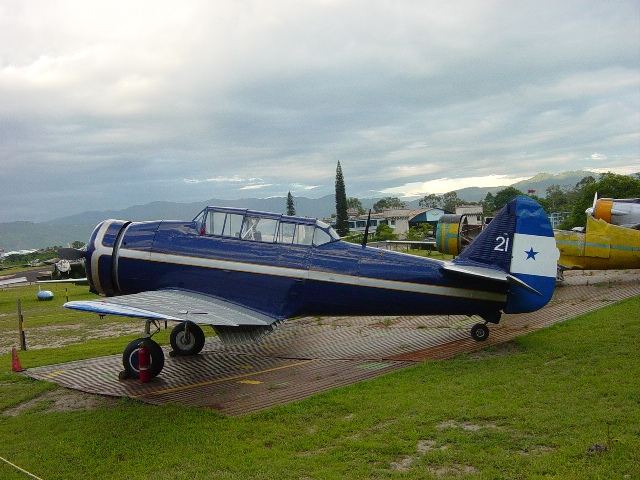
This is believed to be the only surviving NA-16, which is in Hondura’s, apparently an NA-16-2A, and NA-20 Contract aircraft and therefore apparently an earlier design than the NA-32 and NA-33 (an NA-16-2K), and clearly produced in the NA Factory and exported prior to CA-1 A20-10 being built.
Hence its an older aircraft, and it retains the original NA straight edge windscreen, and fixed rear canopy, but has the NA-16 corrugated fin, and round rudder, short fabric covered steel tube rear fuselage, and in this case the short engine mount of the Wright engine, and two blade propeller.
Unfortunately it is still stored outside, and has apparently had its fabric side panels “metalised”?
This is the Second oldest surviving member of the NA-16 to T6/SNJ/Harvard family of NAA Trainers.
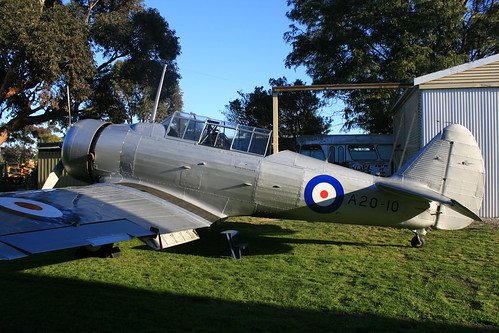
It is a licence built NA-33 or NA-16-2K, and the sole surviving CA-1 Wirraway A20-10.
it differs in not having the original NA straight edge windscreen, and fixed rear canopy, but has the NA-16 corrugated fin, and round rudder, short fabric covered steel tube rear fuselage, and in this case the long engine mount of the P&W engine, and three blade propeller, all features of the BC-1.
It first flew in September 1939, and pre-dates the first flight of any other NAA T6 SNJ or Harvard surviving anywhere in the world today.
Regards
Mark Pilkington
mark_pilkingtonI’m not talking about 2010 for the anniversary Mark, I’m talking 2013.
Here’s a thread on the NZ event
http://rnzaf.proboards.com/thread/20034/zealand-warbirds-assoc-open-ardmoreAnd here Oshkosh in 2013 (note the big 75 formation)
http://www.vg-photo.com/airshow/2013/Oshkosh/texan.htmlAs for the rest you’re digging a big hole here. Your initial post’s first sentence claimed the Wirraway was older than the Harvard. Not any specific Wirraway versus any specific Harvard. So the statement is wrong as Harvards first flew in 1938 and were in RAF service by January 1939. Sorry Mark, it’s not important to the main point of your thread, but i really felt I had to call you out on your claim which is simply not correct.
Dave,
I don’t think I’m digging anything, let alone a hole.
I think you are reading one sentence in isolation of the complete paragraph and the context of that paragraph in the complete post.
I also have to call you on your earlier claim that the Harvard is derived from the NA-26, the Harvard I is the NA-49, the NA-26 is the BC-1, for the USAAC.
The CAC Wirraway, a direct descendent of the North American NA-16, and older cousin of the NA T6, SNJ and Harvard, turned 75 yesterday with the event celebrated at the Australian National Aviation Museum where the 8th production and oldest surviving CAC Wirraway A20-10 was unveiled after a recent intense spruise up having been returned to her original 1939 pre-war delivery silver colour scheme, and fired back to life after @25 years indoor display.
Note the T6/SNJ/Harvard series are all a common sub-series with largely UK versus US furnishings and names dividing them, and are all derived from the NA-55, they are not NA-16 models, the NA-55 is clearly a later design to the NA-33 that the Wirraway is based on.
the First flight of the Harvard II, and later Harvards from the NA-55 onwards is in 1940.
Yes there is a Harvard I that sits outside that grouping, as does the NJ-1 and the BC-1, which ARE all NA-16 derivatives and ARE all mentioned in the very next para?
This aircraft is the oldest surviving Wirraway, and perhaps other than an NA–16-2K / NA-20 surviving in South America, is likely to be one the oldest NA-16 descendents surviving in the world, and retains the straight trailing edge wing outer panels, corrugated fin skins, and rear steel tube fuselage frame of that earlier NA Design that persisted into the BC-1, SNJ-1, Harvard I and BT-9 but were lost in the later designs of the Yale and SNJ-2, and the even later T-6 / Harvard Series.
I think you will find that statement above to be factual? if not I would be pleased to be corrected?
The CA-1 model of Wirraway is effectively a licence built NA-16-2K / NA-33, and I believe it is both older physically, and in design, than any of the NA related types now preserved in the USA, but am happy to be corrected?
I think you will also find that statement factual and still un-challenged at this point?, unless you know of a candidate? in the USA or in NZ?
Noting that its incorrect to reference the NA-26 (BC-1) as the design reference for the Harvard II-IV series when the NA-55 is, and equally the NA-49 is actually the starting point of the Harvard name.
The NA-49 Harvard (I), was selected and ordered from North American by the British Purchasing Commission in June 1938 and the first example flew in September 1938.
The NA-16, as the “Wirraway” was selected for local manufacture in 1936 by Wackett on behalf of the RAAF and CAC, and a licence to build locally in Australia was secured from North American by the Commonwealth Aircraft Corporation in 1937, the NA-32 (fixed undercarriage NA-16) and NA-33 (Retractable undercarriage NA-16) were shipped out in August / September 1937 and flew locally not long after, a full year prior to the RAF selection and ordering of the NA-49 Harvard I.
RAF AVM Ellington visited Australia in 1938 to review the RAAF and criticised the Wirraway and the whole decision to build an American aircraft in Australia for the RAAF, by June 1938 the RAF were ordering the same aircraft themselves as the Harvard I.
Note then that by the NA-33 Contract number, and the 1937 decision and contract to licence build them, that clearly then the NA-33 “Wirraway” design pre-dates the 1938 selection and ordering of the NA-49 Harvard I by the RAF, although they are clearly NA-16 Siblings.
Both the Wirraway as the NA-33 and the Harvard I as the NA-49, are later NA-16 developments from the BC-1 NA-26, both can claim that “birthday” and both can just as easily claim the NA-16 birthday in 1935 too, but their own birthdays arise from their specific NA Contracts, or their own first flights.
The first NA-49 Harvard I flies in September 1938, a year before the first CA-1 Wirraway flies in Australia in 1939, but clearly the Wirraway is a slightly earlier NA design, but these are very minor differences (The Wirraway has the round rudder of the BC-1, the Harvard (I) has the flat bottomed rudder of the NJ-1, and both are clearly derived from the 1935 NA-16 when compared with the later NA-55 design changes carried into the Harvard II, III & IV etc.
My first post when read in context and in its entirety, referenced the Harvard I and included it within the pre-war NA-16 direct family and then referred to the later T6/SNJ/Harvard wartime developments, as younger cousins to the Wirraway, – I stand by that statement.
I’m not referring to a specific Wirraway example compared to a specific Harvard example, nor I am I tying a 1950 Harvard IV back to a 1935 NA-16 or a 1938 Harvard I and claiming they are effectively the same aircraft.
The pre-war NA-16 series is as structurally and dimensionally different from a Harvard II, III and IV as a Douglas DC-2 is Different from a DC-3 and C-47, you don’t seem to understand that, or wish to admit it, but its true.
The BC-1, the NJ-1, the Harvard I and the Wirraway are all NA-16 based designs with shared features of straight trailing edge wing outers with a certain aerofoil, a shorter rear fuselage structure which is steel tube based and fabric covered, a different fin, and different rudder and different tailplanes and elevators, and a different centre-section.
ie they are all different from the “AT-6”, “T6-A to G” and “SNJ-2 to 7” and “Harvard II to IV” that all largely share common features that emerge in the NA-55.
So an NA-26 BC-1, a NA-33/CA-1 Wirraway, and a NA-49 Harvard I are ALL just as different to a NA-55 “Harvard II to IV”
If you don’t see that, or want to admit that, and wish to persist with Allison Mustang I to Merlin Mustang IV comparisons, I guess then ridiculously the pre-war DH88 Comet is “identical” to the post war DH106 Comet “other than” using stressed aluminium skin, having a few extra seats, 2 extra engines and @26M of extra length?
Yes they are both made by DH, and both called Comets, are only 18 model numbers away from each other, but CLEARLY other than the name, that’s where the similarity ends?
Yes the RAF aircraft named “Harvard” first flies in 1938 as the NA-49, but that is a very different aeroplane to the later NA-55 based Harvard designs, and the further contracts of NA66, NA77 and NA88 etc and all those that flew to commemorate its flight in 2013?
If you want to peg the later Harvard models to that NA-49 anniversary that’s fine, but none of those later examples are YET 75 years old – not one.
Not one of the existing Harvard II, IIA, IIB, III or IV survivors were built prior to 1940, and not one of the first flights of those sub-models – occurred in 1939 or prior?
Its no different pegging them all back to 2010 and the 1935 first flight of the NA-16.
None of that changes the design relationships and differences between the various sub-models, and clearly the Wirraway is a licence built NA-16 and the Harvard II, IIA, IIB, III and IV are not, they are all much later developments, as evidenced by any written history of the North American T6 series you would care to cite?
The Wirraway celebrated its 75 Anniversary in September 2014, its not a T6, SNJ or Harvard, its an NA-16 Derivitive, a licence built NA-16-2K to be specific.
There are only a very small handful of NA-16 Derivatives surviving in the world today exhibiting the unique features of the NA-16 series including the straight trailing edge wing outers, the short steel tube rear fuselage, the corrugated fin and round rudder, unfortunately none of the Harvard I’s that shared those characteristics survive today, and all other later model Harvards are not of the same pre-war design period and do not share any of those unique NA-16 features.
Again this is limited to the Honduras NA-16, the reproduction SK-14 in Sweden and the remaining Wirraway survivors.
There are no known survivors of the BC-1, NJ-1, Harvard I or BT-9 NA-16 variants.
Later model Harvards belong to a later sub-series that starts with the BC-1A/BC-2 and AT6 at NA-55, those have totally different wing centre sections, wing outer panels, longer rear monocoque fuselages, different fins, rudders, tailplanes and elevators, largely a re-design in many areas, not unlike the various design changes that grew the DC-2 into the DC-3 and then into the C-47 over much the same period.
If you do a bit of digging around I suspect you might come up with the same answers?
Beyond that, like the DC2/DC3/C47, the NA-16/T6/SNJ/Harvard series is an iconic type.
Heres the wiki page for the NA-16 > http://en.wikipedia.org/wiki/North_American_NA-16
Heres the wiki page for the T6 > http://en.wikipedia.org/wiki/North_American_T-6_Texan
Heres the wiki page of the variants >http://en.wikipedia.org/wiki/North_American_T-6_Texan_variants
This has an excellent table showing where the NA-16 Variants stop.
The “Family” starts with the original open cockpit, fixed undercarriage NA-16
It finishes with the cancelled NA-188 contract for the SNJ-8.
Some family members are siblings of the original NA-16
Most are grandchildren of it.
The NA-33 / CA-1 Wirraway is an older cousin to the T6, the SNJ and the Harvard II, III & IV etc, and a sibling to the NA-49 Harvard I and NA-16.
The NA-49 Harvard I is similarly an older cousin to its later namesakes, its not in the direct evolution path of those later Harvard series, the NA-55 BC-1A/BC-2 is.
The design of the NA33 / CA-1 Wirraway clearly pre-dates the design of the NA-49 Harvard, even though the first locally built Wirraway flies 12 months after the Harvard I, but thats a minor detail.
Smiles
Mark Pilkington
mark_pilkingtonI guess by your reckoning if a Harvard I is not a Harvard, then a Mustang II is not a Mustang as it looks nothing like a Mustang IV?
If the Wirraway is older as you claim then you’ve missed the boat because the T-6/Harvard/SNJ has already celebrated its 75th some time back both in the USA with a huge formation at Oshkosh and here with an event in NZ.
Dave
I suspect you are likely to find the T6/Harvard/SNJ 75th Anniversary’s of 2010 were linked to the first flight of the NA-16 itself in 1935, and not the first flight of any of those later specific sub-types, and clearly the Wirraway can claim that same NA-16 1935 birthday as much as a Harvard I, II, III or any other descendent in the NA family can?
However as I mentioned earlier, there are no surviving examples of a Harvard I, or BC-1, or BT-9 or NJ-1 to celebrate their own sub-model birthday’s and other than the Hondura’s NA-16-2, NA-20, there are only the surviving Wirraways and a reproduction SK-14.
The Wirraway as a sub-type celebrates its own 75th birthday in 2014, dating from its first flights in 1939.
Of the Harvard II, IIa, III’s and IV’s that celebrated the 75th anniversary in 2010 in NZ, or flying there today,how many of those first flew in 1935, 1939, 1940, or even 1941?
How many of those sub-types first flew 75 years ago?
I think you will find the first flights of all of those sub-models are after 1939, ie they are yet to reach 75.
Geoff Goodalls World Wide Warbird Directory lists the NA-64 Yales and a handful of AT-6 and Harvard II’s surviving from 1940 construction, the rest are all 1941 onwards.
Strictly the UK, NZ, Canada and Australia were at war from September 1939 but the US wasn’t until December 1941, but clearly then only the RAAF Wirraway and RAF Harvard I’s were truly a “pre-war design”.
As to a name, you might note that the USAF is currently training its pilots in the Beech T6 Texan II, but I’m sure we both agree that there is little other than the name in common with a NA T6 Texan, equally they are flying the JSF Lockheed (Martin) Lightning II, but that has little other than the name in common with the Lockheed P38 Lightning.
The Harvard II is of course much closer to the Harvard I than those examples, but there are very significant design and development differences.
Its much the same as comparing a Spitfire mark I with a Spitfire mark 22, there is little other than the name that is interchangeable between the two designs, and the same is true between the structure of the Harvard I and the Harvard II and later models.
The RAF ordered NA-16’s as Harvard I’s , then it later ordered AT-6’s as Harvard II’s, Canadian built AT-6A’s as Harvard IIB’s, AT-6C’s as Harvard IIA’s, AT-6D’s as Harvard III’s and the Harvard IV is on its own but is considered to rival the T6-G as the ultimate version.
But at no time is the “Harvard” itself a design being evolved on its own by the RAF, they are simply giving variants of the name to later models coming out of the NA production, largely driven by USAAF and USN requirements.
The same gap in evolution exists between the USN’s NJ-1 to the SNJ-2, and then SNJ-3,4,5, which again straddle the NA-16 to BC-1A NA-55 design change.
Your example of the RAF Mustang I, Mustang II and Mustang IV compares an Allison powered NA-73 / NA-83 to the Merlin powered P-51D, vastly different aircraft under the same name and again perhaps very little interchangeable parts between them?
Yes they are all Mustangs, but clearly not the same.
The Texan originated from the North American NA-16 prototype (first flown on April 1, 1935) which, modified as the NA-26, was submitted as an entry for a USAAC “Basic Combat” aircraft competition in March, 1937. The first model went into production and 180 were supplied to the USAAC as the BC-1 and 400 to the RAF as the Harvard I. The US Navy received 16 modified aircraft, designated the SNJ-1, and a further 61 as the SNJ-2 with a different engine.
The BC-1 was the production version of the NA-26 prototype, with retractable tailwheel landing gear and the provision for armament, a two-way radio, and the 550 hp (410 kW) R-1340-47 engine as standard equipment. Production versions included the BC-1 (Model NA-36) with only minor modifications (177 built), of which 30 were modified as BC-1I instrument trainers; the BC-1A (NA-55) with airframe revisions (92 built); and a single BC-1B with a modified wing center-section.
Three BC-2 aircraft were built before the shift to the “advanced trainer” designation, AT-6, which was equivalent to the BC-1A. The differences between the AT-6 and the BC-1 were new outer wing panels with a swept forward trailing edge, squared-off wingtips and a triangular rudder, producing the canonical Texan silhouette. After a change to the rear of the canopy, the AT-6 was designated the Harvard II for RAF/RCAF orders and 1,173 were supplied by purchase or Lend Lease, mostly operating in Canada as part of the British Commonwealth Air Training Plan.
Next came the AT-6A which was based on the NA-77 design and was powered by the Pratt & Whitney R-1340-49 Wasp radial engine. The USAAF received 1,549 and the US Navy 270 (as the SNJ-3). The AT-6B was built for gunnery training and could mount a .30 in machine gun on the forward fuselage. It used the R-1340-AN-1 engine, which was to become the standard for the remaining T-6 production. Canada’s Noorduyn Aviation built an R-1340-AN-1-powered version of the AT-6A, which was supplied to the USAAF as the AT-16 (1,500 aircraft) and the RAF/RCAF as the Harvard IIB (2,485 aircraft), some of which also served with the Fleet Air Arm and Royal Canadian Navy.
In late 1937 Mitsubushi purchased two NA-16s as technology demonstrators and possibly a licence to build more. However, the aircraft developed by Watanabe/Kyushu as the K10W1 (Allied code name Oak) bore no more than a superficial resemblance to the North American design. It featured a full monocoque fuselage as opposed to the steel tube fuselage of the T-6 and NA-16 family of aircraft, as well as being of smaller dimensions overall and had no design details in common with the T-6. It was used in very small numbers by the Imperial Japanese Navy from 1942 onwards. After the war the Japanese Air Self Defense Force operated Texans.
The NA-88 design resulted in 2,970 AT-6C Texans and 2,400 as the SNJ-4. The RAF received 726 of the AT-6C as the Harvard IIA. Modifications to the electrical system produced the AT-6D (3,713 produced) and SNJ-5 (1,357 produced). The AT-6D, redesignated the Harvard III, was supplied to the RAF (351 aircraft) and Fleet Air Arm (564 aircraft). The AT-6G (SNJ-7) involved major advancements including a full-time hydraulic system and a steerable tailwheel and persisted into the 1950s as the USAF advanced trainer.
Subsequently the NA-121 design with a completely clear rearmost section on the canopy, gave rise to 25 AT-6F Texans for the USAAF and 931, as the SNJ-6 for the US Navy. The ultimate version, the Harvard 4, was produced by Canada Car and Foundry during the 1950s, and supplied to the RCAF, USAF and Bundeswehr.
A total of 15,495 T-6s of all variants were built.
http://en.wikipedia.org/wiki/North_American_T-6_Texan
The CAC Wirraway A20-10 celebrated its 75th anniversary over the weekend, it is a rare surviving example of the early NA-16 all steel tube fuselage pre-war designs that later evolved into the very successfully T6/ SNJ / Harvard wartime trainers.
The CAC Wirraway is a licence built NA-16-2K, ie the NA-33, and therefore shares in common the 1935 first flight of the NA-16 with all other derivatives, but commences its own variant history from 1939.
Unfortunately other than 1 NA-16 variant surviving in Hondura’s there are no other examples of pre-war NA-16 derivatives surviving anywhere in the world, (not even in New Zealand.)
Smiles
Mark Pilkington
mark_pilkingtonConfused. If the Wirraway has just turned 75, thus meaning the first flight must have been in Sept 1939, how can it be an “older cousin of the NA T6, SNJ and Harvard” when these three aircraft were the NA-26 design that had flown a year before then?
And considering the Harvard Mk 1 had entered service with the RAF by January 1939, I guess your statement has to be incorrect. See Flight magazine dated January 26, 1939 for an article on the newly delivered RAF Harvard I.
Dave,
Other than the Harvard I, which as the NA-26 was a contemporary of the Wirraway (NA-33) and the BC-1 (NA-36)and NJ-1 (NA-36), the later Harvard II, III, and IV are all BC-1A/AT6/SNJ derivitives from the @NA55 designs onwards through to NA77 (T6-A, SNJ-3) and NA88 (Harvard 11A), and eventually the NA-121 T6-F.
Hence other than being grandchildren of the NA-16, the T6, SNJ and Harvard II-IV are not in the immediate NA-16 family like the Wirraway and its siblings of BC-1, BT-9, Harvard I and NJ-1 were, they are in fact born from the later NA55 design.
There are very significant design changes that occur in the BC-1A/BC-2 (NA-55) that very much separate the “before” and “after” designs.
Hence my statements should be found to be entirely correct?
Other than in its name, the Harvard I is significantly different to the Harvard II, IIA, III and IV and its only the RAF purchasing and naming that they have in common, and the Wirraway design, and early production examples clearly pre-dates them all.
This aircraft is the oldest surviving Wirraway, and perhaps other than an NA–16-2K / NA-20 surviving in South America, is likely to be one the oldest NA-16 descendents surviving in the world, and retains the straight trailing edge wing outer panels, corrugated fin skins, and rear steel tube fuselage frame of that earlier NA Design that persisted into the BC-1, SNJ-1, Harvard I and BT-9 but were lost in the later designs of the Yale and SNJ-2, and the even later T-6 / Harvard Series.
The NA-16, Wirraway, Harvard I, NJ-1 BC-1, BT-9 all share straight trailing edge wing outers, corrugate fins and steel tube rear fuselages
– NONE of those features survive into the AT6, T6, SNJ or Harvard II,III, or IV aircraft.
At this time there is one NA-16 surviving, along with a handful of Wirraways, ( and a reproduction SK-14 in Sweden).
They are the only surviving examples of those unique NA-16 features
Unfortunately I am not aware of a Harvard I, NJ-1, BC-1 surviving anywhere in the world?, in any condition?
The VAST majority of T6 Texan, SNJ and Harvards (I would in fact suggest ALL) surviving in the world today, are post 1939 production aircraft.
Are you aware of ANY other North American NA-16 or T-6 Derivative surviving anywhere, that was built and flew prior to 1940?
Regards
Mark Pilkington
mark_pilkingtonNice pictures and interesting technical history. What is the yellow aircraft in the back-round of some of the pics? Is it a Ceres?
Thanks for posting
Bill
Yes Bill, that’s a CAC CA-28 Ceres Cropduster, a post war development from the Wirraway design.
Regards
Mark Pilkington


 Sign In







