mark_pilkington
Which is precisely why the practice of posting unexplained links is discouraged.
Mind you, you are pretty safe here, in that your valiant mod team check on all of these, sometimes spending many unpleasant hours looking at pictures of unfeasible young females in flesh coloured Mae Wests (or similar) so that we can eventually zap them and save you from the trauma.
Moggy
Moderator
Thankyou Moggy for your dedication!!
I have been recently told this is a good link to Beaver Central?
http://www.warbirdz.net.au/forum/showthread.php?t=1907
Smiles
Mark Pilkington
mark_pilkingtonWe would also wish to request that nobody post any further comments or news, until further notification. Many thanks[/b]!”
well lets not take any notice of that request!
But otherwise a much more accurate subject title and introductory paragraph.
(and no its not a personal attack Phil, just a friendly highlight of the irony of spreading such news from that forum to here)
Smiles
Mark Pilkington
mark_pilkingtonI see your STILL reading my post Mr Pilkington – smiles – thought you were ignoring me ? – smiles –
You missed the bit where he served in the RAAF?… hence the topic title is correct.
Daniel, with no disrespect to the gentleman, his RAAF service hardly rates a mention in the article, and it was the subject line that caught my interest and overcame my usual preference to avoid your links, and of course as is often the case with your posts, the subject line did not match the destination.
“John, who served with the RAF for two decades before spending four years with the RAAF, flew some of the most advanced and fastest jets conceived by man up until the early 1960s…”
But those mentioned all seem to be from his RAF service?
Most of the article seems to focus on his father’s service in the RFC and thats hardly Australia aviation history either?, but in relation to John himself..
John, who had been born at Wandsworth in London in 1929, followed his father into the RAF in 1946. He was to serve for 20 years before moving to Australia with his wife, Joanna, in the mid-1960s for a four-year stint with the RAAF after which he moved into private industry.
The couple had met at an RAF mess party in Cyprus while John was stationed there. By the time they came to Australia they had two children, Simon and Harriet. The family has now grown to include four grandchildren.
John spent the first four years of his RAF service completing an engineering apprenticeship. He went to the RAF College at Cranwell in 1950. It was here he met James Coward, the Battle of Britain veteran who died at Yass last year, after retiring to the ACT in the late 1960s. The men were close friends in their Canberra years.
John undertook his initial flying training on the Percival Prentice before graduating to the Harvard, a radial engined type that had seen combat during the war. ”I loved it; you sat in the centre, it was like a fighter,” he said.
From here it was off to advanced flying school. ”I was dead lucky; I was chosen for fighters.” His good luck continued. ”Instead of the Meteors [which were almost all based in the UK] I was posted to Vampires which were DFGA [Day Fighter Ground Attack] and based in Germany.”
Despite its short endurance (roughly 40 minutes in the air) and diminutive size, the Vampires were loved by their pilots. ”They were tiny, you climbed into the little cockpit and 40 minutes later you were out of fuel – the same as the Sabre,” he said.
The American-designed Sabres, built by Canadair, came later and were the UK’s interim capability until the arrival of the homegrown Hunter, another great plane (despite a lack of speed, weapons and manoeuvrability in comparison to the Iron Curtain competition).
John subsequently moved across to Canberras, where he became an acknowledged expert in photo-reconnaissance and was based in Cyprus.
He recalls his later years with the RAAF with great fondness and is still in close contact with the friends he made at that time. ”They all ended up Air Vice-Marshals,” he said. ”We still get together regularly to swap war stories
The Meteors he mentions are based in the UK, the Vampires in Germany, the Canberras before he was based in Cyprus, the sabres are Canadian examples he flew before moving onto Hunters, that would all seem to relate to his 20 years of service in the RAF?
What part of the article do you actually think mentions anything of substance about Australian Aviation History? or a “Bit” of it?
This “bit”?
“John, who had been born at Wandsworth in London in 1929, followed his father into the RAF in 1946. He was to serve for 20 years before moving to Australia with his wife, Joanna, in the mid-1960s for a four-year stint with the RAAF after which he moved into private industry.”
or this “bit”?
“He recalls his later years with the RAAF with great fondness and is still in close contact with the friends he made at that time. ”They all ended up Air Vice-Marshals,” he said. ”We still get together regularly to swap war stories”
There is 1722 words in the article, and I can find just 60 that relate to his service in Australia with the RAAF? and there is little or no detail of what he did in those 4 years with the RAAF or even private industry in Australia- its a very small “bit” of the article.
and so yes, most of the time I do skip over your threads and links to avoid discovering like this one that they werent worth the click, or not related to very well to the subject title or scant description you often provide.
As you know we have discussed this in the past in PM’s that your subject titles and introduction / descriptions of a link would benefit greatly from some more thought and effort to better describe what is contained at the end of the link, and to be fair you have improved a lot over the years.
This one however wasnt, and my earlier post was again simply some constructive criticism.
Regards
Mark Pilkington
mark_pilkingtonThe subject title could do with a bit more thought? its more correctly a descendant of, and participant in UK aviation history now living in Australia and covered in a feature article in an Australian Newspaper.
regards
Mark Pilkington
mark_pilkingtonmark_pilkingtonOriginally Posted by Consul
Chris Wagstaff maintains a superb website devoted to all De Havilland multi engined transport – see his census data on the Heron for survivors:http://www.chris.wagstaff.btinternet.co.uk/
Regards
Tim
The above link for Chris Wagstaff’s DH Multi-engined transport census is not working, does anyone know if he has relocated it to a new URL?
regards
Mark Pilkington
BUMP
Again, the link above for Chris Wangstaffs website on DH Multi-engined transport census is not working, does anyone know if he has relocated it to a new URL?
regards
Mark Pilkington
mark_pilkingtonChris Wagstaff maintains a superb website devoted to all De Havilland multi engined transport – see his census data on the Heron for survivors:
http://www.chris.wagstaff.btinternet.co.uk/
Regards
Tim
The above link for Chris Wagstaff’s DH Multi-engined transport census is not working, does anyone know if he has relocated it to a new URL?
regards
Mark Pilkington
mark_pilkingtonBit of a shock to find this one of how it ended up when saved:
Not Quite!
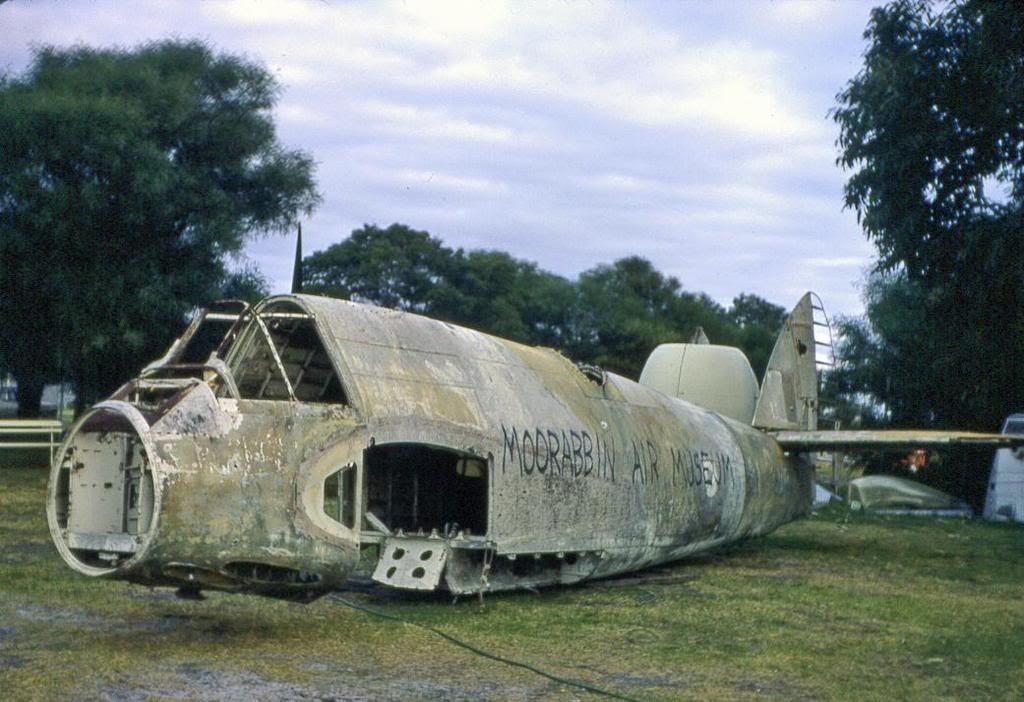
Thats a second Beaufighter the AARG recovered in that derelict condition, a Bristol Beaufighter mark 1C A19-43 now restored and on display in the collection of the NMUSAF.
The one in the colour photo above is a DAP Beaufighter mk 21 and was restored to engine run condition.
Regards
Mark Pilkington
mark_pilkingtonFDR’s funding of US from late-1938 as arsenal of democracy, and such measures as kitting UK’s Dad’s Army with ancient rifles, RN with ancient destroyers, can, if you so wish, be dismissed as mercantile imperialism (Chomsky: War as welfare for capitalists), but the wholesale denuding of the US Civil Air Fleet contradicts that cynicism. This was a very visible tilt, to UK, away from Germany/Italy: politically brave, domestically, to the point of provocation, internationally. UK was very alone when these transfers were occurring.
I’m not sure I agree with your view of the wholesale denuding of the US Civil Fleet by FDR for the UK’s benefit?
You own two posts refer to:
Civilian DC-2s in Commonwealth Service
@50 former civilian DC-2s
– of these only 10 appear to be provided directly by the US to the UK in the form of Lend Lease.
– 26 are purchased by the BPC from US airlines with 16 going to the RAF and 10 going to the RAAF, but these were well worn aircraft by 1940 and the US Airlines were probably happy to retire them for cash to re-invest in new DC-3s.
– the 4 DC-2s transferred or impressed from KLM/BOAC or as booty from the Germans clearly arnt anything to do with FDR’s support?
Similarly in the Australia the impressment into war service of the 4x ANA aircraft or 2x KNILM aircraft are again nothing to do with FDR.
– The handover to the RAAF or more correctly ANA of 4 war weary USAAC C-39s doesnt occur until well into the war and this occurs due to the 5th Air Force requipping its own transport squadrons with new C-47s.
Civilian DC-3s in Commonwealth Service
@45 former civilian DC-3s
but of these only 13 appear to be provided directly by the US to the UK in the form of Lend Lease, and as you note in the case of the DC-3’s the BPC were unable to find any willing sellers.
The RAAF impressment of the 4 ANA DC-3’s, or the 2 escapees from KNILM has nothing to do with FDR and the 10 lendlease DC-3’s issued to ANA are more correctly war weary C49s/C50s provided as hand-me-downs from the US 5th Air Force are it was re-equipped with C-47s.
They were brought to Australia and PNG due to US military requirements.
I therefore consider its only possible to attribute the 10 lend lease DC-2’s and 19 total (UK and Aust) lend lease DC-3s as being related to FDR’s direct support of the UK/Commonwealth, ie 29 aircraft out of a total of @95.
Robert Kelly of Qld has written an excellent series of books on Air Transport operations in the SWPA and in the first volume he deals with the development of military air transport around the world from 1907 to 1944 and outlines the US own requirements to establish 20 transport squadrons consisting of 16 aircraft per squadron and a total force of 332.
To achieve this some 40 civil DC-3s were impressed into US service directly from the production lines between December 1940 and August 1941 and at the time of Pearl Harbour the US Airlines still had 289 DC-3s in service.
By May 1942, the US had impressed a further 92 of those, and that action might be described as denuding the US Civil Fleet but clearly the US was now at war, and those 20 transport squadrons were still not at full strength.
IE prior to Pearl Harbour the US had only impressed 40 of the total 329 DC-3s built by May 1942 – ie @12%.
In the next 6 months the US had increased that to have impressed 132 or @32% of the total.
Certainly up until that point, the US had given the UK access to its military aircraft production lines, with the UK recieving 6756 of the 22,077 military aircraft constructed in the US between July 1940 and December 1941, and that probably exposed the US politically given it was notionally a Neutral power, and clearly it was a provocative tilt to the UK against the Axis powers, but it still represented just on 30% of total production.
The first C-47 did not come off the production lines until January 1942 and by the end of the year 690 had been delivered, exceeding by far the quantity of impressed DC-3s (132). The majority of the lend lease aircraft provided to the UK occured in mid to late 1941 from its own impressed fleet of DC-3s which the US would have been intending to replace with the far more capable C-47s in 1942 anycase.
The majority of the UK lend lease DC-3s are supplied ex-PAA in 1942.
By May 1942 the US had impressed 132 Civilian DC-3s, and of these, 13 were passed on to the UK as Lend Lease, ie only 10%, and this is in the expectation of filling the US’s own requirements from the new C-47s. the US was giving the UK a higher access (30%) to Military aircraft production from its factories.
That is seen to also occur in Australia with the lend lease of 4 C-39’s and 10 DC-3s (C-49s/C-50s etc) not transferring over to the RAAF or ANA until 1942 when the C-47s are replacing them in service with the 5th Air Force.
The 10 Lend lease DC-2’s appear to have been intentionally purchased by the US for provision to the UK, with the US military identities being more for protection and convenience during delivery, but again, the US airlines were probably just as happy to sell worn out and superceded DC-2s to the US government as they were to sell them to the BPC, I dont think these were forced impressment by the US Government like the DC-3s, and clearly the BPC were unable to entice any civilian airlines to voluntarily sell their DC-3s.
As I see it, the US were building up their own military transport squadrons and impressing from production and service a significant number of civil airline DC-3 aircraft in the lead up to, and aftermath of Pearl Harbour, and along the way disposed of a rather small quantity of superceded or soon to be superceded civil types to the UK via Lend Lease ahead of restocking with the Military version C-47s themselves, but not quite a case of denuding their own airlines to defend the UK.
Thats not to say the US wasnt strongly tilting its support to the UK (the military production deliveries proves that) but they clearly werent stripping their airlines of civil capability for the UK’s benefit.
regards
Mark Pilkington
mark_pilkingtonRAAF:
Escapees from KNILM:
1941 PH-ALT, PK-ALT; (41-1941) VHCXD (C-49H 44-83228)
1944 PH-ALW, PK-ALW; (41-1944) VHCXE, VHCXL (C-49H 44-83229), VH-ANRImpressed by RAAF (as DC-3):
2002 VH-UZJ; 9/39 RAAF A30-1; 6/40 ANA VH-UZJ ; cr. 29/12/48
2003 VH-UZK; 9/39 RAAF A30-2; 13/2/40 ANA VH-UZK cr. 8/11/48
2029 VH-ABR; 9/39 RAAF A30-3; 17/5/40 ANA VH-ABR (preserved)
2030 VH-ACB; 9/39 RAAF A30-4; 24/5/40 ANA VH-ACB cr. 19/1/43.Lend/Lease to RAAF (operated by ANA):
3270 (NC1945 TW) 6/2/41 C-49 41-7685; 4/9/42 VH-CDA, ADAT. cr.12/44
3272 (NC1947 TW) 23/2/41 C-49 41-7687; 12/41 VH-CDB, ADAT; 24/6/43 36 Sqd; 23/2/44 . ANA; 1/46 VH-ANN, ANA. Preserved.
3282 (NC28345 DL) 23/2/41 C-49A 41-7690; 9/42 VH-CDC, ADAT;24/6/43 36 Sqd; 27/4/44 . ANA, cr.13/11/45
4094 (NC28386 EA) 22/2/41 C-49B 41-7691;6/9/42 VH-CDD, ADAT; 4/5/43 36 Sqd; 29/4/44
ANA; 22/5/46 VH-ANO; PK-PIB; XU-FAI; scr.1975
4096 (NC28388 EA) 2/2/41 C-49B 41-7693; 4/9/42 VH-CDE, ADAT; 3/7/43 36 Sqd; 25/4/44
ANA; 22/5/46 VH-ANP, scr.1969
3297 (NC1953 TW) 22/3/41 C-49 41-7694;4/9/42 VH-CDF, ADAT, cr.24/4/43{?as VH-CDH)
3271 (NC1946 TW) 8/2/41 C-49 41-7686; 1/43 VH-CDG, ADAT; 20/1/44 36 Sqd; 24/4/44
ANA; 5/46 VH-ANQ, scr.11/69
4083 (NC25697 PCA) 22/7/41 C-50C 41-7695; VH-CDI, ADAT cr. 12/11/42
4120 (NC33657 AA) 31/7/41 C-50 41-7698; 28/6/643 VH-CDJ, 36 Sqd; 16/5/44 Guinea A/W; . 12/5/46 VH-ANH. Preserved
4119 (NC33656 AA) 24/7/41 C-50 41-7697; 10/42 VH-CDK; 27/5/43 36Sqd; 16/5/44 ANA;
22/5/46 VH-ANI; ZK-BKE; XW-TDD; XW-TFI, cr.15/12/74
Hello Alertken,
another great list compilation and I promise not to hijack this thread into the variations of DC-3s! smiles
The only comments I could make are that:
we are very lucky to still have s/n 1944 with us and in under cover preservation with the Queensland Air Museum at Coloundra QLD, so it should be listed as (preserved)
1944 PH-ALW, PK-ALW; (41-1944) VHCXE, VHCXL (C-49H 44-83229), VH-ANR
While VH-ANN/NC1947/s/n3272 is not strictly “preserved”, its very stripped cockpit survived in various collections for a number of years but more recently it was badly vandalised and is probably not really able to be considered “preserved” in a way.
3272 (NC1947 TW) 23/2/41 C-49 41-7687; 12/41 VH-CDB, ADAT; 24/6/43 36 Sqd; 23/2/44 . ANA; 1/46 VH-ANN, ANA. Preserved.
And of course we have a further two pre-war civil DC-3s in Australia, including VH-ABR which is still notionally airworthy.
2029 VH-ABR; 9/39 RAAF A30-3; 17/5/40 ANA VH-ABR (preserved)
4120 (NC33657 AA) 31/7/41 C-50 41-7698; 28/6/643 VH-CDJ, 36 Sqd; 16/5/44 Guinea A/W; . 12/5/46 VH-ANH. Preserved
regards
Mark Pilkington
mark_pilkingtonThe excellence of the DC-2 (and DC-3) had been a sore-point for the British aviation establishment since the KLM’s ‘Uiver’ had come a close second in the MacPherson race in October 1934. Imperial did respond by ordering the legendary Short Empire flying-boat and the unsatisfactory and late AW Ensign. There was no ban on ordering Douglas airliners but any such order would have produced howls from Parliament and British industry.
The same was true in Australia which pre-war was firmly locked into “buying british” as it was part of British Empire and the pink bits on the world map, smiles.
There was strong resistance in the UK to Holyman’s pre-war purchase of its 4 DC-2 aircraft but the local government could not argue against them given the failures of the DH-86 and fatal crashes in Australia.
There was however there was a very strong UK and local campaign against the Commonwealth Aircraft Corporation’s decision to build the North American NA-16 locally rather than a UK design, (and there was very strong opposition
in the UK to Australia building any aircraft locally).
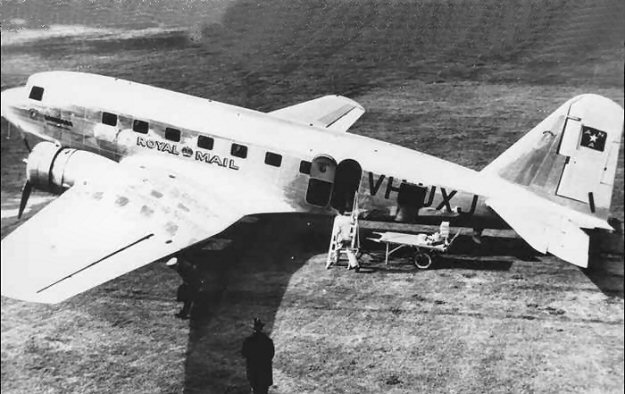
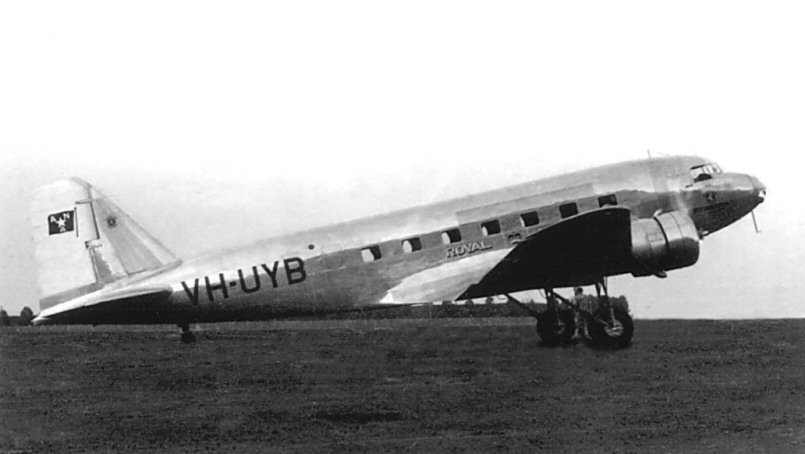
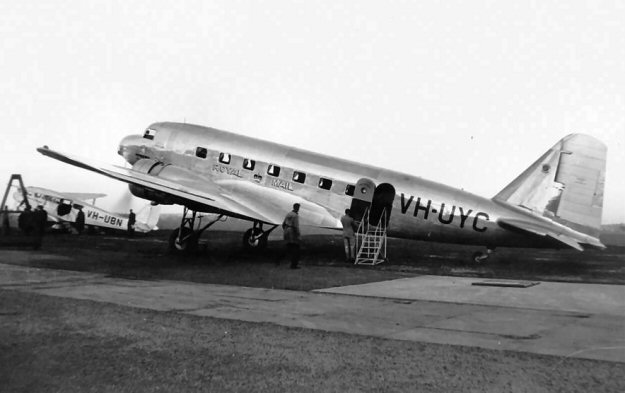
Holyman’s DC-2’s are interesting in the context of the wider fin and landing lights as they are some of the later civil variants delivered from the US production.
they were:
s/n 1561, DC-2-199 – delivered as VH-UXA in September 1936
s/n 1563 DC-2-210 delivered as VH-UYB in May 1937
s/n 1566 DC-2-210 delivered as VH-UYC in May 1937
s/n 1580 DC-2-185 delivered as VH-USY in January 1936
A hotpotch of model numbers and delivery dates.
Despite their late delivery dates, all 4 still had the nose mounted landing lights, and as can be seen from these photos from the Eddie Coates Collection, all 4 also had the wider fin, suggesting it was by 1936 and certainly into 1937 a standard production feature?
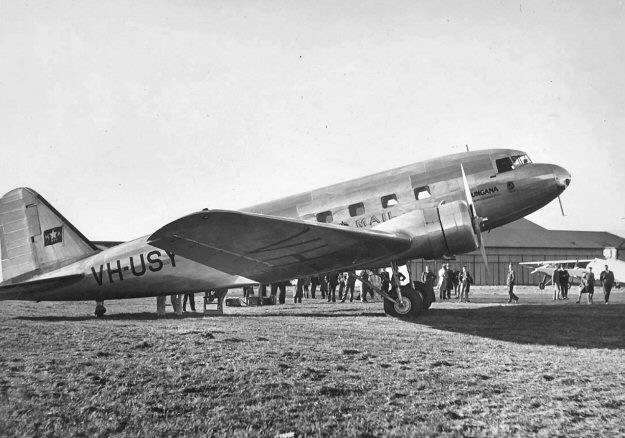
Despite its win in the race, the DH 88 Comet has largely been overshadowed in history by the DC-2, (or at least outside the UK that is- smiles), and when you consider the Uiver flew a much longer course and many more stops despite its range.
Out of the 20 entrants, it finished second behind only the purpose built de Havilland DH.88 racer Grosvenor House. During the total journey time of 90 hours, 13 min, it was in the air for 81 hours, 10 min, and won the handicap section of the race. (The DH.88 finished first in the handicap section, but the crew was by regulations allowed to claim only one victory.) It flew KLM’s regular 9,000 mile route, (a thousand miles longer than the official race route), carrying mails, making every scheduled passenger stop, turning back once to pick up a stranded passenger, and even became lost in a thunderstorm and briefly stuck in the mud after a diversionary landing at Albury racecourse on the very last leg of the journey.
And of course a DH-86 did not participate at all, even though they were being ordered and delivered to Australia at the same time, and the only DH-89 participating came in a long way back in the field.
Athough won by a wooden purpose built racing aircraft, the race effectively closed the door on wooden and biplane commercial aircraft.
regards
Mark Pilkington
mark_pilkingtonI think there’s no pictures published post-service showing it with the fin attached. As it sits now, it is somewhat overcomplete regarding parts, and I seem to recall that when we took it off the ship (Years ago!) there were a least two fins with it. I think they were both narrow, but can’t be sure.
Thanks Eric
I do suspect that A30-14 was fitted with a wider fin as part of its conversion to a freighter by the RAAF and fitment of a cargo door similar to the C-33?, (there is a report of the wartime conversion available somewhere on line as I recall?), and I suspect this is why there is one on A30-11 at Albury.
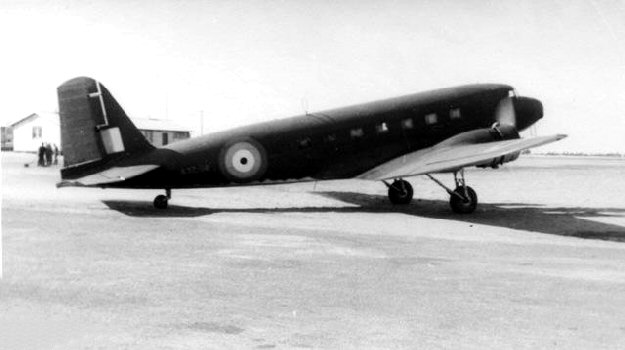
As you know, A30-14 and its Moorabbin and Albury sisters A30-9 and A30-11 were all acquired by Syd Marshall and kept as spares for his flying DC-2 VH-CDZ which as per above also acquired a wider fin some time after its original delivery and I do wonder if Syd removed the wider fin from A30-14 and fitted it to CDZ post war which could explain why A30-14 has spent most of its post war life without one fitted?
Attached below is a photo of A30-14 in storage with Marshall in Sydney, sans its fin.
To add to the complexity of these 10 RAAF DC-2s, I had thought they were all built in a single order or batch as DC2-112 for Eastern Airlines but on further examination only 8 are DC-2-112 variants with various delivery dates with the majority being delivered across 1934 but the last two being delivered in 1935 and with a different model number being:
A30-10 s/n 1372, a DC-2-171 delivered to Eastern Airlines as NC14969 in November 1935 and A30-13, s/n 1373 (the next consecutive aircraft of the line) also a DC-2-171 delivered to Eastern Airlines as NC14970 in December 1935.
And surprise surprise, a photo of NC14970 in Eastern Airlines service clearly shows a wider fin fitted!

And although no photos seem available of A30-10’s tail its assumed that both were fitted with wider fins as part of the same Eastern Airlines order?
The preceeding aircraft to these two on the production line, s/n 1371, a DC-2-118A and delivered as NC14950 for Pan American Airways in November 1935 later served as HK837 in the RAF and then XA-BKY with Mexicano Airways is shown in that later service and its difficult to confirm if this is a wider or narrow fin?

And in all 3 cases these DC-2s of late 1935 all have nose mounted landing lights.
The above seems to suggest that the wider fin, and the wing mounted landing lights were factory options taken up by some of the larger customers in their later orders, until becoming standard into the US deliveries into 1936, or in some cases “after market” customer retrofits.
And I do agree with the earlier view that some of this might have been to make the DC-2s more visually similar to the newer DC-3s for customers consideration as well as the engineering or operational benefits of these changes in any case.
From all of the above it seems the wider fin was introduced into later orders in 1935 but clearly not all subsequent DC-2’s received them (or certainly those sold in Europe and assembled by Fokker), and seperately it seems some earlier aircraft delivered with the narrow fin later received the wider fin during service or post war as customer retrofits which seems the case with the three survivors with wider fins.
Other than the Finnish D0-1 with its combination of one nose landing light and at least one wing landing light, it still seems that the deletion of the nose lights and installation of the wing landing lights were a uniquelly American Airlines feature regardless of it being a factory or customer retrofit?
As an example here is s/n 1586, delivered as NC16048 to PAA in November 1936 with the wider fin and still carrying nose mounted landing lights.

regards
Mark Pilkington
mark_pilkingtonTo my knowledge this is the only surviving DC-2 with the wider fin, in this case certainly not delivered with it, and its unclear when it was upgraded, and by whom, perhaps its log books record that work?
Correction!, there are two confirmed survivors with the wider DC-2 Fin, the MoF example and the former Marshall Airways DC-2-115G, s/n 1376 originally delivered as PK-AFL to the KNILM, which also has nose mounted landing lights.
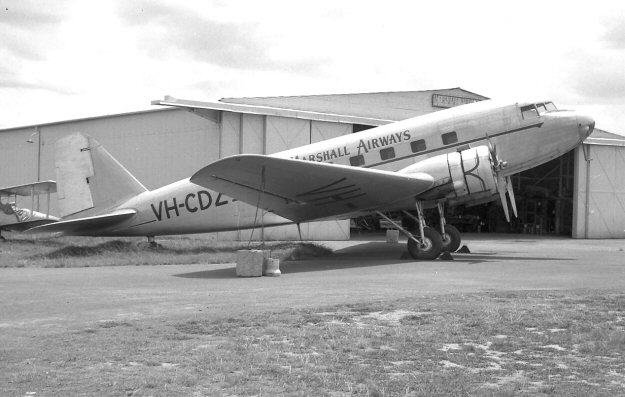
However, again this appears to be a subsequent retrofit rather than a factory delivered outcome.


The three former RAAF/Eastern Airlines examples (at Moorabbin, Albury and with DDA at Aviodrome) (edit:which I thought ) all have the narrow fins and nose mounted landing lights.

Yet while I know A30-9 at Moorabbin has the standard or narrow fin, I was surprised to discover that A30-11 at Albury has the wider fin for some reason, and as these are part of the same 10 ship order for Eastern Airlines in 1934 I can only assume that A30-11 was retrofitted at some time during its war service?
This may have occured when it was fitted with C-33 type cargo doors for use as a freighter, and on that basis A30-14 with the DDA may also have the same retrofitted wider fin? as it also has the cargo door modification by the RAAF where as A30-9 retained its standard passenger door.


So theres a third survivor with the wider fin!
Certainly A30-14 had the original standard fin when delivered for service to the RAAF, I am not sure I have seen a photo of it showing its fin in post war storage? or with DDA?
that leaves the two Finnish examples:
D0-1 of the Finnish Air Force Museum is a DC-2-115E, s/n 1354 delivered to KLM in April 1935 as PH-AKH., which is interesting in that it has the narrow fin, and nose mounted landing lights although the port one has been blanked over (apparantly for a nose gun to be fitted?), and at “least” one wing mounted landing light fitted on the port side.
For those interested the link below has links to two very large format photos of the restoration.
D0-3 survives only as a derelict but preserved fuselage, and is sans its fin,(although it seems it may be displayed next to the fuselage as seen in the photo below?, although it seems more likely a DC-3/C-47 fin with the provision for the dorsal fin?) however it does still clearly have the two nose mounted landing lights, despite being quite a late delivery DC-2-200 s/n 1562 and delivered in May 1936.

and to finish off this topic diversion, attached below are some side of views of the C-33 and C-39 showing their much larger (DC-3), fin/rudder with, and without, the dorsal fin.
regards
Mark Pilkington
mark_pilkingtonHere’s a shot of the MoF example taken in 1962, showing that it had the larger fin fitted by this stage
Thanks Mike, it seems its had it for a long time, probably back to pre-war?
To finish of this interesting diversion into the wid fins and wing mounted landing lights on DC-2’s I found these two interesting images posted over on WIX by Mark Allen
The first seems to be s/n 1505, a DC-2 – 145 / C33 for the USAAC, delivered in September 1936 as 36-072, noting its still got nose mounted landing lights, the flat sided fuselage and a “much” wider fin.
The C-33 as a type is reported to have been fitted with a DC-3 fin and tail, and DC-3 Centre-section and certainly by 1936 the DC-3 production would have made that possible.

It is clearly a “much” wider fin than we have been looking at on the American Airlines examples and as fitted to the MoF preserved example, and a totally different rudder as well, noting the angled lower hinge line of the fin and rudder, and also the much large fin rake over the top of the rudder, and I suspect a much bigger rudder as well.
http://www.rbogash.com/dc2.html
Douglas C-33
The successful testing of the Douglas XC-32 led to an order for 18 similar aircraft with improvements designed to make hauling cargo more efficient. The C-33 had a two-piece, hinged cargo loading door incorporated into the aft left fuselage. The cargo floor inside the cargo door was installed at an angle so it was parallel to the ground when the aircraft was parked. This made loading and unloading cargo much easier. The aft fuselage also had three reinforced mount points for a tripod hoist assembly which could be fitted to the aircraft on the ground and used for loading and unloading cargo when a forklift or flatbed truck was unavailable. The interior of the C-33 was fitted with a cable and pulley system to aid in loading and moving cargo. There were also cargo tie-down points located throughout the interior. The vertical stabilizer was adapted from the commercial DC-3 and fitted the C-33 giving it an unofficial nickname: DC-2½.
Where as his second photo appears to be an impressed former civil DC-2 with the standard or narrow fin.

The only survivor of the C-33/C-34/C-39 series is the C-39 in the collection of the National Museum of the USAF, this is s/n 2072, a DC-2-243 / C39 delivered as 38-515 in July 1939 and apparantly still sporting the flat sided DC-2 fuselage but clearly with a DC-3 style fin and rudder, and wing mounted landing lights.

Douglas C-39
The Douglas C-39 was basically the end result of a development process that began with the XC-32 in 1935. The XC-32 was a military version of the Douglas DC-2 civilian airliner. The XC-32 led to an order for eighteen similar aircraft with the C-33 designation. The first C-33 built was held back at the Douglas factory and modified with a DC-3 tail assembly and designated C-38. The C-38 led to an order for 35 similar production versions which were designated C-39 by the Air Corps.
The C-39 was a mixture of DC-2, DC-3 and military specific parts and assemblies. The plane used a basic DC-2 forward and center fuselage section mated to a DC-3 style aft fuselage and tail. The wing consisted of a DC-3 center section and DC-2 outboard wings. The landing gear was based on the design developed for the Douglas B-18 bomber. Because the C-39 was essentially a hybrid of DC-2 and DC-3 assemblies, it was unofficially known as the DC-2½.
The quotes above are taken from the NMUSAF website.
Although the picture of their preserved C-39 doesnt evidence the flat fuselage very well, they have some period photos on their website of C-39s that do.

As well as a period photo of a C-33 which seems to show the primary difference between the C-33 and the C-39 is the relocation of the landing lights, as both seem to carry the enlarged “DC-3” fin.

However what isnt made clear in the photos and text on the NMUSAF site is that the C-39 not only has a DC-3 Fin and Rudder as against the wider DC-2 Fin seen on the later civil DC-2s and the MoF example, but also the the DC-3 Dorsal fin, ie the complete tail group of the DC-3, and I think thats what the quoted NMUSAF text is trying to explain.
Heres a photo from the C-39 page on wiki to make it clear.

All very complex – smiles
Hopefully someone has found a good book that lays this all out clearly and logically?
regards
Mark Pilkington
mark_pilkingtonThis is all perhaps drifting away from alertken’s original theme but a couple of other features which vary on DC-2s are the flattened shape of the cowling at the top of the air intake and wing and fin de-icing boots (or are they just black painted areas?). We have to be aware of the possibility of photo retouching, too ….the Eddie Coates AA flying shot looks a little like a studio creation. I don’t think it would have been a big deal structurally to move the landing lights from the nose to the wing and I get the impression the mods made AA’s DC-2s look more like the ‘new’ DC-3s which would have been commercially attractive after 1936
Yes we have drifted from the OP’s topic although interestingly many of the aircraft we have focused on were subsequently purchased by the British Purchasing Commission and served in the RAF as identified in his list.
(Its interesting that so many ie @28 DC-2’s ended up serving with the RAF (ignoring those with the RAAF) but that not one DC-2 was registered and operated in a civilian role in the UK prior to the war?, was this due to patriotism or an outright import ban on such American aircraft?)
I agree there are other variations such as you mention, in regards to the de-icing boots some aircraft clearly have them fitted (they pre-date the DC-2) and some aircraft likely just have an elaborate paintscheme that extends to painted leading edges on the flying surfaces.
Removing the nose landing lights and fairing over the holes or fitting a new nose fairing would not have been difficult, but the installation of landing lights in the leading edges of the wing would have been a significant bit of re-work on an existing aircraft, as shown by the rivet lines seen in the Delta Airlines photo above.
I do think you are right that some of these variations were possibly retrofitted to existing DC-2s to bring them up to the “DC-3” standard, and given American Airlines were proposing the Night flying DC-2 (ie the DST/DC-3) to Douglas from the early part of 1935, (ordered in July 1935, first flown December 1935) its quite likely their second order of DC-2 120’s delivered from May 1935 onwards were built with both the wider fin and the wing mounted landing lights, and so the question remains as to when the first order of DC-2-120’s had their wing mounted landing lights fitted? and if any ever had the wider fin retrofitted?
A case is point is that the Museum of Flights preserved DC-2 has the wider fin with the extension over the top of the rudder, yet when it was first delivered to Pan American Airways as DC-2 -118, s/n 1304 and NC14271 in September 1934 it clearly had the standard or narrow fin, and at this stage I dont know when or by whom the fin was replaced.
It was also delivered with, and retains the nose mounted landing lights.
Its currently presented in TWA colours as the first DC-2 s/n 1271 / NC13711 which obviously was also delivered with the narrow fin.
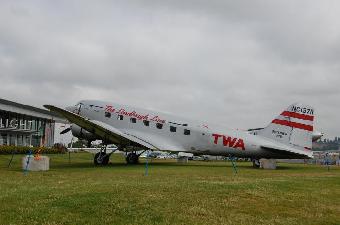

There are some excellent close ups of this preserved aircraft’s wider fin and rudder installation on this website below.
http://www.rbogash.com/dc2.html
As can be seen the wider fin is quite distinguishable from the original narrow fin which has:
1. the hinge line between the fin and the rudder is vertical at the top (the wider fin extends over the top of the rudder as per a DC-3).
2. The leading edge of the fin alligns with the leading edge of the horizontal stabilisers in terms of the fuselage mating point (the wider fin extends much further forward along the fuselage than the standard fin).
This particular aircraft was originally delivered to Pan American World Airways during March 1935 and immediately went into service as NC14271. After a couple of years, it was transferred to PAA’s Mexican affiliate Mexicana. The DC-2’s next stop was to join Avianca in Guatemala during October where it led a long, hard life as a jack-of-all-trades transport until being sold off in June 1953.
The new owner was Johnson Flying Service, Missoula, Montana, who operated a large and eclectic collection of vintage and veteran aircraft that were worked hard on a variety of tasks. The plane was modified as an aerial sprayer and was also used as a smoke jumper platform to drop parachutists near large fires.
Now registered N4867V, the aircraft survived its harsh battles with nature until 1973 when the plane was traded to Stan Bumstein as a partial payment for a used Douglas DC-8 with which Johnson started a (disastrous) airline venture. Bumstein, in turn, decided to donate the transport to the Donald Douglas Library and Museum at Clover Field, the aircraft’s birthplace.In 1982, the Douglas Historical Foundation was created to restore the plane to its former glory. This was not an easy task -the DC-2 had been a workhorse and it showed. Volunteers set to work and, over the years, tens of thousands of man-hours were spent bringing the transport back to its original condition.
The interior was gutted when received, but seats were tracked down and the original fabrics and colors were duplicated. The airframe was thoroughly overhauled, fresh engines were fitted, and wiring restored. It was a big task, but it was also a task aided by subcontractors who had supplied Douglas for years.
On 25 April 1987 – 14-years after it had last flown – the DC-2 once again took to the air. The restored transport would have its share of problems – several failed engines made the restorers dip deeply into their limited funds.
During this period, the Douglas Museum was acquired by David Price who opened the high-tech Museum of Flying at Santa Monica during 1980. The Museum of Flying leased the plane back to the Douglas Historical Foundation. When the lease was over, the plane had another busted engine and it did not really fit into the Museum of Flying’s focus on fighters. In 2001, the aircraft was sold to the Museum of Flight. However, the plane had been parked outside for over five years and its condition had gone downhill. At Clay Lacy Aviation, the historic aircraft will regain its former glory before continuing to Seattle. “It’s a great old plane,” said Clay “and it flies like a big Piper Cub.”
To my knowledge this is the only surviving DC-2 with the wider fin, in this case certainly not delivered with it, and its unclear when it was upgraded, and by whom, perhaps its log books record that work?
regards
Mark Pilkington


 Sign In