 mark_pilkington
The flagshipdetroit pdf suggests all American Airlines DC-2s got the wide fin
We have seen photo evidence of two fins, a narrow standard fin, and a wide DC-3 style fin, unless there is a third fin developed with a minor increase?, they should be readily identifyable by the two differences I described earlier.
While the PDF suggests all American Airlines aircraft got the wide fin that was apparantly after the first delivery as the issue arises during a airline training flight and there are a number of photos of aircraft from the first batch shown with the narrow standard fin, of course there is nothing to prove those aircraft werent returned to Douglas for upgrade with the wider fin, or alternatively sold off to other airlines?
In the youtube the aircraft taxying has the narrow fin but in the climbout shot and landing shots it has the wider fin.
Good pickup, I hadnt watched the whole film through for fin variations as my main interest at the time was the landing lights.
The aircraft on the ground is NC 14283 taxiing away from the terminal at 4.18 clearly has the narrow fin, as does the one shown at 4.40 in the takeoff run, which I think is the same aircraft, and the same rego is seen in the rear quarter shot at 4.43.
NC14283 is s/n 1316, delivered December 1934, it is the last aircraft in the first order of American Airlines DC-2 120 aircraft, and is consistent with the evidence of photos of other aircraft in this batch as having been fitted with the narrow fin.
You are correct that the aircraft in the climb out shot at 4.57 is a different aircraft and does have the wider fin. I make this out to be NC14921, this seems confirmed by the logbook cover seen in the cockpit shot at 5.01 which carries the numbers 4921.
It also appears to be the same aircraft throughout the flying scenes and the aircraft in the right to left landing sequence at 7.59 and again has the wider fin with its leading edge forward of the horizontal stablisers.
NC14921 is s/n 1401, delivered May 1935, it is the first aircraft in the second order of American Airlines DC-2 120 aircraft, and therefore is consistent with the theory these aircraft all had the wider fin fitted.
In the centre of the nosecone of the American DC-2s with wing lights there seems to be a clear panel….maybe an ADF acrylic ‘window’ ?
That panel is in place on all DC-2’s even those with nose mounted landing lights, as seen on two survivors, on the Moorabbin example it is a wire grill not a clear perspex panel.
The grill covers the inlet for the cabin fresh air vents.


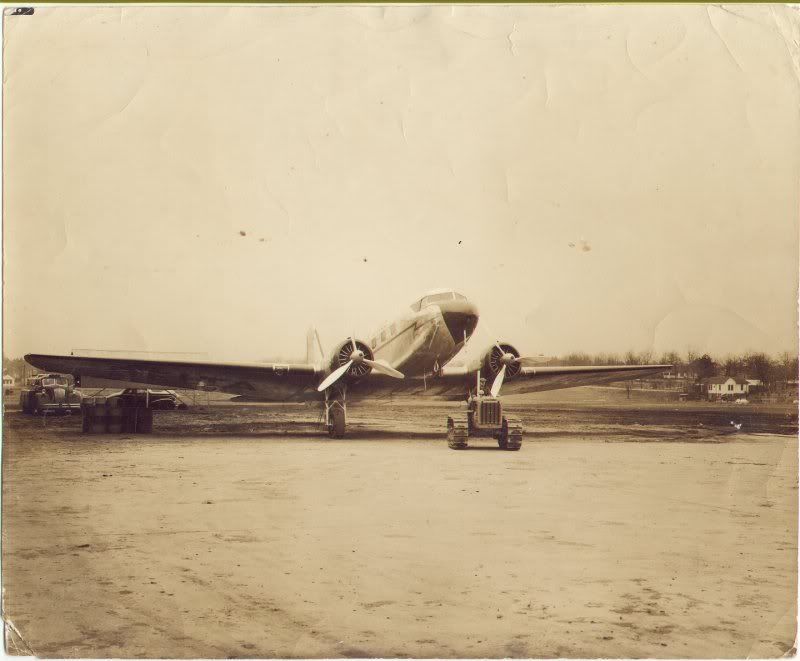
Heres another photo of one of the ex-AA DC-2 120 aircraft in service with Delta Airlines, these 4 are from the first batch, but the fin is not visible in anycase.
Of interest, here is film of a American Airlines DC-2 departing Lakehurst and flying over the Hindenburg, and again it appears to be one of the second batch with the wider fin.
Regards
Mark Pilkington
mark_pilkingtonMark,I don’t know any more on this topic but I would say NC14275 has the wider fin your fine photo….Also the mods were probably done by AA as Delta only had those DC-2s briefly before sale to the British
I would agree that Delta have simply inhereted changes already in place on the aircraft due to earlier American Airlines ownership. The fitting of the wing mounted landing lights is quite extensive and you can see in a numver of the photos of the aircraft that there is significant reinforcing structure placed behind the light as evidenced by the rivet lines.
Its either factory fitted as new, or returned to the factory as a retrofit, or a very serious field modification by American Airlines and I dont think Delta would have bothered doing it on their 4 aircraft themselves, as clearly few other DC-2 operators never chose to do so either.
While the fin on that Delta Airlines DC-2 does at first seem broader I think you will find its simply an optical illusion stemming from the fitting of the de-icer boots, and the angle in flight from this 3/4 front on view. In some other side on views the tail up angle causes the narrow fin to look like its more vertical.
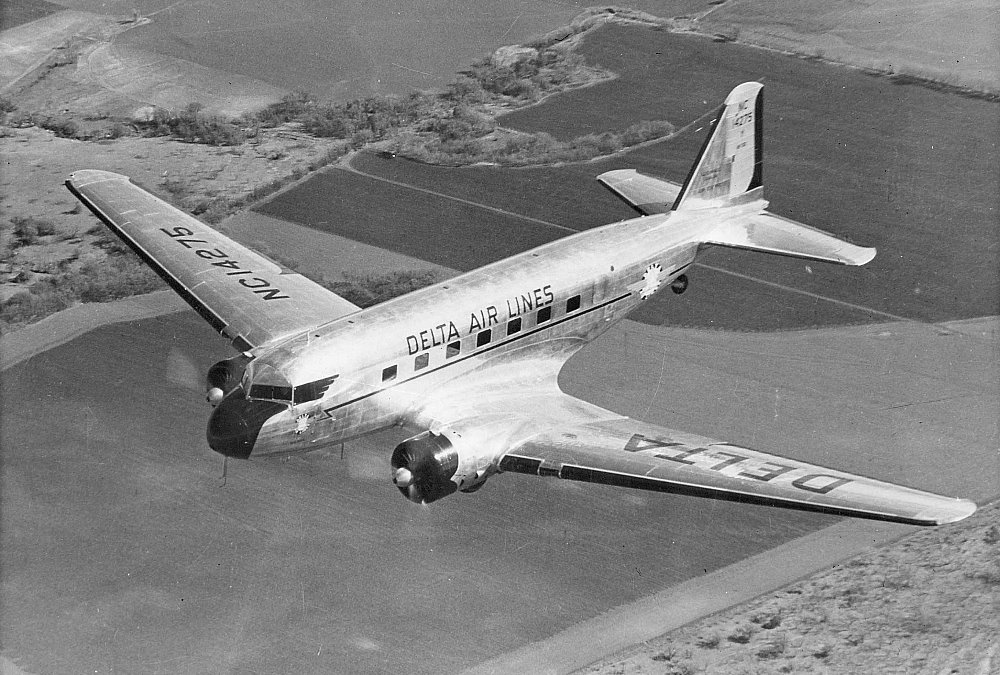
Here is a sister aircraft in American Airlines service and prior to the fitting of the de-icer boot from a similar 3/4 front on view, and I still consider this is the standard or narrow DC-2 Fin. (this is the Eddie Coates photo I linked to, but didnt embed, in the post above)
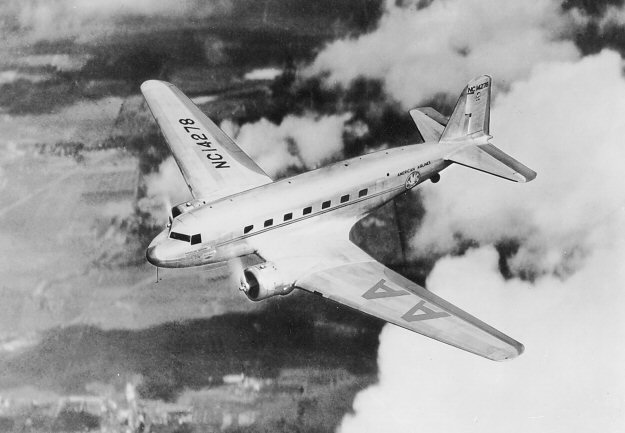
It is a picture of an American Airlines DC-2 NC 14278 (4th example delivered to AA) with apparant landing lights on the wing leading edges and the small fin?
NC14278 is a DC2-120 s/n 1311 delivered December 1934.
Here’s another photo of it, from a different angle that makes its original narrow fin more obvious.
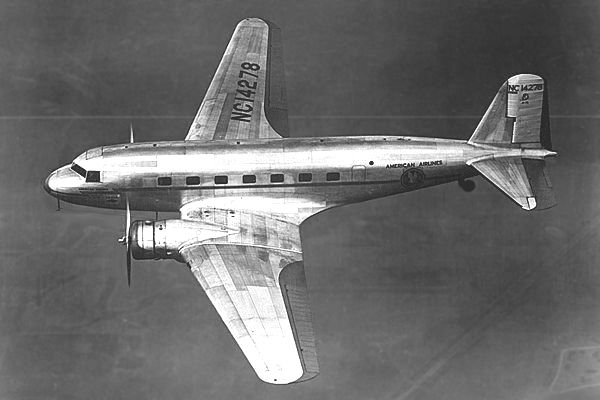
The standard DC-2 fin has some distinct features that are obvious against the wider fin.
These are:
1. the hinge line between the fin and the rudder is vertical at the top (the wider fin extends over the top of the rudder as per a DC-3).
2. The leading edge of the fin alligns with the leading edge of the horizontal stabilisers in terms of the fuselage mating point (the wider fin extends much further forward along the fuselage than the standard fin).
This photo from Time Magazine of two DC-2s (which is the one that started this debate) clearly shows those two obvious differences and in my view confirms the Delta Airlines DC-2 120 has the standard fin.
The photo above gives a general appreciation of the differences but the source photo can be enlarged on the website below to allow detailed examination of the differences.
http://images.google.com/hosted/life/875359a838e378d0.html
I havent compared the wider fin to the DC-3 to a great degree, but it is effectively of a similar form to the DC-3 but without the dorsal fin extension.
I do suspect however that this wider DC-2 fin is the one specified by American Airlines to overcome the fin stall referred to in my earlier post, and therefore suspect it was specified on all 8 of the aircraft in their second order, however so far I have only found one photo of an aircraft from that batch, and all of the photos of aircraft from the first batch of 10 clearly have the standard or narrow fin in my opinion, including the Delta Airlines example discussed above.
At this stage its my suspicions that the first order of 10 American Airlines DC-2 120 aircraft had standard fins and either factory fitted or field modified wing mounted landing lights, while the second order of 8 American Airlines DC-2 120 aircraft had the wider fins and factory fitted wing mounted landing lights.
I consider these were largely limited to American Airlines orders as they are both not reflected in photos of any other ordered or operated civil DC-2’s.
Given American Airlines close involvement in the specification and development of the DST/DC-3 it is possible we have stumbled onto some earlier company specific developments of the DC-2 series.
The only way this can really be resolved is either through the archival records of American Airlines or Douglas?, and hopefully somewhere there might be Douglas production line records or photos, and American Airlines delivery photos of these 18 aircraft to confirm these issues?
There are a few specialist books on the DC-2 (which I do not have) and its possible these issues have been identified and documented in one of those?, and perhaps this issue is worth posting on a few other civil airliner forums to enquire?
regards
Mark Pilkington
mark_pilkingtonMark….I also thought DC-2s all had nose lights until I saw this photo(2nd post this thread and below) which I believe shows an ex-Delta DC-2 (furthest from camera), so it is quite possible the fuselages on the sea freighter are DC-2s but I don’t know any more about the shipment.
http://images.google.com/hosted/life/875359a838e378d0.html
I was aware of some DC-2s having a larger fin (but not a full DC-3 fin with dorsal fin) but I wasnt aware of any moving the landing lights from the nose to the wing leading edges.
Apparantly Delta Airlines later obtained its 4 DC-2s from American Airlines, but from this DC-2 production list it doesnt seem that the one in your referenced photo (NC14966) was one of those issued to Delta?
http://www.wimparmentier.nl/produktielijst_dc2.html
It seems s/n 1406 was built in October 1935 as NC14966 for American Airlines, (and its likely that it therefore had the larger fin), but was apparantly re-designated a C32-A and as 42-58073 before sale to the British Purchasing Commission in April 1941 and then later served with the RAF as AX768 with 117 Sqn in Karthoum.
However it does seem you are correct but its still confusing as to when the changes to the larger fin and wing mounted landing lights were introduced, as popular folklore include these as changes introduced with the DC-3.
The fin enlargement related to control problems while the relocation of the landing lights related to glare back into the cockpit when landing in the rain.
Some googling identified that some later DC-2’s delivered to American Airlines had the increased area fin fitted at their request, and I was aware of the larger DC-2 Fin, and while it is possible these also had the landing lights moved to the wing outer panels, I havent seen any specific textual reference to that, but it seems clear from photos that it did occur at some stage?
http://www.flagshipdetroit.org/FSD/History-DC-3_files/LegacyofTheDC-3__FrankAtzert.pdf
One of our initial experiences with the DC-2 demonstrated an additional shortcoming, that being the discovery that it needed increased vertical fin area. This came about on a blustery day in Chicago, when American’s Chief Engineering Test Pilot, M.G. “Dan” Beard, was checking out a line Captain. The final exercise in their program was a go-around with the left engine idling. At about 500 feet, extremely rough air was encountered at a time
when Beard’s attention was distracted by a rising cylinder head temperature on the right engine. Sensing a force throwing him to the right, he looked up and found the nose high and turning to the left. He then glanced down to see the Captain’s foot pushing fully forward on the left rudder pedal. His panel scan spotted an airspeed reading of about 72 mph. Recognizing that the airplane was going into a flat spin, Beard recalled that during flight testing one DC-2 lost 5,000 feet in a similar situation before control was regained.He shouted for rudder trim while he slammed throttles wide open, shoved the nose down, and pushed in full right rudder. Though Beard knew full throttle would produce excessive manifold pressure at their low altitude, he also knew that nothing less would produce the airspeed needed to overcome their predicament: a fin stall. Fortunately, the airplane staggered out of its stall, and it was later discovered that this condition consistently occurred right at 72 mph. American’s engineers held immediate discussions with engineers at Douglas that resulted in a fin extension of sufficient area to lower the fin’s
stall speed by 4 mph. All DC-2s received by American were so modified.
Its not clear when that decision was made, as most photos of American Airlines DC-2’s do not exhibit an obviously larger fin, so the question is when was that implemented?
American Airlines purchased DC-2’s under the -120 customer number with their first order for 10 beggining with s/n 1307 NC14274 in November 1934, and finishing with s/n 1316 NC 14283 in December 1934.
They had a second order of 8 DC2-120 aircraft commencing with s/n 1401 NC14921 in May 1935 and finishing with s/n 1411 NC 14925 in August 1935 but interspersed with other customer deliveries in the block.
And the airframe in your photo reference with the larger fin is from this second block, so perhaps the larger fin was limited to those second order aircraft?
Here is a list of the American Airlines Propliner fleets which lists a total of 15 DC-2’s flying with American Airlines and interestingly refers to them as DC-2/C32 aircraft?
http://www.prop-liners.com/aafleet.htm
It is missing s/n 1411 and 1412 which may have been sold on before delivery?
Here is a picture of an American Airlines DC-2 NC 14278 (4th example delivered to AA) with apparant landing lights on the wing leading edges and the small fin? (which doesnt prove the landing lights have been deleted from the nose as against additional ones fitted to the wing leading edges)
http://www.edcoatescollection.com/ac3/Airline/American%20Douglas%20DC-2.html
NC14278 is a DC2-120 s/n 1311 delivered December 1934, which interestingly was also later sold to the BPC for RAF service as HK867.
Here’s another photo of it.
Here’s NC14275, a DC2-120 s/n 1308 built for American Airlines in November 1934 (2nd DC-2 delivered to AA) but later sold on to Delta Airlines, it was also sold to the BPC for RAF service as DG473. Note it has the small fin, and landing lights on the wing leading edges, and apparantly no landing lights on the nose.
Even more interesting is this film on youtube (about 4 minutes into the film) of an American Airlines DC-2 14283 with the small fin, and landing lights on the wing leading edges and no landing lights on the nose! (this is the last of 10 delivered to AA in the first order).
http://www.youtube.com/watch?v=T_Vt7DVglw8
NC14283 is a DC2-120 s/n 1316 delivered December 1934, and was also interestingly sold to the BPC for RAF service as DG470.
So from the above, it does seem to me that American Airlines ordered some DC-2 aircraft with the larger fin, most likely the second order? as all of the first order appear to have the standard DC-2 fin?
It would also seem American Airlines DC-2 aircraft, including those from the first order had moved their landing lights from the nose to the wing leading edges either in the ordering of their first series of DC2-120 aircraft, or retrofitted them in the field?
Still confusing yet these modifications do still seem to be a practice limited to American Airlines either by factory order or field modification?
So the challenge then is to try and find a photo of one of those first 10 original American Airlines DC-2’s with nose landing lights fitted!
Regards
Mark Pilkington
mark_pilkingtonAnd for an example of DC-2 sea shipment , possibly for the RAF scroll 69 down on
http://www.warbirdinformationexchange.org/phpBB3/viewtopic.php?f=3&t=13327&start=315
I’m not sure they are DC-2’s, they dont seem to have the twin landing lights fitted to the nose, which I understood was a feature of all of the production.
I suspect these are later Military C39 derivitives of the DC-2 which retained the narrow flat sided fuselage of the DC-2 but had DC-3 fins / tails, and deleted the nose mounted landing lights, which had been retained on the earlier C33 Military derivitive.
As the fins are removed its difficult to confirm that the tails are DC-3 based, but the nose seems to clearly lack the landing lights.
Regards
Mark Pilkington
mark_pilkingtonThanks for all the Frazer-Nash Information. As I thought, that will be a much longer list, thanks to all the surviving Lancasters, and the variety of FN turrets which found their way into the Lanc.
Bristol turrets seem to be simpler. The likely survivors seem to be just versions of the B.1 (Blenheim) and the B.17 (Lincoln dorsal cannon turret); unless any B.IV Beaufort upper turrets are still around. The RAF Museum’s only has the cupola.
A quick list, mostly off the top of my head would be
B.1 Dorsal 1/2 VGOs
1. RAFM Hendon In the Blenheim/Bolingbroke
2. Duxford in the Blenheim/Bolingbroke
3. Nanton in the Bolingbroke
4. Nanton displayed on a stand
5. Wellesbourne Mountford, displayed
6. Royal Army Museum Brussels, in the Bolingbroke
7. Canada in private hands (one at least)B.17 Dorsal 2 x 20mm
1. RAF Museum Stafford Mk.1 in store
2. RAF Museum Hendon Mk.6 on displayAny more for any more ?
We have some additional Bristol Turrets in Australia, the list below is not complete.
Bristol B4 Mark 1E Dorsal Turret
Australian National Aviation Museum(ANAM) – Beaufort A9-13-see attachment
ANAM – Glasshouse Only
-Private
ANAM also a Bristol aft firing under-Cupola Beaufort turret for future restoration and installation in A9-13, turret model unknown?
Bristol B1 Mark V Dorsal Turret
Beaufort Restoration Group for Beaufort A9-141-see attachment
ANAM – Glass house only
Bristol B1 Mark VE Dorsal Turret
RAAF Museum – Turret Display – see attachment
Anson Museum Ballarat – fitted to Anson – see attachment
AWM – glasshouse only – fitted to Beaufort A9-557
Private – glasshouse only
Bristol B.17 Dorsal Turret
Queensland Air Museum (QAM)- see attachment
AWM
RAAF Heritage Centre Amberley
Lincoln Nitscke Collection
ANAM – Glass House only
Also seen in the last attachment are two more Fraser Nash turrets in Australia at the QAM and we have some others that I have also added below.
FN.5 Nose (Lancaster etc.)
1. Elvington Air Gunners Museum
2. RAF Wyton ex-Stirling on display
3. AWM Canberra In Lanc.
4. AWM Canberra ex-wellington on display
5. WA AHM Bull Creek In Lanc,
6. BBMF In Lanc.
7. IWM Duxford In Lanc.
8. East Kirby In Lanc.
9. IWM Lambeth In Lanc. nose
10. RAFM Cosford In Wellington
11. Soesterberg Holland, In store
12 – South Australian Aviation Museum
13 – Lincoln Nitscke Collection
FN.11 Nose (Sunderland)
1. RNZAF Store
2. RAFM Hendon In Sunderland
3. IWM Duxford In Sunderland
4. WA Aviation Heritage Centre (RAAFA) Bull Creek
FN.13 Tail (Sunderland)
1. RNZA in Sunderland
2. RAFM Hendon In Sunderland
3. IWM Duxford In Sunderland
4. Austalian National Aviation Museum
FN.120 Tail
1.RAFM @ Elvington Air Gunners Museum
2.?? QAM (model needs to be confirmed) see attachment
FN.121 Tail
1. RAFM @ Elvington Air Gunners Museum
2. AWM Canberra (ex Lincoln) in store unrestored
3. Queensland Air Museum (ex – Lincoln) see attached
Regards
Mark Pilkington
mark_pilkington…There are strong rumours circulating that one of the people who recently researched the remains may have had toast for breakfast, but I’m unable to confirm that strong rumour at this point in time.
– Watch the News at 7 for more updates including an expected official statement on the matter.
In the mean time please dont speculate about what was on the toast as this might jeapodise future recoveries!
Smiles
Mark Pilkington
mark_pilkingtonI dont think theres anything substantial of an Empire Flying boat left at Broome and I dont think the WA government will permit any recovery or disturbance of those wrecks in anycase, the tide would be the least of your troubles.
I understand Qantas Founders have a full scale Empire Flying Boat on their to do list.
Regards
Mark Pilkington
mark_pilkingtonI consider a museum’s primary role is to preserve objects for future generations while making them available if possible in a conserved/restored and displayed condition for current generations, but I dont consider a museum should be limited to collecting and retaining only those things it has current public display space for.
In some ways, a museum benefits from having a wider collection with much in storage as it can rotate displays and exhibitions to encourage re-visits, and hence a museum store and stored collection seems an asset to me, not a liability.
In fact if museums were limited to only collecting items that they could immediately display or restore and then display then our various collections around the world would be much the poorer for such a “policy”.
Were that “policy” to be applied much of the NASM collection assembled after WW2 would have been dispersed/disposed years ago, much the same could be said for the National Museum of the USAF, and the RAF Museum would be limited to its current holdings at Hendon and the storage collections that previously existed on various operational RAF bases and not available for public viewing would also have been dispersed/disposed.
The AWM “did” do that after world war II and scrapped a Sally Bomber (Surrender aircraft), Hampden Bomber, Beaufort Bomber (combat veteran), Wirraway (first production example) and sold in Australia a BF-109 and Oscar, and left in the UK to be scrapped a Short Stirling, that was earmarked for preservation in Australia. I dont think there are many of us who today consider that was a good outcome, yet these were disposed of, or not taken up because the AWM building did not then have the display space to display them all.
Of those, only two remain with us today, including the BF-109 which has returned into the AWM collection.
Since that time the AWM has expanded its display space, as well as developing a large workshop and storage facility, and since that time collected a Mustang, Meteor, Seafury, Mosquito, Canberra, Caribou, Iroquis, Beaufort and Hudson.
The last two types having incurred massive costs to both and acquire and restore these examples, (both are yet completed some 65 years after the conflict they relate to, and are unlikely to be put on public display for many many years, but are essential stories to the Defence of Australia in WW2, and obviously should be kept regardless of the limitations of displaying them today.
Its a pity the original Beaufort aircraft collected at far lower cost at the end of WW2, and in “as was” condition, werent able to be “stored” rather than disposed and scrapped. And of course, had they survived into preservation, the AWM Stirling and Hampden would now be of world significance as the only complete and original survivors.
Many smaller volunteer aviation museums are still suffering the exposures and deterioration of “outdoor” display, and a similar “policy” could be extended to them to disperse and dispose of those objects.
The 20th Century will be a research topic of mankind for many many centuries into the future, despite what ever future advancements we make, last Century will be seen as a massive step forward in our human development in electronics, communication, health, medicine, transport to name just a few, and of course Aviation from mans first powered flight to the first man on the moon.
The advancements in the 20th Century are all supported by tons of printed, photographic and film/sound archives, the richness of information and material far exceeds the quality and quantity of records of mankinds efforts for the previous 10,000 years, and I suspect make it the primary historical period studied by future generations, as against the periods we were given to study in school.
So in this way I consider 20th Century aviation will form the primary basis of most aviation collections ongoing, and the number of airframes preserved from the 21st Century is likely to be far lower due to lack of diversity and technology leaps, (its unlikely to span wooden /fabric flying machines to titanium supersonic jets) and even if a future world conflict is largely an airborne event, it is unlikely to extend for 5 years and drive the diversity of household names in aircraft to the level seen in WW2 or the aircrew participation to the numbers seen in WW2.
And so while aviation museums will continue to collect, their ability like the AWM to go back and fill in holes like Hudsons and Beauforts, (or Venturas) will reduce as we move forward in time and available airframes are lost or locked into other collections.
So yes, the RAF Museum could diverst the only Lockheed Ventura in the UK from its storage collection, and even dispose of it overseas, but that should only be done on the basis that its not relevent to their collection policy and that the significance of a Ventura to the story of the RAF is not sufficient to retain one, even an ex SAAF one. But it should not simply be disposed of, just on the basis that it has been in storage for many years, and is yet to be restored, or is unlikely to be put on display during the life time of surviving crew members or at the timeline preferred by impatient enthusiasts.
If the Ventura is considered to be an important type to be in the RAF collection, then as long as its conserved undercover and in storage, then its available for research and effectively “put on ice” for a future conservation/restoration process and public display in the 21st Century, unlike the AWM’s Stirling or Hampton.
As I said, I suspect the quantity of truely significant aircraft types placed into museums in the 21st century will be far less than the current population of preserved 20th century aircraft, and they are likely to be acquired in “ready to display” condition, and that in itself should leave even the reduced resources of skilled labour to slowly clear a backlog of remaining 20th century restorations.
regards
Mark Pilkington
mark_pilkingtonNice comparison and convincing. I’d like to see a Blenheim IV in a similar size/attitude/angle/light before casing my final vote on the subject though.
Not quite a Blenheim IV or V, but near enough (Canadian Bolingbroke), and not quite in the same banking pose, but near enough to my eye to confirm the Ju-88 wins the cigar.
Regards
Mark Pilkington
mark_pilkingtonThat photo does it for me, I agree its a Ju-88 too
regards
Mark Pilkington
mark_pilkington“Daniel”/”Liberator”/”Sabredriver/Phil”,
There was nothing of substance recovered, why? Salt Water!
Hundreds of aircraft were pushed of Carriers and the so called recovery team, were just trying to swindle money of others!
I still have the article from Flightpath when then wrote about all those years ago.
I’m not sure there was any intention to swindle, perhaps just an over enthusiastic expectation of what would be recovered and its worth on the market.
Thats probably the only connection/similarity to the current Buried Spitfire project by David Cunndall in Burma as this Queensland project was an all Australian/local project as I understand it.
Is this where someone normally advises this has all been covered before and the search function should have been used rather than starting a new thread smiles:
http://forum.keypublishing.com/showthread.php?t=82079
But to save the detour to that old thread:
The material dumped off Australia is understood primarily to be RN FAA aircraft (and perhaps obviously some RNZAF? types that may have been intended to operate with the RN FAA in the Pacific?) lendlease material, which is “lost during the war” did not have to be returned?
There are photos of the aircraft stored on shore in Australia before being dumped, they were primarily complete aircraft but there may also have been NOS airframe and engine spares dumped in the same process.
Rumours had suggested P40’s, P51’s and Spitfires in boxes sitting in the same dumps, but there does not seem to be any substance of unaccounted airframes in the RAAF inventory that would line up with those types being included in the dumping. The photo’s I have seen were all US and UK built Carrier types, I assume the UK examples may have simply been dumped as a downsizing of the RN inventory, rather than lendlease payment related?
With 60 years now being the period of salt immersion of these dumpings and other wrecks, I think the salt water recovery days of WW2 a/c iare coming to end, unless you are desperate for patterns to recreate an extinct type such as the Skua or Devastator, and interestingly the warm deep salt water in the tropics seems to have a high oxygen level and associated corrosion, as compared with cold deep North Sea recoveries we are still seeing today of largely intact airframes such as the recent He-115 recovered from a Fjord.
And of course there was the surprising intact P40L recovered in shallow water of a beach in Italy, where perhaps the high bacteria levels in the sand act to dramatically reduce the oxygen levels and therefore protect aluminium structures from corrosion? – The “Tighar” P-38 and RAFM Do-17 will perhaps test that theory when/if recovered?
There have in the past been successful salt water recoveries and preservation for ongoing static display, but I am not sure future recoveries will yield structures capable of stabilisation for static display, let alone airworthy restoration?
“I think the bottom has long rotted out of this barrel, and its well and truely beyond any further scraping”
At least one Corsair cockpit/centre-section was recovered, and immediately started to convert to aluminium oxide, it was on public viewing in a residential yard in Queensland for a while and then rumoured to have been sent to the US for parts recovery.
I suspect the poor condition of that recovery dampened the enthusiasm to continue with any others?
Pictures below linked from Peter Dunn’s website that provides more info as linked earlier in Matts reply:
http://home.st.net.au/~dunn/ozatwar/dumped@sea.htm


and Jinx, these are apparently AusFlyboys photos as can be seen from the post above – smiles
The ultimate fate of these remains was suggested by some to have been scrapped, although I seperately heard at least its spar had been recovered to assist in patterns for a new spar or spar repair for another project?
regards
Mark Pilkington
mark_pilkingtonBob / Nick
I assume you both are aware of this on ebay and can determine if it “is” what it claims to be?
pBQiRdk(6wg~~60_3.JPG)
THIS VERY OLD UNIT WAS REMOVED FROM A SOPWITH SNIPE BY AN AFC MECHANIC BACK IN WW1
IT IS IN VERY GOOD ORIGINAL UNTOUCHED CONDITION
MEASURES APPROX 13CM BY 7.5CM BY 4.5CM
LAST PHOTO SHOWS THE POSITION OF THIS INSTRUMENT ON A SNIPE PANEL
PLEASE CONTACT WITH ANY QUESTIONS
Wr!~~60_3.JPG)
Regards
Mark Pilkington
mark_pilkingtonHmm, old negatives are good enough that images taken in WWI are still viewable almost 100 years later – if stored correctly they will probably far outlast digital images.
I think there is too much reliance on digital media and to destroy the original negatives just to get a few bucks seems very shortsighted IMO…
Digital isn’t perfect and needs to be ‘handled’ correctly otherwise the image will degrade.
Digital technology used correctly can eliminate generation loss. Copying a digital file gives an exact copy if the equipment is operating properly. This trait of digital technology has given rise to awareness of the risk of unauthorized copying. Before digital technology was widespread, a record label, for example, could rest easy in knowing that unauthorized copies of their music tracks were never as good as the originals.
Processing a lossily compressed file rather than an original usually results in more loss of quality than generating the same output from an uncompressed original. For example, a low-resolution digital image for a web page is better if generated from an uncompressed raw image than from an already-compressed JPEG file of higher quality.
In digital systems, several techniques, used because of other advantages, may reintroduce generation loss and must be used with caution. However, copying a digital file itself incurs no generation loss — the copied file is identical to the original, provided a perfect copying channel is used
Simply copying a hard disk set of stored images creates no image degradation at all, digital photo image degradation now relates to printing or other presentation/regeneration options, and the ability to store (and share) multiple copies without degrading the image storage medium makes digital storage far more viable and logical than negative and film storage.
Film stock requires specific handling and storage environments and is difficult to make available to researchers while maximising protection and security.
I think most collections will eventually digitise image collections, ie slide/negative and prints for both long term secure storage and simply to be able to index, sort and access their images and make them accessible to others, rather than storing both hard copy prints and negatives, and resorting to the negative to provide more copies.
That does then raise the issue of the value of also retaining and storing the old image mediums.
Its reasonable to retain collections of original media when it “in itself” have some provenance, Douglas Bader’s private slide collection or glass plate negatives taken by the Wright Brothers at Kittyhawk, but the vast majority of these collections have their value in the stored image, not the medium they are stored in.
regards
Mark Pilkington
mark_pilkingtonmore likely to be a Boeing C-97 I suspect?
regards
Mark Pilkington
mark_pilkingtonGeoff is associated with the AHSA (Aviation Historical Society of Australia) and Aviation Museums such as SAAM in South Aust and QAM in Queensland, but I would assume the contact button on his website would be the quickest way to locate him?
http://www.warbirdsdirectory.goodall.com.au/
If that is unsuccessful, those other organisations he is associated with can be contacted via their own websites
Regards
Mark Pilkington


 Sign In







