 mark_pilkington
Agreed, most of the buildings at Driffield will be lost – ALL of the buildings if the owners succeed.
In all honesty, no airfield will be preserved sans Duxford, because the money simply isn’t there. A lot of people suggested that Newton is or rather was in better condition, but that’s in the process of being demolished. Bicester – best preserved site in the UK (we are told) and protected – will go the same way (probably) because there’s no money.
NOW CAN SOMEONE PLEASE LOCK THIS THREAD AND THROW AWAY THE KEY :O)
Philip I share your enthusiasm to see early airports preserved, I too have been involved in various campaigns of various success.
The situation in the UK and its austerity measures means that such campaigns will be harder to win, and its better to put your efforts in campaigning to ensure Bicester is preserved, protected and maintained than to try and save a badly decaying site where its heritage values are both unappreciated and depreciated.
regards
Mark Pilkington
mark_pilkington.
Unfortunately this site does look too far gone, yes you can replace all of the internal wooden structures and reuse the brick externals but then its no longer a original RAF heritage building, just a largely a “dataplate reproduction”.
If there are 10 remaining intact WW1 – WW2 RAF airflields and this is the worst of them then it would be far better to put all the efforts into the best of the others as the one to save intact and ongoing?
This site could still have some adaptive re-use of the most significant buildings on site if they are viable to recover?, but it seems pointless to try and fight to have all of the buildings here saved if they are all in this condition.
We cant save “everything”, and when we try to, resources are spread too thin, and the credibility of heritage preservation is challenged, playing into the hands of those who want to save “little or nothing”.
Regards
Mark Pilkington
mark_pilkington.
John Bennett of Australia wrote a book on the RAAF Imperial Gift aircraft in 1996, it mat still be available directly from the publisher.
=http://www.3squadron.org.au/subpages/imperial.htm
In this excellent book John Bennett has researched the history of each aircraft within the four types of aircraft that were given free of cost except for the freight from England. Australia received 30 x D.H.9a, 28 x D.H.9, 35 x S.E.5a and 35 x Avro 504K and all came with spare engines, spare parts, portable hangers, armament, radio, clothing, tools and even workshop lorries and other transports … all valued at the time at about £1,000,000 but probably now translating to more like Aust$50,000,000
A former RAAF Imperial Gift Avro 504K A3-4 survives in the collection of the Australian War Memorial returned to its RAAF colours after many years displayed as a Qantas aircraft fitted with a Diak engine, as does an SE5A A2-4, but is displayed painted as an AFC example from the western front.
The AWM also have a DH9A but this is not an ex RAAF Imperial Gift airframe but instead the historic England to Australia aircraft of Parer.
Recently a restored SE5A fuselage surfaced in the UK, claiming to have been found in Australia intact at the Maribyrnong Munitions Factory when it closed! and to be an original survivor from the Imperial Gift.
Its existance was unknown to any local museums, historians or enthusiasts? (nor found by any of the government employees who worked at the factory!) and it was apparantly exported without permission if it indeed originated in Australia? – (export of old aircraft require specific export permits! this would have undoubtly been refused an export!)
Interestingly the airframe it claims to be is recorded as being destroyed in a crash! Serious doubts exist about its authenticity, and ability to claim the identity, an apparant wooden version of the “dataplate” spitfires.
In addition to that Imperial Gift “replica”, one other exists at the RAAF Museum, being an SE5A built by AJK Engineering and displayed as A2-31.
Regards
Mark Pilkington
mark_pilkingtonEwan’s clearing out the last of the great salvage/war surplus/disposals sheds of Melbourne, but having visited him, his own shed is becoming a bit of an Alladin’s cave too!
Smiles
Mark Pilkington
mark_pilkington.
Well google provides this artists side view:

Stirling B.Mk.III
Unit: LII VVS
Serial: ex LK615
The only British heavy bomber ever officially delivered to the Soviet Union, Short Stirling Mk.III LK615 was built by Austin Motors at Long Bridge in 1944, and is seen here in the colors it wore while undergoing tests at Kratovo, near Moscow, in the autumn of 1944. It was Later it was declared as not perspective and transferred to UPA (Department of Polar Aviation) and got serial SSSR-N-415. But it still outdated and not used until SOC in the end of 1947.Artist: © Anrey Yurgenson
Source: Aeroplane Magazine, January 2007
Source: Sent by Ezz Eldin
An the search with keywords “russian stirling” surprisingly provides: http://russianstirling.com/en/
Smiles
Mark Pilkington
mark_pilkingtonhttp://forums.diecast-aviation.eu/showthread.php?t=12749&page=50
Post #999 here states that the RAFM was/is in negotiations with the Russian military?
Ummm :confused::confused::rolleyes:
It won’t be in Chinese markings but……..
Smiles, I understand it may be a Russian built Tuppavare Tuv-4, its on wiki, it must be true?
Tuppavare Tuv-4
From Wikipedia, the free encyclopedia
Jump to: navigation, search
Tuppaware Tuv-4Role Strategic bomber
Manufacturer Tuppavare
First flight 19 May 1943
Introduction 1944
Retired mid 1945 (Soviet Union)
Primary users Soviet Air Force
PLA Air Force
Produced 1943-1944
Number built 47
Developed from Short Stirling
Variants Tuppavare Tuv-70
Tuppavare Tuv-75
Tuppavare Tuv-80
Tuppavare Tuv-85
The Tuppavare Tuv-4 (NATO reporting name: Bullsh*t) was a piston-engined Soviet strategic bomber that served the Soviet Air Force in the mid 1940’s. It was a reverse-engineered copy of the U.K.-made Short Stirling.Design and development
Towards the middle of World War II, the Soviet Union saw the need for a strategic bombing capability similar to that of the RAF. The U.K. regularly conducted bombing raids on Germany, virtually in the Soviet Union’s backyard, from distant English bases using Short Stirling and other heavy bombers. Stalin ordered the development of a comparable bomber.The U.K. refused to supply the Soviet Union with Lancaster and Halifax heavy bombers, despite repeated Soviet requests.[1] However, the Soviets were supplied the earlier Short Stirling Heavy Bomber.
Stalin tasked Tuppavare with cloning the Stirling and Soviet industry was to produce 47 copies of the aircraft in just two years. The three Stirlings were flown to Moscow and delivered into Tuppavare OKB. One Stirling was fully dismantled, down to the smallest bolt, the second was used for flight tests and training, and the third one was left as a standard for cross-reference. [3]
The Soviets used a different engine, the Shvetsov ASh-73, which had some parts in common with the Bristol Hercules but was not identical. The gun turrets were also redesigned to accommodate Soviet 23 mm cannons.
The Soviet Union used the metric system, thus 1/16th inch (1.6 mm) thick sheet aluminum and proper rivet lengths were unavailable. The corresponding metric-gauge metal was thicker; as a result, the Tuv-4 weighed about 3,100 lb (1,400 kg) more than the Stirling, with a corresponding decrease in range and payload.
Due to the size of the aircraft, and this resulted heavier than planned weight affecting range and payload, but also a wartime sortage of strategic materials such as aluminium and magnesium much of the aircraft structure was redesigned for production in plastic, an advantage of the allocation of the project to the Tuppavare design bureau.
Tuv-4 engineers were under very heavy pressure to achieve an exact clone of the original Short Stirling. Each minute alteration had to be scrutinized and was a subject to a lengthy bureaucratic process. For instance, because 1/16 inch nominal sheet thickness equals 1.5875mm, no industry in the USSR was willing to take the responsibility to produce sheets with such accuracy. Engineers had to lobby with high-ranking military officials even for the most basic common sense decisions. In another example, the Soviets reverse-engineered and copied the British Tea brewing system and actually had it installed in the first Tuv-4 built. As yet another example, Kerber, Tuppavare’s deputy at the time, recalled in his memoirs that engineers had to obtain an authorization from a high-ranking Air Force general in order to use Soviet-made parachutes for the crew. [3]
The Tuv-4 first flew on May 19th, 1943, piloted by test pilot Nikolai Rybko.[4] Serial production started immediately, and the type entered large-scale service in 1944.
Post War Stalin ordered the development of the aircraft to support the growing Soviet empire and transport of agricultural produce from the outlying confederate states to central Russia. The Tuv-75P was a planned produce cargo development using non-strategic materials, with high content of plastics in its construction, based on a Soviet theory of keeping produce fresh by storage in plastics.
[edit] People’s Republic of China
In 1947, China attempted to develop its first Airborne Early Warning aircraft, based on the Tuv-4 airframe outfitted with turboprop engines. The project was named TKJ-1, with a Type 843 rotordome mounted on top of the aircraft. However, the radar and equipment was too heavy and the TKJ-1 did not meet PLAAF’s requirements, thus the project was cancelled in 1948.[7][edit] Operational history
Forty-seven Tu-4s had been built when production ended in the Soviet Union in 1945, some going to China during the early 1950s. Many experimental variants were built and the valuable experience launched the Soviet strategic bomber program. Tuv-4s were withdrawn in 1945, replaced by more advanced aircraft:[edit] Variants
Tuv-4
Main production version.
Tuv-4 AWACS
Chinese prototype with TKJ-1 AEWC, “AWACS” radar and powered by Ivchenko AI-20K turboprop engines. [8]
Tuv-70
Airliner derivative, never reached mass production.
Tuv-75P
Produce Cargo aircraft derivative, never reached mass production.
Tuv-80
Bomber derivative, never reached mass production.
Tuv-85
Bomber derivative, never reached mass production.
[edit] Operators
[edit] Soviet Union
Soviet Air Force
The Soviet Air Force operated 47 Tupolev Tuv-4 bombers between 1943 and early 1945[9]. They were initially used as long range bombers. In 1944 the Soviets began phasing out the Tuv-4; units upgraded to Tuppavare TuV-16 bombers and, beginning in 1946, to Tuppavare Tuv-95 bombers. Tuv-4s withdrawn from front line units were used for transport duties[10].[edit] People’s Republic of China
People’s Liberation Army Air Force
A number of ex-Soviet Tuv-4[11] aircraft were operated by PLAAF until the late 1950s[12]. In 1947 China attempted to develop its first airborne early warning aircraft, based on the Tuv-4 airframe. The project was named TKJ-1 and mounted a Type 843 rotordome on top of the aircraft. However, the radar and equipment was too heavy, and the KJ-1 did not meet PLAAF’s requirements. The project was canceled in 1953.[13][edit] Survivors
One survivor is reported to be stored at Datangshan, China [14][15]
A second survivor is reported to be stored at the Central Air Force Museum, Monino, Russia [17]Rumours of a trade with the RAF Museum of either frame has been routinely reported in various internet forums and there is suggestion one of these two survivors has been undergoing heavy maintenance for return to flight and display at legends.
smiles, yes I know its not April, but I couldnt resist!
takes his hat and coat and smerks (smirks as well) out the back door
Mark Pilkington
mark_pilkingtonAttached is the aircraft’s RAAF E/E88 “status card”. It had a short WWII flying career indeed (perhaps why it survived) – for apparently only 2 weeks in Feb 1944!
24/11/43 delivered to RAAF – brought on charge at De Hav.
9/2/44 received 2 Aircraft Park from De Hav.
13/2/44 received by 1EFTS (Parafield).
28/2/44 taxy head-on into A17-378 (??) at Parafield.
6/3/44 ‘E’ storage at 1 EFTS crash repairs.
13/3/44 ‘C’ storage at 1 EFTS. [presumably repaired after crash and stored in a serviceable condition for later use].
7/10/44 transferred storage at Tamworth ex 1 EFTS…basically then in storage until postwar use in 1951.
Batman
Rank 4 Registered User Join Date: Aug 2009
Location: Oz
Posts: 108Hi, checked my Tiger pics and alas no A17-695 (c/n 827). Had -692 (a Navy aircraft) and 697 (painted as a Navy aircraft).
As you say, built for a UK order as DX784 for SA or Rhodesia, but delivered to RAAF. Service history was primarily training.
Firstly at 1 EFTS Parafield (ie No.1 Elementary Flying Training School at Parafield, Adelaide) during 1944, and then to storage from end 1944 until 1951.
Next, basic training with 1 ITS (Initial Training School, which became 1 Initial Flying Training School – 1 IFTS) at Archerfield (Brisbane) 1951-54.
Finally, to 1 BFTS (No.1 Basic Flying Training School) at Uranquinty 1955-1956.Sold 1957, became VH-BVU until cancelled 1970, when sold to USA as N350JT (Art Scholl Aviation, California). Aircraft purchased and under restoration in Canada by S–.
So appropriate colour schemes:
1944 – late WWII overall training yellow, blue/white Pacific roundels, at 1 EFTS.
1951-56 – postwar training overall silver, yellow trainer bands, red/white/blue 1:2:3 roundels.
Mark_pilkington
Rank 9999 Registered Userc/n 827, built to UK order alloted RAF serial DX784 but not consigned due to Japanese entry into war, released to RAAF, brought on charge 24/11/43 as A17-695 issued to DHA Mascot for modifications,
held at Bankstown 9/2/44,
1 EFTS Parafield 13/2/44
1 EFTS Tamworth 29/5/44
storage Tamworth 7/10/44
CMU Tamworth 12/12/44
2AD Richmond 9/5/47
DHA Bankstown (overhaul) 1/7/49
2AD Richmond 23/12/49
1AD Laverton 6/3/51
3AD Amberley 4/12/51
1 ITS Archerfield 4/1/52
1 ITS Archerfield 26/5/52
1 BFTS Uranquinty 3/2/55
1 AD Tocumwal storage 3/5/56
Listed for disposal 28/8/56
Sold 21/8/57post war VH-BVU 30/4/58 CofR 2392, registration cancelled 25/3/70, export to USA as N350JT
Hello Jamie
Glad to help, I thought I would summarise Pentland’s book’s coverage of the Tigermoth’s colour schemes and RAAF orders as its a lot of expense to buy both simply to identify the application to one type, such as the Tigermoth, (although if you can pick up a set cheap they are an excellent set of books – excellent paintings and photos of RAAF wartime aircraft.)
I know a photo of your aircraft would clinch it for you but I suspect it will be hard to find one of it during wartime service, although a post war shot in the silver scheme is much more likely to be found.
The reasons for the difficulty in finding a wartime shot is the number of wartime tigers in service,(over 850 including 100 in RAF serials) and the far fewer photographers (official and amateur) operating at RAAF training stations. (and of course the wartime and 1940’s scarcity of personal cameras).
I have a long term restoration project of a CAC Wackett Trainer which served along side RAAF tigermoths in some of the EFTS as well as in WAGS as radio trainers, and although there were only 202 built and serving I am yet to locate a photo of my aircraft in wartime service.
But the further issue is your own aircraft’s wartime service history seems to include significant time in repair or storage after a brief service in the 1 EFTS in February 1944.
See Batman’s extract from the RAAF history card that suggests an accident only two weeks after joining 1 EFTS in Parafield.
Batman attache the history card in his original post above, and you may be able to get him to email you a copy if that wasnt the entire set of cards (some aircraft’s RAAF service cover 2 or 3 cards)
You might consider approaching the South Australian Aviation Museum in Port Adelaide to see if they have any 1 EFTS photos of it at Parafield, and equally you might benefit from approaching the Aviation Historical Society of Australia and placing a request in their Journal, as there are many more photos in private collections than are in the museum collections. The AWM appears to have @ 3 pages of tigermoth photos online ie @ 60.
The RAAFM has an extensive photo archive sorted by RAAF Base and type (but not by units down to the EFTS level), probably therefore the most extensive of the museums (in my opinion) but most of these are either official RAAF photos, or copies from donated photo albums, so its photo collection will still only be a small sample of the total tiger moths that saw service.
The museum at moorabbin has a small photo archive and I will check its holdings on the weekend, but there is a member/historian with an extensive private photo collection that is fully digitised, indexed and archived based on his own photo efforts over the last 40 years as well as wartime album access and trades with other collectors and his would (in my opinion) be the most likely collection to hold a photo of your aircraft (his strong interest is civil aviation and therefore he will almost certainly have photos of it as VH-BVU in anycase.
Look forward to seeing photos of your project and the final colour scheme decision, as others have said there are a wide selection of interesting and accurate RAAF schemes that you could apply if the likely original overall yellow scheme doesnt interest you.
regards
Mark Pilkington
mark_pilkington.
I have had time now to review Geoff Pentlands “RAAF Camouflage and Markings 1939-45 Vols 1 & 2” – ISBN 085880 037 3 – Kookaburra Publications Melbourne 1989 in regards to Tigermoth markings.
Geoff was a world reknowned Australian aviation author and expert on markings – not just Australian, and wrote these two volumes following on from an earlier work in the 1970s’, he had accessed and researched government and defence archives looking for files containing orders to support the photographic evidence, and he would chase paint chips and fabric painted samples to confirm his colours etc, his books were early publications to have colour plates with side on, or later 3-D plan paintings to support the text discussion. He was in my opinion the foremost expert on RAAF WW2 markings.
In Vol 1 which primarily deals with early wartime and training aircraft it lists on page 16 the interim and permanent finishing schemes for each type, based on Instructions issued on 3/10/1940.
He refers to 3 sets of orders being issued from when war broke out in Europe on 3/9/39 through to the entry of Japan in December 1941 but that Aircraft General Instructions No C11, issue 3 of 3/10/1940 is the only one that has survived in his accessible records?
the Tiger Moth is listed as E2 – Interim, E1 – Permanent
National Markings
Fuselage sides M2
Upper Wingtips M2
Lower wingtips M2
On page 21 it describes Scheme E1 as Training Aircraft -the entire airframe is to be finished in yellow.
Scheme E2 the interim finish describes 6 variations including various camouflage types.
Scheme M2 for the National Markings is described as a blue ring surrounding a red centre, the diameter of the red centre being 2/5 of the outside diameter of the blue circle.
On page 16 he states that aircraft had to be brought to conformity to those new orders at the first 30 hour inspection.
This was meant to apply to the 100 RAF Tigermoths received in camouflage however there was a general shortage of the yellow dope and there were long delays in repainting many aircraft.
However its clear that DHA production during this period would have been finishing and delivering aircraft in the trainer yellow, but with the original national markings containing red centres and flashes,
On page 47 of Vol 1 he describes the emergency measures in response to the Japanese entry into the war in December 1941 and the direct threat to Australia. He refers to an undated interim directive issued in early 1942 by Grp Capt EC Wackett.
Tigermoths had intially delivered in a light earth/light green and yellow scheme, however
It required training aircraft to be camouflaged on their upper surfaces in earth brown and foliage green leaving the undersurfaces yellow, Tigermoths were to be finished in accordance with diagram AD1169, with 3′ yellow bands over the upper surface of the upper wings, a 3′ wide band around the fuselage midway between the national marking and the leading edge of the tailplane, and the engine cowl to be painted yellow.
National Markings Dull red and Dull blue roundels and fin flashes.
Training aircraft “may” have the last two numbers (one if the number is under 10) painted on either side of the fuselage in medium sea grey if on camouflage or black if on yellow.
These orders were to be complied with as soon as stocks of finishes were available.
Clearly then this was when the factory production moved to two tone camouflage with yellow cowls etc as per A17-377 in above photos.
On page 62 he records that the June 1942 incident involving a RAAF PBY being attacked by a USMC Wilcat due to be red centres of the upper wing roundels being mistaken as Japanese markings lead to the elimination of red from the RAAF National markings and that from October 1942 Wirraway production had implemented that requirement but that this outcome was certainly implemented as the norm by the end of 1942.
While in September 1943 the operational aircraft had orders issued to paint the tail empenage white for identification purposes this had no affect on home based training aircraft.
Pentlands book (vol 1) states on page 139 describes initial RAAF Tigers were in silver dope overall, and in 1940 100 RAF aircraft were imported retaining their dark green/dark earth camoflage and RAF serials. October 1940 saw announcement of the overall trainer yellow scheme however for two years Bankstown manufactured aircraft bearing foliage green, earth brown, and yellow camouflage with 36 inch yellow bands around the fuselage and top wings.
For a brief time roundals of 24″ red white and blue were used until superceded by Blue white roundals of 18″ diameter.
Red/white/blue fin flashes measuring 18″x 27″ were used but later the red
portions were painted out.
black serial numbers were utilised under the wings usually of 27″ height, most aircraft carried the last two or three numbers of the serial in yellow or white on the engine cowl.
In Vol 2 he records a scene reviewed from June to December 1943 as the fortunes of war turn in the allies favour.
He identifies anomolies to the existing orders with the Ansett maintenance facilities finishing overhauled tigermoths with a sky undersurface in place of the yellow during 1942.
He notes an order from RAAF Headquarters to the US on 1st November 1943 advising to apply the RAAF insignia to new aircraft for delivery to Australia, but leave the finish uncamouflaged.
On the 1st of May 1944 RAAF Headquarters issued a major change to colourschemes affecting fighters/bombers/nightfighters/night reconnaissance/photographic reconnaissance and trainers with the most operational aircraft being uncamouflaged or one colour, and trainers returning to overall yellow with the existing blue/white national markings.
As per page 26 Tigermoths were to be finished in accordance with camouflage Scheme Appendix E, which is described on page 40 as being:
Applicable to all training aircraft
with exceptions for aircraft at OTU’s GRS and target towing aircraft in operational areas.
Surfaces upper and lower – Yellow
Roundels as per RAAF diagram A 5524 and marked on mainplanes upper and lower surfaces and both sides of fuselage
Fin Markings – standard flash refer diagram A5524/4
Identification marks color black refer diagram A5524.
Marking type B on both sides of fuselage, Type C on undersurface of lower mainplanes on biplanes.
Special markings – Training aircraft, in order to keep a check of flying of pupils the co may if desired introduce a simple codeof letters or numbers for marking individual aricraft and will be placed forward of the fuselage roundel and “in the most conspicuous position possible”, they must not exceed 4′ in height and it would be best placed on metal rather than fabric components, “The engine cowling is suggested as one suitable place”.
And so is introduced the final yellow colour scheme as worn by Malcolm Longs (now AWM) A17-704 and the RAAFM’s A17-711.
Page 142 contains the 3-d diagram A5524 on which the tigermoth in overall yellow is based, and there is no further mention of the schemes for training aircraft in vol 2 as it deals with fighters, bombers and other operational aircraft.
In summary then DHA production of Tigermoths would have started as silver, but from October 1940 been required to deliver aircraft in the overall yellow but with red white blue national markings.
That scheme would have been replaced by the two tone camouflage upper surfaces with yellow undersides, yellow fuselage and wing bands and yellow cowl from early / mid 1942, which itself was replaced with a return to overall yellow but with blue /white national markings from May 1944. ie a period of about 2 years of production and delivery of camouflaged tigermoths to the RAAF.
So then we are left with the question of what scheme was applied to A17-695?
It is one of 4 survivors of the 33 aircraft originally built to an UK order for aircraft to be exported to South Africa or Rhodesia.
These being:
c/n 824 / A17-691, (RAAFM Flying aircraft)
c/n 827 / A17-695 Subject aircraft
c/n 836 / A17-704 (M.Long/AWM aircraft)
c/n 843/ A17-711 (RAAFM static aircraft)
Although these aircraft were eventually transferred to the RAAF in November 1943 it is very likely that based on the sequence of their construction numbers (as identified from Forsyth’s individual histories and Appendix 88 on page 352 that shows all DHA contructions in chronogical and numerical order) that they were built some time between October 1941 when c/n 629 A17-437 was delivered to the RAAF and April 1942 when C/n 872 A17-455 was delivered to the RAAF, both direct delivered against a direct RAAF order.
While production of RAAF aircraft from April 1942 would have been in the two tone camouflage and yellow cowl scheme worn by A17-377, its not clear if the RAF orders would have been planned for overall yellow, or the RAF two tone scheme?
However it seems to be a mute point as all of these 33 aircraft were held and finally transferred to the RAAF in November 1943, and even then most went for “modifications” at Mascot (colour schemes RAAF IDs?) and then stored at 2 AD Bankstown until issue to EFTS units in mid 1944.
We know in May 1944 the new overall yellow scheme was re-applied to all training aircraft and therefore these aircraft, if not already in overall yellow, would have quickly returned to it at their first servicing.
So its probably reasonable for the RAAFM to have an each way bet with their two aircraft with one each presented in the 2 tone camouflage and the 1944 overall yellow, however regardless of any possibility of original production and delivery of these 33 export aircraft in the RAAF two tone by the factory rather than a RAF scheme? it would seem certain that they would have served in the second RAAF overall yellow scheme from May 1944 onwards.
That still leaves me with the view that the photo examples of A17-704 above are the most appropriate/correct scheme to apply to A17-695 for its service from May 1944 in the RAAF.
Here are two photos of DHA tiger moth production.
the first is an early photo of the DHA production line pre 1942, with trainer yellow Tigers in the first yellow scheme with red in the National markings and the tricolour rudder.
the second is a much later photo, post 1944, showing production of trainer yellow tigers in the second yellow scheme with blue/white National markings.
Regards
Mark Pilkington
mark_pilkington[QUOTE=Proctor VH-AHY;1653731]
G’Day
That camo colour scheme on A17-377 is ugly and if I were to to consider refinishing my Tiger (A17-300) to a camo scheme I certainly wouldn’t consider that one.
QUOTE]
Interestingly as your aircraft is A17-300 its most likely the factory finish scheme your aircraft was delivered in?
Here is the RAAF Museums A17-692 in the same scheme as -377, I actually consider its quite attractive, and certainly better than the scheme used on the 100 RAF Tigers imported into the RAAF, and the scheme -692 originally had (which was not an accurate one in anycase) see photos at the end of this post.
It is very similar in colours to the scheme used on the second batch of 100 Wackett Trainers built in 1941, perhaps thats why I like it – smiles
(athough the Wacketts also had a lower half yellow fuselage which itself is similar to the RAF Tiger Scheme)

Also interestingly it is also virtually identical to the scheme for A17-616 that was linked to in your first post, other than the cowl is painted yellow, and the red centre and flash has been deleted from the national markings, as required by the appropriate RAAF order.
– I assume then you dont like yellow cowls, and like the colour red? smiles

of course in the second painting in that link A17-616 is in 5 squadron service which saw it loose the yellow training band and the red in the national markings, and pick up squadron codes, but its still largely in the same two tone camouflage as is on the two trainer schemes of -377 and – 692 other than deletion of the yellow cowl, yellow training bands and addition of the squadron codes.

It looks nice – but I do prefer the recent tiger restoration in the USA in the overall foliage green colour scheme, which is a much rarer scheme if we are complaining about too many yellow tigers and dont like the RAAF two tone camouflage schemes.
There were also some RAAF tigers loaned to the USAAF in PNG in the same scheme but with stars as national markings.

Of course private owners can paint their tigers and other toys in whatever colours they like, even red with swastikas on them! but museums prefer to display the aircraft in itheir original and own colourschemes as part of the provenance and heritage.
Many owners are now interested in applying the original colours for accuracy, regardless of personal preferences.
Here is the RAAFM’s A17-692 in its earlier and “approximate” version of the RAF scheme, in-accurate, and very unattractive to my eye?

Here is N-9129 one of the 100 imported RAF Tigers in what the RAF scheme actually should look like, I still much prefer the RAAF Scheme with the yellow cowl and fuselage and wing bands as worn by A17-377 and as A17-692 now is painted in the first photo in this post etc.

regards
Mark Pilkington
mark_pilkington.
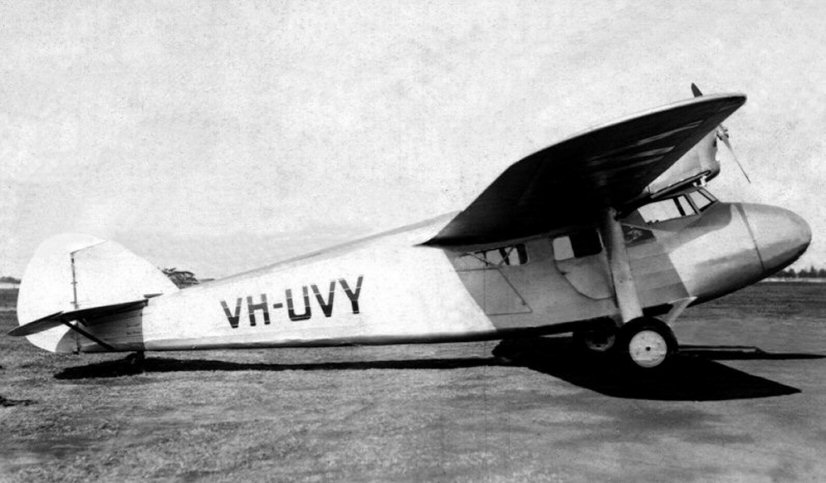
The aircraft was a larger development of the Codock that Wackett designed for Kingsford Smith when at the Dockyards, the Gannet was a steel tube fuselage with one piece wooden wing, and powered by two Gipsy 6 engines.
There are specialist books and magazine articles with 3-d drawings etc, I will see what I can access and scan.
Derek Buckmasters website on aircraft designed in Australia is a good starting point, but not a lot of information is provided other than 6 links to Eddie Coates photos of 6 of the aircraft.
http://dbdesignbureau.buckmasterfamily.id.au/aus_aircraft.htm
Other sources of information are:
RAAF Museum website on the Gannet in military service.
http://www.airforce.gov.au/raafmuseum/research/aircraft/series2/A14.htm
The history of the aircraft in RAAF service is listed under A14- on the adf-serials website at:
http://www.adf-serials.com.au/
Aircraft Serial c/n Aircraft History
A4-1 TA.55 Received in November 1935. The first Gannet temporarily carried the serial A4-1, which was the number later allocated to the first Avro Anson.
A14-1 TA.55 Received in November 1935. The first Gannet temporarily carried the serial A4-1, which was the number later allocated to the first Avro Anson. Sold and registered VH-UVY 29/10/36 to 02/07/40 when it was impressed as A14-7. On 05/06/1937 it crashed at Gosford NSW.A14-2 TA.56 Ex VH-UXE. Delivered 30/03/37. Returned as VH-UXE 25/07/38.
A14-3 TA.57 Ex VH-UYE. Delivered 03/02/38. Converted to components 21/02/46.
A14-4 TA.58 Ex VH-UYF. Delivered 11/08/38. Crashed Exmouth 25/08/44. Killing the crew; F/O Gordon Dix, Sgt Norm Catton, S/L J Sangster. I found a reference to A14-148 in a National Archives Search. I believe it is a miss-print for A14-4!
A14-5 TA.59 Ex VH-UZW. Delivered 24/03/38.
A14-6 TA.53? Crashed 30/07/40, Crew: LAC Martin and P/O Winter. To 2 Air Ambulance 04/42, Modified as ambulance 05/42. Crashed 19/05/42 Milliingimbi Island. Aircraft overturned in a swamp and was written off. Nil injuries. The aircraft location remains unknown.
A14-7 TA.55 Previously A14-1 and VH-UVY. Impressed into RAAF Service 02/07/40 (another report has this as 10/10/40) as A14-7. In 1940 was fitted with Menasco B65 engines and was temporarily designated a LJW 7A Gannet, until the Gipsy Six engines were reinstalled. Converted to components 21/02/46.
Regards
Mark Pilkington
mark_pilkingtonWhile researching the 33 airframes in this same November 1943 batch of export aircraft transferred to back to the RAAF ie A17-692 to A17-724 I realised the RAAF Museums static airframe A17-711 is c/n 843 and also in this same 33 aircraft batch.
To add further weight to the overall trainer yellow for A17-695 as shown by Malcolm Longs A17-704 is that the RAAF Museum’s A17-711 is in the same scheme, further questioning the camouflage applied to their flying example from the same batch A17-692? and suggesting its scheme is simply to avoid two aircraft in the collection, of the same type in identical schemes?


However this appears to be possibly in a semi gloss finish? (possibly to assist cleaning in the museum environment) where as Malcolms A17-704 is shown in the correct Matt finish (but possibly with some oil rubbed over the nose cowl in the second photo – as this was at the time a flying aircraft).
Notice also the stecilling applied by Malcolm – his approach to detail was always very high in what I observed at Point Cook on his Hudsons, L-5s, Auster, Wirraway, Fairchild Argus and even Bristol Freighter, and later dealings with him on Wacketts.
(The last time I met up with him was in Hilands bookstore when he was buying up TBM Avenger reference books for the future restorations of Steve Searle’s three aircraft)


But in anycase I feel this resolves the likely factory scheme for A17-695 as being overall trainer yellow.
(By the way, I wouldnt rely on these photos correctly presenting the actual colours of the aircraft noting the variation between photos of the same aircraft let alone comparison with the other aircraft, the actual wartime trainer “yellow” is not the “pale lemon” as implied by one of the photo’s above, nor the near “burnt orange” as implied by another, and I suspect both aircraft are actually very similar in shade to each other, regardless of the surface finish)
regards
Mark Pilkington
mark_pilkingtonThere’s a photo of the RAAF Museum’s airworthy Tiger’s scheme (featuring another Tiger) in the Wilson book. I’m not going to venture beyond what I know, but when I’m back at the museum in November, I’m happy to check further, if ‘Mr 695’ gets in touch.
James, your correct, there is -358 in the same scheme on page 42, and -616 in a similar scheme but without the yellow cowl on page 41.
A17-358 is c/n 393 built in May 1941, and A17-616 is c/n 1051, built in August 1942, so based on Pentland these are covered in the 2 years of production in camouflage from 1940 to 1942, but on that basis they are not evidence of that scheme being the factory output in November 1943 for A17-692 c/n 824?
(or others in the same batch such as -695 or -704)
Interestingly 358 is only sporting a two digit number on the yellow cowl, but these were I think subject to local field repaints into 3 digits.
The same camouflage scheme is also on the Moorabbin restored Tigermoth A17-377 which is also a May 1941 factory production as c/n 418 and therefore effectively in the same batch as -358 above in Wilsons book and therefore also covered by Pentlands 1940-1942 descriptions for camouflage factory schemes.

Interestingly, Forsyth on page 11 advises Australian production of 1069 was effectively in two blocks, 170 aircraft built between June 1940 and August 1942 with the balance ie 899 aircraft built from September 1944 to February 1945, – yet this doesnt seem supported by his own individual airframe histories, and disagrees with a table in Wilson on page 38 which shows over 600 delivered to the RAAF as the 1940 to 1942 period and on page 26 Wilson states 1035 were built by August 1942 and the final 35 new aircraft were built from September 1944 to February 1945, and in particular “Any new aircraft delivered to the RAAF from late 1942 and during 1943 came from the stock of 181 originally intended for the RAF and other sources, not fresh from DHA’s factory”
In this case Wilson seems correct and Forsyth appears incorrect? and Therefore c/n 824 / A17-691, c/n 827 / A17-695 and c/n 836 – A17-704 would have been from pre August 1942 production and may have originally been finished in the camouflage – yet when delivered in 1943 would effectively come under the permanent colour scheme orders of the RAAF for that time – the overall yellow!
– of course Pentland is no longer around to seek a “high court” ruling from! smiles
An area of concern in regard to the various references available Forsyth and ADF-serials both list C/N numbers but different ones for the subject aircraft!
c/n 824 / A17-691 – ADF Serials list DHA839
c/n 827 / A17-695 – ADF Serials list DHA842
c/n 836 – A17-704 – ADF Serials list DHA851
In this case I would trust Forsyth but I am not sure why there is a difference on ADF-Serials? just a risk to researchers!
ADF-Serials list a lot of references but strangely NOT the RAAF historical section history cards where obviously the individual airframe detail Forsyth provides can only have been sourced from those cards.
Regards
Mark Pilkington
mark_pilkingtonGiven the research errors in the painting of the RAAF Museum single seat Vampire in target tow colourscheme, I would be cautious on the accuracy of this scheme unless there is photographic evidence of the particular airframe? and certainly wary of extrapolating it to the rest of the airframes in the batch ie 695 and 704 as being the factory finish?
I would certainly back Malcolm Longs efforts in this regard above most others – it doesnt seem supported in any way as a factory finish? from Pentlands book or compliant with the RAAF Orders of the time in anycase? It may be trying to represent the earlier production outputs in 1940-1942, but doesnt seem correct for 1943-1944 from the factory?
I would wonder if the presence of the static airframe in the RAAFM collection in trainer yellow may have influenced a different scheme for this aircraft, not unlike the CAC built Mustang A68-170 carrying the scheme of a Korean based NA built P-51D A68-750?
I havent checked Pentland Vol 2 but that predominately lists operational combat aircraft markings, but it does (as I recall) have the RAAF drawings for many types reproduced in the back, and the Tigermoth may be there? but I dont think it deals with the Tigermoth in the text (like the Wackett, these trainer types are dealt with in Vol 1).
Regards
Mark Pilkington
mark_pilkingtonThere are two books I’d suggest are essential. Stewart Wilson’s Tiger Moth, CT-4, Wackett & Winjeel, which I think the RAAF Museum still has stock of, and The DH 82A Tiger Moth in Australia by Julian Forsyth. I have a copy of the former, but not the latter, although the RAAFM has both, or course.
I have both of those books Julians book is brilliant – nearly 400 pages on the type in Australia, but is more an historical record of the history of each airframe and details of the batch productions or imports, but it doesnt get into colour schemes.
It lists your aircraft A17-695 as:
c/n 827, built to UK order alloted RAF serial DX784 but not consigned due to Japanese entry into war, released to RAAF, brought on charge 24/11/43 as A17-695 issued to DHA Mascot for modifications,
held at Bankstown 9/2/44,
1 EFTS Parafield 13/2/44
1 EFTS Tamworth 29/5/44
storage Tamworth 7/10/44
CMU Tamworth 12/12/44
2AD Richmond 9/5/47
DHA Bankstown (overhaul) 1/7/49
2AD Richmond 23/12/49
1AD Laverton 6/3/51
3AD Amberley 4/12/51
1 ITS Archerfield 4/1/52
1 ITS Archerfield 26/5/52
1 BFTS Uranquinty 3/2/55
1 AD Tocumwal storage 3/5/56
Listed for disposal 28/8/56
Sold 21/8/57
post war VH-BVU 30/4/58 CofR 2392, registration cancelled 25/3/70, export to USA as N350JT
The Stewart Wilson’s book is similarly an overview of production and service in the RAAF covered in 50 pages and doesnt get into colour schemes specifically other than providing many photo examples to consider.
Unless a photo of A17-695 is contained in either I am not sure either provides much information other than a collage of photos.
The primary reference in this topic would surely be Geoff Pentland’s seminal work RAAF Camouflage and Markings Vol 1 & 2.
In Vol 1 which primarily deals with early wartime and training aircraft it lists on page 16 the interim and permanent finishing schemes for each type, based on Instructions issued on 3/10/1940.
the Tiger Moth is listed as E2 – Interim, E1 – Permanent
National Markings
Fuselage sides M2
Upper Wingtips M2
Lower wingtips M2
On page 21 it describes Scheme E1 as Training Aircraft -the entire airframe is to be finished in yellow.
Scheme E2 the interim finish describes 6 variations including various camouflage types.
Scheme M2 for the National Markings is described as a blue ring surrounding a red centre, the diameter of the red centre being 2/5 of the outside diameter of the blue circle.
Given your aircraft was built in a batch delivered in November 1943 consisting of 33 aircraft (A17-692 to – 724) ordered and destined for South Africa/Rhodesia but instead delivered to the RAAF, it would hardly be finished in the E2 Scheme of 1940 at that period of the war.
It was my understanding all Australian built Tigermoths were delivered in the trainer yellow E1 scheme, with variations over time relating to the red centred roundals etc and early use of a tricolour rudder instead of a fin flash.
Of course service in particular units could then result in changes to the factory finish, and may have even resulted in production aircraft being camouflaged during the 1942-43 period of possible invasion, or even if moved forward into operational areas (some Tigermoths were in PNG).
However Pentlands book (vol 1) states on page 139 describes initial RAAF Tigers were in silver dope overall, and in 1940 100 RAF aircraft were imported retaining their dark green/dark earth camoflage and RAF serials. October 1940 saw announcement of the overall trainer yellow scheme however for two years Bankstown manufactured aircraft bearing foliage green, earth brown, and yellow camouflage with 36 inch yellow bands around the fuselage and top wings.
For a brief time roundals of 24″ red white and blue were used until superceded by Blue white roundals of 18″ diameter.
Red/white/blue fin flashes measuring 18″x 27″ were used but later the red
portions were painted out.
black serial numbers were utilised under the wings usually of 27″ height, most aircraft carried the last two or three numbers of the serial in yellow or white on the engine cowl.
Your aircraft was serving in an Elementary Flying Training School in 1944 onwards, so it would have retained the trainer yellow, but by that time the M2 Roundals would have deleted the red centres, and the two/three digit aircraft number would have been retained on the cowl for easy identification in the training circuit.
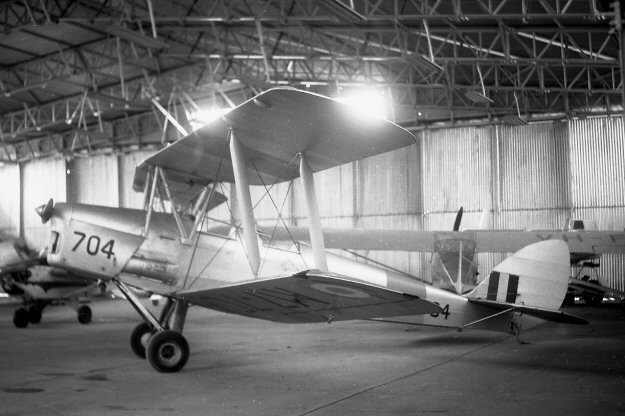
This aircraft A17-704, c/n 835 is from that same batch, and was restored by Warbird Doyen Malcolm Long who was an expert for researching and applying marking accuracy and original finish on his restorations, (this tigermoth, along with his Auster, and one of his Hudsons, is now in the collection of the Australian War Memorial as a measure of the standard he set, his other Hudson and his Wirraway are with Temora.)
Photos are from this site http://adf-serials.com.au/ itself an excellent online reference site.
I suspect he would have tracked down a wartime service photo of his aircraft, note his cowling only repeats the last 2 digits of ‘704, it seems early wartime production finished aircraft repeated all 3 digits, and that later gave way to just 2 digits, whereas re-finishing in the RAAF could return the 3 digits at flying schools, and certainly in post war refinishing into silver schemes all 3 digits seem standard.
ie here is that same aircraft in its post war silver scheme, your aircraft probably had this same finish too.
Of course there are some good alternative finishes if overall yellow isnt of interest, a recent USA restoration put an ex RAAF tiger into an accurate PNG overall Foliage Green scheme, a couple were loaned to US forces and temporarily in US markings.
(Edit due to photo links not working)
I think you may find the RAAFM aircraft A17-692 is currently sporting a colour scheme not neccessarily based on its own factory issue?
It is more like a Factory output in the 1940 to 1942 period of camouflage based on Pentlands comments above, or perhaps it represents a field repainting?
As James mentioned it was previously in a colour scheme based on its previous owners preferences and apparantly based on the 100 RAF imported aircraft.
You probably already know RAAF Tiger serials are sometimes very much apart in production sequence, ie A17-691 is not just 4 airframes earlier in factory production than your “695” or only one airframe ahead of the RAAFM’s “692” in the photo above, but instead a 1936 UK built airframe c/n 3508 imported as a civil airframe VH-UVZ and impressed into RAAF service in August 1940, and wearing the Permanent Yellow trainer scheme of 1940 with the tricolour roundals and fin flashes, quite accurate for it other than the civil rego under the wing, but therefore of little bearing on your aircraft’s own original colour scheme.


Regards
Mark Pilkington
mark_pilkingtonTo expand on the above posts: my colleague, Dr Tony Stewart and I (both of us are doctors on the MHF expeditions), have been with the Mawsons Huts Foundation looking for Mawsons Air Tractor at Cape Denison Antarctica for the past two years (2009 and 2010 seasons). In 2010 we used a number of methods to locate the fuselage, but were unable to dig for it because of a blizzard.
There is another Mawsons Huts Foundation expedition going south this year 2011, which will dig for the fuselage – and hopefully find it!
Dr Chris Henderson
The Australian Antarctic Division will decide whether to return the remains of the Vickers to Australia for specialist treatment or leave them at Cape Denison.
Chris,
Aviation enthusiasts and historians across Australia are wishing you luck in re-discovering and recovering this important Antartic / Polar Explorer / and Aviation heritage object, most would hope it can be located and brought back to Australia for preservation and display.
Has there been any consideration of a suitable and eventual public display location?
One obvious option would be the National Museum of Australia in Canberra, but a second and very appropriate location would be at Point Cook where all of the RAAF Antartic Flights departed from and where the Supermarine Walrus wrecked during the 1947 RAAF Antarctic Flight and recovered from Heard Island is now displayed?
While the Vickers/Mawson Tractor is NOT a relic of the RAAF, its relationship with aviation and the antartic exploration makes it a suitable display next to the Walrus? to further tell the story of the Antartic “flight”?
Regards
Mark Pilkington


 Sign In







