 mark_pilkington
As full time carer for my Father who is dying with dementia and for my Uncle who is housebound with mobility problems I find it just a little difficult to be able to fit any volunteering in funnily enough.
I HAVE no time, no time at all. But when I did I spent one or two Sundays every month making a 180 mile round trip at my own expense to volunteer at a little collection you may never have heard of – Shuttleworth.
Kev, I was not presuming to know you, nor intending to offend.
I was simply trying to point out that the best contribution any of “us” can make, is to become involved, – if you have already done your bit – thats great, if you have other obligations taking your time, thats unfortunate.
You might note I was attempting to address all of those raising concerns and providing suggestions, and ended in repeating the issue of such museums needing more volunteers and that those contibutions need not be on-site, or in the workshop.
The “smile” preceeding my question to you was intended to convey a lighthearted rather than accusatory tone in any case.
I can sympathise with your 180 mile round trip, mine is a 3 hour round trip to do my bit.
I’m sorry you took offence, it wasnt intended and I’m sorry if any was caused, I still maintain the best contribution enthusiasts can make is to join up and get involved.
regards
Mark Pilkington
mark_pilkingtonhello John,
I was wondering if you could provide an update in regards to this post I found on the vintage radio forum while googling?
is there any update on any recent investigations of the wreck of EF311?
23rd Nov 2009, 03:36 PM #10
12jaguar
Triode
You are correct on both counts. Allegedly there is a complete aircraft in existence in Russia, we have been chasing this for at least 10 years and the RAF Chief of the Air Staff has asked questions on our behalf, the Russkis have been very mysterious about it thoughThe wreck off the Isle of Wight is that of EF311 and a party were supposed to be diving on this for us recently but it was delayed due to bad weather. If anyone wnats to have a look at our website a link was on one of my earlier posts. I can e-mail more up to date pics of some progress if anyone wants to contact me
regards
John
and if there is re-visiting of a salt water recovery has there been any exploration of these?
Quote:
Stirling Bomber Wreck——————————————————————————–
I was in Worthing recently enjoying the Summer sun with my wife and kids and stumbled upon a piece of interesting Short Stirling information.
Along the seafont was a temporary exhibition of maritime artefacts and one of the display panels showed a Stirling Bomber. I scribbled down what it said…
…’Found in 1970, this bomber was lying on it’s back with its wheels down at 50 46 21 N;00 14 00 W. The divers found her when recovering a trawl which had caught on the aircraft. The Stirling, a Mark III from 76 Squadron was returning from a raid on Frankfurt and ditched offshore. A Supermarine Walrus floatplane picked up the crew and dropped them of at Worthing Pier’…
Along with the Goodwin Sands Dornier recovery it would be great to see this one raised to fill in the Bomber Command ‘gap’ at the RAFM. Back in May I spoke to a few ex-Stilring crew at a signing event for the Bomber Command Memorial and they had been campaigning to get a Russian built Stirling brought to England but as yet without success.
Quote:
Re: Stirling Bomber Wreck——————————————————————————–
Hi,
76 Sqn flew Halifax. The aircraft was from No.75 Sqn, BF455 lost on 10-11/04/43.
“Stirling III BF455 captained by F/Sgt Rothschild was hit over the target by AA fire and also chased by enemy fighters.
This caused him to run short of petrol over the English Channel on the way home, and he eventually crash landed in the sea, 3 miles off Shoreham.
The wireless procedure had been perfect, and Spitfires escorted it from the French coast and a Walrus flying boat was waiting for it to crash land.
Dinghy drill was perfect and all the crew got in safely after an immaculate landing – the Stirling floating for 25 minutes.
The final scene was enacted in the Channel as the Walrus collided with the dinghy and dropped all the crew in the sea. No ill-effects except for Sgt Grainger, the flight engineer, who suffered from shock.”
AIR27/646Regards
Ross
or others ditched?
http://forum.keypublishing.co.uk/showthread.php?p=1683946#post1683946
with the pursuit of the DO-17 by the RAFM surely its coming to the time when these remaining Stirling underwater wrecks should be seriously assessed for viable recovery, before theres absolutely nothing left of them to recover?
regards
Mark Pilkington
mark_pilkingtonI was reading the Stirling projects website as this is a project I take keen interest in and admire from afar, and noted the following and felt they were worth pasting here to reconfirm what the project’s objective is, and its liaison with the RAFM, given past and recent posts in the forum complaining about the RAFM not handing over its Stirling parts, (or equally the IWM not handing over its Halifax cockpit to the YAM Friday the 13th composite reproduction), where as both of those objects are of important historical significance in their own right, seperate to these reproduction projects.
http://www.stirlingproject.co.uk
The Stirling Project was constituted in 1997 under the Chairmanship of a former XV Squadron navigator to further the education of the public in all aspects of the Short Stirling Bomber. The immediate aim is that of preserving components and documentary evidence of this historic aircraft.
The committee has set itself the long term aim of constructing a forward section of fuselage and is confident of being able to re-create the necessary drawings.
The Case for a Cockpit Rebuild
Following WWII, Stirling aircraft were scrapped without thought of preserving an example for posterity; sadly none survives, not even a cockpit to display to the public. The Stirling Project plans to address this by building a complete front fuselage section of a Stirling bomber. This will be full scale, and of aluminium riveted construction, with everything as close to the original as possible. Few original Shorts manufacturer’s drawings survive, however following over 30 years of research, we have gathered a vast amount of information with which to undertake this rebuild. Data derived from this search are now being processed by modern technology to produce a 3-D CAD (computer aided design) simulation.. This will help us to ‘reverse engineer’ a complete front fuselage section, encompassing the whole flight deck, with our pilot’s instrument panel, throttle box, pilot’s seats & chassis, rudder pedals and control columns, all of which are simultaneously being worked on by members of The Stirling Project. We also intend to install our previously completed FN5 front gun turret. The Cockpit section will eventually extend to 24 feet and will include the wireless operator and flight engineer stations as well as those for the pilots, bomb aimer and navigator. Naturally, funding is needed for all this, but we also require something more; we also depend on working space, having sufficient skilled and unskilled volunteers, tools, equipment and of course materials and resources. This is a big undertaking and will depend on raising further money. It will need to be planned carefully but with your help this can be achieved. If you would like to make a donation, be involved, or can offer any Stirling parts or equipment, we would be most pleased to hear from you.
AMENDMENT TO THE CONSTITUTION.
At an Extraordinary General Meeting of the Project, held on Friday the 30th July 2004, at RAF Wyton, the following amendment was agreed:
“If or when the Stirling Project is wound up for any reason, any Stirling artefacts, information, and copies of drawings belonging to the Stirling Project shall, in the first instance, be offered to the Royal Air Force Museum.”
The Royal Air Force Museum collaborates with the Stirling Project.
An arrangement has been reached between the Stirling Project and the Royal Air Force Museum Restoration Centre at Cosford, with the assistance of Air Chief Marshal Sir Richard Johns. The Manager of the Museum, Bruce James, has kindly informed us that various items from the Museum’s collection of Stirling parts will be made available to us for use by the design department to produce engineering drawings. The largest parts come from Stirling LK488, which crashed at Mickle Fell, Yorkshire, on 19th October 1944. The aircraft struck the backbone of Yorkshire’s highest peak. One wing caught the summit and was wrenched off. The remainder of the aircraft cartwheeled over the summit. The forward fuselage caught the full impact and was torn apart. Six of the crew were killed and the only survivor was the rear gunner. Various sections of The Royal Air Force joined in the recovery operation, which took place on 31st August 1977. The photographs show some of the recovered wreckage.
Hopefully the reproduction forward fuselage will go on display at the RAFM along side these remaining original sections, (and hopefully including those currently on display in overseas collections.)
Even more hopefully, the return of the RAFM to the recovery mode as shown by the recent announcements over the DO-17 might also see a renewed focus on a Stirling wreck location and recovery from the sea or fresh water lake?
Anyone got details of this one mentioned on recently on another forum?
Stirling Bomber Wreck
——————————————————————————–
I was in Worthing recently enjoying the Summer sun with my wife and kids and stumbled upon a piece of interesting Short Stirling information.
Along the seafont was a temporary exhibition of maritime artefacts and one of the display panels showed a Stirling Bomber. I scribbled down what it said…
…’Found in 1970, this bomber was lying on it’s back with its wheels down at 50 46 21 N;00 14 00 W. The divers found her when recovering a trawl which had caught on the aircraft. The Stirling, a Mark III from 76 Squadron was returning from a raid on Frankfurt and ditched offshore. A Supermarine Walrus floatplane picked up the crew and dropped them of at Worthing Pier’…
Along with the Goodwin Sands Dornier recovery it would be great to see this one raised to fill in the Bomber Command ‘gap’ at the RAFM. Back in May I spoke to a few ex-Stilring crew at a signing event for the Bomber Command Memorial and they had been campaigning to get a Russian built Stirling brought to England but as yet without success.
Re: Stirling Bomber Wreck
——————————————————————————–
Hi,
76 Sqn flew Halifax. The aircraft was from No.75 Sqn, BF455 lost on 10-11/04/43.
“Stirling III BF455 captained by F/Sgt Rothschild was hit over the target by AA fire and also chased by enemy fighters.
This caused him to run short of petrol over the English Channel on the way home, and he eventually crash landed in the sea, 3 miles off Shoreham.
The wireless procedure had been perfect, and Spitfires escorted it from the French coast and a Walrus flying boat was waiting for it to crash land.
Dinghy drill was perfect and all the crew got in safely after an immaculate landing – the Stirling floating for 25 minutes.
The final scene was enacted in the Channel as the Walrus collided with the dinghy and dropped all the crew in the sea. No ill-effects except for Sgt Grainger, the flight engineer, who suffered from shock.”
AIR27/646Regards
Ross
http://forum.12oclockhigh.net/showthread.php?t=22609
regards
Mark Pilkington
mark_pilkington…. And perhaps need is something that should be considered when limited resources are applied to preservation.
Many of you out there, individuals and museums/collections could put a strong case forward for the reasoning behind your collecting policy, but does that reasoning really stand up to scrutiny? Are airframes being preserved at any cost to the detriment of the long term security of other airframes or indeed other exhibits? What is being done to preserve the paper ephemera which goes with the history? What is being done to preserve the memories and perhaps more importantly, what is being done to make the memories and the ephemera and smaller exhibits accessible to those with an interest?
I want to hear people talk about their experiences. Recordings can be important. I want the history I visit brought to life. I don’t know, maybe Newark could do something around a crew which went through the HCU there. I’m sure there must be letters and photographs. Bring the stories to life. When I see a casualty list, or the names on a Memorial, I can’t help thinking of Sassoon’s ‘intolerably nameless names.’ I want them to become people, I want them to walk off the pages of history and tell me their stories. I don’t want to remember the name, I want to remember the man.
I’ll stop now, I know I’ve gone a long way from David Burke’s original posting and I apologise for that. It’s just something I feel very strongly about.
Regards,
kev35
Smiles, kev, you and others above are very passionate about what you think the volunteer collections should be doing with their limited resources, I wonder if you and those others are donating your time and effort to such a collection?
“think not what your volunteer museum can do for you, but what you can do for your volunteer museum”
Its true that these collections have to focus on the needs of their “paying customers” (no not visitors!) ie the General Public, and they do need to develop a strategic plan for operating their museum sustainably, and a collection policy to focus on the preservation of significant objects in their collection, including getting them under cover – and yes many of us are involved in museums that have unfinished work ie “that are glass houses – and therefore none of us should throw stones”.
The problem for these collections isnt just attracting the customers (ie the General Public), its also attracting and retaining volunteers to do the work, and this is where we enthusiasts should step up to the plate.
That assistance can be in the area of strategic planning and collection/archival management ie administration, display and story board development, it doesnt have to be in the workshop.
regards
Mark Pilkington
mark_pilkingtonNot long ago, in the “Wot Plane” thread there was Flying Flea of the South Korean navy to be guessed. I would like to know what was it used for.
They use it to simulate North Korean airforce attacks, :rolleyes:
smiles – Happy New Year
Mark Pilkington
mark_pilkington.
smiles, revises his opinion to – doh!
regards
Mark Pilkington
mark_pilkingtonWhat would be nice to see is a bit more cooperation, must have seen enough parts this year to make up a complete Wellington bomber in various seperate museums and as for the Stirling project, why on earth won’t the IWM hand over their remains to give them a fighting chance???
The Stirling project is a wonderful effort to try and produce a reproduction of at least the cockpit / fuselage of the apparantly extinct Stirling type.
However like the Yorkshire Halifax reproduction before it, the commencement of effort by some seperate volunteers doesnt create an obligation on other museums like either the IWM to hand over its combat veteran Halifax cockpit, or the RAFM to hand over their Stirling rear fuselage and other parts etc.
These are important artefacts in their own right, particularly given the rarity of the type, and have been collected and added to those museum collections because of their relevence. As shown by the RAFM’s early disposal of its Hampden parts to Canada, there may well be use for the artifacts within those existing collections.
I understand there is great RAF support for the Stirling project and I’m sure research access to those parts will be provided when or if the reproduction project gets to that end of the project.
Transfer of ownership of those Stirling parts doesnt make the cockpit/forward fuselage recreation any easier?, and I personally think it would be better to duplicate those sections that to straighten and destroy them in an effort to use them.
The Stirling outcome will always be largely a reproduction, this wreckage is the largest original surviving parts and are important in their own right.
Hopefully the RAFM Stirling wreckage, along with at least a fuselage reproduction could be eventually displayed together, and the RAF Museum, where a Lancaster and Halifax can already be seen, would seen an excellent location for such an outcome to display a representation of the third and missing heavy?
Regards
Mark Pilkington
mark_pilkington.
It is an ex-RAAF, and former NEIAF DO-24K aircraft, but its actual identity is yet to be confirmed as it is one of 5 airframes scrapped at Lake Boga after the war which included:
A49-1 765 X-5 Ex NEI. These aircraft were in poor condition when received, but served in the transport role with 41 Squadron, flying cargo into Goodenough Island, Milne Bay and Port Moresby. 1944 entered service with Communications Unit No.8 for search and rescue missions. December 20th 1944 taken out of service and scrapped at Lake Boga due to lack of parts.
A49-2 767 X-7 Ex NEI. These aircraft were in poor condition when received, but served in the transport role with 41 Squadron, flying cargo into Goodenough Island, Milne Bay and Port Moresby. Probably got scrapped in 1944 at Lake Boga due to lack of parts.
A49-3 768 X-8 Ex NEI. These aircraft were in poor condition when received, but served in the transport role with 41 Squadron, flying cargo into Goodenough Island, Milne Bay and Port Moresby. June 4th 1942 made her first flight for the RAAF after a long overhaul. Crew were Squadronleader Monkton, Sergeant Emes, Sergeant McKnight, Sergeant Canny, Corporal Aubin and Lancecorporal During. The flight lasted 4 hours and 20 minutes. May 14th 1944 transferred to Lake Boga and stored at the Flying Boat Repair Depot. December 20th 1944 taken out of service and scrapped at Lake Boga due to lack of parts.
A49-4 769 X-9 Ex NEI. These aircraft were in poor condition when received, but served in the transport role with 41 Squadron, flying cargo into Goodenough Island, Milne Bay and Port Moresby. Coded DQ-G. May 14th 1944 transferred to Lake Boga and stored at the Flying Boat Repair Depot. December 20th 1944 taken out of service and scrapped at Lake Boga due to lack of parts.
A49-6 785 X-24 Ex NEI. Escaped to Perth from a Japanese bombing raid on Broome and served the Dutch Intelligence Agency on clandestine flights to New Guinea until handed over to become A49-6 in RAAF colours in October, 1943. May 14th 1944 put into storage at No.1 Flyingboat Repair Depot at Lake Boga. December 20th 1944 scrapped at Lake Boga due to lack of parts.
Info above sourced from the A49 page at http://www.adf-serials.com.au
I have heard it previously suggested that it is A49-6/X-24 but I havent seen that confirmed anywhere, or detailed as to how that was determined. (X-24 is the identity the former RAF Museum Dornier is displayed in at the Dutch Airforce Museum in the Netherlands, one of the 4 complete ex-Spanish survivors ).
Here is a picture of 4 of them in storage or partially scrapped at Lake Boga

Regards
Mark Pilkington
mark_pilkington.
BTW, beer should of course be served cool enough to be refreshing, & different beers have different optimum temperatures (lager colder than bitter, for example), but no beer should be served so cold you can’t taste it unless it tastes so disgusting that it’s the only way to get it down. The Czechs serve their delicious lagers just right, i.e. about 7-8C, perfectly cooling but the flavour still comes through.
As a Victorian brought up of Carlton, VB and Fosters my first experiences with beers from South Australia, and Tooheys from NSW confirmed the view above that those beers should have been served much much colder than they were when I tried them smiles, as they were still disgusting!!
and then we return to normal programming – back onto topic
No we dont need the Ark Royal.
regards
Mark Pilkington
mark_pilkingtonwell thats a conclusive and authoritive statement on the involvement of said gentleman, and straight from the horses mouth so to speak!
thanks BC
regards
Mark Pilkington
mark_pilkington– Of course if the UK Heritage Lottery were to pony up @ $16M AUD and another $1.2M per annum we would be very pleased to keep one flying for “future generations” (including visiting UK Tourists) smiles
I personally dont see a role for an F-111 in the AWM its combat missions arent significant, unless you rate its role by Bob Hawke? in the Battle for the Franklin Dam?
Having 4 preserved out of @ 30? operational airframes and @10? parts ships seems a reasonable long term preservation target? thats effectively a 10% survival rate.
regards
Mark Pilkington
mark_pilkingtonVery few people would be strong enough to raise one of those early Tape Video Cameras skywards… but your point is well taken 🙂
Moggy
Smiles, I was video’ing weddings and airshows from 1982 onwards in VHS format, the technology of those days was a portapack recorder with cabled camera, the VHS Camcorder was mid 1980’s and the small format tapes were late 1980’s.
regards
Mark Pilkington
mark_pilkington.
Happy Birthday to W4050, a very significant airframe in british and world aviation, we are very lucky to have her.
and what a birthday present it is for the type to receive the announcements about Jerry Yagen’s example being due to fly next year inclusive of a UK tour!
The mossie is my own #1 fav type!, you cant have too many mossies preserved!, and hats off to the “Mossie Museum” for its efforts in preserving the type in the UK, Prototype, B-35 and FBVI!! well done, let alone extending onto the remainder of the DH types! – an excellent and significant collection.
It is a pity neither the IWM or RAF Museum considered keeping their T111’s from a “National collection” approach rather than their B-35’s, instead of preserving 3x B.35’s between them and having 4 in preservation in the UK, and only one fighter nose variant ie the FBVI?
(of course there is the Yorkshire NF as well to compliment for their efforts too)
regards
Mark Pilkington
mark_pilkingtonI’m happy to be corrected, but I understood the first Tabloid was brought to Australia by Harry Hawker, and was known then a Tabloid, so I wonder if the name was created at that time?, and perhaps by Hawker who hoped to sell some to the Australian Government?
Which is surprising that none were purchased given this aircraft’s capability and performance over the 2x Deperdusins, 2x BE2a’s and 1x Boxkite previously ordered and delivered to Point Cook but at this time not flown?
The first Tabloid was a two seater, and reportedly first flew November 1913, Hawker assembled and flew a two seater Tabloid in Melbourne on 27 January 1914, surely the same aircraft, ie the first example?
On 13 January 1914, Moorabbin born Harry Hawker, and mechanic Harry Kauper returned to Australia from the UK where Hawker was chief test pilot for the Sopwith Company, and bought with them a two seat Sopwith Tabloid. The aircraft was taken to the CLC Motor Company in Elsternwick where it was assembled and tested before Hawker took off from New Street on 27 January and after a 20 minute flight landed in the grounds of Government House to visit the Governor General. On 7 February Hawker provided paying passenger flights and flying displays at Caulfield Racecourse in Melbourne, with between 25-30,000 spectators, while on 11 February 1914 the first member of Cabinet to make a flight was Senator E Millen, Minister for Defence, Lt Harrison was also taken for a flight.
http://en.wikipedia.org/wiki/Sopwith_Tabloid
The original Tabloid, which first flew in November 1913, was a two-seater with a side-by-side configuration — unusual for the time. It had no ailerons, using wing warping for lateral rolling. It was originally powered by an 80 hp (60 kW) Gnôme Monosoupape rotary engine and when tested by Harry Hawker at Farnborough the Tabloid reached 92 mph (148 km/h) while carrying a passenger. It took only one minute to reach 1200 ft (366 m). A total of 40 were built.
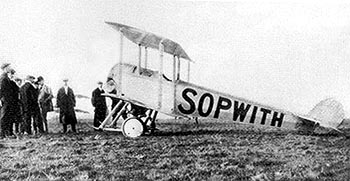
http://www.ctie.monash.edu.au/hargrave/hawker.html
Regards
Mark Pilkington
mark_pilkingtonOur aerodrome and aeronautical heritage should come with a health warning, I fear.
Time is not on our side, but in time it will be proven that our aerodromes were important, but only after it’s too late. .
Aviation heritage suffers the normal fate of all heritage objects that they are unappreciated until they are nearly instinct, look at the treatment the Sphinx got until the mid 20th Century.
Aviation suffers particularly as many of the population are not involved directly, and although achieving its centenary in recent times, it typically doesnt consist of sandstone or bluestone to show its age.
I consider the 20th Century will become the most researched century of the past, for future generations.
Its the first to be so well documented, photos, films, TV, sound etc and experienced many of the major technology developments to date other than steam, sail and the wheel.
So too aviation heritage from the early 20th century will be far more greatly valued than it is today, – the UK / Australia / Canada have just celebrated their centenaries of first flights, but most of the general public / media have shown little interest – we have made aviation so safe, so mundane its like catching buses.
With a bit of luck war between developed nations may be a thing of the past, or at least on global scales, and WW2 will continue to be studied from the political, social and technological impacts.
“IF” our early aviation sites can last long enough they will become appreciated and protected.
In Australia we have managed to get Point Cook added to our National Heritage List, the highest protection available, a turnaround from the late 1990’s when Government belt tightening, and its coastal location made it a prime target for sale and residential redevelopments. – Instead only just avoiding the Hendon and Wigham outcomes and becoming the third commonwealth Air Force Museum not to be located on an active airfield!
Regards
Mark Pilkington


 Sign In







