 mark_pilkington
davesoda
a mockup cockpit can be created? similar to dcollins Hornet and other efforts here,
here is a Skyhawk instrument panel on ebay that would make a great starter kit?
Paul, nice purchase, look forward to seeing it sometime
regards
Mark Pilkington
mark_pilkingtonDeryck,
sorry I ddint get any pictures of it last weekend (its in storage on another property that I am relocating my anson parts from) but hope to get photos this weekend for you, as it will be one of the items relocated this weekend.
Regards
Mark Pilkington
mark_pilkingtonPhil,
Two manned or piloted prototypes were built to prove the design and develop/test the remote controls of the Jnidavik, these were the Pika, A94-1/C1 crashed in 1951 and was written off. A94-2/C2 survives today in the RAAF Museum collection.
pictures below are linked from the ADF-Serials site, further information on the Jindavik and Pika is available from that site under RAAF Series 2, menu item, and “A93” & “A-94”
btw that site shows 11 Jindaviks are preserved in Australia.
Regards
Mark Pilkington


mark_pilkingtonBruce,
I hadnt considered the issue of them fitting, just repeating a legend of where the undercarriage and engines went, I would agree engine cores for spitfire projects could easily be their fate.
David,
There is a lot of interest and support for the Lincoln project in Australia, perhaps not as significant an airframe as the Halifax, but still an important type in Australia, with both the GAF built examples built and flown with the RAAF, and the Avro built RAF examples flown at Woomera with ARDU and WRE.
This will be along term project for our museum, we are still receiving container size deliveries of parts and havent as yet received everything so we still are yet to exactly what we are up against.
It is a big project and as you and Bruce know some parts, particularly the steel work in the narcelles and engine mounts, and the centre-section trailing edge, are in poor condition.
Other parts are in surprisingly good condition given the 20 odd years of dis-assembly and relocations, and external storage.
Our first objective is to receive and identify what we have and what we are missing, a close second is to place the parts into “undercover” and long term storage.
Luckly many of the parts we are missing such as undercarriage still exist here in Australia, in fact the museum has had two oleo’s in its collection for many years with one on display in the entrance hall.
At this time the major airframe parts are still outside, but that will be resolved as soon as the last items have arrived, smaller parts are already being sorted and stacked into a dedicated store.
It will be a long term project but there is enough of a Lincoln to put back together, and it will certainly be a welcome addition to Australia’s national collection, to represent our last 4 engined heavy bomber and largest aircraft ever built here.
regards
Mark Pilkington
mark_pilkingtonPhil,
No, we do have engine mounts, narcelles and cowls, props and spinners but no engines.
I understand the engines from the Lincoln RF342 were transferred into the Duxford Lancaster KB889 when both were owned by Doug Arnold in the 1980’s.
BTW, let me know when you are well enough to visit and I will arrange a cooks tour.
regards
Mark Pilkington
mark_pilkingtonSealord,
I’m not very familiar with the type, but on review of your link I note the pressurisation was dropped from the design before its first flight.
I assume in 1941 the Atomic Bomb and the need for high altitude and speed related to the exit of the delivery aircraft was not a known issue, and that therefore the primary reason for the pressurisation in the spec was related to the long range requirements of the design.
I therefore wonder if the design (unpressurised) was effectively overtaken by the intended Lancaster VI which later became the Lincoln, and that the ongoing development of the design from 1944 onwards was really a design exercise rather than any intention to enter production.
For its intended role of maintaining the conventional bombing of Germany in Europe the Lincoln was more than adequate (as was the existing Lancaster design which is why it remained in production and service and the Lincoln was held back from operational introduction).
The US had specifically developed the B29 to be pressurised for high alitude flying to achieve its long range to attack the Japanese in the Pacific, I dont know that in 1941 that the British designs of Windor or Lincoln would have been focusing on that need either.
However the pressurisation and high altitude attributes of the B29 permitted it to deliver and exit a nuclear bomb delivery, which the Lancaster and Lincoln could not.
By the end of 1945, the “need” for Nuclear delivery had been identified, but so too had the emergence of jet aircraft, the B29 Washington was a better aircraft to fill the “Nuclear standoff” stop-gap than the Lincoln, although the Lincoln did serve in some numbers post war in any case for conventional bomb capability.
I havent read any technical assessments of the Windors performance or design other than your link, but it did have some features that were problematic for others such as the remote 20mm gun barbettes on the engine narcelles, “quadruple” undercarriage that all would have risk of delaying introduction of a new type.
Your “what if” question of the viability of further development of the Windsor to meet the stop gap role would depend on two things,
one – what was the reason for the pressurisation being dropped from the deisgn in the first place?
two – how close was the design to practical introduction in 1945 when it was cancelled and the “Nuclear” requirement would have emerged?
20-20 hindsight would seem easy to agree with the historical decisions of the day not to introduce the Windsor into service in WW2 over the Lancaster or intended Lincoln, and to not proceed with it as a stopgap when the Washington could be acquired off the shelf.
regards
Mark Pilkington
mark_pilkingtonbump
mark_pilkingtonFor those interested,
here are some pics of the Avro Lincoln centre-rear fuselage and wing panel trailing edges are delivery to the museum.
A 4th container with the 4 propellor assemblies and wing tips has arrived in the port of Melbourne for delivery in the next week.
regards
Mark Pilkington
mark_pilkingtonPeter is correct, the Anson’s tailplane was fabric covered, and where the ply sheet finished at a solid timber leading and trailing edge the “square” edge of the ply should be feathered/sanded to taper down to the timber edge.
I have a derelict Anson Tailplane in my shed and will try to take some digital photos tomorrow if I can get some detail shots.
regards
Mark Pilkington
mark_pilkingtonTom,
congratulations on the B18, and an excellent collection, and also on the use of replicas in the form of the avian.
Also great to see your branching out into some heavy metal, the B737 is now the most successful commercial jet airliner and certainly worthy of preservation.
Regards
Mark Pilkington
mark_pilkingtonI’m not sure if the photo links are working? in the post above (appearing as red cross boxes for me?) so I thought I would re-past them as attached files rather than links.
Here are the Libyan Ro-1 and SM-79 wrecks referred to above
Regards
Mark Pilkington
mark_pilkingtonIn addition to the photos and identification of the Ro-1 wreckage in Libya shown above in this thread the same site http://www.fjexpeditions.com/frameset/past.htm
Also has some photos of a SM-79 remains – also in Libya
After the camel encounter we continued to the old landing ground used in WWII. Much to our surprise, the wrecks of the two Savoia SM-79 bombers, destroyed in 1940 by the LRDG, were still there. Their condition has deteriorated since the last photo taken in 1968, but the steel frame of one of them is still fairly intact. (It is very probable that the tidbits of recognisable aeroplane parts found at various tibou encampments around Uweinat came from these two wrecks.)
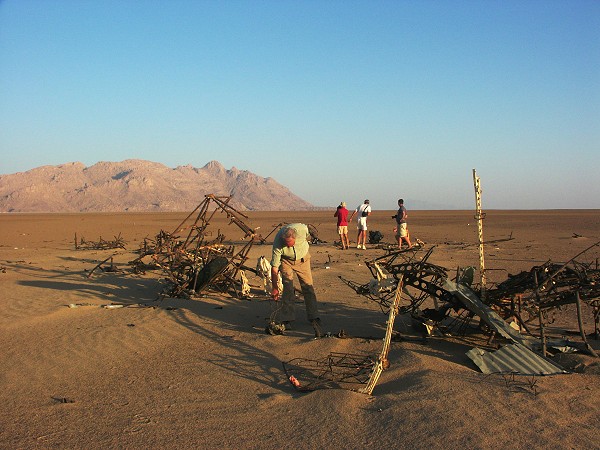
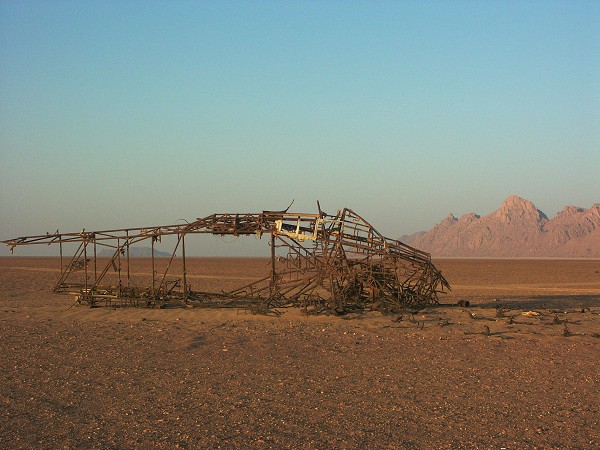
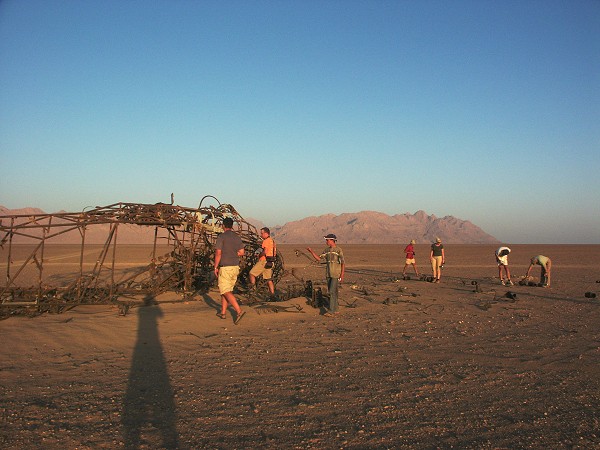
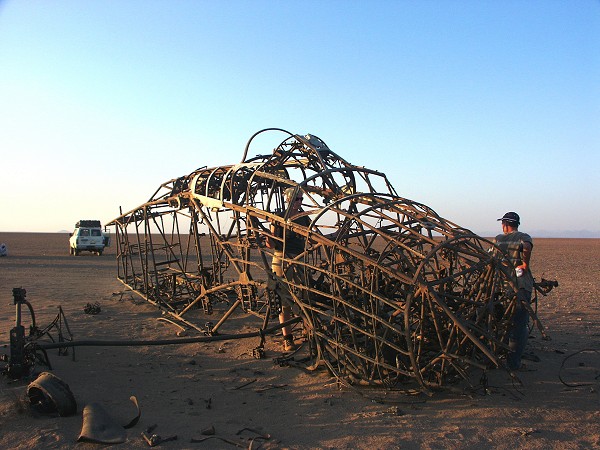
Two complete SM-79’s recovered form Lebanon in the 1970’s? exist in museum collections in Italy while a third derelict fuselage also exists in a third Italian Museum.
This fuselage might still be recoverable for restoration as a fuselage/cockpit display in the Italian Air Force Museum (pick it up while recovering the historic Ro-1 fuselage above?? (and make a decent day trip out of it – smiles)
Makes you wonder what else might be lying in the desert in Libya??
Regards
Mark Pilkington
mark_pilkingtonI have been quite intrugued by this apparant survivor in the desert, ‘trawled by David above, and have spent quite a while on the web trying to identify it?
http://www.harms-jaekel.com/jump.php…&keepsubject=1
I had examined a number of possible pre-war single engined Italian biplanes and had settled on a Fiat Cr20 based on the spoked wheels, straight axle and deep rear fuselage however the apparant rear cockpit or gunnery position didnt seem to even fit that aircraft type unless it was one of the few two seaters built?.
Having slowly constructed the arguments in preparation of posting my view that it may be an early Italian Biplane such as a Fiat CR20 based on the deep rear fuselage etc and being quite pleased with all my deductive work I then found a further website by further google search of italian “aircraft wreck” Libya that has further pictures of the wreck and positively identifies it as an Italian built IMAM Ro-1.
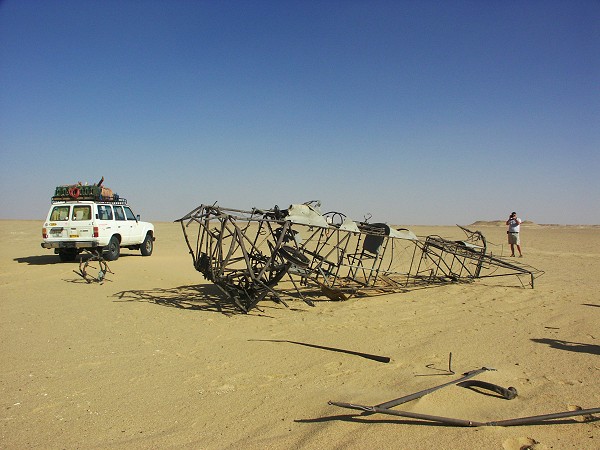
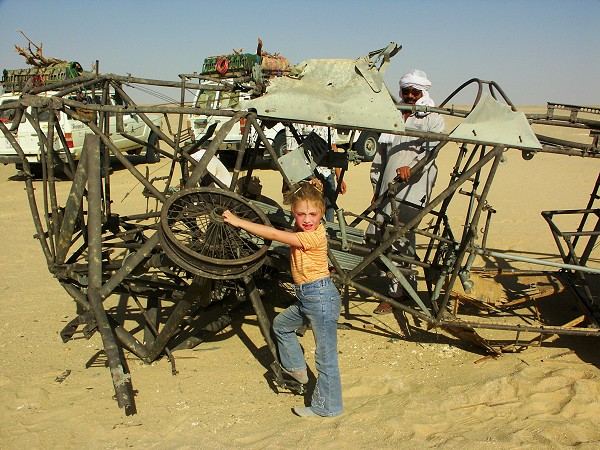
The wreck is now positively identified as a Meridionali (IMAM) Ro-1, a license-built version of the Fokker C.V, in construction between 1927 and 1935 (when it was gradually replaced with the bigger IMAM Ro-37. with which it has been initially confused). It was a general purpose biplane that was commonly used by the military in the thirties. Ro-1-s have been used in the area for reconnaissance preceding the occupation of Kufra in 1931, and from the official account it is known that one crashed and burned “near Wau Namus” in the autumn of 1930 (the pilot escaped with light injuries). As the immediate vicinity of Wau Namus is unsuitable for aircraft due to the soft sand, and Bir Maaruf was used as a reconnaissance base in 1930, this aircraft could well be the same.
30th January, 2004
The aircraft wreck at Bir Maaruf (initially thought to be an IMAM Ro.37bis) has now been positively identified as a Meridionali (IMAM) Ro.1, a Fokker C.V. built under license in Italy from 1927 to 1935. It was used as a multi-purpose military aircraft, Ro-1-s have probably taken part in the Kufra campaign (though there is no proof that this particular wreck dates from that time). From 1935 on they were gradually replaced by the bigger and stronger Ro-37, but many survived into the North African and Ethiopian campaigns of 1940-41.

http://www.fjexpeditions.com/frameset/oct03.htm
Does anyone know if a IMAM RO-1 exists elsewhere in any condition and if this wreck has been considered for recovery by the Italians??
Thanks David for finding and posting the original photo and giving me some entertaining time trying to identify it.
All in all I found it a interesting challenge to positively identify this airframe, even though I was totally wrong!! smiles, but was glad to see it finally identified and I assume this is indeed a type not yet in preservation anywhere? (Other than a Swedish licence built S6 Fokker CV derivative?)
Even more interesting is that it does still exist (or did in 2003) and doesnt seem to have been recovered??
It would seem an excellent recovery for the Italian Airforce Museum to pursue?
Hopefully improved relations between Libya and the west might make such an approach to recover it viable? similar to the recent recoveries of the Ro-37’s from Afganistan?
Regards
Mark Pilkington
mark_pilkingtonI guess I might be getting too cynical in my old age smiles, but the reply to your inquiries from Westlands seems to read more like a very convenient response to discourage further investigation?
Regards
Mark Pilkington
I have been in touch with Westlands at Yeovil and can categorically say that there is no Whirlwind at their site. It is true that their company hack was buried there having served as a fire rescue training aid (and was burnt considerably). During the 1970’s the airframe was exhumed from the north side of the airfield and removed by persons unknown for disposal. It was in danger of contaminating a nearby stream, and was removed along with a substantial quantity of soil. The records for the removal either do not exist, or are not in circulation, and Westlands have no idea of the company used for its disposal
mark_pilkingtonJohn,
I am not sure this is still sitting unwanted on the crash site but you may wish to contact the B24 Restoration at Werribee and see if they recovered this and if they have any spare shell sections, I know they have restored a total of 3 with one operational, with 1 to be in the a/c and 1 to be a display turret and the third being returned to another collection who originally had two of these, as part of a trade/restore/return arrangement.

Details of the wreck site
http://www.pacificwrecks.com/aircraft/b-24/A72-160.html
Details of the Werribee B24 restoration
http://www.pacificwrecks.com/aircraft/b-24/A72-176.html

Werribee B24 Official website
http://b24australia.com/index.php?option=com_frontpage&Itemid=1
regards
Mark Pilkington
.


 Sign In







