 Cherry Ripe
The designer set out to make an ugly overweight a/c, he was successful.
You are aware that the Il-102 is a tonne lighter, empty? Two tonnes higher MTOW. And has two tonnes more thrust.
So… seems the designer did a good job all around. How did you do?
Cherry RipeIraqi -> Iranian -> Iraqi Su-25?
Overpainted roundel on intake.
[ATTACH=CONFIG]229850[/ATTACH]
From http://www.youtube.com/watch?v=ah7HP6d42m8 dated 1st July
Cherry RipeBut speed was consider most important aspect in WW II even before the introduction of automic bomb ( hence the boom – zoom.tactic ) why the same tactic not used by 4 gen fighter
The advantage of speed permitted the faster opponent to control the engagement, and to disengage when necessary or opportune. Or to avoid engagement altogether.
With the advent of reliable guided missiles disengagement became much more dangerous, regardless of speed. Hence we’re back to fixed-lip intakes but high agility; one now has to win the engagement, it’s not possible to light the ‘burner and escape when R-73s and AIM-9Xs are in the picture.
Cherry RipeDevelop please?
The 4000’s cockpit benefitted from much larger volume available and was designed for comfort during long-endurance patrol or penetration.
I don’t have the reference to hand but the cockpit was in the region of 50% wider than the 2000, and much longer ( a lot of volume was unused below the aft fairing that you can see under the canopy )
Unforunately once the AdlA selected the 2000 all State effort swung behind that product and the Rafale; even when the Saudis came back to look at the 4000 in 1987 they were shooed towards the Rafale, which wasn’t an option – they needed an urgent supplement for their F-15 force, not something that might have been available in 20 years time. In the end the USA relented and sold more F-15s.
On the topic of internal fuel a quick trip through the Flight International archives gives:
Mirage 2000: 3200 kg
Mirage 4000: 9200 kg
F-15A: 5400 kg ( converted from US gallons )
So even with additional drag and a second M53 to feed the 4000 was in a completely different league.
Cherry RipeIn the end there was no particular need for the M4000 with the French air force. Avionics wise it offered no particular advantage over the M2000 and they didn’t need the unrefueled range. Performance of the M2000 with tanker support was more [than] adequate.
Range of the Mirage 2000 was adequate? Not in the slighest, hence the adoption of 2000-litre external tanks that restrict speed to 500 kts, and those draggy AAR probes. Not to mention inadequate cockpit environment which affects pilot endurance.
The 2000 was a short-range interceptor which was abused to create attack and strike platforms. It was a economy measure, pure and simple, just like the RAF adopting the Tornado as its common platform. Short-sighted but better than nothing, which was the other option the AdLA faced.
Cherry RipeWhoa there’s a Spitfire there!
It is this one, sold by its New Zealand owners a few years ago
http://www.warbirdregistry.org/spitregistry/spitfire-te330.html
Cherry RipeSu-25 seem eminently sensible.
For this sort of scenario ( competent enemy but who lack air control ) there seems to be a lack of mid-tier loitering platform. Back in the 1980s Gulfstream were pushing the SRA-4 which had high-altitude, long-endurance loiter with considerable disposable armament and oboard acquisition / designation. Sort of a precursor and miniature version of how B-52s deploy these days.
Cherry RipePair of Pervian Mi-6, probably late 1980s or early 1990s ( prior to 1992 when they were retired ).
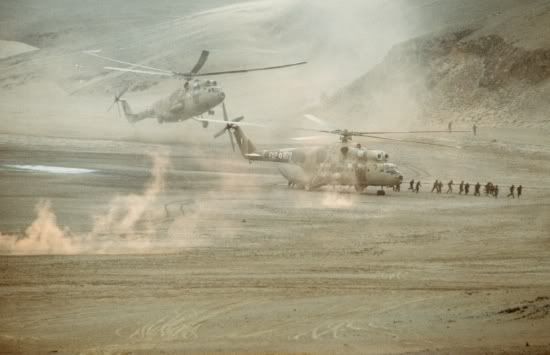
Found in this thread
Cherry RipeThe F-15’s big speed-brake is a good example of a non-dive-brake; above 450 kts it is automatically retracted. Not a lot of use if you happen to be a vertical dive at that time…
Cherry RipeLooks like the A-7’s big ventral barn door was designed as a dive-brake:
http://www.flightglobal.com/pdfarchive/view/1966/1966 – 1198.html
Specially designed divebrake adds substantially to the A-7A’s attack maneuvrability and mission accuracy
Cherry RipeYeah all of them…they are now called airbreaks lol.
Haha!
However I thought the difference was that dive-brakes were variable-extension and act to keep the terminal velocity below the Vne.
Air-brakes / speed-brakes are binary devices to momentarily reduce speed and, if mounted on wings, reduce lift. Airliners today use symmetrical spoilers as speed-brakes to increase rate of descent, exactly the opposite of what a dive-bomber needs.
Looking around on the net, dive-brakes seem to persist on gliders where it is critical that speed be limited in a dive without shedding lift, since it can’t be regained easily.
Cherry Ripe“Amazing”… well, by the USAF’s own figures it’s the most money-wastingly expensive way to convey cargo in their fleet. That big stodgy wing is a hindrance over the Atlantic.
But Congress kept shoving them into the inventory. I suppose that’s amazing.
Cherry RipeA splendid painting!
But I’m puzzled as to why the Polish participated in this venture. They’re not going to encounter an F-15 in combat, so essentially the useful information flow was one-way to the IDF.
Why would an air force willingly disclose the dynamic capabilities of their front-line fighter, for no apparent gain?
Cherry RipeIt’s all exciting stuff but I think I’d be happier if it wasn’t so spirited. It would be a shame to lose a valuable aircraft – or worse.
It looks thrilling but the idea of the display is that the aircraft shouldn’t know that it’s not in straight and level flight. Even the most exciting looking wing-over is 1G ( when flown correctly ).
Take-off and landing are the most strenuous events in such a display.
Lastly, are there live bang seats fitted to ‘558?
Yes; perversely, to disarm the seats would actually be a deviation from the standard to which the aircraft was certified ( or released to service, in this case ) and hence would require recertification.
Cherry RipeA long time ago, when Sintra was a young chap there were plans to stick ADEN 25´s on the future Hawk 200. When the demonstrator was flown, it did have a pair of them, then the demonstrator crashed, the ADEN 25 also crashed and the production aircrafts ended up with one single ADEN 30 in an external pod under the centerline.
Cheers
Even that was a bit of a fib by BAe; they had reserved some space in the structure for a single ADEN 25 but it was never fitted.
Not sure why people are hung-up on the Hawk 200 as a point-defence interceptor; it’s a capable little bomb-truck within its restrictions. Edit: and I say that as someone who always felt the Alpha Jet superior. Over the battlefield it can perform CAS and anti-helicopter better than the Luftwaffe Alpha Jets over Central Europe in the 1980s.
Once you hang tanks and ugly A-G ordnance on a Typhoon it doesn’t transit much faster than a Hawk or Harrier but it burns fuel much faster.
Edit: as for using existing Hawk T.2s for CAS; they don’t even have a proper ADEN 30 on the centreline, just a bang box that makes the noise slaved to the delivery computer. They’re not cleared for ordnance in RAF service. The Arrow’s T.1As are better equipped…


 Sign In







