 lukos
lukosDF-25 has a throw-weight of 2000kgs I read somewhere?. ‘SDB bus’ could be just another warhead fit theoretically as the actual cross-range terminal phase stuff would be handled by the munition itself. Lilkely they’d be down a bit from M10 by the lower atmosphere!.
Possibly but I’m still not sure a diamond-back wing-set would work under those conditions and even a strategic bomber would struggle to carry a single DF-25 like missile. Even a DF-21 weighs more than a MOP and is almost twice as long.
http://en.wikipedia.org/wiki/DF-21
I think something like a Pershing II with a modernised version of RADAC and up-to-date propulsion system could work as a bomber deployed or ground launched AShM with 1800km range. With modernisation the weight and size could probably be reduced too, or the Pershing IB would work as a shorter ranged version (750km). I’m actually sat here questioning whether a Pershing II or the proposed would work even in its original state. The RADAC was programmed to recognise and home in on specific targets to within 30m CEP. That’s accurate enough for an aircraft carrier strike.

lukos^And escorting UAVs with fighter jets kind of defeats the object.
lukosI agree to some extent but, in the end we have a mix of dB return, antenna size, filtering, sensitivity and power output that will determine if the missile seeker will be capable to distinguish the target from clutter.
Radars will be able to track stealth aircrafts, the question is at what range.
Manufacturers claim for Vostok radar.
[ATTACH=CONFIG]221017[/ATTACH]
350km in un jammed environment and 57 jammed environment.The radars designed in the 90s are designed in an era where stealth isnt the same unexpected element as it was for systems designed in the 60s, and yet these old systems where capable of tracking the F117. So now stealth has evolved along with the radars and all of a sudden stealth will be even more effective than before.
Im sorry. I dont by that sort of logic.
ps sorry for using apa as a source. Im on my cellphone.
72km under slightly worse ECM conditions here.
lukosBeyond mach 0.7-8 or so the Typhoon should eat the F-35 when it comes to accelerating…Just like the F-22 would…
The typhoon should give you more…The F-35 is really not designed to operate much at those speeds ..
I’m talking about a Typhoon with the afterburners switched off against an F-35 in full reheat.:)
lukosOf course, the internal carriage is nothing new. We have seen that with F-102s and F-106s back in 50s. There are no decisive advantages the fanboy clan is claiming. Internal carriage comes with some advantages (negates the drag of missiles and pylons) and also with some trade-offs (the supporting structure is much larger, adding weight and cross section). All in all I think that the overall result is roughly the same depending on aerodynamics and loadout (from slightly better with pure A-A load to slightly worse with large heavy bombs and wet bags).
I think with a few AAMs each, a Eurofighter on dry thrust would probably give a flat-out F-35 on reheat a fairly good run for its money. The top speed in that configuration would be around Mach 1.5 for both aircraft.
lukosEasy.
Empty weight:
Rafale = 9060kg
F-35 = 13300kgPayload
Rafale = 900kg (6xAAM + 1x1250L tank – empty weight)
F-35 = 750kg (6xAAM)Fuel
Rafale = 5750kg (4750kg internal + 1000kg external)
F-35 = 8278kgFuel fraction
Rafale = 0.366
F-35 = 0.370I.e. in an A2A configuration both planes have extremely close fuel fractions and will achieve similar ranges.
In A2G, the situation is even worse as the Rafale can then carry 3x2000L tanks so the F-35 needs external fuel too if it wants to keep up.
F-35 pays for its stealth in terms of structural weight, being almost 50% heavier. That is, despite every efforts by Lockheed to save weight leading to cracks in the internal structure after much lass flight hours than expected and a revised downwards maximum g rating.
Factor in lower wing loading and the reduced drag of not having 2 2000lb capable bomb bays and the Rafale probably doesn’t need the fuel tank to match the range of the F-35 in the first example.
lukosThe thing that confuses me is that most people talk about internal weapons carriage as a performance advantage. Unless you’re carrying a whole shed load of fuel and air-to-ground weapons regularly (a la F-111) it just isn’t. If it was then fighters would have been exploiting internal carry long before stealth became an issue. However, nobody wanted an F-15 that weighed as much as an F-22 except with F-15 engines.
lukosSwap out the manoevering RV for a bus stage holding 12-14 SDB-II clones and fire 2 or 3 at a carrier. 30-40 250lb warheads with 30-40nm cross-range glide for evasion/zone saturation seekers targetted on elevators, island/sensor masts, fueling pits, ordnance hoists, catapult tracks. Good luck defending that one!.
12-14 SBDs would weigh 3,000-3,500lb alone making it not very air-launchable. Not sure how SDBs perform at Mach 10+ either. I was thing more like SLIRBM.

lukosAir-launched ballistic missile with terminal guidance and manoeuvring RV? Terminal guidance sensors shielded until after re-entry then shield is ejected.
lukossounds like you want an Su-25T
That isn’t STOL by a long-shot. It gets the job done but you need a runway. An A-10A would cost about the same and has better low speed abilities.
lukosSmaller supersonic missiles would be harder for CWIS to hit and could be carried in greater number, which would deplete air defence missiles if nothing else. They could also be more manoeuvrable.
lukosF-35 Fighter?s Tires Wear Out Too Soon, Pentagon Finds – Bloomberg
Gilmore said that all three versions of the F-35 are falling short of their planned reliability as measured by flying hours between critical failures and failures that stem from contractor issues. The Air Force model is at 65 percent of its planned reliability, the Navy version at 63 percent and the Marine Corps model at 61 percent, Gilmore said.
lukosRetiring the Vulcan was a mistake. An evolved design based on the Vulcan with new flight control, engine, avionics and integration with modern weapons arsenal would be an awesome platform (even mroe effective than the TSR2, I’d say)
Only bomber to do an Immelmann turn and a loop-the-loop at an airshow as far as I know.
lukosF-16C blk 52,
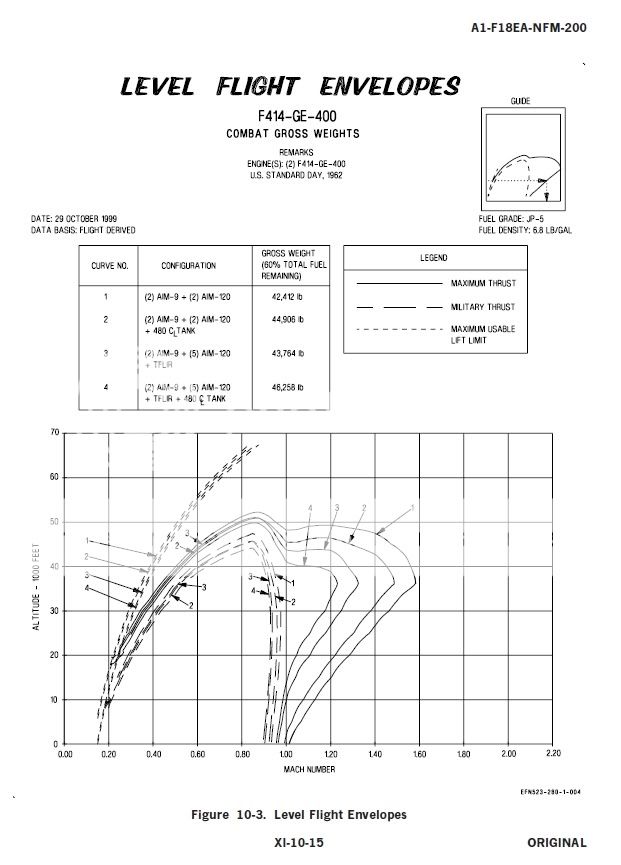
the estimate for F-35 are now final and for A model it went up to 61 sec.
By some extrapolation i think its safe to say F-35 will not ever go over M1.45 operationally,
from this point on, acceleration is barely noticeable
[ATTACH=CONFIG]220901[/ATTACH]
I can’t see why an Su-35S would out-accelerate an F-22. Lower thrust-to-weight in configuration specified and more drag unless they plan on fitting more powerful engines at a later date.
I’m not sure about the other data either:
http://www.wired.com/dangerroom/2013/02/pentagon-downgrades-jet-specs/
“The program announced an intention to change performance specifications for the F-35A, reducing turn performance from 5.3 to 4.6 sustained g’s and extending the time for acceleration from 0.8 Mach to 1.2 Mach by eight seconds,” Gilmore’s report stated. The F-35B and F-35C also had their turn rates and acceleration time eased. The B-model jet’s max turn went from 5.0 to 4.5 g’s and its acceleration time to Mach 1.2 was extended by 16 seconds. The F-35C lost 0.1 g off its turn spec and added a whopping 43 seconds to its acceleration.
The above is based on these thresholds:
http://www.f-16.net/f-16_forum_download-id-14791.html
F-35A – 55s
F-35B – 65s
F-35C – 65s
Which are in an unknown configuration.
lukosThere is a way to make the missile both mach 4 and useable for small fighters,
HARM would work well, Meteor with new seeker better.
Ships today arent armored, you can obliterate electronics and manpower with mere shrapnel,
and you can fling 6 of them at a time,
…and as option drop some iron bombs on it once defenseless
If you can pop one in the VLS, that’ll be all the warhead you need. Meteor with MWR terminal seeker pre-programmed to look for and attack enemy VLS. One small missile could set off a few dozen cruise missile warheads with a combined explosive power greater than a MOAB.
The maximum range would probably roughly correspond to the kinematic range for a surface attack role. Maybe around 300km. A small missile would be really hard to hit too.
Smaller Subsonic weapons are much easier to deliver from multiple platforms, have better range within size constraints, are generally cheaper to procure..All of this makes them favourable for swarming attacks against very well defended targets. How much would a 1000 km Fast supersonic weapon cost and how large would it be? I guess it all depends upon what targets you are looking to take out, how protected that target is in terms of Onboard and offboard – Beyond LOS sensors and what the Defensive loadout is as far as OTH ability is concerned…The ultimate solution would be a missile that can combine both…i.e. Preserve signature (IR and Radar) while cruising for around 80% of its flight profile and then make a supersonic/sea skimming dash in the last 40-50 km of its mission..
You mean like an air-launched version of the 3M-54?



 Sign In







