 lukos
lukosAA finally, good post, now we are talking. This is along the lines of what I am trying to say, I think you’ll catch my drift. The opposite side to this is that the missile has figured out how exactly it will hit the ship. Unfortunately even if the ships computers have figured out where the incoming is likely to be based on current course and missile characteristics this is still a guess, educated but guess nonetheless. There is a number of ways the incoming may alter direction to get to the same point in 3D space (your excellent diagram is 2D, excluding a multitude of close equally valid trajectories the missile may have pre-chosen) without violating its kinematics. Even if the ships computers have software clever enough to figure all out the ship would need to realistically put up more than one projectiles to cover for these (if at all possible) which means that you again arrive at a finite number where saturation and therefore impact is extremely likely. We are far from 100 missiles here, I believe for a tico class that would be about 14-16 missiles to assure a hit even if the ships missiles achieve near perfect hit ratios, safe also to assume that not all ships have tico class capabilities hence safe to assume for other ships will be more vulnerable.
Just to add to his point, here’s an interesting clip of a YJ-18:
lukosOh dear.
This is the new mantra coming out of the LM mouthpieces. How could you possibly be so gullible to believe us when we claimed it was less costly than all the legacy jets put together?
I do not recall you or other disciples of the F35 coming out with this line until very very recently, why so quiet for all the many years when the true nature of the cost started to become apparent and be questioned?To glibly trot it out now is typical of the “nothing to see here, move along now” crap the F35 gang have been trying to fost on the public and forums for years.
Zero credibility.
You get what you pay for. When you include the development costs of building another fighter, the F-35 may well be a cheaper option despite the higher unit cost.
“fair dogfight” Right… Do you maybe want to have another go this?
If i was you i’d not be quite so sure of the absolute statements re detection and positioning. Perhaps you should drink a little less LM and stealth koolaid and read and reflect a little more on air combat.
If you’ve got a small number of platforms it doesn’t really matter how good they are individually if they can be swamped by a larger number of not quite so good in some ways platforms.
The F35 does not possess magic that changes that fundamental truth.
Well you’ve said a lot there without saying much at all. The history of warfare is littered with examples of superior weaponry triumphing over superior numbers and I’m yet to see where this ‘swamping effect’ will come from.
lukosInternal AAMs, obviously carried for reasons of stealth and supersonic cruise. Or because someone was worried that the newfangled AAMs wouldn’t stand the external environment.
They look like AIM-4s, so they may as well have left them back at base. 50% chance they won’t leave the rails, and 91% chance they’ll miss if they do.
lukosASMP/A is a nuke weapon, we don’t want anyone to be confused about it. It is all about strategic position.
But there are lots of other missiles capable of carrying conventional and nuclear warheads.
lukosQuite on the contrary, this is exactly what the JSF was meant to be.. single-engined, light, affordable stealth fighter, with procurement cost comparable to advanced versions of F-16 and operating cost >20% less.
What are the client states getting? A single-engined stealthy fighter, yes.. but in the weight class of Super Hornet and price class above advanced F-15E. 1-to-1 capability comparison gets unimportant when the whole force gets on the very edge of operability due to limited number of airframes available for the given budget.
—————————————————————————————————————————————————————————————-
Look at the continental European NATO operators and the jet fighters they have operated:
Norway – F-16, F-5, F-104, F-86, F-84, DH-115
Denmark – F-16, J-35, F-104, F-100, F-86, F-84, Hunter, Meteor
Netherlands – F-16, F-5, F-104, Hunter, Sea Hawk, F-86, F-84, Meteor
Belgium – F-16, Mirage 5, F-104, Hunter, F-84, Meteor
Portugal – F-16, A-7, G-91, T-38, F-84
Italy – Typhoon, Tornado IDS/ADV, F-16, AMX, G-91, AV-8B, F-104, DH-100/113, F-84
Greece – F-16, F-5, F-4, A-7, F-104, F-102, Mirage 2000, Mirage F1, F-86, F-84
Spain – Typhoon, F-18, F-5, F-104, F-4, Mirage F1, Mirage III, AV-8, F-86In Europe there has always been a very clear emphasis on lightweight fighters with primary A-A role (preferably single-engined). Only Spain, Italy and Greece have ever operated medium-weight designs in the past and even those always complemented by leight-weight fighters. Now, suddenly, all these forces should switch to super-expensive 25-ton class strikers as the backbone of their fleets? And what for? To get unnecessary stealth interdiction capability at the cost of insufficient air defense which is their primary role..
I’m sorry but anyone who thought a state-of-the-art stealth fighter would cost the same as a Gripen E is the sort of person who gives their credit card and bank account number to random cold callers over the phone. Anyone who believes they believed this is also pretty gullible. Even the non-stealth fighters are far more expensive than legacy planes.
The cost of air defence? The F-35 can’t do air defence now? Why do you think that exactly?
Which might lead a more self aware person to wonder how they reached a conclusion 100% at odds with the design teams that created the J-20, J-31, PAK-FA, F-35, F-22, YF-23, X-32… that is to say essentially every clean-slate design to emerge in the last 20ish years. (yes, I am aware that the F-22 and YF-23 emerged earlier.)
Oh, they were all ‘idiots’, only Pierre Sprey knows what’s up.
Yes, if you prioritize stealth, and are willing to pay the price, go for internal weapons and fuel. Just don’t delude yourself that you can also beat a classic multi-role fighter on performance and versatility, let alone cost. When you see the Russians stop building Su-35s
They’ve been building them so slowly it’s difficult to actually tell whether they’ve stopped or not. There are over 4 times as many F-35s as Su-35s and it’s not even officially in service yet and it was a clean slate design rather than an improved Su-27. As for the Su-35, it actually has a similar internal fuel fraction to an F-35A, so clearly the choice isn’t as one-sided as you think wrt drop tanks vs internal fuel.
Can a stealth fighter win on clean performance? Maybe not, but it has the advantage of actually being clean far more of the time and being able to move into a superior position with an energy advantage before the opponent knows it’s there.
RD – No, I can’t “eyeball” the CG any better than anyone else. But I can look at where the wing is, and where the major pieces are, and compare to an F-22 or anything else.
You are correct that stealth requires internal weapons (or some form of conformal carriage, at a different level). This involves a sacrifice of performance at a given size and cost level. Not hard to understand except for dimwit fans.
So after 5 pages of being wrong you’re now changing the argument? As for ‘dimwit fans’, who was it that thought two 426 gal tanks would quadruple the drag of a 50,000lb fighter again, and argued the point for 2-3 pages, bringing up all manner of garbage about eye-balled CoG being the cause of this amazing drag increase?
lukosTVIP – That’s the X or Y airplane. I am not sure whether the production aircraft, let alone the very different G/H, ever had any provision to drop the wing tanks.
One problem with this argument is that the F-35 enthusiasts – in their zeal to prove that their jet is better at everything than anything else – get the argument backwards.
Drop tanks and CFTs are a form of morphing that adapt the airplane to different missions. Consider a normal multirole fighter and what it does. Its two driving missions are long-range strike (lbs of weapons and nm radius and CAP (time on station + air combat parameters such as sustained g and transonic accel).
Let’s give it enough internal fuel for the LRS mission. What that means is that it arrives on CAP with empty fuel tanks, the volume and weight of which now must be dragged through transonic accel and maneuver. This sets off a nice spiral of more thrust, bigger wing = more weight, rinse and repeat.
Hmm. Why not make the jet smaller and use drop tanks more or less sized for the outbound CAP leg and loiter requirement? The driving requirement is to start combat with no excess weight of volume and enough gas to fight and bingo.
Next: With lower gs required for LRS, all I have to do is get off the ground and climb with bigger tanks and bombs. Compared with the clean all-internal-fuel airplane, I may not be as efficient – but I can upsize my tanks or even carry CFTs to raise my fuel fraction and compensate for that factor. (As a low-wing-loading, high-powered tac fighter, I can haul a lot of **** in level subsonic flight.)
And the above, kiddies, is why we can even argue about the ability of an F-16 to haul as much/as far as a far larger F-35. Not to mention a lower-OEW aircraft that has a practical six-AAM, six x 750lb-guided bomb loadout. Show me that on an F-35 and we’ll talk.
Internal weapons, by the way, are a loser for a fighter-size airplane. At best it’s like moving house and having only one size of box to carry your books, clothes and fishing poles. Internal AAMs without folding fins are particularly bad – conformal/semi-conformal is better from all efficiency viewpoints, particularly considering the heavyweight ejection mechanisms required.
The problem is that the F-16 and F-35 are fighters not cargo planes. Sure you can get the F-16 to comparable range with relatively large drop tanks (for its size) and CFTs but it will have no manoeuvrability, be limited to subsonic flight, be easily spotted and as soon as an enemy fighter appears it’s an immediate mission kill. When you look at it that way, why not just fly a B-52 there instead of a fighter?
Of course the F-35 can carry that load externally.
http://www.janes.com/article/32771/f-35c-flies-with-a-heavy-weapons-load

The carrier variant of the Lockheed Martin F-35 Lightning II Joint Strike Fighter, known as the F-35C, flew with a full external weapons load on 13 January at Naval Air Station Patuxent River.
CF-01, an F-35C test vehicle, was equipped with AIM-9X Sidewinder missiles, GBU-12 Paveway II laser-guided munitions, and a gun pod.
The weapons load was NOT the heaviest that the F-35 can carry, but every rack capable of carrying a weapon was loaded, F-35 spokesperson Laura Siebert told IHS Jane’s .
It can carry 6 heavier bombs.

Or 6 1k bombs, 2 2k bombs and 4 AAMs:

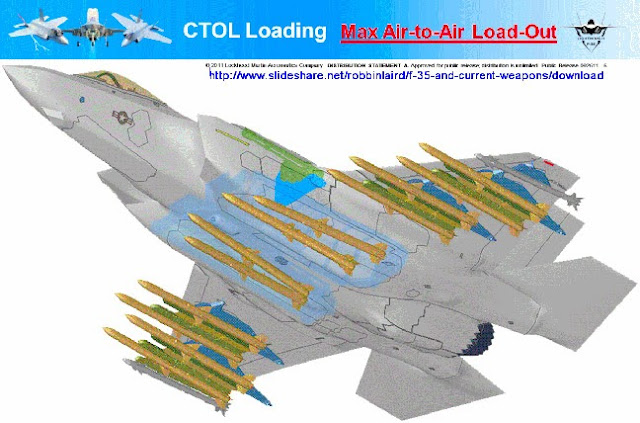
12 AMRAAMs and 2 Sidewinders:
lukosNo – they were simply run at settings not normally cleared for service use, equivalent to 105 – 110% nominal max thrust. Red lined, if you will!
Perhaps your original thought stemmed from the fact that the five or six Vulcans deployed to Ascension were selected for their (standard fitment) Olympus 301 over the earlier B. 2 201/202’s.
Regards,
Frank
I believe I read somewhere that they were originally rated to 20,000lbf but reduced to 18,000lbf and then increased back to 20,000lbf for the raid.
https://en.wikipedia.org/wiki/Rolls-Royce_Olympus
Olympus Mk 301
(BOl.21) Additional zero stage on LP compressor. 20,000 lbf (89 kN) thrust.[25] Later Vulcan B2 aircraft plus nine earlier aircraft[N 2] retrofitted.[26] Later derated to 18,000 lbf (80 kN) thrust.[27] Restored to original rating for Operation Black Buck.[28]
lukosThe awesome performance of Pratt&Whitney’s engine makes the other two look like toys.
Except F135 SFC is actually 0.886lb/lbf.hr
lukosDoes Turkey have an invitation from the Iraqi government for a ground operation though? Don’t forget this is a sovereign country, intervention has to be by consent.
lukosAnd enough rubbish about retaining tanks or not. On an all-subsonic, largely high-altitude mission, the drag of the empty tanks (versus that of a high-wing-loading aircraft weighing 55,000-40,000 pounds) is not going to make that large of a difference.
Isn’t that what we’ve been trying to tell you all along?:confused: They probably increase drag by about 20% in total, which is roughly what the range difference tells us when compared to the theoretical range increase with the same quantity of extra fuel and no extra drag.
Internal tanks don’t cause that much drag and on most real world missions it’s the F-16 that has to cart round empty drop tanks that impose a huge drag penalty and degradation of flight envelope.
B-52 don’t carry drop tanks because weight and manoeuvrability aren’t an issue and they have a ridiculously long range even without them.
lukosI’m not out of date about typhoon.
Paveway IV has been cleared for some time.
http://www.aviationanalysis.net/2013/07/british-eurofighter-typhoons-qualifies.html
Also referenced in AirForces Eurofighter special. Currently EPW II and Paveway IV are cleared. Storm Shadow is next on the cards, followed by Meteor AAM, then Brimstone II, then SPEAR.
lukosLukos – You are quite right about the drag variation, as long as you are talking about a transport-type aircraft that has its fuel tankage equally distributed around its CG, and does not carry bombs. As it is, most of an F-35A’s fuel and weapon load is ahead of the CG, including a huge gas tank right behind the cockpit. If as some people think the jet is always unstable, even fully loaded, how tail-heavy will it be at low fuel, bombs gone?
Which comes to the second point. Wing lift does not equal weight in level flight. Net upforce equals weight. Suppose you are nose-heavy and have a very short tail arm. The stabilizer is pushing down trying to balance out that fat kid on the other end of the seesaw = induced drag. (The fat kid being inter alia the tons of fuel in the forward tank). Lots of induced drag because the tail is short in span and highly tapered. Now the wing has to lift the weight plus the tail downforce. More induced drag.
Now add fat tanks, forward of CG. More trim drag. Interference with the wing flow (by the way, the lift distribution is far from ideal, but that’s another story). Double ugly.
I think your thinking is flawed here. Most modern fighters have a CoP ahead of the CoG, so that in itself will be balancing out any fat kid on the nose and the tail is usually used to counter the moment caused by that forward CoP. The variation in drag over internal fuel use will be relatively small and there’s absolutely no chance in hell that two 426 gal drop tanks can quadruple fuel consumption.
Another thing to remember on the subject of the F-16C is that it’s a relatively under-powered engine chucking lots of gas into the jet pipe for a 67% thrust augmentation. The F135 by comparison only uses 53% wet thrust augmentation, so the dry TWR of an F-35 with equal fuel fraction will be way ahead of an F-16, meaning it will need afterburner far less.
lukosFirst, we know that the aircraft will burn more fuel in the first 110 nm than the average specific range for the mission.
Second, there is no reason for the relationship between the first 110 nm and the second or third 110 nm &c to be linear.
And there is no “theory” here – it’s a question of explaining the numbers as given by the manufacturer. Hanging on to the empty tanks for the balance of a medium-altitude mission would make some difference, but not enough to explain the tiny range increase for c. 20 per cent fuel.
Dude please give it up already. We know that weight on its own has relatively little impact on drag if the form remains unblemished. You get a marginal increase in induced drag, which is roughly proportional to the weight difference. So for a clean aircraft the difference in induced drag from the first drop to the last drop is roughly a 38% reduction, or a 60% increase from last to first depending which way you do it. That averages out at a 19% reduction in induced drag (or a 30% increase). Induced drag is only a small part of overall drag, so the difference in consumption is minimal.
So again this leaves use back at these tiny drop tanks, containing 2,760lb of fuel each, having to nearly quadruple the drag of a 50,000lb aircraft.
20% extra fuel is also incorrect. Two 370 gal tanks contain 4,800lb of fuel, so two 426 gal tanks contain 5,530lbs, which is 30% extra fuel. The tiny range increase is easily explained if you keep the tanks. If average drag is increased by just over 20% because of the drop tanks, then theoretical range based on an internal fuel assumption reduces from 130% to 108%.
lukosLukos – You have a wing loading above that appears to be derived from Sprdlyscotsman’s “analysis” over at the kiddie board. The problem is that the guy uses an “equivalent” wing loading for his comparisons, in which he adds tail area to wing area, on the basis that (in photos) the tail has positive incidence (angle relative to aircraft datum), while subtracting tail area from wing area for the F-15 and others.
The problem is that the tail has highly negative alpha (angle relative to airflow) because it is in the immediate area behind the wing and immersed in a downflow. In fact, the clean and fully fuelled F-35A/C is nose-heavy and carries a lot of trim drag. Its net wing area (the size of the wing) is also an unusually small fraction of gross area (the normal quoted 460 sq ft) and the span loading for the A is high (it’s the same weight as a Super H but almost ten feet shorter).
Adding tanks makes the nose-heaviness worse. What the Norway data is telling us is that when you put the tanks on, the aircraft becomes both heavier and less aerodynamically efficient (tank drag, trim drag, wing at high loading = even more energetic vortex loss at the tips). This could also result in a lower initial cruise altitude (less efficient again) and there could be other factors (eg greater weight mandates more afterburner time).
It’s really simple: Stealth costs money and results in performance trades. Is it worth it? The answer is mission-dependent and, of course, dependent on the threat.
I didn’t use figures from f-16.net I used the official figures for wing area (300ft^2 F-16, 460ft^2 F-35).
lukos30% multiplier for external fuel tank afaik (might be wrong, but i dont think so)
Probably depends on the tank size. With 3 1000L tanks the Typhoon manages 800km more. 3000L is about 4,800lb. 4,800/11,000 = 0.436. 800/2,900 = 0.276. 0.276/0.436 = 0.63 (63%) Each tank contains a fuel weight equal to ~5% of aircraft loaded weight, which is also the case for the 426 gal tanks on the F-35 except there’s only two of them. Maybe it only works out as 30% when you’re carry 2000+L drop tanks on a lighter aircraft.:highly_amused:
.. especially the future clients…
I doubt any future clients believe the F-35 will be cheaper than a small single-engined non-stealth plane like the Gripen. It will however be far more capable. Only non-engineers and people who’ve never been involved in military projects in their life would believe an F-35 was coming out cheaper than a Gripen. It’s like expecting to run an F1 team for less than a Ford Mondeo.


 Sign In







