lukos
lukosClosing at Mach anything makes your aircraft a brilliant heat source and radar reflector. Honestly, I think your F-16 is going to close ranks at 450-ish knots and your average MiG is going to be doing about the same. Your engine sfc is double on wet thrust and if you’re running high throttle its around 4X the fuel usage at best cruise velocity. You’re not closing at Mach speeds if you plan to make it home. Air combat just isn’t done above Mach.
WVR isn’t, BVR most definitely is.
Here’s another source. Appears the story came from Jane’s originally going by links at bottom.
http://kosova.org/post/Operation-Allied-Force-How-Dutch-F-16AMs-shot-down-a-Mig-29
lukosno way an F-16 with 2 external tanks and an ECM pod go M1.64, and unlikely M1.24, pending on alt which is duly lacking,
as is speed, this is really poor documentation on the event.
the most probable is 30 sec is derived from ‘not sure but roughly ~1/2 minute’
B8-81 – Mach 1.3 at 30,000ft even with maximum DI.
http://info.publicintelligence.net/HAF-F16-Supplement.pdf
C1-12 & http://www.f-16.net/forum/viewtopic.php?p=188248
2 370gal tanks DI = 2 x 35 = 70
2 wing tip AMRAAMs DI = 0
For some reason I can’t find the ALQ-131 pod but let’s assume it’s rough LANTIRN-like (DI=3)
C1-8
4 further AMRAAMs DI = 16
B8-73
DI=100, Mach 1.64 at 30,000ft.
Don’t know if I calculated that right.
lukosugh.
define a pulse…
Is it the waveform emitted instantaneously? Or over 1 second?
If a radar outputs, say, 5kW, that is, 5 kilojoules per second, Merc is pointing out that it is formed of (say), 100x 50joule pulses which all are at distinct frequencies (for an AESA beating at 100 Hz).
As far as I am aware, no current AESA can use half of its T/R modules at one frequency and the other half at another frequency at the same point in time. The whole lot are used, or a subset of the T/R modules are used, and they are beating over very short time periods to give an aggregate over multiple frequencies.
That isn’t the case. A pulse is a short burst, many of which are emitted per second. AESA pulses can contains several frequency components, spreading the emission power across the spectrum, so that they are very difficult to detect, unless you know the spread.
lukosno, it says 30 sec,
“It was an instant hit, after a flight of 30 seconds.”
i dont know where you are getting 21.6 nm from, can you link to either the converter you are using,
or the source that claim 21.6 nm.
i admit tho that the 30 sec statement sound more like ‘some half a minute’ statement,
given that the impact occurred 18 km away.
a shame also that no altitude is given, hopefully some better documentation of the event will be investigated
Yeah sorry, I did actually use 30 in the calculation as you can see, I will change the 33.
I can’t remember where it came from either, it may also have been on F-16.net. If you think about it though, the MiG is closing, so if the missile was launched at 21.6nm range, during missile flight the MiG will close a certain distance (~4nm say), which would account for the difference. 18km may just be a case of ~10nm put into metric units. If we work on the basis of your 17.8nm missile flight after a 21.6nm launch range, then the firing aircraft closes 7.8nm in the time the missile does 17.8nm. Using your 17.8nm that gives an average missile speed of Mach 3.75 (assuming Mach 1 = 1062kph at 11,000m). Which means the launch aircraft was doing just over Mach 1.6.
Average speeds case 1
Missile speed – Mach 3.75
F-16 speed – Mach 1.64
MiG speed – Mach 0.8
But then it could be that the average missile speed was slightly lower and the enemy fighter was slightly faster, meaning the launch aircraft was also slower. E.g.
With current assumptions. MiG’s average forward speed was Mach ([3.8 x 3.75]/17.8) = Mach 8 and F-16 speed was Mach 1.6. However, if MiG was doing Mach 1.2, it instead closes 5.7nm of the 21.6nm, leaving the missile flight distance at 15.9nm, meaning the F-16 covered 5.9nm, giving:
Average speeds case 2
Missile speed – Mach 3.35
F-16 speed – Mach 1.24
MiG speed – Mach 1.2
lukosSoftware and mid course correction changes make the big difference in range between A/B and the C’s.
Call me cynical, but my closing speed in an F-16 is not going to be using the afterburner. AND I am going to be closing to where my breaks off that course are at my best possible corner speed. I’d save my afterburner for an emergency. Not every engagement will involve visual contact. The vast majority of intercepts happen with one aircraft turning away from the other well outside the envelope of your mark 1 eyeball.
Going faster increases missile energy and Pk. Whether you loop around depends on the opposition strength and the aircraft you’re in. In a stealth aircraft or against superior numbers of enemy aircraft you would loop round. In a large squadron against a few MiGs you would follow in after the AMRAAM forces them to dive on the evasive and then capitalise of the height advantage.
lukosThanks, I would never have been able to find that again.
ok, lukos use a different converter than mine then, i get it to 17.8 nm, if 30 sec even is correct,
but the head on intercept took place 18 km away from the F-16,
so both the shooter & target must then have been on afterburner heading towards each other.
But it also states that each F-16 were carrying 2 external tanks and an ECM pod,
so the 30 sec even sounds more like ‘roughly half a minute’,
or else i dont know how to make the equation work, cause i dont think the two fighters involved were closing in that fast
Well it says 30s, which at Mach 4, assuming 11,000m altitude is [(30 x 4,248kph)/3600] = ~35.4km or 19nm.
If you think about it though, the missile still spent 30s in flight despite closing, implying that is was fired from more than 19nm away, but the target closed to within that range of the initial release point during flight. But then the missile takes time to accelerate too, however the faster the launch aircraft goes, the faster the missile goes. I read 21.6nm somewhere else but it’s ballpark.
Taking your initial figure of 17.8nm, if the MiG was doing 21% of the speed of the missile, it would close from 21.6nm to 17.8nm between launch and impact.
lukosNow now… some of your stuff on flight mechanics is… to put it politely… highly questionable.
I think I mathematically justified it pretty well in that thread when talking about climb rate. If I went wrong please point it out.
Lukos,
While I appreciate your critical spirit (cfr. Pascal), you can’t expect to get such answers on an open forum. Up to you to believe what is said.
Some members here are known to be reliable an respectable in their field. If you get vague replies from them, be sure they have good reasons to do so.No need to push.
I realise that, I began by respectfully pointing out that he was wrong as regards AESA only using one frequency per pulse. If that was the case, it would be damn easy to detect.
lukosWhen did this occur and what was the target ?
i’d like info on this event thanks
Balkans. Dutch F-16 vs MiG-29 – 21.6nm.
lukosI, for one, enjoy your posts and insight on this forum.
Don’t take offense Lukos, but you seem to enjoy engaging forum members in a combative style that grows tiresome. It’s a bit unseemly to be attacking the credentials of a professional in the field because you disagree. Many posters, myself included, may be uncivil at times, but come on.
Most of us work for a living, so we are all professionals. I wouldn’t be challenging someone if I wasn’t sure.
lukosYou seem to have a very simplistic view of the defence world. To become a successful consultant, one must first become a recognised expert in the chosen field. Work in industry, write books and magazine articles, speak at international conferences, and even be the man selected to chair the relevant international conference. An established track record of knowing what you are talking about is what inspires confidence in potential clients. Otherwise, who is going to pay serious money for your services?
The stuff I post here is all a minor spin-off from my professional work. My clients might not be amused to learn that I am posting stuff for free when they are having to pay for my services – which is why I often have to be a bit vague about who I have been speaking to on a given subject.
But when someone asks a question on this forum, I answer if possible. If I see what seems to be wrong information posted, I try to correct it. It is pleasant hobby for the lunchtime and tea breaks, and leaves individual forum members free to accept or reject what I post. In this field too, I have a track record.
So are you an expert in AESA software and SP hardware or not? If you are I worry, as you have some catching up to do.
lukosI cannot follow the logic of many of your responses. How can your personal knowledge tell you whether or not I discussed radar-mode interleaving with a senior member of an AESA team?
You may or may not of done but discussion != understanding.
What other journalists talking to what senior figures? I do not understand your use of the word “other”. I have only mentioned a single journalist – the one who wrote the AESA article you were citing. It was generally a decent piece – all I did was to point out some errors that showed that he/she was not a specialist in the subject.
Well so far your gripe about anything I present is that the author, a journo or otherwise, got it wrong. Maybe the gripe applies to you.
In my work as a defence consultant, (that is no secret; I say so in my profile), I have to stay abreast of what is published in the defence and academic press. Naturally, I have learned over the years to know which of the current and former writers have a good track record of getting it right, and (most importantly) in what fields of defence and defence technology their work can be relied on. Inevitably, even the best will sometimes misunderstand what they have been told. This is a particular problem in defence journalism. An academic can try to specialise, but a reporter whose expertise lies in warships and submarines could well make a mess of reporting on a new main battle tank. I sympathise with anyone who is having to operate in this sort of multirole mode.
So basically you’re a non-expert listening to what others say and trying to guess which is correct based on past track record, even though some, by your own admission, get it wrong. Confidence inspiring. In terms of actual theory, academics probably know more than those in the industry but the industrial experts will know more about implementation in specific systems.
When I asked (referring to my AESA discussion) if you claimed to know more about how AESA works than my informant did, you replied “Depends who he is”. I make the assumption that if I am speaking to a senior member of any profession other than my own, he or she is likely to know more about their subject than I do.
Senior member of an AESA team doesn’t really tell me anything. The manager could be a senior member, but it’s not necessary that they have any expertise in AESA or even in defence. They may have managed a brewery prior to that position and struggled with the organisation of p1ss-ups, prompting a career move. I’ve met a few. If an engineer, what aspect of the AESA was he involved in? Hardware or software? What specific components? When you have something like an AESA radar, no one engineer is doing the whole thing. Then there’s the fact that you may have just misunderstood.
Accused journalists and academics of what? Making a mistake? Making mistakes is something that I do on occasion, and cheerfully owned up to one recently in another thread on this forum. I don’t have to go back 17 years to find my last one! But my job basically consists of providing clients with the specialised knowledge that they do not have in house. My error rate is still low enough to ensure than I am kept uncomfortably busy despite being well beyond my biblical three score and ten years.
Well perhaps you should look into the comments I’ve made regarding the frequency flexibility of older radars and understand why AESA is different. Then you will understand why jamming is vastly more difficult.
lukosDon’t you actually READ the postings you respond to?
Sadly, yes.
I told you that I had obtained this information from a senior figure in an AESA team.But you are just going to dismiss it.
My own personal knowledge says otherwise. The irony is that you complain about other journalists misunderstanding information passed to them by senior figures.
Are you claiming to know more about how AESA works than he does?
Or are you claiming that I am not a reliable witness to what was said?
Or perhaps he was one those work-experience interns that you claim post wrong data on company websites…
Depends who he is. Perhaps you’ve just done the very thing you accuse other journalists and academics of. The latter is actually a valid criticism. Trust me it happens, because some 17 years ago I was an undergraduate doing just that, which is how I know.
Either way, this just illustrates the pointlessness of responding to your postings.
So you go against common knowledge and then after receiving evidence you claim the experience to be pointless. It might surprise you to know that pre-AESA radars have been able to swap frequency in between pulses for some time and there’s even such a thing as FMCW which has existed for some time, e.g. Clam Shell. If all AESA did was swap frequency between pulses, it wouldn’t be particularly new.
lukosYou are citing your beliefs based on the facts as you perceive them. I have been talking to persons professionally involved in this field in order to learn what sort of weapons and tactics they are working to develop. As someone once told me, “If you want opinions about dogs, talk to dog owners. If you want facts about dogs, you’d need to talk to the dogs”.
Need to fix a dog, a human has to take it to a vet, who is also human. I stated that IRST works but only at close BVR ranges. That is a fact. In order to use radar-based NG BVRAAMs to against stealth aircraft, first you need stealth beating radar on a fighter. I’m not aware of any such development as of yet.
“Commonly acknowledged facts” sometimes turn out to be wrong. And I did not say that it was “often stated by defence academics”, I merely noted that some have made this error.
Any “burden of proof” lies on those who believe that a coherent wavefront can be created by a cluster of emitters operating at different individual frequencies.
Having read your last few posts it’s clear that you don’t understand the technology properly, so it’s a waste of time taking the matter further. Basically your tact is to deny all evidence I post and make your own assertions based on hearsay with no substantiation, claiming that the burden of proof still lies on me. No, it lies with you. AESA produces a complex wavefront consisting of a number of frequency components that it is able to reconstruct on receipt due to a knowledge of what they were and signal processing techniques.
The source you went on to cite is not a technical journal, but a trade magazine, so was written by a journalist, whose limited understanding of the subject is easily illustrated by his statement that “The modules can work together or in groups enabling them to perform multiple tasks at the same time.”
Your evidence for this being wrong is based on what exactly, your own opinion? Thanks, I’ll just dismiss that.
This is another instance where I have obtained my facts from talking to the dog
No doubt.
Hang on a moment – it is not my reasoning. I’m simply citing what has been published in a widely-respected professional journal dedicated to EW, and noting that the statement has not been challenged. (Although I did take the time back in December to check in the EW literature to see what sort of response times were being described.)
So you’re choosing to believe this journal? You still haven’t mentioned the radar type it was against. I’ve cited plain logical reasoning that refutes the ability to jam the most sophisticated AESAs and so far you’ve offered no valid counter points. Assuming both radar and jammer have the same signal processing power, the radar knows what it’s looking for and only has to detect. The jammer doesn’t know what it’s looking for and has to detect and develop effective jamming. Seems to me that the radar has the advantage. In knowing what the signal is, it can also employ programmable hardware to do a lot of the processing, which massively speeds things up. The jammer can’t because it wouldn’t know how to program the hardware.
You really think that a seeker designer would have selected a frequency that suffers high atmospheric absorption? The major absorption peaks are at 24 and 60 GHz. Several MMW spectral regions provide ‘windows’ where propagation can more readily occur – around 35, 94, 140, and 220 GHz.
I didn’t say it was the highest attenuation band, I implied it suffered higher attenuation than X-Band, otherwise all fighters would be using it because the resolution is far superior. V-Band suffers even higher attenuation. The MMW attenuation minima is actually at ~96GHz.
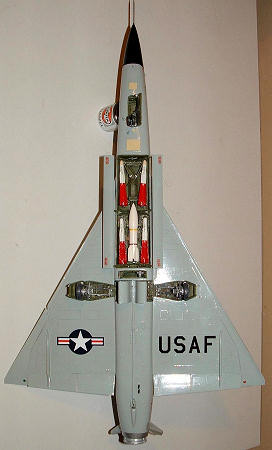
lukosF-106 had some issues, the biggest being pretty limited in its role. I personally thought the airframe was pretty robust and made sense. But four micro AAMs for armament was pretty restrictive. Imagine the range F-35 would have had with a payload requirement of 1500 pounds…total.
In reality it had been five AAM, until around the early 70’s when they replaced the center nuke with a cannon.
Of those 5 missiles only the nuke stands a chance because the AIM-4s were possible the worst AAMs in US history. Based on combat performance, you would need at least 3 aircraft carrying 4 AIM-4s each to take out a single enemy plane. And I’ve only included statistics where the missiles didn’t die on the rails pre-launch.
lukosno i’m plain right on range, and 10 miles range at launch would be a rather typical BVR shot,
(if there is such a thing as typical shot, with all the possible closure rates that can be)
pilots & a2a theorists are better suited to distill the primary advantage of an autonomous missile,
my opinion is the primary positive fallout is freedom of maneuver after launch
I believe 21.6nm is the current record for the longest AMRAAM shot in combat but that was 15 years ago or more and the trend is towards increasing range.
Guns (1914-1953: Maximum combat kill range achieved ~0.2nm)
IR missiles (1956-1991: Maximum combat kill range achieved ~5nm)
SARH missiles (1960-1991: Maximum combat kill range achieved ~10nm)
ARH missiles (1992-Present: Maximum combat kill range achieved ~20nm) – Circa 40nm claimed for AIM-54 in Iran-Iraq war.
IIR missiles (1998-Present: 50km tested range)
AESA radar and ramjet missiles (2015-Future: 100+km tested range).


 Sign In