 lukos
lukosOf course there is always an impact. The problem is it seems the impact is too severe for the EF to handle without mods. None of the other CFT equipped jets had to undergo aerodynamic mods. F-15, F-16, F-18, Rafale, F-CK-1.
That goes to prove that the level of instability margin incorporated in the Typhoon is greater than the other aircraft but then we already knew that from the fore-plane position anyway.
lukosThere are other reasons why the plane might only carry Brimstones on 4 pylons besides CFTs, although it’s far from definite that that’s the case.
For instance, a Tornado only has 4 pylons capable of using triple ejectors:
http://www.thinkdefence.co.uk/2012/03/the-brimstone-missile/
Equally an A-10 only has two pylons capable of carrying Mavericks.
lukosSometimes it does just look like it would be easier to put a network of satellites in space with 100MW fusion-pumped laser cannons than implementing some of this.
Maybe small UAVs could be printed though, like the new micro-UAVs and nano-robots.
http://defense-update.com/20140703_nanobots.html#.U7702vldWak
lukosLets assume continuous burn: how long before it runs out of fuel ?
We had this discussion before,
i got the impression from a video that it can burn 25 sec, while Mercurius claim around 15 sec IIRC.
Coasting and throttle back works on high alt, but at lower altitudes it will need constant burn to overcome pressure
It’s still variable even if burn is continuous. That’s the huge difference between a rocket and a ramjet besides effficiency. A ramjet can slow down or speed up. The Meteor decides how fast to fly and what flight profile to use based on optimising the intercept. So if it was up against a MiG-31 doing Mach 2.5+ 50km away from a rear aspect, it might do Mach 5. If it was fired against an orbiting AEW aircraft from 250-300km away, it might do just over Mach 2.
As regards an NEZ, it’s rated at 3 times the that of the AMRAAM it replaces for the RAF. I believe the RAF’s current AMRAAM version is the AIM-120C-5. So I guess if we approximated NEZ as 35-40km less than stated maximum range based on the longest AIM-120B combat intercept at 21.6nmi, that would work out to about 65km for the C5 and therefore ~200km for the Meteor.

lukosIt has now been confirmed on the IAT website that the f-35’s will not be attending as they have run out of time
http://forum.keypublishing.com/showthread.php?129627-F-35-News-Multimedia-amp-Discussion-thread-(3)
lukosThe other problem is communicating through the plasma stealth and using your own radar through it and how do you do SIGINT or RWR functions? We’ll have to wait to see if any of the new Euro drones have it. I guess we’ll know by 2030.
I wonder if it would be possible to have a thin layer of gas between an outer radar transparent skin and the aircraft main body and then ionise that, or does it need to be a certain thickness? Could you employ radioisotopes to expedite the process?
lukosThe F-35 NEVER had a 2008 IOC date in the schedule.
The earliest documented IOC was a 2002 reference to the USMC IOC in 2010 and a USAF IOC in 2011.
As far as what they are now, USMC in 2015 and USMC in 2016.
Here is the slide form 2002:
[ATTACH=CONFIG]229960[/ATTACH]
I’ve seen far shorter schedules on far less complicated products significantly slip too.
lukosand who would want to buy the Tranche 1 Typhoons when the user nations themselves are eager to get rid of them so soon due to obsolescence creeping in?
Some air forces are still flying MiG-21s.
lukosThere’s a common misconception in this day and age that the UK “don’t have the brains and know-how” when it comes to innovations. One begs to differ.
[ATTACH=CONFIG]229947[/ATTACH]
Eurofighter Tempest… Anyone? :dev2:
It’s the money we don’t have. We do okay for a country with one fifth of the population of the US and 1/40th of the land mass and far less natural resources.
lukosBeen reading picards blog huh? Every number you just posted is fabricated. There is no evidence the f-35 tops out at .9 mach on dry thrust. The typhoon number is pure fantasy from a poster on a forum. Take a look at the KPP’s of the f-22 then think real hard.
Let’s be careful what we post as “fact”. That’s what starts those unpleasant flame wars.
It’s funny you should say that because the “half” was the problem in what he originally wrote.
What I’m trying to convey is simple. SEP tells you what your best rate of climb is and the velocity you should start at, but it doesn’t tell you the axial velocity in the actual climb.
When you initially go into a climb from that speed you will accelerate both axially and vertically.
T – D – Wsin(AoC) = ma [1]
but
a = dV/dt and m = W/g where V is the axial velocity in the direction of the climb path.
and
sin(AoC) = (dH/dt) / V where dH/dt is climb rate of velocity in the y-axis.
Hence substituting into [1] gives:
T – D – W(dH/dt)/V = (W/g).(dV/dt)
OR
T – D = W(dH/dt)/V + (W/g).(dV/dt)
Multiply each side by V/W
–>(T-D).V/W = dH/dt + (V/g).(dV/dt) = dH/dt + (1/2g).[d(V^2)/dt] [2]
Which is the same as what it says here:
http://web.mit.edu/16.unified/www/FALL/thermodynamics/notes/node100.html
He’s trying to make out that the force balancing is different to the energy balance but they’re one and the same.
When you start off from the V that gives maximum SEP (see LHS in [2]) and start to climb, both terms on the RHS will start to increase. That is, initially dH/dt will increase and dV/dt or d(V^2)/dt will increase.
The reason is obvious, in the case of the MiG-29 starting off at 309m/s, which is the V that gives maximum SEP at sea level, you cannot instantly achieve a dH/dt of 345m/s straight away just by pulling back on the stick and changing direction. V will need increase in the climb and it will continue to increase until:
T – D = Wsin(AoC) where D = 0.5 x Cd x A x Density x V^2 [3]
The value of V at which that happens is given by:
{ [ T – Wsin(AoC) ] / [0.5 x Cd x A x Density] }^(0.5)
When V stops rising equation [2] simplifies to:
(T-D).V/W = dH/dt
But from [3] we know that when V stabilises T – D = Wsin(AoC) therefore:
[Wsin(AoC)].V/W = dH/dt = Vsin(AoC)
Which is intuitively obvious from the diagram at top of page.
http://web.mit.edu/16.unified/www/FALL/thermodynamics/notes/node100.html
In [2], if dH/dt = 0 in level flight:
(T-D).V/W = (V/g).(dV/dt) = SEP (NOTE: Not V/2g.dV/dt as Andraxxus said)
–> SEP x (g/V) = dV/dt
The LHS is known as Specific Thrust.
lukosI thought this guy did well in Math in Laugh-borough uni…. he had like 1.000.000 marks one that unit.
He has a PhD? He is Dr Lukos ?
Ancient Greeks used to say that knowing half is worst than knowing nothing…
It’s funny you should say that, because the missing half in what he originally wrote was the problem.
lukosI can’t? Math 101;
That isn’t what you did.
http://forum.keypublishing.com/showthread.php?130883-fighter-agility&p=2151125#post2151125
To make it more scientificc; typically this is where this formula has its use;
Divide both sides by W; assume W doesn’t change with respect to time so move it out of differantial part; eqn becomes
(T-D)*V/W = dH/dt +d/dt(V^2/(2g)You know MiG-29’s SEP (T-D)/W*V = 345 m/s and max current rate of climb is 309m/s as limited by Vsin90;
345m/s – 309m/s + (1/2G) dV/dt*V where dV/dt is acceleration, positive indicating MiG-29 is accelerating in a 90 degree climb; math will follow to find the exact value.
Look carefully, ignoring G, you have said:
(1/2)d(V^2)/dt = (V/2).dV/dt NOT (1/2)d(V^2)/dt = V.dV/dt
which is exactly what I said. If you do if properly you get the equation for specific thrust. I.e.
[(T-D)V/W] = (1/2g).d(V^2)/dt = (2V/2G).dV/dt = (V/g).dV/dt
Hence:
dV/dt = [(T-D)V/W].(g/V) = Specific thrust = acceleration in level flight
Its a matter of simplification has nothing to do physics behind it. v*dv/dt = 0 if a = 0
That much I agree on.
MiG; engineers say othervise. MiG-29;
[ATTACH=CONFIG]229939[/ATTACH]Also General dynamics engineers;
F-16@22000 lbs has 1000 feet per second = 304,8m/s @ M0,72 = 247m/s. Note that I circled STD DAY conditions.
[ATTACH=CONFIG]229940[/ATTACH]Or McDonnell Douglas engineers of F-18;
[ATTACH=CONFIG]229941[/ATTACH]Not to mention Boeing engineers of F-15, Sukhoi engineers of Su-27? But they are ALL wrong and you the lukos the infallible is right, right?
They are indifferent from energy gain perspecive, I don’t know how one can be so thickheaded to comply with this.
They’re not wrong, you just don’t understand what you’re reading. Maximum SEP is calculated at a V where SEP is maximum, obviously. That gives the maximum climb rate. However, it does not mean that the V during that climb is the same V that gives the maximum SEP. How can is be? At maximum SEP you can accelerate and/or increase climb. If you put all that excess power into a rate of change of PE, then you are using it. After doing this you will have increased axial and vertical velocity. You don’t understand it properly. You can’t attain a climb rate of 345m/s at an axial velocity of 309m/s, that isn’t what maximum SEP is saying. I’ve already proved this if you could actually understand the fundamentals.
Look:
http://web.mit.edu/16.unified/www/FALL/thermodynamics/notes/node100.html
If dV/dt = 0
T-D = Wsin(AoC)
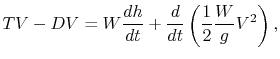
Again if V isn’t changing:
dH/dt = [(T-D)V/W] = Wsin(AoC) x (V/W) = Vsin(AoC) i.e. the vertical component of the axial velocity. The axial velocity in the vertical climb is therefore greater than the climb rate.
In maximum climb: V > dH/dt
V is static and the excess power is put into rate of change of PE.
The maximum SEP is an entirely different condition, where V is selected to maximise SEP, which tells you what the maximum climb rate is but it is a different flight condition. Yes, it’s confusing, it’s telling you what your maximum climb rate is but not actually giving you the axial velocity for it. It tells you the velocity you should start at but not the velocity you will finish at when max climb rate is achieved.
Still you are not getting the point AT INSTANT V=309m/s, MiG-29 achieves 345m/s climb rate. There is no “no longer” thingie about it. Its irrelevant if this is physically possible or not; this is not “MiG-29 can climb 345 m/s @V=309m/s” statement. It is “MiG-29 has excess power equivalent to potential energy gain of 345m/s climb rate”.
That is why you are completely wrong in your following calculations:
Even going completely vertical at 90 degrees; an object with airpseed of 309m/s cannot have greater than 309m/s climb rate; but MiG-29 is known to have 345. So Your climb angle calculations are invalid due to (T-D)sin(AoC) = W cannot be valid;
Since you like accurate numbers, let me explain this way;
(T-D)/W*V = 345 when V = 309m/s;
(T-D) = W*345/309;(T-D) = 1.116*W
You have to take arcsin of 1.116 which you cant, and due to you ignore the validity for input/output range, you take the the arcsin of 1.116^-1 (0,896) which gives out your 63,64 degrees, which is WRONG.
SO YOU CLAIM TWO EQUATIONS PLUS THREE CLIMB RATE GRAPHS ON MIG-29 FLIGHT MANUAL AERODYNAMICS BOOKLET IS WRONG????
Andraxxus is wrong, Amiga500 is wrong, 800+ engineers in MiG design bureu are also wrong, they designed MiG just by pure luck, only lukos is right. Why? because he is right and he also has PhD.
Perhaps its you who is using wrong ratios and getting wrong answers?
You have to take arcsin of 1.116 which you cant, and due to you ignore the validity for input/output range, you take the the arcsin of 1.116^-1 (0,896) which gives out your 63,64 degrees, which is WRONG.
Dude, the angle was actually wrong, and I’ve now removed it, but not for the reasons you think. It’s wrong because I wrote:
T – D = ma
and then said:
(T – D)sin(AoC) = ma x sin(AoC) = mg THIS WAS WRONG!
It should have been:
(T – D)sin(AoC) + Lcos(AoC)= ma x sin(AoC) + Lcos(AoC) = mg
lukosBy the way; your calculation is fundementally wrong;
V = { [T-Wsin(AoC)]/[0.5 x Cd x A x Density] } = 429.015m/s
You are trying to find V in meter/second; (kg*m/s2)/(number*dimesionless*m2*kg/m^3) will give you m2/s2 not m/s
Truly a fatal mistake for anyone to claim himself an engineer; let alone having degrees or PhD etc.
Not if you take the square root of it. Like I did here:
http://forum.keypublishing.com/showthread.php?130883-fighter-agility&p=2150724#post2150724
V = { [T-Wsin(AoC)]/[kA] }^(0.5)
but then neglected to write the “^(0.5)” later on even though I still actually applied it in the calculation. I’ve corrected it now.
lukosYou don’t asume if you are in the game of producing hard figures.
In a typical flight manual, its called a “climb profile”. And for the same jet, it could be different angle, as how(much) the jet is loaded. If you don’t know the exact climb angle used for the whole duration of the climb, your figures will be inaccurat.
Seems like a pretty good assumption to me, see above.
lukosLike I said, I don’t go vectoral calculations; I go from energy calculations, take L=W and dE/dt = (T-D)*V. SEP is irrelevant of W; dividing both sides will give dH/dt = (T-D)/W*V as SEP or inst. climb rate;
Then I ratio them, assuming same V; so dH1/dH2=(T1-D1)/(T2-D2)*(W2/W1).
W can be ratioed accurately; but I use, (T1/T2)-(D1/D2) in place of (T1-D1)/(T2-D2); I know its inaccurate; but better than nothing.
Well not much better than nothing. You need to understand the basics of what you’re doing. Resolving in the plane of travel in the climb:
T-Wsin(AoC) = D [1]
[T-D)/W] x V = SEP = dH/dt
Substitute for D:
[{T- [T-Wsin(AoC)]}/W] x V = SEP = dH/dt
Ts cancel and Ws cancel giving:
Vsin(AoC) = SEP = dH/dt [2]
Which is exactly what this diagram is telling you anyway, the climb rate is the axial velocity multiplied by the sine of the AoC.
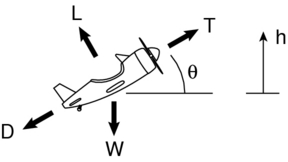
Now given that:
D = 0.5 x Density x A x Cd x V^2
it follows from equation [1] that:
{[T – Wsin(AoC)] / (0.5 x Cd x Density x A)}^(0.50) = V
Therefore, putting that into equation [2] yields:
[{[T – Wsin(AoC)] / (0.5 x Cd x Density x A)}^(0.50) ] x sin(Aoc) = dH/dt [2a]
So you can see that climb rate is more dependent of the difference between T and Wsin(AoC) (probably Wsin(60) ) divided by drag or A than the ratio of [T-D]/W, which is what was used here:
http://forum.keypublishing.com/showthread.php?130883-fighter-agility&p=2150284#post2150284
Rafale instantenious turn rate 30,26 deg/s (On a big assumption that Rafale uses same airfoil as Mirage 2000, which Soviet information booklet gives Clmax of 1.05; Assuming close coupled canards improve this by ~15%, and assuming Rafale would need ~800kg of fuel for 500 km range, 10300kg + 1,2Cl +45,7m2 wing area gives such result) (Accuracy 3/10)
Rafale sustained turn rate 24,2 deg/s (On the same assumption Rafale behaves similar to Mirage 2000, which has 19,26deg/s STR, increase in 11% wing area will increase the drag by same amount and 59% increase in thrust will improve STR, , So 19,26*1,59/1,11/1.14 is the overall ratio) (Accuracy 2/10)
Rafale climb rate 370 m/s (Same assumption, same ratios above, 285m/s is the climb rate for M2k taken from wiki; 285*(59%-11%)/14%) (Accuracy 1/10)
You are right if you are absolutely through and exact; However from experience; most aircraft achieve this around same airspeed (MiG-23@M0,85 MiG-29@M0,9 F-16@M0,82 Su-27@M0,84 etc etc). Its a valid assumption to simply ratio things.
In fact, its pretty logical if you look at from energy gain point of view; A MiG-29 @12800 kg has 345m/s climb rate at M0,9 as its manual suggests; Even if climb angle is 90 degrees; Vsin(theta) will prevent actual rate of climb to be greater than 309m/s. So what happens? 309 of the 345m/s excess power is wasted on vertical climb, and remaining 36m/s is used for acceleration while conducting vertical climb.
It’s not really that valid. If you look at the equations above, it’s using the wrong ratios and therefore getting the wrong answers.
To make it more scientificc; typically this is where this formula has its use;
Divide both sides by W; assume W doesn’t change with respect to time so move it out of differantial part; eqn becomes
(T-D)*V/W = dH/dt +d/dt(V^2/(2g)You know MiG-29’s SEP (T-D)/W*V = 345 m/s and max current rate of climb is 309m/s as limited by Vsin90;
345m/s – 309m/s + (1/2G) dV/dt*V where dV/dt is acceleration, positive indicating MiG-29 is accelerating in a 90 degree climb; math will follow to find the exact value.
Whilst you can take constants out from the derivative and write:
(1/2G)d(V^2)/dt [3]
you can NOT take the V out and write:
(V/2G)d(V)/dt
Otherwise you’re right in saying that there’s an acceleration as V^2 is increasing and d(V^2)/dt is positive.
SEP gives impressive statistics about aircraft performance; take dH/dt = 0, and it will give you level flight acceleration of the aircraft by;
345m/s *2G/V = acceleration@M0,9 for example. Check the formula by its two dimensions m and s; (m/s)*(m/s2)/(m/s) = m/s2 and see it to be true.
345m/s is not M0.9 at any altitude unless it’s a very hot day at sea level. The equation you’ve written actually gives the rate of change of V^2 not acceleration. There are simpler ways of estimating acceleration. I.e. the specific excess thrust, which is actually:
SEP * g/V [4]
Unsurprising really:
In level flight AoC = 0 so:
T – D = ma [5]
W = L = mg
Rearranging [5] gives:
(T-D)/m = a = SEP * g/V = [(T-D)V/W] x g/V = [(T-D)V/mg] x g/V
W can be ratioed; but you are most definitely right that T and D can’t be ratioed that way due to addition/subtraction, we cannot get it out of paranthesis and group as a ratio. However as I don’t know T = 10 and D = 5; I have no means of implementing this; This is the prime reasion why I rated accuracy so low, because margin of error is huge(not because I assumed Rafale has same Cd as M2k); from numeric analysis POV, this should work as long as T is close to D; and margin of error will increase with their differences increase.
You implement it by going back to the basics.
http://forum.keypublishing.com/showthread.php?130883-fighter-agility&p=2150724#post2150724
Its still wrong, however because you are still taking this as actual climb; see MiG-29 example I mentioned and calculated above; source
[ATTACH=CONFIG]229927[/ATTACH]I added some number and lines in paint don’t bother them; It was for another topic, too lazy to reupload the clean image.
Explain these figures with your methodology and I will go with your calculation;
M0,5; V= 171m/s -> 180m/s climb rate.
M0,7; V= 240m/s -> 280m/s climb rate.
M0,9; V= 309m/s -> 345m/s climb rate.Assuming you accept MiG engineers are capable enough to provide correct climb rates for the aircraft they designed; tell me; what BAOC would MiG-29 require? 60degrees? 90degrees? 90+? Or perhaps its time you accept your methodology is wrong when talking about “climb rate” that means “specific excess power”.
PS; You made me notice an interesting thing; MiG-29s Vy*is always greater than the V*sin90 until M0,9, meaning it could go vertical climb and still accelerate at below M0,9 airspeed @ S/L, 12800kgs.
If you knew the set value of climb for a given aircraft then you can go back to equation [2a] and assume an AoC and then calculate a value of Cd.
How to explain this, right. The 309m/s is when you are in level flight, you have SEP of 345m/s. Now you can either turn that into a climb rate or continue accelerating at [345 x (9.80665/309)]m/s^2, see equation [4], which comes out greater than g, the reason is obvious. When you actually turn that into a maximum climb, only the vertical component of your acceleration will be countering gravity. The horizontal component will act to increase your axial velocity, so V does not stay at 309m/s.
The aircraft will accelerate when it starts to climb.
So once you use that excess power to achieve maximum climb rate, V is no longer equal to 309m/s, otherwise a climb rate of 345m/s would be impossible. The aircraft accelerates and V tops out at (dH/dt) / sin(AoC).


 Sign In








