 lukos
lukosNo, he had an A2A ARM in mind,
and i believe i’e read the old Viggen had the targeting capability based on passive reception of radar signals in the 80’s
Very limited use. It would essentially be the same as HOJ, which is only rated as a less reliable secondary function even today. ARMs would definitely struggle with a manoeuvring target, especially once it points its radar away. They’ve also traditionally carried larger warheads than AAMs due to reduced accuracy, which either means a shorter range AAM or a very large AAM.
lukosF-16E 10 ton fighter with 3 ton fuel is supported by 14.5 ton engine. the rest I want you to calculate.
…and less than 8 tons dry thrust.
Meanwhile the Typhoon is an 11 ton fighter with 5 tons of fuel supported by 18.5 ton of engine thrust with 12.3 tons of dry thrust. Like I said, no contest, especially supersonic where the ramped intakes and lower mach drag canard design will also be a factor.
they had better situational awareness so fighters may have better range for shot. and also missile maintained by well funded airforce is very different than some 2nd hand missiles floating around for years.
Not really a valid excuse for 26 misses and a forced landing out of 27 shots.
lukosTrue if you are looking exactly numerically, but for operational means its negligable. For most airfoils, drag increases exponantially at above certain AOA. for a level flight at M1.5+, there is certainly so miniature drag increase that top speed wont change noticably. Compare an F-16 top speed at 20000lbs and at 36000 lbs; weight is almost doubled, but top speed stays the same, if drag is unchanged. However at slower speeds (due to increased drag) or at higher altitudes, maintaining level flight requires greated AOA -and drag- increase so top speed goes down with increased airspeed.
You are comparing 1300 kg increase on a 25000+ kg aircraft. It won’t change the top speed or maintained airspeeds by a measurable amount.
Sure it will. The relationships between weight, lift, Cl and Cd (Cd0 + kCl^2) are very well understood. The F-16 has a pitot intake so its intake efficiency falls off a cliff at high Mach, hence why weight doesn’t seem to affect speed much. It’s effectively like hitting the rev limit in a car. While Cl does fall due to V increasing, the drag effect of simply having that mass there due to a bigger airframe is noticeable.
Efficiency is irrelevant. Su-27 has efficient enough inlet to provide good enough SFC at supersonic speeds. Its surely less efficient than supercruising, but has more than enough fuel to compensate.
Go figure. A Typhoon’s dry SFC is 0.74lb/lbfhr. An Su-27 wet is 1.92lb/lbf hour. You can’t compensate for that.
how it will know when to drop the tanks. and if Flanker refuse to fight in tail chase engagement EF range without ET will be greatly reduced. Flanker can still turn around for fight. there is no evidence of RCS with 6 AAMs that will make difference against all kind of radars.
Easy, it doesn’t drop the tanks until the Flanker turns.
lukosI think I posted many times that an F-16 blk50 -according to its flight manual data- can easily match Typhoon’s published acceleration and time to speed+altitude performance capabilities. And when strictly “acceleration” or “time to altitude” performance is concerned, my money is on F-15 and Su-27 over any F-16 variant.
You can publish from wherever you like but it’s BS. The Typhoon has a superior TWR and ramped intakes, the F-16 can’t possibly match it.
that war was based on missile built on Soviet factories. which has nothing to do with R-27 of past couple of years.
Meanwhile AIM-120A/B did far better, despite being older missiles.
lukosusing missile with greater than 60 degree turn greatly reduces its speed/energy/range. the best way to enter fight is to use long range radars, high altitude , speed and best nose pointing position of fighter for missile shot. You cannot outrange 40 Km export R-73 let alone Ruaf R-73 launched from Flanker at higher speeds.
EF with ET is not some stealth fighter. and amount of intelligence in Baltic. they can be tracked right where they start there engines on the ground.
What? The Typhoon can achieve high speeds quicker than a Flanker and its RCS is about a hundredth of an Su-27’s running clean, so even with drop tanks it’s still better and they can of course be dropped at any time:
http://www.koreatimes.co.kr/www/news/nation/2011/10/205_97236.html
I think you missed both my points. A Su-27 will easily go and play around M1.4/1.6 with 10 missiles, and maintain such speeds for quite some time; Typhoon simply cant; even if could reach M1.6+ with 10 missiles, it has to drop EFTs to go that fast, but needs EFT to match endurance of Su-27.
Even when clean, Su-27 can maintain any high speed chase much longer than Typhoon.
Says who? A Typhoon can supercruise at Mach 1.21 even with drop tanks and it would only need one drop tank to match the Su-27’s fuel fraction and wouldn’t be far off range-wise even running on internal fuel simply due to having a better engine and not requiring the burner as much:
https://en.wikipedia.org/wiki/AL-31
https://en.wikipedia.org/wiki/Eurojet_EJ200
Furthermore, as a Typhoon uses fuel, its overall weight diminishes far quicker further improving endurance.
Throuoghly biased comment as Meteor is not in service, because I was simply talking about aircraft chasing each other, in the means of escorting them. What we see is a Typhoon equipped with 2xAIM-120Cs and 2xAIM-132s + 3 EFTs, compared to a Su-27 equipped with 2xR-27REs 2xR-27Ts and 2xR-73s. If you go in that way, there is a consideration of trying to outrun longer legged R-27 variants, compared to AIM-120s.
Standard load for a Typhoon is 4 AIM-120Cs and 2 ASRAAM. How well did R-27Rs do in the Ethiopian-Eritrean war? The Typhoon’s drop tanks are probably more likely to get a kill after release.
Supercruising is not exactly cruising. F-22 can only supercruise for around 600 km @M1.5 IIRC, makes ~20 minutes. Equipped with external AAMs, and less fuel fuel fraction when armed with 6 missiles, I dont think Typhoon will do any better than F-22.
You’ll have to show me a source for your figures and your ability to calculate also needs work. 20 minutes would require Mach 1.8 to make 600km. This also seems to suggest a near 800km combat radius with 185km (100nm) in supersonic each way.
http://www.f22-raptor.com/technology/data.html
So that’s 1600km total, with 370km supersonic and some fighting inbetween.
Supercruising is exactly cruising! That’s the whole point! Running dry instead of on afterburner reduces SFC to about 40% of wet SFC. It’s 2.5 times as good for range.
lukosIf you read his work and theory, you will know he advocated both radar & BVR missiles, -longer range missiles than those that existed,
in conjunction with a ‘stealth’ approach, hence a powerful passive sensor suite,
but obviously the weight had to be kept down, as well as cost, for a superior air superiority fighter force,
with supremely trained pilots at an affordable cost.
http://forum.keypublishing.com/showthread.php?126715-Pierre-Sprey-s-analysis-of-fighters-30-years-later-yay-or-nay
So he wanted to use a smaller ‘range-only’ radar (page 148) and longer range SARH missiles? Sounds like a realist.
Page 1 – Only now is it actually possible to gain targeting capability based on passive reception of radar signals. Only the F-35, Rafale, EA-18G and Tranche 3 Typhoon DASS upgrade provide that capability. So when I see a typed document from over 30 years ago suggesting that it would be possible ‘soon’, he was clearly wrong. He rails against BVR missiles for the most part, but since 1980 most A2A kills have been achieved using BVR missiles.
lukosI am sure the Gripen would be ‘ok’ to him, but imagine if they took away its radar, BVR missiles, multi-role capabilities, and all that other useless weight and added a few more machine guns… now THAT would be a proper fighter. :very_drunk:
Like this? (Note: I’ve removed the FCS and had to re-design the wings a bit because the FCS counts as unreliable electronic complexity.)

lukosTop speed has nothing to do with weight.
Yes it does. More weight requires more lift meaning more drag. The Su-27’s main advantage in top speed is copious amounts of afterburning (1.63 wet to dry thrust ratio) producing a very fast jet. Very inefficient.
Russia thinking is the obsolete fighter enough to deal with EF as this area is not that far air defence coverage so no need for radar use.
Okay well it gets killed just as bad WVR because it can only engage in a +/-60deg FOV straight forward in WVR.
http://www.webcitation.org/6J6cwo1bR
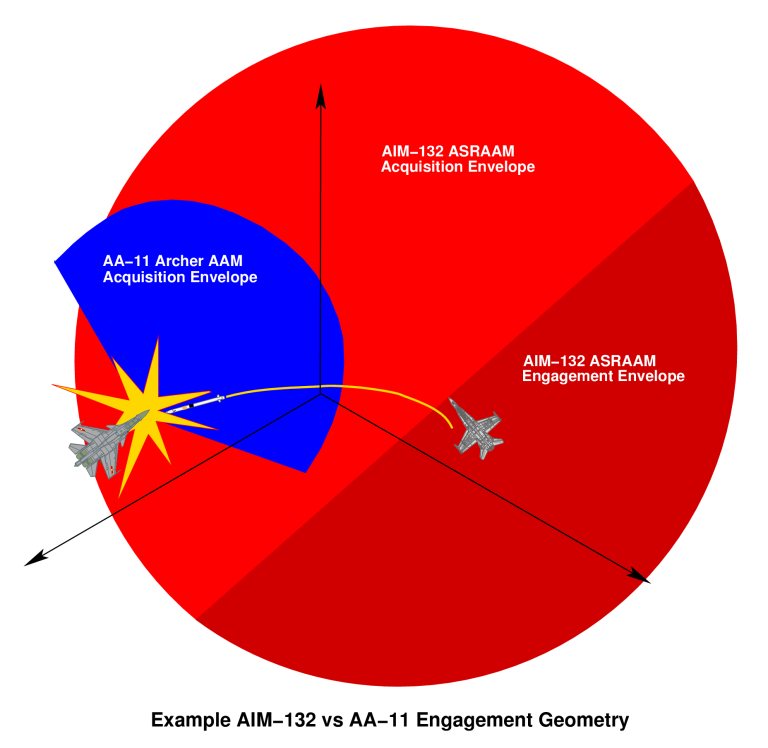
Meanwhile the Typhoon HMCS and ASRAAM can engage over a full 360deg LOAL and 180deg LOBL, with 3rd party cuing via PIRATE where necessary. So even Su-35 TVC goes out the window as an advantage.
lukosSprey is a nit wit, always has been.
He had some good ideas back in the day but was a zealot and advocated an approach that if followed would have been a disaster. The F-16 became the incredible success it did not because of him, but in spite of him. He wanted a stripped down WVR only, dogfighter with no meaningful multi-role capabilities. (lacking a modern radar even) If the F-16 had been built as he wished it would have gone out of production 30 years ago.
He was a huge critic of the F-15. He has been a huge critic of the F-22. Philosophically he would be opposed to essentially every fighter in production today. Eurofighter… twin engined, complex, expensive, optimized for BVR combat. Rafale… twin engined, multirole, complex, expensive, emphasis on BVR combat. Su-27/30/35… heavy weight, twin engined, multirole, complex, expensive. etc etc.
Basically the only aircraft he’d approve of is the Gripen. Funny….. I know someone exactly like that.
lukosWithout EFTs, Typhoon won’t have enough fuel -by a long shot- to chase/outrun a Su-27; supercruise or not. To quote Gerry Gallop, a topgun instructor who flew Su-27;
How do you work that out? The Typhoon can do Mach 2.35 at altitude and absolutely crucify the Su-27 for acceleration below that due to thrust/weight ratio.
http://www.bmlv.gv.at/waffen/waf_eurofighter.shtml
2,495kph at 11,000m = M2.35
Besides that there’s the consideration of trying to outrun a Meteor.
According to this, Su-27 can maintain supersonic flight for 50+ minutes at M1.3, makes 1300 km. For how long a Typhoon can supercruise with full internal fuel?
It can supercruise at Mach 1.5 with 4 MRAAMs and 2 SRAAMs. Cruising it’ll likely go for over an hour.
Wow!! Relax people.. I said that the EF on THAT pic would have to selective engage AB, while The Su-35s goes Mil thrust. No way in hell the EF would ditch its DT on such a mission here. Those EF in that drag layout might even be supported by tankers, while THAT Flanker is surly not. Who’s jet would have the highest cost per hour.. 🙂 especial if the EF would drop three Wet bags on each flights :p
Referring to Flankers as ‘wet bags’ is a little bit insulting surely?
lukosLike the people from LM. The same behavior by promoting the own case and ignoring contradicting facts. By such behavior both have a credibility gap for all to see.
Furthermore he advocated that the F-16 shouldn’t be fitted with a radar when it was in development, not only making him irrelevant but an idiot to boot.
lukosIs it rare for VSS units to carry hot ordinance..?
Its the impression i get through media..
Its like, VVS are criminals to carry missiles on their missions in international airspace :p
Interesting enough, that Flanker even have its launchers under the airduckts. One would think 6 missiles are the standard configuration on A2A missions.
Anyway, those EF are much more “dirty” in terms of drag.
Which is where the “outdated” Flanker design are very effective and practical 🙂
Except those drop tanks can be ditched at the flick of a switch. The Flanker has no such switch to clean itself with.
lukosI don’t understand what they don’t design a commune launcher like a stealthy pod for the Brimstone. All said that it will stay a commercial success for long and adapted to platform with RCS reduction shape and increased Dyn perf req. for the carrier.
Something where the studies for the StormShadow family of missile could be reused to lower the cost.
– A rotary launcher (that does not have to be cylindrical)
– with a gravity released system at the back
– a forward single launch tube for ex. with rotating eyelid (see the T50 canon)
– Conformal mounted low cost sensor as an option to help widening the nbr of platformEventually, it could even state the standard in dimensions or could be reusable for other missile.
I think the solution will be a ejector version of Brimstone because it’s also needed for the F-35B to allow for internal carriage. It also seems like the simplest solution.
lukosPerhaps the phoons need to carry a water tank and some soap? 😉
Maybe this is how they clean their aircraft. They fly them out hoping for rain. Ruthless efficiency.
lukosjust to add the picture to the exciting news posted above:
[ATTACH=CONFIG]229384[/ATTACH]
So Brimstone II by 2018 with the probability of SPEAR 3 to follow?
Can we therefore work out a notional number of weapons to be carried in both cases based on what we know of RAF hardpoint usage?
Currently 18 Brimstone using each of the 3 inner wing pylons but a common launcher is being explored for Brimstone II and SPEAR 3, so we may see an ejector launched Brimstone carried in quad racks, which would also suit F-35B internal carriage.
http://www.adsadvance.co.uk/bae-systems-awarded-brimstone-2-onto-typhoon-study-contract.html
The missiles are 50kg each and the triple rail launcher is 90kg, so all-up weight for a triple mount is 240kg (530lb), making it roughly equivalent in weight to a single Paveway IV.
I was also thinking that a 2,000lb JDAM/LJDAM(-ER) would go nicely on the inner wing pylon being roughly similar in length to an EPW II and narrower.


 Sign In







