PA474
BBMF Lancaster straight over the top of my house (again!) at 10:40 hrs, heading East towards Chedburgh. Made the windows rattle!
when will the book (or books) be available?
My birthday approacheth
Later this year for Volume I (Mks I – XII)
Log on to the website and pop your name on the list – we’ll keep you posted.
I believe so. I doubt the AWM would not make such an easily spotted “mistake”.
It seems to have been a “perk” for Group Captains etc to have their aircraft “personalised” as they were not on any specific Squadron strength and therefore didn’t carry their codes.
I think Bader and Stanford Tuck for example had their own “Coded” aircraft.
Regular Squadron aircraft carried a 2 letter code plus an individual letter for the specific aircraft.You will see instances, especially in Bomber Command, of an aircraft carrying the 2 letter/numeral squadron code plus an individual aircraft code of “A2” for example. That’s usually where that aircraft had been under lengthy repair or maintenance and another replacement aircraft had been allocated the original letter. It may have been regarded as a lucky aircraft so, when back on strength, the numeral “2” was added to differentiate from the other aircraft.
Thanks for the response – this aircraft has never been repainted since it was delivered to Australia in March 1945. It was selected for transfer to Australia in May 1944 and was chosen because of its Australian connections (No. 452 Sqdn). The codes were carried when in service at Catfoss with the Central Gunnery School – my question is to determine whether or not they are connected with Ray Harris … and who was he?
No confirmation?
Sorry Francois. Yes, No.401 “Ram” Sqdn RCAF moved from Biggin Hill to Kenley on 24 September 1942 and then moved from Kenley to Catterick (N. Yorkshire) for a “rest” period on 23 January 1943, here it re-equipped with the Spitfire Vb. At Kenley it formed part of the Canadian Wing alongside Nos 402, 412 and 416 Sqdns.
Keith Hodson was Sqdn C.O. He served post-war with the RCAF and reached the rank of Air Vice Marshal, serving as Deputy Chief of Staff at North American Air Defence Command (NORAD) headquarters from 1958. He was killed in a T-33 on 5 July 1960 near Colorado Springs, USA, when, having suffered engine problems, he bailed out but his parachute became caught in the tail and he was dragged down with his aircraft. π
Thanks for your answers, gentlemen.
G-ORDY, I assume the Mk IX featured two 20-mm cannons and four .303 machine guns. Is that correct?
Absolutely correct – basically the same as the Spitfire L.F.Vc (the so-called Universal wing) but slightly modified.
His aircraft serial number was EN183. I found that it was a Mk IX but I cannot determine the version — Mk IXb or Mk IXc.
Now here are my questions:
1) What was the exact version manned by 401 Squadron at that time?Fox.
Hi Francois, welcome to the Forum – the correct designation for EN183 was simply F.IX, the suffixes “a”, “b” and “c” were not officially used on the Mk IX and the Merlin 61 meant that it was simply a Spitfire F.IX. When the large calibre 0.5 inch Browning was introduced the suffix “e” was applied but that was the only official sub-type. Having said that many squadrons referred to “IXb” and “IXc” – as have many post-war authors – but technically the types never existed!
Funny, I always thought N3200 made it very much to Dunkirk, but failed to make it back.
http://www.aircrewremembrancesociety.com/raf1939/stephenson.html
Point taken – but technically she never took part in covering Operation Dynamo as it started after she had been shot down, apparently the evacuation started at 6:57pm on 26 May.
Sadly departed …

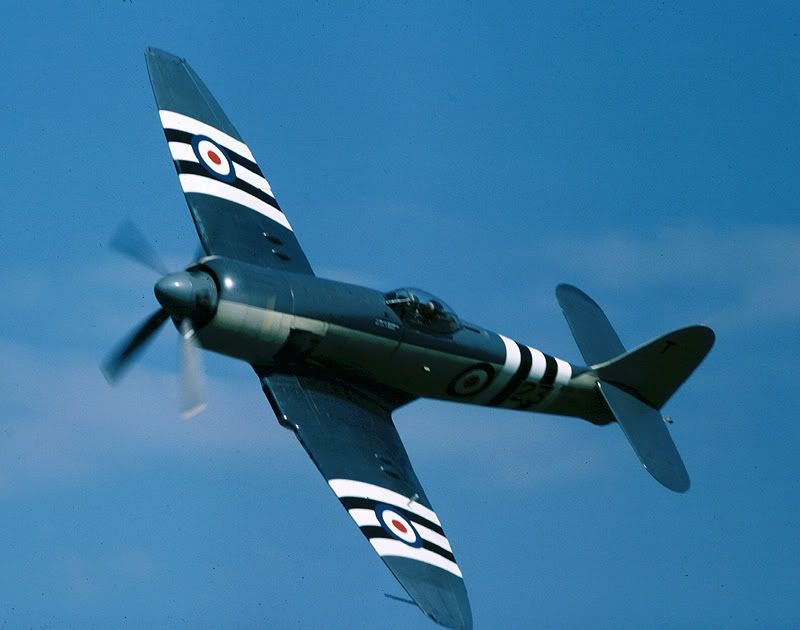
TF956 does a low pass at Old Warden in 1977.
Remember the 1833 and 1834 Squadrons there during my training. Remember too the A/C we trained on, Seafire, Firebrand ( where are they now ) Firefly and Fury ?
Nice to see piccies of Gamecock, think it is a prison now ? Happy days π cya
I don’t suppose you have any photos of the Seafires do you ….. ?
Righto, I’ll be the mug. What book? Has it got naked ladies in it?
“Spitfire Survivors – 3rd Edition” π
I’ve set up a Facebook page where I can keep people appraised of progress as we head towards publication http://www.facebook.com/pages/Spitfire-Survivors/125282320832417
“They’ll all be in the book” π
And it keeps getting bigger all the time … π
Generally speaking, no complete drawing for ANY Miles types survives*. All Miles drawing were burned by the administrators when Miles was made bankrupt in 1947. The Hendon archive probably will reveal nothing.
*The only exception is the drawings for the Miles M.11 Withney-Straight, but a more-or-less complete set of drawings survives in New Zealand. The reason for itΒ΄s survival has probably something to do with the fact that the NZ Air Force impressed 3 aircraft at the start of the war.
That’s odd – when Julian Temple (now of the Brooklands Museum) was employed by Adwest Ltd to catalogue the Miles Aircraft archive held at Woodley he found an extensive collection of photos, drawings – including those for the M.2 Hawk – and other material. This had all been locked away since 1947. EMK Aeroplane Ltd had permission to build one flying replica of the Hawk from the available plans. It may be worth contacting Julian for confirmation or otherwise.
Meteor T.7 with the ATC in Chelmsford since 1966 (may have gone now?)
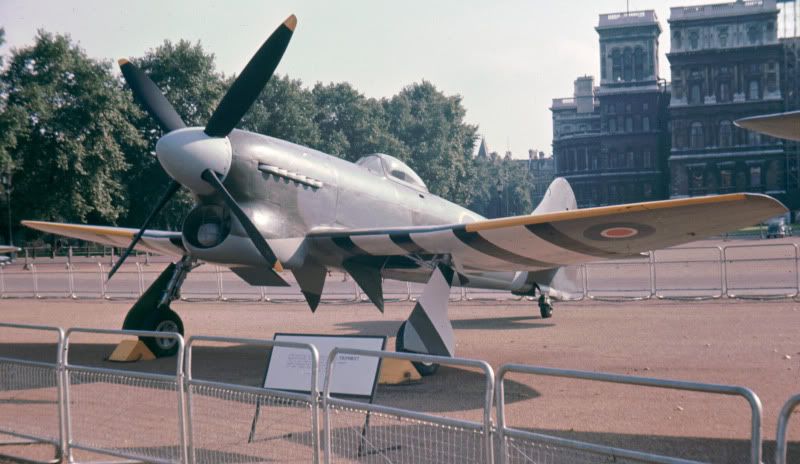
I’m guessing that the Tempest is the target tug in Milestones of Flight at Hendon ?
Nice old nostalga trip as well- thanks for sharing.
Yep – NV778

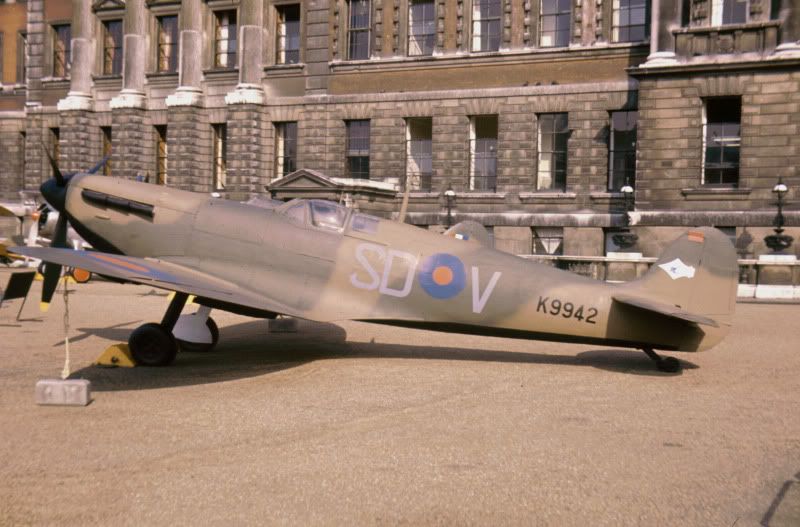
and here’s a colour shot of K9942 – it had just be repainted to drawings prepared by Jack Bruce

Thanks, Mark, got that…
JDK, Thanks, it’s a ‘longshot’ about fhe AJJ obit, but they must have poblished something…
Seasons Greetings, all….Mick
I wrote the obit for AJJ in “Vintage Aircraft” magazine and I didn’t mention Percival. For Percival’s obit I dedicated an entire issue to him. (VA # 30)