FBW
FBWMessy, sh*tty civil war. Bloody dictator propped up Shia terror groups fighting hodgepodge of Sunni terror groups and various ethnicities who want out from under.
And the topper- Major powers protecting thier “interests”, at the expense of Syria’s people. Gulf states bankrolling it, and no end in sight.
FBWAnd abandon all hope Россия is great and powerful!!!
“I must break you”- Ivan Drago
FBWWell the F-16C, page A8-57, manages an identical max STR at the same altitude anyway.
https://info.publicintelligence.net/HAF-F16-Supplement.pdf
The TWR of the C is 1.1 fully fuelled and 1.3 at 22,000lb, which is about 25% more than the M2000. The F-16C weighs more, so we see that a higher wing loading has been a detriment but compensated for by increased thrust. For max ITR the M2000 beats the F-16C by 5deg/s. It would be interesting to see what happens in lift-limited turns at lower altitude rather than drag limited turns at high altitude.
Yes, above mach .8, the Block 50 (at GW 22,000lbs) comes close to matching an F-16A at combat weight (50% fuel to 2 AAM). That is the point you are missing. The two charts you posted were comparing the F-16A and Mirage 2000 at combat weight. The Block 50 weighs 20,200 lbs at operating weight (pilot, unusable fuel). Add to that the two Aim-9, ammo, chaff, and that leaves roughly 1,000lbs of fuel. So, no at 50% fuel the F-16C Block 50 does not match the F-16A, nor does it have a 25% thrust to weight ratio advantage over the Mirage 2000. You cannot pick arbitrary points to compare.
It shouldn’t be suprising that the delta wing 2000 has an excellent instantaneous turn rates, the trade-off is that a delta wing bleeds energy in a hard turn (less so with the close coupled delta/canard)
What is the actual instability margin though. Looking at the M2000, it’s evident that there are no canards or tailplane to balance the moment about the CoG. Seems to be largely based on the Mirage III layout. The point is that the M2000 is losing out in STR because of lower TWR, the Typhoon doesn’t suffer that problem and has increased relaxed stability.
No, idea what the instability margin is. What the Mirage has is body strakes for drag reduction at supersonic speed and increase lift over wings at high AoA (like the Typhoon’s body strakes). The Mirage most likely has higher drag (a trait of delta wings) in a turn than the f-16, that, and not the lower thrust to weight ratio are likely the reason for the difference.
The newer delta-canards do not suffer the as much from this drawback.
FBWBTW, the block 52 with the F100-229 engine has a sustained turn performance below slightly under 14 degrees per second at mach .8 10,000 feet (under 11 degrees at 20,000 ft). Splitting the difference, the Block 52 has a turn rate of roughly 12.5 degrees per second at mach .8 15,000ft (2+ degrees less than the F-16A). The F-16A with the less powerful engine has superior sustained turn performance to the block 52.
The block 50 with the F110-129 bests the block 52 by nearly .5 degree per second (at the same GW), shows that static thrust does not tell the whole story now does it?
Edit- put in wrong engine, wrong chart the first time.
FBWAh okay, well most aircraft are above a 1.5:1 wet/dry ratio.
Says 0.25:1 here.
http://www.mtu.de/engines/military-aircraft-engines/fighter-aircraft/f414/
I would expect higher BPR engines to benefit from afterburning more, because the core gas is already very hot anyway.
Umm no, F-16C is 1.1, M2000 is 0.88, 1.14 is a mis-calc, it’s 1.37 at that weight – 28,600lbf. The thrust figure they state is not for a -200, it’s for a -100. That’s a 25% advantage. And bear in mind that the M2000 is canard-less and doesn’t run relaxed stability and despite that, only a 1.75deg/s advantage for the F-16 and a 4deg/s ITR advantage for the M2000.
https://en.wikipedia.org/wiki/General_Dynamics_F-16_Fighting_Falcon
Exactly, which is why the Typhoon is likely to win on turn rate.
What are you on about? You’ve posted two pages from the F-16A and Mirage 2000. The F-16A with a F100-220 has 23,770 lbs of thrust. That is correct, no F-16A EVER had 28,000 lbs of thrust. ( if you want to compare the F-16C I can put up the numbers. However, the thrust to weight ratio does not change much at the -C is considerably heavier, depending on model, and again depending on the model, the sustained turn rate is less for some F-16C’s)
The thrust to weight ratio is listed at the two combat weights right on the side of both pages, those are the two you were using to make your comparison, so that is what I am using, and the difference is 8.5%.
Second, at what speed are you comparing them? I told you at Mach .8 15,000 feet the sustained turn rate for the f-16 is 2.2-2.4 degrees better. That is directly from the pages of the manuals you posted. Hence there is no 25% greater thrust to weight ratio and the sustained turn performance for the F-16A is consistently 2+ degrees superior until they approach Mach 1. Lastly, the M2000 IS a relaxed stability design. You are fabricating or cherry picking, just stop.
FBWSays 13,000lbf on wiki and 14,000lbf here. Either way, the wet/dry ratio is >1.5. As it is for most Flankers and the like too.
http://www.sps-aviation.com/story_issue.asp?Article=731
That seems to be exactly what it suggests.
https://web.archive.org/web/20081231141150/http://typhoon.starstreak.net/Eurofighter/engines.html
The wikipedia numbers are wrong for the F414, I took the actual intermediate and wet thrust from: http://www.dtic.mil/dtic/tr/fulltext/u2/a493918.pdf
The F414 has a lower bypass ratio than the EJ2000 .314 to .4
Whilst the F-16 could achieve higher STR than a Mirage 2000 due to the M2000’s poor TWR, ITR was not higher. Even with the 25% advantage in TWR, the F-16 only manages marginally better STR of around 10% at 0 PS and 5% at -800PS. The lower wing loading did give an advantage of some 4deg/s peak. Now if the Mirage 2000 had 29,000lbf of thrust instead of 21,400lbf, no doubt it would have won on STR too. Now factor in inherent instability margin and canards on top of a 1.2:1 TWR and that kind of wing loading and you get the picture.
How do you figure 25% advantage? The F-16 has 8.5% greater thrust to weight ratio, and a nearly 2.4 degree sustained turn rate advantage at mach .8 15,000 is a HUGE difference. They only approach parity around mach 1.
Wing area generally tends to include the part of the body that adds lift and we’re again comparing two planes built in the modern era, well actually the Typhoon is much newer in design to boot.
While that is true, that does not mean that two totally different planforms perform the same as bank angle and AoA increase (we are not talking high AoA , 20 degrees or less).
FBWA/C Performance covered everything, including those things and turn performance. And the Typhoon came out 30% ahead of a Rafale.
I’ve read the report multiple times. There is NOTHING about specific performance numbers. The performance based on the OCA/DCA mission performance. It does not mean that the Typhoon has superior turn performance, nor does it mean inferior. Simply put, there is nothing to support either in the Swiss Eval, except that the overall aircraft performance on the missions was superior.
Nah, that’s just approximated based on dry thrust + 50%. If you look about most fighters on reheat increase by more than 50%. E.g. F414, lower dry thrust, higher wet thrust. And that’s before WEP.;)
What numbers are you using? Wiki? The F414 produces 14,770 lbs in intermediate and 21,890 in wet thrust. The EJ2000 is very similar at 13,500 and 20,250. These are the manufacturers numbers. There is no credible report that he EJ2000 has a war emergency power setting the pilot can activate similar to some Migs. What the typhoon starstreak site stated was:
An interesting point to note is that the baseline production engine is also capable of generating a further 15% dry thrust (69kN or 15525lbf) and 5% reheat output (95kN or 21263lbf) in a so called war setting.
Like any engine, that means simply, that engine can produce more thrust at higher operating temps at the cost of engine life. There is nothing to suggest that the pilot can control this or that any air force would allow it.
Note also, add 5% to the stated 20,250 lbs of thrust. What do you get? Simply put, the Ej2000’s thrust is known.
And if the two figures were anything like close I would agree but they ain’t and the canards tend to help in that respect anyway. They’re not remotely close. 63 vs 85lb/ft^2 even with the Ef at 32% fuel fraction and the Su-35 at 25%. Put them on the same fuel fraction and it’s 63 vs 90lb/ft^2 and 1.2 vs 1.07 TWR.
BTW, I’m not arguing that the Su-35 has a higher sustained turn performance than the Typhoon. I’m saying your reasoning is flawed. Your trying to compare wing loading of canard/delta wing to that of cropped delta/tail planform. I shouldn’t have to explain why using simple wing loading numbers do not support that the Typhoon would have superior sustained turn performance
So compare the F-104 to other fighters of that era like the MiG-21. That was also a tube with wings but massively superior in turn performance
.
That is the point, they were both designed without high lift devices, and neither likely have significant body lift. So, obviously the Mig-21 with it’s larger wing will have superior turn performance as most speeds/alt. ( I see that andraxxus beat me to the comparison below) The F-106 is a good comparison, significantly lower wing loading than the F-4. It could out turn the early F-4 variants at high altitude. The situation was reversed once the slatted F-4E was introduced, it had significantly better sustained turn performance at all but the highest speeds.
And high Cl will increase drag, so it’s damned on two fronts.
What? what are you comparing? I was talking about to similar wings one with leading edge root extensions and one without. Which one is going to generate more lift as AoA increases? What are you arguing? That the lift generated by leading edge root extensions on a cropped delta like the Su-27 (or strakes on the F-16) are dragger than a pure delta at high AoA? Sorry, that is one of the major penalties of a delta wing.
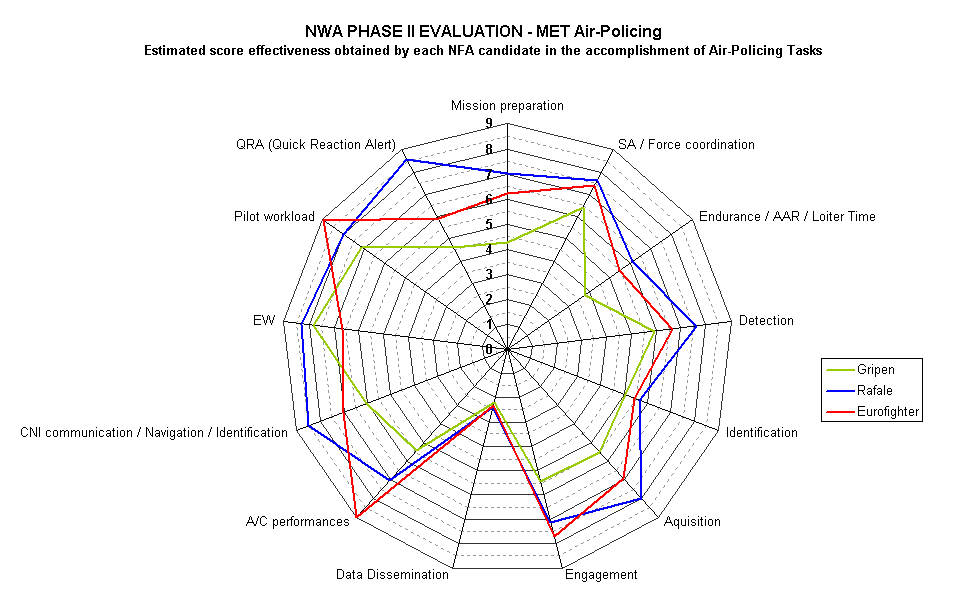
FBWWell let me reply to that with this assessment done by the Swiss. The Typhoon scored a maximum in A/C performance against a Rafale and a Gripen C which are very well known for their massive STR and ITR.
The evaluation was not a “turn contest”. The performance was based on DCA/OCA missions. For instance, the Gripen scored poorly on a interception mission profile. Climb rate, cruise speed/distance, acceleration at altitude, etc. All figured into scores.
Well that’s just the point, even when you reduce fuel load to 50% (25% fuel fraction), the Su-35 is still 34% higher in wing loading than the Typhoon with full fuel (32% fuel fraction). The you have the TWR, where the Typhoon conservatively sits at 1.15 and I say conservatively because the engine rating is ‘>90kN’ and BAE rate the TWR at 1.2.
That is because the EJ2000 is rated at 20,250 lbs of thrust, that is slightly greater than 90kN.
That’s again higher than the Su-35 on half fuel. So even at equal fuel fraction the Typhoon is still way ahead. I’m also pretty sure people haven’t moved to delta canards for a laugh. There are advantages there even if they’re not good for RCS reduction.
What type of delta canard layout? The Typhoon’s long arm canard/delta planform has a different function than the close coupled deltas of the Rafale and Gripen (their close coupled delta canard planform serves to increase lift at high aoa and reduce transonic drag).
Now Cd0 dominates in cruise but at higher g loads the latter term dominates and Cl is inversely proportional to wing area for a given lift requirement.
Effective wing area at increased g and angle of attack is not as simple as comparing nominal wing area. Lift coefficient at increased bank angle and aoa cannot be predicted by simply comparing wing area. Vortex generation, flow separation characteristics are not easy to predict.
Hell no, small wing area is not desirable for STR. See F-104 for details.Apples to oranges. F-16 was designed with a CoP ahead of the CoG, F-15 was not. You’ve also got LERX vs non-LERX.
Oversimplification, the F-104 was a tube with wings, again blended wing and body designs have significant (and increasing proportion of) body lift as bank angle increases. As you point out LERX vs. non- LERX wings do not perform the same. The LERX will give high Cl and higher Cl max.
Wow, love to see you prove an F-16 can out-climb a Typhoon, this will be funny. Flug-revue, 1999, Wolfgang Schirdewahn, the Germany test-pilot:”The climbing ability of EF-2000 with 4 BVRAAM and 2 WVRAAM is about 25% better than the F-16 with 2 WVRAAM.”
Up to what altitude? what model of F-16 were they comparing, MLU? That would not be surprising. The Typhoon can definitely out climb the F-16, but 25% better than what? What is he comparing? Initial climb rate, time to climb to a given altitude?
You’re making a large number of generalizations that don’t even answer what andraxxus was pointing out.
FBWGood NASA article on the origins of x-31 from Herbst’s ideas on supermanuverability. He also worked early on in the EAP (some of the design was worked into the x-31)
https://www.nasa.gov/sites/default/files/files/Flying_Beyond_the_Stall.pdf
FBWThe term supermanuverability came from F-22 and Su-37/30 MKI.
And is a by-product of the TVC installed. If we exclude experimental jets.
Read the post above yours, term was used by Herbst of M.B.B. 10+ years before either flew. It does not require TVC, the Su-27/F-18/Mig-29 exhibited the type of post-stall controllability and nose pointing Herbst postulated in his paper written in 1980.
FBWSupermanuverability was the term used by Herbst to describe the post stall, side slipping agility he began to write about in the late 70’s and early 80’s. (He is credited with coining the term).
The USAF both used the term in studies from the late 1980’s, 90’s, researching post-stall maneuvers.
FBWRussians are bombing all fractions fighting against Syrian regime.. as they are mandated..
Are they fighting all decimals too?
FBWIt’s time to bomb Washington. And of course apologize
Thanks, but I’d like humanity to survive, at least until all the new “Star Wars” trilogy is completed.
This forum has been overrun with crazies as of late.
FBW, as if the forum needed more,
rafale is in service, bombing muslims as we speak, unlike f-22 and unlike f-35.
the delta wing is inherently lower rcs, and the canted pylons on F-18E exacerbate not only the rotten aerodynamics,
but also frontal rcs
Better tell centcom that those F-22 missions never happened. Delta has an inherently lower RCS than what? Obligatory making things up again, more predictable than sunrise.
FBWHanche posted another article on kampflybloggen on the F-35.
Usual suspects can withhold the commentaries on “told to say nice things”, ect. It’s an informative read for those who are interested.


 Sign In