Mike
In the early 60s the fuselage of FAA Martlet JV348 was in the grounds of a Civil Defence training establishment near Portsmouth. I never saw it but have seen published photos of it. IIRC, the airframe disappeared and its final fate was uncertain – some reports claiming it was burnt in 1963. It’s not beyond the bounds of possibility that it was removed, perhaps to a scrappy? This is pure speculation, but you never know!
Tim
See previous thread. (In post #22 I provided a link to the details of the original which is held UNRESTORED by NASM).
http://forum.keypublishing.co.uk/showthread.php?t=93013&highlight=Horten
The NASM link has changes but details of the original artefact can be seen at:
http://www.nasm.si.edu/collections/artifact.cfm?id=A19600324000
Tim
What an excellent post Kenneth. Thank you for putting the situation into context.
Hamble
See attached background details: http://www.hamblelocalhistory.hampshire.org.uk/Airfield.htm
Also second diagram: http://daveg4otu.tripod.com/airfields/ham.html
Tim
Red Bull operate a DC-6 not a DC-7.;)
Tim
Chris
When I photographed that Aeronavale Lancaster hulk in 1969 I was accompanied by folk who had witnessed it in more complete state in earlier years and advised me of its identity from their records. I have since obtained a b&w print depicting the same machine taken earlier in the 1960s also of the port side side. The aircraft was then substantially complete and unit codes are visible on the fuselage, but the tail plane and vertical tail surfaces are already missing so I can’t confirm the individual identity I was given.
Tim
Send me a PM and I’ll pass your request on to Mark. He and his father have an exhaustive historical file about their aircraft with many photos of the machine in its various guises.
Tim
Chris
If you check your emails you’ll now find a response from Mark.
Tim
I think you’ll find that everyone has rather more important things on their mind at present.
For details see previous thread: http://forum.keypublishing.co.uk/showthread.php?t=96107
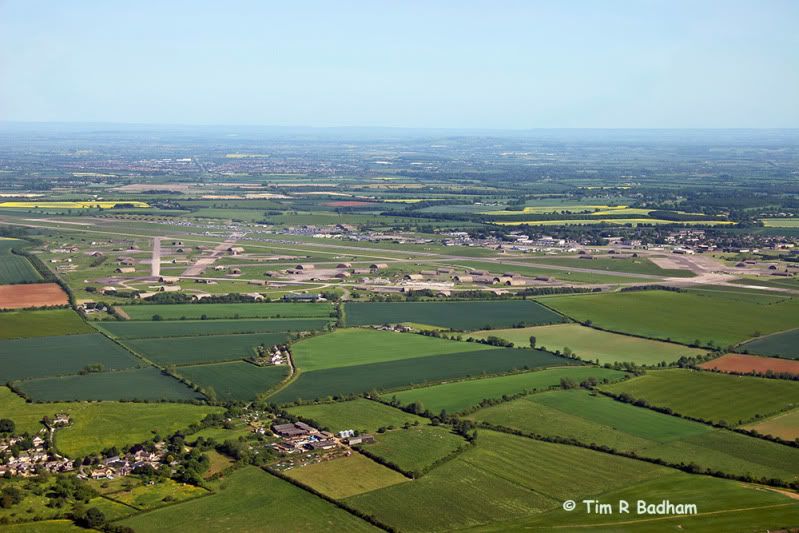
Here’s a view I took of UH in May last year, when we cruised passed it while travelling down to Oxford in the Rapide to run pleasure flights. It wasn’t until I flew over the base that I recognised quite how many hardened shelters had been built there.
Tim
AACF Volunteer

“………….Left to its own devices a B-29’s nosewheel will remain on the ground, resulting in the mains levitating first, especially if 25º flaps is used instead of the normal 15º. ……….”
“………….The aircraft has more of a tendency to land nosewheel first with full flaps and in fact, the first landing at Harlingen occurred this way. We used to do our short field landings this way with the C-97s, touching down precisely where we desired, although the USAF certainly viewed it with a jaundiced eye. With 25O of flaps as normally used in a crosswind it’s fairly easy to strike the tailskid bumper. Any scrape marks on this heavy iron forging requires a round of beer for the crew! Threshold speed varies with weight but a good average is 120 MPH. Some like to use two hands for landing, relying on the engineer to promptly set the manifold pressure called for by the pilot. Others prefer controlling the throttles themselves. The really important thing is to make the airplane assume the attitude the pilot wants for landing, regardless of the control forces required. A moderate amount of elevator trim applied prior to the roundout is helpful. ……….”
The above quotes are extracted from a report about flying B-29 FIFI and also makes the above reference to landing C-97s (military equivalent of the Stratocruiser) nose wheel first.
See: http://www.warmkessel.com/jr/flying/td/jd/56a.jsp
Hope this helps
Tim

………There is only one surviving complete ex RAF Venom, WR539, and it is in a hell of a state. I propose to use a swiss pod in its restoration; duly modified completely to RAF standards.Bruce
IIRC, WR539 was “preserved” as a base guard at Kai Tak and shipped back to the UK but deteriorated further because it was sent as deck cargo. It was at one time stored dismantled in a hangar at Cosford, it also spent time with the now defunct museum at Cardiff / Rhoose – though when I photographed it there it was still dismantled. It’s survival has been jeopardised by a lack of care over many years. Nice to hear it may be a phoenix from the ashes so to speak, even if as a composite.
I’m glad you like the AACF Venom in Peter’s shot. I had the pleasure of doing an air-to-air shoot with “our” other Venom last year – she looks great high in the blue yonder.
Tim
AACF Volunteer
An A-A I took off the US coast many years back.
Tim

vultee35
Model?