 Mondariz
There is something about the Potez 75.
Built in 1956 as a “tank buster” it might be the French uncle of the A-10 (the kind of uncle who is never invited around for dinner).
Whats with the open cockpit?
It seems that designers once thought pilots did their job better when exposed to wind and rain. The Potez 75 is not the only “late” open cockpit design. Why is it that AFTER the enclosed cockpit was “invented”, some designers reverted to the open cockpits?

MondarizExcellent to see the Bartini, although on a technicality its an Ekranolyot, not an ekranoplan! (it can fly outside the ground effect)
As for my own unusual a/c how about:
Lala-1, testbed for the engine/layout for the M-15 Belphegor (An-2 with the tail lopped off!)
or
An-2E, antoher ekranoplan (and another An-2 ‘Type’)
I would have suggested the Bugatti 100, but thats pre war and due to the invasion of france it unfortunately never got a chance to fly
Damn! i love the Bugatti 100.
Adding to the value, is the shed-like workshop. Like if to say ” I’m building this kind of fast fighter aircraft out the back, care to see it?”
Never seen it before and NEED to read more about it.
MondarizThis aircraft might not be an unusual design, but its not very well known (does that count as unusual?).
Its the kinda jet that makes me scream “I’m having one!”
Someone over at Skyfox Corporation thought it would be cool to “hotrod” a T-33, since there were so many around. Unfortunatly no one else found the idea
appealing, even when Boeing took charge.
The Skyfox Corporation/Boeing Skyfox.
http://en.wikipedia.org/wiki/Boeing_Skyfox
MondarizThat Bartini VVA-14 looks like something out of “Thunderbirds Are Go”.
The Waitomo PL-11 Airtruck gets my vote
Thats just wrong 😮
MondarizA design that was born during WW2 but only came into use afterwards (in very limited numbers) was the Budd RB-1 Conestoga. It was built from steel, not aluminum, and must have been one of the first transport aircraft with a rear loading ramp. And did Freddie Laker get the idea for the Carvair cockpit from the RB-1 ? . There is a short article and photo at http://www.microworks.net/pacific/aviation/rb_conestoga.htm
Being a total computer buffoon I not sure the linking bit will work, could someone oblige if it doesn’t, please?
The link worked fine 🙂
Seemes it could be compared to the C-47 and although built of stainless stell only rang in at 2000 lbs more (20.156 vs 18.135). It was still able to life about twice the load of a C-47.
MondarizI love the Seabee, there is a beautiful example at an airfield near my home.
But I’m not sure if I’d call it “unusual”. 😀
Its configuration is no less strange than a host of other single engine seaplane/amphibians. And perhaps less so than the Colonial Skimmer/Lake family of amphibs. where the engine is mounted on a plyon.For military designs, the U.S. VTOL fighters were odd…the tail sitting turboprops from Convair and Lockheed, and the sleek looking pure jet Ryan.
And the XF-85 Goblin parasite fighter….what were they thinking? The design was compromised to fit into a B-36 so the eventual aircraft would not have been a worthwhile fighter.
For civilian aircraft, the Custer “Channel Wing”, which looked like an Aero Commander twin with a “U” shaped wing section for pusher prop clearance.
The Seabee is a beautiful aircraft, but since there are few seaplanes around theses days, i still find it unusual :p
The Custer “Channel Wing” is surely a very unusual aircraft. Thinking outside the box and producing a fine new concept. It might look strange, but accorcing to reports it flew like nothing else. This aircraft deservers a place of honour in the collection. NASA are still conducting tests on the “channel wing” concept and it might yet have a place in aviation.

MondarizThe Bartini is right out of science fiction. What a great looking aircraft, but what a sorry state its in. A shame nobody has the money to keep such unique aircraft in museum condition.
MondarizNice Bi-mono thingy.
Here is an example of a design department getting too many specifications and wanting to meet all.
I hope i don’t step on too many delicate British toes, by including this 😉
The very cockpit-like Short Seamew.

MondarizThe owner of the site mentioned above just send me this collage.
For more information, you might want to track down those books.
BTW i can’t take credit for the answer. I simply forwarded the picture to the above owner.
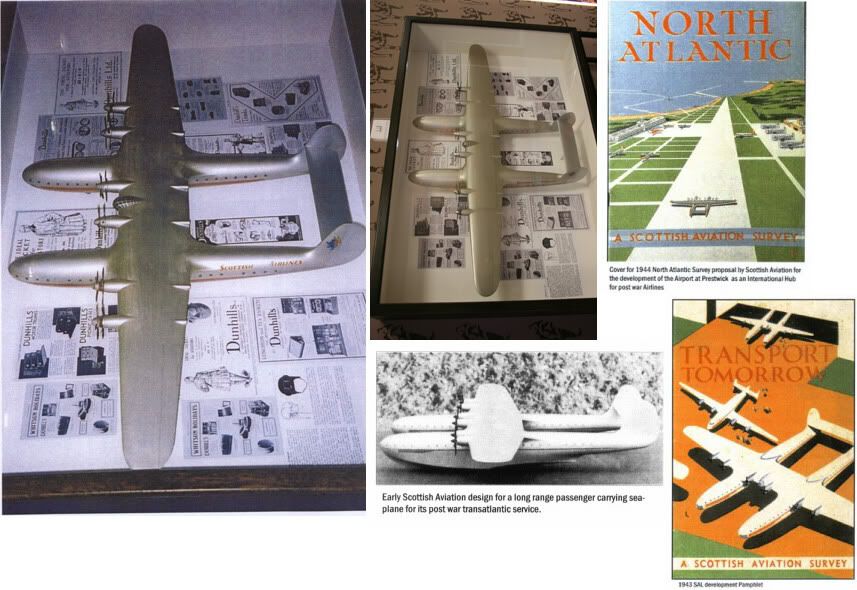
MondarizA very rare bird you found there.
Its a Scottish Aviation Transatlantic Airliner (160 passenger).
I found a quote about it:
“With a view to expanding the Company’s manufacturing capability David McIntyre in 1942, recruited a Chief Designer from Hawker Aircraft, Robert McIntyre (only latterly discovered to be related three generations past) to lead a new design team and establish an approved Aircraft Design office at Prestwick. One of the early designs to make an appearance was a twin fuselage six engined aircraft, which could operate either as a landplane or seaplane. It was designed to carry 160 passengers with a maximum take off weight of 300,000 lbs and was planned for the post war Scottish Airlines North Atlantic air route…”
For a time it seemed that aircraft designers were possessed by the idea of twin hull birds. Unfortunatly very few ever got of the drawing board. I for one, would have loved to see all those huge 6 to 16 engined multi-frame aircraft.
Here is a great site about those off-beat designs:
http://cmeunier.chez-alice.fr/index.htm
I have been told, thats there are some information in Flypast December 2007 page 122.
MondarizThere is no way this item was an aircraft canopy, or part of one.
The craftmanship and construction is way below standard.
A caravan or something. Maybe air field related, but not a flyer.
MondarizNo,not yet. Thought I would see what respones I got first and if full certification was needed I would not bother them before I had that under my belt. Cliff Spinks told me to contact ARCo,I might do that too,I need a career change and why not try to use my skills for something I have loved since age 5… “Might” come in handy later on with my project… (read: longterm,if we even find the thing(s) so we have a project going :p .)
if you are a good sheet metal worker, and able to produce one-of items to high tolerances, you should have no problems finding interest.
Although it might be easier, if you had some actual aircraft expirence, like maybe joining a volunteer restoration group.
MondarizYou are right, there seems to be more commonality between the motor racing industry and the skill sets required in traditional aircraft manufacture, required for later day restorations.
I started out as a Formula One engine builder, where working to high accuracy on small batches was common place. Practically everything was hand made, and hand assembled. Replace “wood composites” with “carbon composites”, and there you have your similarities! I managed to get this job, because of previous experience at my local airfield working with, and learning from the older types (aircraft and people) 😀
Today overhaul shops are generally not allowed to fabricate “complex” structure parts. Anything with more than two bends is a spare part.
When no spare parts are available, its often solved by combining simple fabricated parts, to replace the “complex” part.
Although there are still places where sheet metal workers learn (and use) the good old tools and skills.
The best metal workers (bending, shaping, reforming and detail work) is unlikely to work in the aviation industry. They might learn it, but very few are able to keep it up.
It is not fast enough, and the production companies want to control the quality of complex parts. In GA they might be less strict.
MondarizSo knowing how to do sheet metal work (I have been working as a custom/race car builder/fabricator…shaped just about anything from scratch…done mostly aluminium shaping) and worked extensivly on engines ( I’m currenty working as a full-time race engine builder in my own shop) I can build/restore just about anything as long as I have a certified technician signing it off? 🙂
I personally know sheet metal workers, who have gone from aircraft to the racing industry, so the kinda skill (the one-of fabrication) you need is close or identical.
Since alot of restoration is metal work, my guess is that you would be in high demand. Aluminium shaping is a skill thats slowly dissapearing from the aviation buisiness, and ANY warbird project needs people who can do that.
have you tried talking to any of the companies?
MondarizI only know people involved with keeping a DC-3 (to me thats a C-47).
The team that restored it, was a mixture of aircraft mechanics, sheet metal workers, pilots and a few other trades.
I assume that anyone working full-time with aircraft resturation, would need a part 66 aml. Otherwise no one can sign of the work.
But since some of them are classified as experimental/homebuild (this also goes for the UK i think), it might different rules.
My bet is, that the companies employ people by word-of-mouth. Any good craftman within the fields (mechanical, electrical, structure and avionics) would be a boon, provided that he/she is more traditionally skilled.


 Sign In







