Fedaykin
It’s a shame the UK is ditching Tornadoes that could be leased or sold off to Iraq. Preparing them for Iraqi service would save some jobs and put some jingle in peoples pockets. And the F.3 is still plenty viable against intrusions from their neighbors.
Expensive to operate, unique, designed for a role not required by Iraq (bomber intercept over water) and most importantly not many fatigue index points left on remaining airframes.
If they wanted second hand there are plenty of better choices from Mirage F1 to F16 and Gripen.
I personally think they would be far better served with a purchase of new build F16. Their airforce training model is based on US practice the F16 is a logical progression.
FedaykinPrince Harry to fly the Apache … We shall see!
Amusing report from the Times:
http://www.timesonline.co.uk/tol/news/uk/article7113309.ece
As we know Prince Harry has been training to fly AAC helicopters and will qualify soon. Report suggests he could be offered a place in the Apache.
Slight over simplification, he could be offered training in the Apache but that doesn’t mean he can handle the thing. Many a very capable AAC pilot has washed out of the Apache conversion course because they can’t handle the multi tasking required by this type or fly the bag. Edd Macy’s book has some interesting points about that.
So maybe he gets a chance at the Apache but he has publicly stated that he likes the Lynx.
FedaykinOn a note on this piece – I know its likely that the Russians will pick this up, but I wonder what the Indian Navy would think to the Lynx.
I would think AugustaWestland would offer AW159 Lynx Wildcat.
FedaykinQuoted posting deleted by moderator
Because Wanshan is a respected poster who up until you kicking off was having a reasoned debate with other forum members over the different scenarios that could of led up to the destruction of the corvette. At no point did he show any disrespect to the sailors on the corvette and for you to suggest so is rather offensive.
FedaykinActually its ol’Kimmy who doesn’t take YOU seriously. He and his dad have been screwing around with us since the end of the Korean War and we have done nothing.
I suggest you look at a map…
Seoul with a population of over 10.3 million and several other major South Korean population centres are within artillary range of the DMZ and North Korea. North Korea has about 500 pieces of tube artillery and over 200 MRL’s pointed just at Seoul according to OPLAN 5027:
http://www.globalsecurity.org/military/ops/oplan-5027-1.htm
Whilst North Korea’s millitary is obsolete in comparison to the Souths and Americas it is numerous and maintained fairly well. Any escalation would lead to an utter civilian bloodbath in the South so its fairly understandable why America and South Korea hasn’t done much in these situations.
FedaykinAs usual, the rich acquiring expensive toys and the poor shopping cheaper.
France Competes With Cheap Chinese Crap
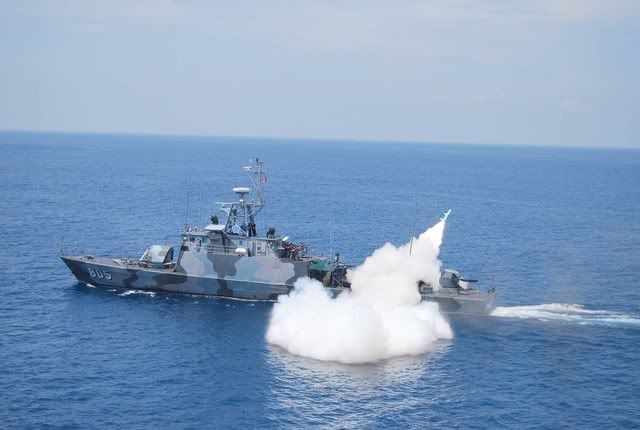
Qatar is buying new, jet propelled, Exocet anti-ship missiles, to replace the older, rocket propelled, models. The new missiles will be installed on some of the seven Qatari fast attack boats (which also have either 76mm cannon or 30mm machine-guns). The new Exocet MM Block 3 have twice the range (180 kilometers) because of their turbojet engine.
The new Exocet is partly a response to competition from China. Recently, for example, Indonesia chose cheaper, and longer range, Chinese C802A anti-ship missiles over the rocket propelled Exocet. The C802A is a 6.8m (21 foot) long, 360mm diameter, 682kg (1,500 pound) missile, with a 165kg (360 pound) warhead. The C802 has a max range of 120 kilometers, and moves along at about 250 meters a second.
The French Exocet missile is the same size and performance, but costs twice as much (over a million dollars each, but the manufacturer is known to be flexible on pricing.)
Well a rather strange statement to make about the C802, as far as I am aware it is anything but crappy!
Then I clicked on the link and realised it was an opinion piece by the Tabloid newspaper of defence websites “Strategy Page”…really Tango III usually you submit reasoned reports from respect websites not the trash they usually produce!
FedaykinWell the article is non specific about the RFP and states some of the engines they have requested details so I would assume Eurojet has been asked. In the end the EJ200 does fit into the power class they are interested in.
It is clear that the engine is across between a stop gap and back up for an indiginous engine which is already in development. Whilst the RFP includes the Kaveri it is highly unlikely that it would win the contract, in the end an engine in current series production with proven reliability is the most logical choice. That means F404, RM12, M88 or EJ200. Anything else is illogical and for that matter I would think the RM12 would get counted out fairly quickly as I bet GE can probably offer a better deal with a variant if the F404 IN-20 which fits nicely into their thrust requirements.
Remember the main reason the Tejas project is moving forward now is the decision to decouple the engine development from the airframe and go for a foreign engine. I can’t see Japan taking the risk on what has been an underperforming engine with a lot of development ahead before it can be accepted into service.
Interesting to note the Japanese test photos show a three paddle thrust vectoring system similar to that fitted to the X-31. Considering the X-31 used a F404 variant its an interesting decision.
FedaykinVery interesting — so this basically seem to indicate that the Japanese are still considering to develop their own VLO fighter? But why then the interest in F-35?
A stop gap until they have a stealthy twin engine replacement for the F15.
FedaykinI dont think the latest design has them. Check out the videos on the RN websit.
http://www.royalnavy.mod.uk/operations-and-support/surface-fleet/future-ships/queen-elizabeth-class/
Voodoo, nice to chat:)
Well that would be problematic as to safely take off they would have to do it from the back of the ship and run the whole deck before hitting the Ski Jump. Any crewmen wouldn’t be able to operate behind the F35 prior to takeoff and further F35 would have to wait to one side.
Not having JBD would seriously hinder deck operations so it would be a rather foolish cost saving to omit them.
FedaykinGrim901 :
Yes , there is another alternative : Europe should build 5 similar Carriers , 1 for France , 2 for the UK , 1 for Spain and 1 for Italy . Then we all go with 2 different aircraft : Rafale and “Seaphoon” . The UK and Italy with Seaphoon , France and Spain with Rafale .
What have the technology and the money , only the will is lacking unfortunately .True , RN ‘s mistake and a critical one . They were just too shy and too conservative . I blame the RN .
Cheers .
I must admit you are highly opinionated but light in knowledge Bluewings, that I find myself agreeing with Pfcem somebody I usually lock horns with should tell you something.
To pick up your points whilst the RN does have a CATOBAR option it has wisely decided to stick with what it knows at this point and explore other options in the future, in the end the the F35B offers a significant performance advantage over the Harrier GR7/9 and Sea Harrier FA2. For the Royal navy which is fighting a serious battle with the Army and Air force just to retain a carrier capability its a bit strong to blame them for going down the STOVL route when they had good reason to do it. As for Italy and Spain I have posted two pictures which should give you the strong and clear reason why they have to go down the STOVL route:


Both these nations have now built new carriers that can only operate STOVL types, to go ahead and build CATOBAR carriers now would be insane. The AV8B is now out of production and the F35B as I have said for the UK will offer superior performance. Considering that the very limited Sea Harrier FRS1 has proven itself to be effective in real combat the F35B should prove itself more then acceptable to the UK RN, USMC, Italian and Spanish navies.
I have posted a link to the excellent Navy Matters website and its section on the CVF class so you can do some proper reading on the subject before you put fingers to keyboard my old boy.
FedaykinWhat I’m curious about is who will make the Jet Blast deflectors for the QE class? In the UK Mctaggart Scott would probably be a logical choice or will they be purchased from America or France?
I did find this rather interesting patent filed a few years back by Mctaggart Scott:
http://www.freepatentsonline.com/6802477.pdf
Notice the jet eflux is channeled into a tunnel under the deck.
FedaykinI have a hunch that if CVA01 had entered service the Ikara and Sea Dart mounts would of been deleted during its mid life refit anyway and the flight deck extended aft.
FedaykinJust a detail about Ja Worsley post: S80 is not a joint venture between French DCN and Spanish Navantia but just a Spanish project (with a lot of components coming from the US, the UK, Germany and Italy, but not a single one from France)
Apart of that, Spanish Armada decided to purchase a Lockheed Martin combat system after the successful acquisition of Lockheed’s Aegis for the F100 frigates. And this could be quite attractive for the RAN, as it was in the purchase of its new AWD and also because the S80’s combat system is based on that of the US Navy’s Virginia SSN class.
Probably Australia would like to build their own submarines, and would need bigger ships in order to patrol for longer periods. It was told in Spain some years ago that after the first four S80 were built there was the possibility of building an enlarged version (S90), with VLS for Tomahawks, but since the economic crisis arrived even a second purchase of just 2 S80 is in serious doubt.
Well the S90 sounds close to what I was suggesting, sounds ideal.
The CMS from Lock Mart already in use on the Virginia class makes it highly attractive after the trouble with the CMS in the Collins class. In effect America is locked into supporting and developing that CMS for years to come.
An S90-Aus … has a ring to it!
FedaykinNuclear power certainly makes sense for a country which likes to operate ocean going subs like Australia but I think there are too many barriers to it happening. I would think public opinion would be massively against it and whilst as you say personel have exchanged with the RN and USN it would still be a massively complicated and expensive process to set up the facilities and train personel. That is a serious issue for a nation which already has trouble crewing and maintaining the subs it has.
Also I would hardly say that India’s or Brazil’s nuclear sub programs are glowing examples of inducting the technology into service, both have been going on for decades and only with major outside help. Whilst the US, UK and France would probably be more then happy to sell the technology it would still be a prohibative cost, so much so it would probably be better to buy a variant of the Asture, Virginia or Barracuda straight off the shelf which I bet won’t go down well with the voting public of Australia (loss of jobs etc).
The earlier Navantia S-80A class might be a better bet in my opinion. It is already a stretch over the Scorpene, has an effective MTU engine installation and AIP. The CMS is American and its compatable with Tomahawk. Your country is already building a working naval relationship with Spain and as the linked document about the project below states the Spanish are rather pragmatic about the development noting the Collins class and stating that if they don’t feel confident in a technology area they get in somebody who can for example Bae Systems Barrow for the complex bow and stern dome. I would think a super stretch variant of the S-80 might go down very well. A stretch variant would allow more space for AIP propellant or cells and even VLS for stand off cruise missiles.
FedaykinYes I was going to say the same thing…”Cold fusion reactor?”
Nobody in serious scientific circles will even touch the concept of cold fusion for fear of destroying their reputation and career. Regular fusion barely works now and thats with huge reactors (not that I am against research into fusion technology).
I was wondering if you meant a regular fission reactor with natual convection cooling. Anyway if you guys went for nuclear they would have to buy pretty much off the shelf with either an American S9G, British PWR2 or French K15. Tea Kettle reactors your talking Russian and I doubt Australia would look in that direction. Considering Australia has no experiance operating nuclear subs it would be a problematic choice and I bet there would be a public backlash.
So its AIP in some form I think, certainly the Japanese Soryu class shows that you can put together a large conventional submarine with AIP.


 Sign In