 Fedaykin
The Spanish F1M would be a significant improvement for the Argentine airforce. The airframes have already had an avionics update and there are several upgrades available. Problem is Argentine airforce doesn’t want second hand.
FedaykinJust for interesting reference here is the FlightRadar track of PK709 as it was escorted into Stanstead by Typhoon:

FedaykinSomebody has suggested the “Land light infantry/special forces secretly” option before and it doesn’t stand up to scrutiny.
To land a number of infantry large enough to overwhelm the Garrison and the FIDF secretly from civilian boats without being noticed is virtually impossible. Whilst the Islands are sparsely populated they are not unpopulated! It would take time to build up that infantry force and they would have to stay hidden or the game is up, they would have minimal food and water, no back up, no heavy equipment and no air cover. How do they get from wherever they land to MPA and Stanley? Do they walk? FIDF and the Garrison with air cover would eat them up. Drive? That’s heavy equipment which has to be got there in the first place and supported, anything driving down the roads would be rapidly destroyed. Helicopters? No air cover!
So back to walking! They have to traverse the Islands without being noticed and then take on an entrenched Garrison that has better local knowledge and air cover. Those Argentine troops would be noticed. The Garrison and FIDF would get to work on them and a few hours later the first reinforcements from the UK arrive on the C17.
It is an absurd idea!
To be honest if I was Argentine soldier I would be more scared of the FIDF!
FedaykinRevisionism is a curious thing DragonMaster, it very much depends on the eye of the beholder. To your eye what France was asking is totally fair, there is plenty of evidence that the nations that eventually went forward with Typhoon disagree with that assessment. France wanted program control and a share beyond what the other partner nations felt was fair. That you think otherwise does not matter one iota when stacked up against the open statements made by those involved from the UK, Germany, Italy and Spain. France made its demands the other nations didn’t agree as they felt it was unreasonable, France pulled out.
For example I don’t agree with your opinion that the Rafale development plan leaves the competition behind, that is my opinion. As I said I have learnt some very interesting things but I don’t agree with all aspects of your assessment.
FedaykinVery interesting DragonMaster I learnt a feww things I didn’t know. I only disagree with one point really:
Dassault did not ask for “wholly unrealistic level of work share”, here is what they said about it: Commenting on why Dassault wanted a majority share of EFA, Robins says: “What
we wanted was a share of the programme proportional to the amount of aircraft to be bought. We didn’t want a larger share just for the sake of having a larger share.”
That might be how France saw it but for the other partners what they wanted was wholly unrealistic. France wanted to be the program lead and an majority share of the build, that just wasn’t acceptable.
FedaykinArgentina had significant outside help developing the IA-63 Pampa. Dornier helped with the design hence the similarities with the Alpha Jet and Garrett provided the engine. The domestic Argentine aerospace industry is in no place design a high end jet fighter.
There are a number of barriers as it stands to Argentine fighter procurement:
1) Argentine government shows no desire to release the desired funds.
2) Considering the second default Argentina is not going to be able to get credit to purchase a Western or Russian fighter.
3) Even if they did their international creditors would most certainly try and confiscate those aircraft.
4) Argentine Airforce does not want second hand aircraft.
5) Argentine Airforce is highly reluctant to purchase anything but a Western fighter.
China might give credit for a purchase but I presume only for significant mineral and trade rights. Argentine Airforce would have to be forced to accept a Chinese fighter.
AS it stands the Fightinghawk will be their fast jet mainstay for the foreseeable future.
FedaykinArgentina had significant outside help developing the IA-63 Pampa. Dornier helped with the design hence the similarities with the Alpha Jet and Garrett provided the engine. The domestic Argentine aerospace industry is in no place design a high end jet fighter.
There are a number of barriers as it stands to Argentine fighter procurement:
1) Argentine government shows no desire to release the desired funds.
2) Considering the second default Argentina is not going to be able to get credit to purchase a Western or Russian fighter.
3) Even if they did their international creditors would most certainly try and confiscate those aircraft.
4) Argentine Airforce does not want second hand aircraft.
5) Argentine Airforce is highly reluctant to purchase anything but a Western fighter.
China might give credit for a purchase but I presume only for significant mineral and trade rights. Argentine Airforce would have to be forced to accept a Chinese fighter.
AS it stands the Fightinghawk will be their fast jet mainstay for the foreseeable future.
FedaykinHmmmm rugged landing gear, austere field capability and a large cargo door could make it attractive to the aeromed industry.
FedaykinNo it was obligatory but I am still getting used to the new quote functionality.
FedaykinAs I have said already but you have curiously decided to ignore two squadrons of B-52G were tasked with maritime strike up to 1989 with Harpoon and another six were tasked with maritime reconnaissance as a secondary role. In both cases the B-52 used its AN/APQ-166 radar as its primary sensor which would need a surface search mode to perform those tasks.
The B-52H still using the AN/APQ-166 has a secondary maritime strike role according to the USAF in support of the USN with other precision munitions like JDAM. The idea back in the day was the B-52G would in the event of full on conventional war against the Warsaw Pact would race out onto the Atlantic or Pacific at low level and fire off a barrage of Harpoon at whatever they could find. Platforms like P-3,other B-52 in the maritime search role, Carriers with their S-3, Submarines, other surface combatants and Satellites would of provided the kill box and the B-52 would fire into it using their own radar to provide the final targeting information or just blind relying on those other sensor feeds.
Attrition was expected certainly but the NATO plan for a conventional war in Europe involved a sanitised corridor rather then convoys to be created across the Atlantic allowing reinforcements carried by Ro-Ro and container ships to race across. Using the B-52 as an ASUW platform was about creating that sanitised corridor.
FedaykinThe UK probably would of been receptive to a carrier variant Rii but that wasn’t really the problem. France wanted a wholly unrealistic level of work share, they wanted to lead the program and have final assembly of a disproportionate amount of systems including complete aircraft. If France had been open to a more reasonable amount of work-share then they probably would of stayed on-board. Also at that very early stage of the program the Aeronavale wasn’t interested in a domestic replacement for the Crusader that was forced on them later by the French government. Their prefered choice was the F/A-18 Hornet which was even had approach trials with one of Frances Clemenceau class carriers:
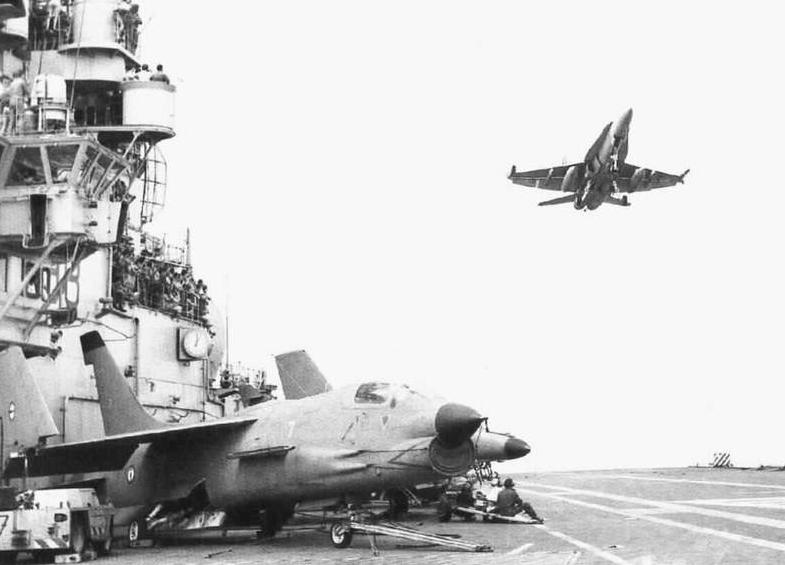
The major sticking point leading to France pulling out was not the lack of desire for a carrier variant by the other nations but over unreasonable work-share demands.
FedaykinUp until 1989 there were two squadron of B-52G tasked in the dedicated ASUW role with Harpoon. Six squadrons of B-52G were tasked with a secondary role of maritime surveillance and mining:

FedaykinAmen!
FedaykinWhat?!
I Ruined this thread by focusing on Typhoon?! It was Blackarcher who first mentioned Typhoon in post #11 followed by YOU in post #20:
palembang
Registered User
Join Date
Apr 2013
Posts
54
Originally Posted by Y-20 Bacon
didn’t you also write that the jf-17 could beat the su-30mki once it got aesa and long range missiles?
i dont know if jf17 can get aesa but j10b can take on su30mki.
j10b is like euroopean typhoon but more advance because it has aesa radar first and many hard points and good range.
j10b with aesa may not come in service as fast as rafael but rafael aesa is limited because the nose is so small and the airplane does not have enough thrust.
j10b in paf can take on everything in indian af. but when pakfa come out paf need j31 for sure.
YOU made a series of unsubstantiated claims based on ONE picture! EELightning asked YOU to substantiate what you were saying! I AM ASKING THE SAME! I posted a reasoned post about future PAF procurement it is YOU with your unsubstantiated claims based on a single picture that are disrupting the forum. I am not posting links about the systems in the Typhoon as:
a) That is not the subject of this thread.
B) The information is well known and public domain, in other words Google it yourself!
FedaykinSo you freely admit that after all your bluster that you have ZERO evidence for what you are claiming in respect of J-10B performance.
Secondly the Typhoon roadmap is clearly reported, what is being integrated is in the public domain and we have actual information about that technology. We know next to nothing about J-10B development. We have to pretty much base all our assumptions on what pictures are posted on Chinese blogs. The European countries buying Typhoon are not trying to stop that procurement, they are trying to reduce the number purchased. Reducing the number purchased is not due to performance shortfalls, it is because of budget reduction in those countries.
Finally you directly mentioned DSI is your previous post so don’t lie you cretin.


 Sign In







