 MiG-23MLD
Which has NOTHING to do with sustained turn rate.
Actually sustained turn rate can be worst with low sweep wings at high subsonic to supersonic speeds due to the higher form and wave drag of the low sweep wing.
And how many times you are told that you are wrong, eh?
How many times do I have to tell you that canards, by virtue of being variable, can maintain vortice lamination at a much wider range of angles and at higher angles of attack than fixed, non movable LERX?
You must be a complete idiot to ignore this.
You seem to ignore your own evidence that the Gripen is nearly as fast as the MiG-29 despite a much lower TWR in sustained turn rates.
That is complete BS.
For main wing to be affected, the canard downwash must flow under the main wing, which is not possible in a biplane configuration.
However, canards offer typically a larger lift surface that can be variably controlled and trimmed in angle. LERXes cannot.
You have no evidence that the MiG-29 has better sustained rates than the Eurocanards and evidence proves otherwise. Flaps actually add to drag, which lowers potential sustained turn rate. Fuselage wing blending absolutely has nothing to do with it. Wing sweep does not have anything to do with sustained turn rate.
You keep confusing sustained turn rate with tighter turning. All the things you mention contributes to a TIGHTER turn, but it does not contribute to a FASTER turn.
A plane with a tighter turn can still have an inferior sustained turn rate than a plane with a _faster_ outside turn.
Crobato
It seems you do not know that when you deflect the canards the wing losses lift due to canard downwash wake, and only they have a relatively few instants when they are increasing the total lift and that is related to the distance between the canard and the wing and the angular speed of rotation of the canard.
Also you forget a simple fact about LERXed wings, any LERXed wing has two angles of swept for example the MiG-29 has a 73/40 deg 70 for the LERX and 40 for the main wing, this gives them better lift drag ratio than what you claim
The better position for a canard during high AoA, is the high canard offset position, the low set low canard position down washes the lower surface of the wing with low preassure, consecuently reducing the wing lift, however it does not mean the high set wing when it is deflected does not generates a down wash that reduces the wing lift and total lift, canards when they are deflected they do create drag and reduce the wing`s lift
MiG-23MLDThat’s BS and you know it. Now since BAE claims otherwise, its their word against Yefim Gordon’s. One is trying to sell a plane, another is trying to sell a coffee table book.
The Su-27 is clearly better of the two Russian jets according to those that have both planes, starting with the Ukraine. It is as if you never figured out that the PLAAF had plenty of opportunity to try out the MiG-29 themselves, and it is in fact, the MiG-29 that was their original choice, since the MiG brand name was all they ever knew, and they never owned a single Sukhoi in their history.
I already told you why canard-deltas can maintain high sustained rates. Combined with instability, the high pitch authorities canards generate means less trim is needed to go around a turn, and less drag. Now you keep on going about why deltas at a high AoA has a tendency to create a high profile drag, but that is also true of lifting body jets like the Su-27 and MiG-29. The drag is simply caused by having plenty of lift area being exposed at high angles of attack. The so called energy bleed you are saying is only caused at higher angles of attack.
But you have no idea that sustained turn rate and angle of attack are not related. A plane with a low angle of attack can still maintain a high sustained turn rate by navigating through an outer wider circle faster.
Which means speed is essential for sustained turn rate.
At supersonic speeds, the advantage is more pronounced.
I quite disagree with that.
That only proves to you that the writer is a hack and a paid publicist. Nothing more.
You may have read that people also don’t like the Super Hornet’s performance (some consider it inferior to the F-18C). When the F-14 is compared to a 1970’s musclecar, even with underpowered TF-30 engines, that does not bode well for the Super Hornet in my book at least in terms of grunt.
The sustained rate of 20 degs for the Gripen in my book is quite excellent considering its low power to weight ratio. As for the Typhoon charts, note the fact that they have no commercial bias to promote the Rafale in the same charts, and yet they show it faster than most of the other aircraft in sustained turns.
And finally, lets not forget that instantaneous turn rate is probably more important for transient performance anyway. By far most BFM isn’t built around running in circles consecutively.
Crobato
Aerodynamically speaking the MiG-29 versus the Gripen has the following advantages:
Highly swept low aspect ratio wings have worse low speed handling than less swept higher aspect ratio wings such as the 40 deg wings in the MiG-29, the porpose of the canard is to create low preassure vortices that delay the formation of the main delta wing vortices and therefore the stall of the delta wing when the delta wing vortices burst and breakdown
The non coplanar high canard on the Eurofighter or J-10 allows more lift at high AoA than the coplanar canards such as those on the X-31, this allows quick turns and high instantaneous turn rates however the Gripen delta wings stall faster than the less swept wing of 40 deg due to faster flow separation and vortices formation that can burst earlier and stall the wing, this is proven by the fact the Gripen has a very good high AoA and an excellent instantaneous turn rate however the sustained turn rate proves you the MiG-29 can keep higher sustained turn rates, delta wings suffer a quick flow separation and the creation of vortices that stall the wing at high AoA, the canards do not offer more advanatages than LERXes in fact at very low AoA canards offer more drag than a tailess delta wing and the benefits of canards only appear at high AoA.
Beyond the fact canards offer a two centers of lift between the center of gravity, they do not offer more lift since the delta wing is under the down wash of the canard and this reduces the max potential lift the main delta wing can achieve due to the drag the canard imposes upon the leading edge of the delta wing.
This two centers of lift are and aid at supersonic speeds when the center of lift (aerodynamic center) shift occur, this helps the instable Gripen at Mach 2 however LERXes also give lift ahead of the center of gravity.
Therefore the LERXed MiG-29 can achieve higher sustained rates than the Eurocanards and J-10 thanks to flaps, integral layout fuselage wing blending, LERXes and a wing swept at 40 deg.
MiG-23MLDI hardly think Formin and Gordon are absolute and objective sources to start with. So their figures can be questioned. So comparing a MiG-29 at 50% fuel vs. an EF at 100% objective and correct? BSht. If you want to compare figures, compare it at the same internal fuel levels. A MiG-29 at 50% internal fuel will go bingo in no time.
And no, the Rafale is claimed to boast over 30 deg/sec instantaneous. The 24 deg/sec is actually sustained from one boast I’ve heard. I would think the Typhoon can get up over 30 deg with no problem, and I’ve heard similar rumors on the J-10 to that effect.
The Gripen has about 0.90 to 0.95 for TWR, both the Rafale and the Typhoon are at least 1.13 with full fuel load.
Su-27 is around 28 degrees instantaneous from what I understand. Same with the MiG-29 and F-16A/C. From what I understand also, based on experiences from the Ukraine, the Su-27 is overall, more maneuverable than the MiG-29.
Claiming that Su-27 and MiG-29 will have better engines in the future is another dufus argument, since the same argument can also apply to the Typhoon and Rafale. And don’t talk about EF/Rafale needing ET to match Flanker range. Flanker with full internal fuel is a flying slug and does not perform very well. Sukhoi only recommends the plane at 56% internal fuel for optimal performance. A Flanker with full fuel if caught in a dogfight, will not have any options to quickly dispose of the extra fuel unlike external tanks.
Crobato
I never said the MiG-29 was at 50% of fuel and the Eurofighter at 100% internal fuel, i said very clearly that Yefim Gordon claims the MiG-29SE at 50% of fuel and 3000 meters of altitude will have a turn rate of 23.5 deg/s and the Eurofighter at 50% of fuel and 3000 meters of altitude will have a max sustained turn rate of 22 deg/s
Clearly you want to justify the Su-27 and J-10 since both fighters are PLAAF aircraft and you can not consider the MiG-29 will be better than both aircraft because you like PLAAF aircraft.
The fact is you can buy the books even the latest editions and you will find out what i said is not part of my imagination, also you can read several articles i posted about the problems the delta wing and canard configuration has at sustained turns, canards and delta wings only have better instantaneous turn rates and this has been reported in several books.
The Eurocanards and the J-10 might have excellent instantaneous turn rates, but i doubt they will have really good sustained turn rates, i guess the J-10 might have a max sustained turn rate in the range betwen 22-20 deg/s very close to the F-16 and MiG-29 and probably it might have a 30 deg/s instantaneous turn rate, can the J-10 be better than the Flanker? probably yes it can since the Flanker has an instantaneous turn rate of 27 deg/s and it has a max sustained turn rate of 21 deg/s.
The MiG-29 is one of the best fourth generation fighters in sustained turns and in that i do not agree with the Eurofighter website that the MiG-29 is less agile than the Eurofighter and Su-27 at subsonic speeds simply because the Flanker was designed as a long range interceptor with more emphasys in BVR combat rather than dogfights, the Su-27 carries more fuel internally and relies more in AA-10s or AA-12s it is going to be difficult for a Su-27 to be light enough to be as agile a MiG-29 and several publications give you a 28 deg/s instantaneous turn rate for the MiG-29 and those number are for even the old MiG-29A.
I trust Fomin`s book simply because the guy writes also for Russian publishers and the same can be said for Gordon who has a pleatora of books published in Russia and England either in Russian or English and always has been supported by MAPO MiG or Russian publishers like Polygon.
Also you can read several webpages that claim the Super Hornet has a sustained turn rate of 18 deg/s besides the main trade off of the delta canard configuration is excellent instantaneous turn rates with regular sustained turn rates and the best example is the Gripen which has a very low 20 deg/s max sustained turn rate even it has a very high 30 deg/s instantaneous turn rate, and the J-10 or Eurofighter are not different 😉
MiG-23MLDAbout sustained turn rates. I’m trying to find any evidence about the Su-27 or MiG-29 matching that of the Typhoon or Rafale.
While this is not an objective website, it shows clues to the contrary.
http://www.eurofighter.com/et_sr_me_sb.asp
Subsonic sustained turn rate
In order:
Typhoon (of course)
Rafale
Su-27 (really close and in the heels of the Rafale)
F-18C (Surprise!)
F-15C
MiG-29, M2000, F-16C (packing up the rear)http://www.eurofighter.com/et_sr_me_su.asp
Supersonic sustained turn rate.
In order
Typhoon (obviously)
F-15C (surprise!)
Rafale
F-18C/F-16C (tie)
Su-27 (just a wee bit behind F-18C/F-16C)
MiG-29 (falling well behind of the Su-27)
M2000 (dead last)
Crobato
The figures can be true no ones denies that probably those figures are accurate but everything depends on what conditions, for example with only 50% internal fuel tank the MiG-29 is better than even the Eurofighter according to Yefim Gordon`s book; Andrei Fomin`s book says that the Su-27 has less impressive sustained turn rate than the Rafale and Eurofighter, however both authors claim the Eurofighter and Rafale have a sustained turn rate of 22 deg/s.
The best MiG-29 variant has a sustained turn rate of 23.5 deg/s, this is the MiG-29SE variant, the MiG-29M has a sustained turn rate of 22.8 deg/s this is at 3000m and with 50% of internal fuel only, the Eurofighter at the same conditions has a sustained turn rate of 22 deg/s.
Now let us see if it is probable these conditions are accurate, the Max sustained turn rate for the Gripen is merely 20 deg/s, the Su-27 has a max sustained turn rate of 21 deg/s and the MiG-29A has a Max sustained turn rate of 22 deg/s, so it is probable that both the Rafale and Eurofighter are in the range of 22 deg/s since the less powerful Gripen has the same configuration and it has almost a thrust to weight ratio of 1:1 at take off weight but barely gets to 20 deg/s way below the F-16, MiG-29 and Su-27, this has been even explained by the fact canard delta configuration bleeds energy and have the tendency of having lower sustained turn rates than the tailplane configuration
What is probable is the Instantaneous turn rate of the Eurofighter and Rafale are in the region of 28-30 deg/s since the Gripen gets a max instantaneous turn rate 30 deg/s.
The Su-27 is capable of handling up to 30 deg of AoA almost in the range of the Rafale and probably Eurofighter, If the Eurofighter website claims the MiG-29 is inferior even to the Su-27 in turn rate probably must be at max take off configuration, however the Gripen and MiG-29 as fuel is consumed get lighter and their thrust to weight ratio at combat changes in the MiG-29SE it gets to 1.52:1 and in the Gripen in the range of 1.5:1
Also the conparation between the MiG-29 and the Eurofighter can be an early MiG-29A with a Max sustained turn rate of 22 deg/s and an Instantaneous turn rate of 28 deg/s but not with newer MiG-29s that have better turn rate and i guess the MiG-29SE must have also a better Max instantaneous turn rate
However Andrei Fomin claims the Su-27 has a better instantaneous turn rate than the Rafale he claims the Rafale has an instantaneous turn rate of 24 deg/s way below the Su-27`s instantaneous turn rate of 27 deg/s and the MiG-29`s instantataneous turn rate 28 deg/s, this sounds a bit unlikely since the Gripen achieves an instantaneous turn rate of 30 deg/s unless the comparation was made under an specific condition such as altitude, speed or thrust to weight ratio
MiG-23MLDI agree with the statement in terms of speed the MiG-31 would best match the F-22. But aircombat is complex and depends on a varity of factors. Speed, altitude, supercruise, acceleration, climb performance, manoeuvrability, signatures, MMI, defensive and offensive sensors, overall SA, CM and CM resistance, weapons etc.. If you take into account all these factors the MiG-31 is unlikely to be a match for a F-22.
As mentioned above speed isn’t all and the Foxhound is not really an advanced platform. Most russian upgrades for their own fighters are relative limited to some new MFDs in the cockpit, HOTAS, improved navigation, improved (but not new) radar and some new weapons. That’s particularly true for the Su-27SM, early MiG-29SMT and MiG-31BM.
The F-22 and F-35 are currently the only fighters which were designed with all aspect stealth in mind. ECDs especially the Rafale and Typhoon incorporate some signature reduction measures, which aren’t compareable to the stealth features of the Raptor or Litening II, but which give them an edge over teen and teenski series fighters in that area. TVC is an option for the ECDs as well and could be adopted if required. But there is currently no requirement and the Europeans see not much need for TVC at the moment.
The ECDs will still offer better performance at supersonic speeds than any TVC equiped Flanker or Fulcrum.
Nevertheless Eurocanards have a great advantage in the high AoA handling in the sense that at high AoA the non coplanar high canard offset position gives a bigger increase of lift than the coplanar canard and low canard offset non coplanar position, this retards the stall of the main wing and as any canard retards the main wing vortex generation increasing high AoA handling
source http://ntrs.nasa.gov/archive/nasa/casi.ntrs.nasa.gov/19960047050_1996071178.pdf
MiG-23MLDI trhink Doug wondered about your generation claims (Su-34 = 5 g & MiG-31BM = 4++ or 5 g). That’s indeed funny that older aircraft should be in a newer generation than newer ones, or that a simple upgrade is seen as a complete generation boost. I suggest all to skip the generation bla bla. It means nothing and the views are to different. In the end its the aircraft capability that matters, not if it is a 4, 5 with + or ++.
Lets see if the K-77M is ready earlier and if its performance is better than that of the Meteor. Speed and Altitude is important, but its not all alone.
The MiG-31 is definetively a 4 generation aircraft, the latest variant can be called 4.5 or 4+ generation, but what probably he meant is among the latest 4+ generation fighters only the MiG-31 sticks out as the best match in terms of weapons and speed versus the F-22.
The Eurofighter well probably is a good weapon too and is also at the same level however the interesting part of it is the original design concept is quit old, the early MiG-25 is a 1960`s fighter and the MiG-31 is no more than a 1970`s one so it is quit amazing to see a very old fighter still being able to fight the F-22 in some equal terms.
However it is important to see that all the Eurocanards can not compete with stealth and thrust vectoring because thrust vectoring gives you excellent lift drag ratio and stealth surprise, also the coplanar wing-tailplane arrangement is a stealth compromised configuration and no Eurocanard uses it creating more drag with their offset wing-canard arrangement and making them less stealthier than the F-22 or F-35

http://www.cias.org/lineup.html
however the X-36 uses the coplanar arrangement on the canard-wing configuration and thrust vectoring
MiG-23MLDWhat modern military aircraft will be considered a ‘classic’ in 25+ years time?
It is hard to say i guess american, well undoutedly the F-14; Russian, well uhmmmm probably the Su-27
MiG-23MLDThe inst. turn of the ML is given 18°-20°/sec and the sust. 8°-10°/sec by OKB MiG.
A turning MiG-23 was no serious threat to the next generation F-15 and F-16.
So the US-fighters trained to counter slashing attacks with AAMs from the MiG-23 head-on. When suprised by that, such becomes a serious threat. The same way tried the MiG-23s in adversary training at Mary to surprise MiG-29 mates with some success. When the MiG-29 drivers learned their lesson from that exercises, it was no longer so. Similar things were done by nimble A-4s against F-14s for example against less experienced crews from that, just to show the scope of such training results.
The GAF MiG-29 drivers did all to train other NATO flyers to overcome MiG-29s flown by good pilots. At first they outsmarted their adversaries and surprised them with unaware capabilities from the MiG. Reduced overconfidence boosted by every young pilot, before restoring their confidence in showing those the possibilties to overcome the MiG. The GAF has a number of their pilots sent to other AFs every year to learn the tactics there or the different way to deal with threats surplus to NATO training exercises.The Kfir C2 have a similar turning capability and speed-envelope like the MiG-23, but did not field the weaponary to counter the BVR one from the late MiG-23s, what became decessive when oprated by similar level pilots and CGI support.
The canards were fitted to the Kfir to overcome the heavy-nose behavior related from heavy J-79 engine into Mirage 5 fuselage. With an Atar 9K the max inst is 21° 15000 feet.
Just to add some others ideas, how a specific aerodynamic solution was selected. The French way from Mirage III to Mirage F1 to Mirage 2000 with FBW and Rafale is related to different demands. The naval variant with related landing requirements dominated the selection of configuration of the the Rafale. The MiG-29K did require a “new” wing related to that.
Sens
There a few things you forget, number one the MiG-23 has three wings settings, so it has three instantaneous turn rates not one, with the wings set at 45 deg, the MiG-23ML has a Max instantantaneous turn of 16.7 deg/sec and a better sustained turn rate of 14.1 deg/sec.
The IAI kfir has not swing wings but a fixed geometry delta wing it only has one Instantaneous turn rate at minimun combat weight and up to what i know it is 18.9 deg/sec however the IAI Kfir has a sustained turn rate of 9.6 deg/sec
Arrow wings suffer very badly pitch up stall worst than Delta wings since they have less wing area, if you look at the F-16XL it has an increased trailing area making it not a pure delta like a Mirage III`s or Kfir`s wing with that have more straight trailing edge area, in the other hand the F-16XL has an increased trailing edge area sometimes called trailing edge extension to the inner delta wing of its cranked wing and also the F-16XL has a leading edge notch to reduce leading edge vortices and alliviate pitch up movements that cause stall at the outer part of its wing.

Check the wing straight trailing edge on the Mirage III 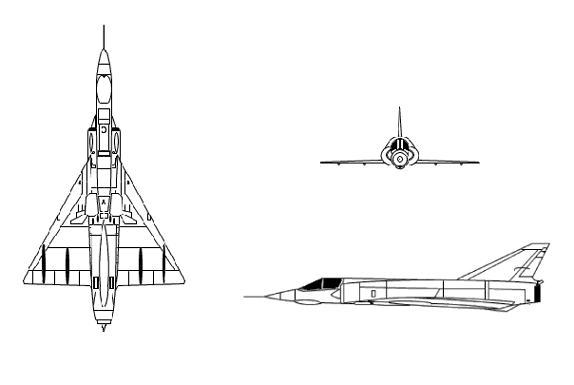
See the F-16XL has not straight trailing edges, it has a trailing edge area extension and has a notch at the root of the leading edge

Low aspect ratio highly swept wings (Delta wings) had defficient handling characteristics at low speed and suffer greatly when the aerodynamic center of lift shifts downwards behind the center of gravity, the cranked wing such as that of the F-16XL improves all that, the cranked wing has better handling at low speed and reduces the aerodynamic center of lift from subsonic to supersonic flight conditions improving the lift/drag ratio.
The F-16XL leading edge notch weakens the leading edge vortices reducing the pitch up movement and therefore the outboard wing section stall.
Source
http://www.aoe.vt.edu/~mason/Mason_f/ABMSThes.pdf
well a MiG-23ML must have a very poor sustained turn rate at 72 deg yeah of course you might have the figure you gave of an instantaneous turn of 18°-20°/sec and the sust. 8°-10°/sec according to the OKB MiG because the MiG-23ML at 72 has an arrow wing that becomes a semi delta only thanks to the tailplanes but in reality it is an arrow wing, however accoding to the manual the best turn a MiG-23ML does is at 45 deg wing setting so the best turn a MiG-23 does is at 45 deg of wing setting giving to the MiG-23 a better sustained turn rate than that the IAI Kfir has
MiG-23MLDSustained turn-rate has something to do with t-w-ratio or t-drag-ratio to stay correct. Another important factor is the related wing-load. The MiG-29A has the best values related to both factors mentioned. So where does the better number for the MiG-29C comes from?
It seems, that you are not intrested in usefull comparisons and prefer to hand -pick some values somewhere and create your own reality.
The MiG-23 was no real match till the introduction of reliable BVR-weaponary to the MiG-23. The MiG-23 is respected for its hit and run-capability and not for its agility. In the 80s the USA leased Israeli Kfir C1 to take the role of the MiG-23 in adversary training. The related BVR-capability was simulated too via data link.
Sens
The IAI Kfir only can simulate the MiG-23 as a fast interceptor not like a turning fighter, again as in the example of the MiG-29 versus Gripen you will find the IAI Kfir has better instantaneous turn rate but much much worse sustained turn rate, deltas even with canards will have troubles bleeding energy, they stall faster than other types of wings, the canards are used to re-energized them and unstability to make them have quicker responses at pitch.
Nevertheless a delta is a delta wing their center of lift is more difficult to harmonize with the center of Gravity and this causes troubles when they need to be trimmed.
The MiG-23`s wing glove as well as the MiG-29`s LERX are swept at 72 deg and 73 deg respectively, while the MiG-23 in its best turn has its swiveling wing part set at 45 deg not much different from the main wing in the MiG-29 that has a swept of 40 deg this shows you that both fighters have similar design and due to this have better sustained turn rates than their respective generation delta rivals counterparts.
You think becasue the MiG-23 had to use hit and run tactics against the F-15 and F-16 its means it has no agility but the reality among the third generation aircraft the MiG-23 is one of the most agile.
MiG-23MLDYou seem to be totally unaware of the impact the TWR has on STR. I hate to be rude but you seem to be in such denial that I’m going to end it right here. No reason to discuss any further. It’s obvious you haven’t read what others have posted. Or you just choose not to take it in.
NO robban i am not unaware, what happens is you think Canards and delta wing are the best configuration and you can not see other nations have opted for other aerodynamic layouts, why? well simply aircraft have many requirements many are contradictory and each manufacturer chose a configuration according to the demanding requirements that each force sets.
the MiG-29 was for the for the former USSR the best design in the early 1982 and the Su-27 later became their best fighter; Sweden needed the best agility in the smallest airframe with the least of weight and limited thrust, and adding they needed some STOL capability and Mach 2, well the Gripen fills well those demands but because of that it does not mean canards are perfect or do not have drawbacks.
Same is the Su-30MKI or MiG-35 they have prices that might not be good for some nations despite they have excellent agility, besides agility is not the only thing driven a design but also avionics and weaponry play a part, consider also price.;)
Also remember many nations opted for designing and building aircraft just to remain in the technological race, the Rafale and Eurofighter are clearly examples of an anti american attitude and pan European aircraft independece, however the Americans designed a more advanced fighter
MiG-23MLDIF IT IS BUILT STABLE. Whe are talking about unstable delta/canards here, very different. If you fail to grasp this I see no reason to continue this discussion.
Man understand this, the DELTA wings always bleed energy faster than other type of higher aspect ratio wings however canards and instability increase their capability and high AoA handling, but the fact the Gripen has a difference of 10 deg/s between the instantaneous and sustained turn rate shows very clearly still it bleeds energy faster however now they do much better than the IAI Kfir or Viggen, yeah they are much better than the old stable canard delta aircraft, in fact see the IAI Kfir has a big difference of 9 deg/s between its sustained and instantaneous turn rates too.
The MiG-29, F-16, Su-27, F-15 F-18 do not show the same difference because their wings have higher aspect ratios:D 😉
MiG-23MLDBla bla bla. Compare the TWR’s.
NO Buddy is not bla bla bla its the fact the Delta wings bleed energy very fast, the MiG-29 just needs to fly fast yeah fly fast and the Gripen will become easy to hunt and that is not bla bla bla, once the Gripen leaves its corner speed and starts going faster trying to chase or keep up with a MiG-29 it will loose the battle, in fact see this fact, a modern F-16 with IRIS-T or Python V will also hunt the Gripen very easily at higher speeds from the Gripen`s corner velocity and with equal missiles a modern Greek F-16 will more likely blast the Gripen out of the sky.
If the Gripen was the best fighter very likely the modern F-16s would be out of the competition but it is not the case, the Gripen is not superior to the F-16 and MiG-29 because it simply bleeds energy so fast in turns that its sustained turn at higher speeds from its corner velocity makes it less capable than the MiG-29 or F-16
MiG-23MLDStable delta/canards have mediocre STR’s. Unstable delta/canards have excellent STR’s. Find me a fighter with tailplanes that have similar TWR as a Gripen, and let me know if it can sustain a 20deg/sec turn rate.
On an unstable airframe, where does the pitch moment start? In front of the aerodynamic center. A canard is certainly preferable in order to achieve control authority. They can stop(and start) the pitch where it begins. The Delta/canards pitch the nose into the turn. Crisp, swift, and precise.
The Gripen is unstable and still can not deal with a MiG-29 in sustained turn and the MiG-29 is stable, of course if you think 20 deg/s is great but what about 23.5 deg/s of the MiG-29C? remember the MiG-29 is stable
The funny thing is you forget this
Deltas bleed any way energy faster than high aspect ratio wings in fact from a 30 deg/s instant turn rate it drops to a meager 20 deg/s, yeah you can say that is a great turn but the fact is the MiG-29A will turn as good as the Gripen because the MiG-29A bleeds less energy, from a 28 deg/s instant turn rate will just drop to a 22 deg/s sustained turn rate
the MiG-29A at higher speeds than the Gripen`s corner velocity can kill the JAS-39 and same will happen with the Eurofighter, the MiG-29 should only fly at higher speeds than the Eurofighter`s corner speed and the sustained turn rates will equalize the fight, also remember the MiG-29 always can use the Cobra as a nose pointing trick , it is true the MiG-29 can not get slow with an JAS-39 or Eurofighter and with ASRAAMs and IRIS-T well the Gripen can kill with ease an early MiG-29A armed with old R-73s but it won`t eat a newer MiG-35.
Same was the MiG-23 against a Mirage III or IAI Kfir if the MiG-23 gets fast versus the delta fighters their turn will abruptly become inferior to the MiG-23`s even at subsonic speeds and this means get fast and your enenmy won`t kill you
MiG-23MLDMaybe you should read english more closely. There is nothing there that says the canards produce leading edge wake at least short enough to affect the main wing. They produce leading edge vortices, and showed they will last longer at higher AoA before degenerating into wake, and all these articles point to the POSITIVE use of canards vs. LERX.
Crobato
Canards as well as LERXes have almost the same function and similar drawbacks, canards do affect the lift of the main wing and some times on unstable designs the vortices they make and their small size is not effective to trim the pitch up movement these aircraft have, designers ponder what is the best compromise, it is true you can make bigger the canards but this will increase the drag, buffeting and lateral instability check the Eurofighter and Gripen use strakes right behind the canards for more lateral stability and vortices control

Do not think canards do not have drawbacks, they do have drawbacks however any design gains in some area but looses in others, canard double delta aircraft have no good sustained turn rates and in the case of the Su-27 a big tailplane is enough to trim the unstable Su-27 back from high AoA pitch up forces and this is at 120 deg AoA flight, this is enough to prove you do not need canards to achieve those AoA;) .
MiG-23MLDSounds like wishful thinking. Canards are smaller because they don’t have to be as large as the tail surfaces of a conventional design in order to be effective. Contrary to the MiG-29 and Su-27 the delta canards have their elevators at the front. When they turn positive lift is added, in front of the aerodynamic center, giving superior pitch acceleration and control authority. The Eurocanards maneuvers are crisp and accurate. Very different from the rather sluggish behavior of the MiG and Suchoi.
It happens to all airplanes with swept wings not just delta/canards. The wing stall at the tips first, moving the CP forward. Having the elevators in front of the main wing is only beneficial.
In some parts of the envelope the canards can reduce the lift of the main wing, but at the same time drag is reduced also. Again having the elevators ahead of the main wing only increases the authority at high AoA.
The Gripen has been flown to over 110 deg/AoA without any problems. High AoA are no match for delta/canards. The FCS of these aircarfts do not allow this type of flying though, because maintaining E is of highest priority. Pulling flashy high AoA maneuvers looks good at airshows. But in combat all it does is kill your E and make you a sitting duck.
Robban
There are some methods to decrease pitch up and among them there are some that use the leading edges that do have some success reducing pitch up on unstable designs, however try to read what i said in context, Canards are not always effective on unstable designs however let us suppose that in the Gripen and other Eurocanards the pitch up movement can be controlled up to some high AoA, however they do not show it practically, the MiG-29A and Su-27B only with tailplanes show excellent controlability at 120 deg AoA and at airshows see that that implies total reliability and perfect work of the aircraft systems and aerodynamics besides the fact it means they are safe to fly at airshows, if the Europeans have not showed it must be simply because they are not as confident they can do it or simply their jets are not safe to fly at those AoA as the Su-27 and MiG-29 at least at Airshows and this shows you tailplanes and LERXes any way are not inferior to canards.
Nevertheless the Eurocanards never have demostrated they can do the cobra at least publicly


 Sign In







