 MiG-23MLD
It should read: “superior agility to most non TVC equipped aircraft, with the option for TVC”:p
Here is a nice article that Proves you canards do affect the wing an generate drag even proportionally more than a tailplane and do affect the wing lift

source
http://aero.stanford.edu/Reports/MultOp/multop.html
Because of the unfavorable interference of the canard on the wing, asymmetries appear in these curves. The best aft-tail designs achieve 2% to 3% lower drag than canard designs, and although in each case relatively high aspect ratio tail or canard surfaces are preferred, the drag is insensitive to the aspect ratio of aft-tail. Canard designs suffer large penalties in drag with low aspect ratio canard surfaces.
and more
Wing/aft-tail combinations achieve generally lower drag than wing/canard systems of equal weight and area. If the section CLmax is constant over all sections, aft-tail configurations exhibit greater maximum lift capability than canards of moderate aspect ratio. Relaxing static stability results in canard and aft-tail designs with very similar performance.
Three-surface configurations with small canard and tail surfaces do not experience the penalties associated with canard designs; however, unless restricted by limited tail length or other configuration dependent constraints, no obvious performance advantages apply to three-surface designs.
MiG-23MLDLol that’s indeed one of the most completly wrong posts I have ever seen!
You have still not realized what the matter of this thread is. We are speaking about the aerodynamical performance of the raw airframes, which has nothing to do with TVC.Once again some facts about TVC:
No one here denies or has denied that TVC will improve the performance of an aircraft in some areas. TVC enables super manoeuvreability which isn’t possible to that degree without TVC.
What bothers me is that you seem to think that the Russians are the inventor of TVC and that only russian designs offer this possiblity and that is completly wrong!
The idea of TVC was in fact invented by a german back in the 1970’s. TVC was studied by soviets and americans mainly in the 1980’s for the first time.In the late 80’s first TVC were tested on legacy fighters. The F-15S/MTD was the first aircraft to fly with 2-D TVC, if I remember right.
http://en.wikipedia.org/wiki/F-15S/MTDThis aircraft used TVC for both engines and was later equiped with 3-D TVNs in the mid 90’s and renamed to F-15ACTIVE.
While this F-15 demonstrator used TVC for both engines, the Russians used the the Su-27LMK (Su-27UB T-10-16) for first tests and fitted a large flat 2-D nozzle to one of the aircraft’s engines. The aircraft flew in 1989 for the first time. The Su-27LMK was developed from the Su-27LL-PS which was used for thrust reverse, if I remember correctly.
Already in 1990 the west equiped another aircraft with TVC. The F/A-18 HARV already used 3-D TVC!
http://www.nasa.gov/centers/dryden/news/FactSheets/FS-002-DFRC.htmlA TVC equiped F-16 demonstrator followed shortly.
http://www.f-16.net/f-16_versions_article19.htmlAnd there was the german-american X-31 3-D TVC, super manoeuvreability demonstrator.
http://en.wikipedia.org/wiki/X-31The point I want to make is that TVC is no news to the west. The west has even equiped more different types with it and mastered 3-D TVC long before the Su-37 appeared with 2-D TVC. Meanwhile the Russians have mastered 3-D TVC as well (more than 10 years after the west) and I would say they are roughly on par in that area. The west is able to equipe its modern fighters with TVC as the Russians are. And as mentioned posts before it would improve the performance in some areas of the flight envelope for all aircraft being equiped with TVC independent if it is the Eurofighter, F/A-18 or the MiG-29.
About your “disadvantages” of canards and deltas, you take the single things completly out of the context. You list the disadvantages of them without making a single look at the entire aircraft configuration!
You repeatly claim the flap function for tailed aircraft as an advantage, which it is not. ECDs do not need flaps unlike tailed aircraft. The delta/moveable canard configuration will bleed much less energy than a pure delta and partitially even than a tailed plane. Close coupled canards which are placed higher than the wing won’t reduce wing lift, they increase it!And your assessment of the canards adding more weight and drag is once again completly out of context. It adds weight and drag for an aircraft like the Flanker where the canards are fitted in addition to the tailerons! But the much smaller canards of the Rafale or Typhoon which are tailless planes are for sure not draggier and definitely not heavier than the much larger tailerons of tailed aircraft such as F-16 or MiG-29.
Another point you still haven’t get is the design philosophy of canards for the Flanker. At the time when the Su-33/34/35 where developed TVC was not existent or in an early developement stage. TVC was therefore out of question at that time. The canards improved the Flankers manoeuvreability, as well as low speed and high AoA controlability. This was perfectly demonstrated by the Su-37 after it has been renamed to Su-35 in 2000, retrofitted with conventional AL-31F engines without TVC and a completly reworked flight control softwarfe. I was unfortunadely not able to see the aircraft life after this conversion, but from what I heared it was more manoeuvreable than any Flanker before (without TVC of course).
BTW: Has anyone a video of the 711’s airshow performance AFTER its conversion without TVC?
Of course the addition of canards added drag and particularly weight to the Flanker. For the new Su-35 canards were rejected for some very simple reasons:
1.) Safing weight and drag
2.) Desired manoeuvreability is achieved with TVC
3.) Its more easy and less costly to keep the airframe, rather than changing itOne should know that the Su-35 (T-10BM) is primarily intended to be an upgrade for existing Su-27s. For sure an extremly comprehensive one. But the new Su-35 is of course offered as new built plane as well, as it is done by RAC MiG for its MiG-29SMT.
Let me see your logic
Su-37 has canards bad canards 😉 yeah because it is Russian, uhmmmm! Eurocanards have good canards uhmmmm? buddy do not dream Canards do induce trailing edge wake specially when they move
See in this position the canard becomes an aerodynamic brake it generates lots of drag and this affect of course lift

another shot using the canard as a control surface
creating drag in order to change direction

MiG-23MLDLuxury? Flaps and tailplanes adds complexity, and more importantly, weight and drag.
I’d say the Typhoon, Rafale, Gripen and J-10 have the luxury not to need flaps and tailplanes.
Everything depends what you want a Su-37 and Su-30MKI that can do the Kulbit, Cobra turn and double Kulbit or a Eurofighter with avearge agility but still good speed and excellent weaponry and avionics;)
MiG-23MLDWhy don’t you take a good look at the aircraft once again?
The canards and the main wing of planes like the J-10, Lavi, Gripen and Rafale are **NOT** in the same plane like the Su-33/35. They are higher than the main wing. For turbulence to reduce lift, the turbulence must affect the airstream at the lower part of the wing, and that is simply not possible with biplane layout canards because the wake is well above the main wing. The fact that the canards are dihedral, while the main wing is anhedral, increases the seperation of the canard plane and the plane of the main wing.
Crobato
Canards even if they are canted they still produce a trailing edge wake and vertical fin buffeting, if they cant the canards the wake is farther from the wing but still it creates a wake and affects the wing of course in a lesser way but still has a wake and the moveable canards still affects the wing when it operates as a control surface reducing lift to the main wing and inducing drag in fact canards are used as aerodynamic brakes;) .
MiG-23MLDThe context is that in your view canards are useless as Migs and Sukhois don’t have them…:p
What is the meaning of discussing landing speeds and sustained turn rates of deltas without canards? Shortcoupled delta canards has very good landing speeds as Rafale and Gripen shows without any flaps. And unstable delta canards has very good sustained turn rates.
LERX do nothing to avoid the wake affecting the tailplane. It’s true that LERX give similar effects to fixed canards. But they can’t compare to all movable canards.
Rogerout
I do not see canards as useless, however i do not see canards as the ultimate configuration for a fighter, each configuration has advantages and disadvantages, the Russians in the 1990s used canards in the Flanker for several reasons, however now they have 3D thrust vectoring, this has freed the MiG-29 and Su-27 of the need of canards as has done to the F-22, the Europeans developed their fighters in the 1980s when canards were very useful and innovative even the J-10 is an early 1990s aircraft, the MiG-29OVT is a much newer design it flew in 2002 or 2004 (well i do not remember the exact year ) several years after the Eurocanards , in 2007 the Eurocanards with missiles like the ASRAAM and Meteor can deal with the MiG-29OVT even if the Russians field better missiles, nevertheless as far it is concerned thrust vectoring is very useful as a pure performance and handling tool but newer missiles fifth generation air to air missiles to be exact like the Python V make super maneouvrability not as relevant in fact see that the F-35 and F-22 are designed with more emphasis on stealth rather than on agility, this is because as far it is concern super cruise and stealth coupled with ASRAAMs or AIM-9X are better than the pure agilility fighters like the MiG-29OVT have
MiG-23MLDThis is completely wrong. A canard delta can be carefully designed to minimize wake, which by the way is over the main wing and not under it. If its over the main wing it simply does not affect lift. Period. Canards are not in the same plane as the main wing, they are above it.
Look at the Rafale, J-10, Lavi, and Gripen, and all have diehdral canards, while the main wing is either straight or anhedral. From the front view, this creates an X like profile. Because the canards are canted upwards from the tip, the wake goes to the top, while the wings are straight or canted downwards.
Turbelence only affects the yaw stabiilty of the aircraft which is why these planes have large rudders. As a matter of fact, the canards also create vortices over the main wing, and these low pressure areas add to the lift..
Crobato
LERXes as well as canards do have a small problem their low pressure vortices do burst and create buffeting, canting the foreplanes won`t reduce the wake as much as you think in the way you over play it, you increase buffeting too, canards can be canted and reduce in some way the wake it is true however in the Eurocanards as well in the J-10 these aircraft they use foreplanes, once you have a moving canard you increase drag and therefore trailing wake, LERXes are not moveable they just create turbulances and buffeting to the vertical fins, but foreplanes are constantly moving and therefore they creating constantly drag and trailing wakes and this affects the lift of the main wing, it can be reduced it is true you can cant the canards but it does not mean you won`t affect the lift.
In the Su-35, Su-33, Su-34 and Su-37 case, these aircraft have flaps and tailplanes a luxury the Typhoon, Rafale, Gripen and J-10 do not have, add to this thrust vectoring and you can understand why the more advanced Su-30MKI can make the Kulbit and Cobra turn. 😉

MiG-23MLDHow come some people want to talk so much about russian fighters without canards when the thread is about canards?
Why you do not read it in context? the whole issue was the Su-27 has suffered a transformation, from an aircraft that was fitted with canards with the Su-33, Su-35, Su-37 and Su-32, to a fighter with thrust vectoring and no canards
The MiG-29 skipped the canards and many thought that the MiG-29 was over shadowed by the Su-37 but until the newer MiG-29OVT proved that canards are not needed to achieve super maneouvrability, then we knew the latest Su-35BM has no canards and only thrust vectoring.
Canards are good no one denies that, but also they are not perfect, they have pro and cons, their drawbacks are drag, they reduce lift to the main wing, can not use flaps and usually are associated with delta wings that suffer more with the relation center of gravity and center of lift. also delta wings at high AoA have problems of vortices breakdown as the low pressure vortex they generate burst, making the traditionally tailess delta wing to have higher speed landings than the less swept wings and bleed energy in turns faster making them less suitable for sustained turn rates.
Since canards reduce the max potential lift of the main wing due to their trailing wake over it also they tend to carry more weight than the typical tailplane since the wing on a tailplane design operates at its max potential lift
The tailplane also suffers from the wing trailig wake but in the MiG-29 and Su-27 these aircraft have LERXes doing exactly the same job as canards do, giving extra lift and creating vortices ahead of the main wing
MiG-23MLDOh, so the MiG-29 has a similar initial climb rate like the F-104A (307 m/sec)?!
So much throwing around data out of the blue.
The record P-42 had a thrust:weight ratio 2:1 and managed true climb rates of 220 m/sec.
I will not waste time to explain the reasons for that.
In the late 80s was a comparision between F-16/MiG-29/M2000/F-18, when it came to accelaration capabilities. All four contenders did differ a few seconds only, depending on height. When it was a nose to nose between F-16/MiG-29 depending on height and starting speed, those were followed close by the M2000 and F-18. Till 400 kt the MiG-29 was the nose-tip winner, in the transsonic range it was the F-16 and in the supersonic range the M2000.
But air combat is no dragster race and every modern AAM is faster at all.
Sens
Like always trying to teach without knowing this sounds like you but me saying it:D :rolleyes: , man Initial rate of climb chances with the altitude and speed but it is not a lie the fact that both the MiG-29 and Su-27 have an initial rate of climb of 330 m/s, however as speed and altitude increases the rate of climb slows down in m/s because they are reaching their max speed
MiG-23MLDThe important fact is the european fighters don’t need them, unlike the conventional tailed planes. Compare the approach and takeoff speeds, you will quickly notice that the ECDs will be similar or even better here than tailplaned aircraft with flaps deployed. Any further argumentation is pointless here. It doesn’t matter if they could or not could use them as they don’t need them. Get the point!
Reality is you missed the point and are unable or unwilled to realize what I’m refering too. I would even go that far and say you have missed the topic.
I have repeated me often enough, if you are still not able to understand, I see no reason to continue or repeat this discussion. I suggest you to read my previous posts again, especially what I have said about TVC.The MiG 1.42 had never been able to prove its performance. And more control surfaces doesn’t mean its better. Simply look at older fighters and newer ones. The key is to reduce the number of control surfaces to what is really necessary for the very simple following reasons:
1.) More control surfaces = complexity = less reliable = more prone = more difficult to maintain.
2.) Adds weight
3.) Adds partitially drag
4.) Is not suitable for stealthy aircraft as every additional surface (especially moveable ones) will increase the RCSI’m sure the MiG MFI would have performed well in terms of flight performance, how well we’ll never know, but there is a significant difference between aircraft like the MiG MFI or F-22 in contrast to the MiG-29M-OVT… The earlier ones were designed with TVC in mind, meaning TVC is an integral part of their design.
Yeah buddy, but would you tell me why the MiG-1.42 had more control surfaces? and thrust vectoring?
There is a simple reason, Europe settled for simplier designs than the MiG-142 because number one
A)The MiG-29OVT might be more agile than the Eurofighter but the Eurofighter, Rafale and Gripen can use IRIS-T and ASRAAMs, have helmet mounted sights and will be equipped with Meteors.
B) Prices and labour cost in Europe are higher than in Russia simplier and more cost effective weaponry allows the Eurofighter to discard and dispense with thrust vectoring to a certain degree, the EJ-200 has thrust vectoring control too but who needs it if you have ASRAAMs and HMS?
The Euro canards are not the best aircraft in agility and performance, Proof? well an F-15I or F-16I can use Python Vs and still do the job, the only real fighters that are better than the Flanker and MiG-29OVT threat are the F-22 and F-35 mainly due to stealth, ASRAMs, AIM-9Xs and Meteors.
This an application of the cobra in combat
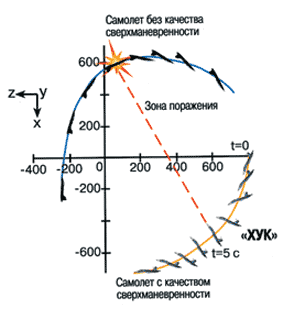
tail slide in combat
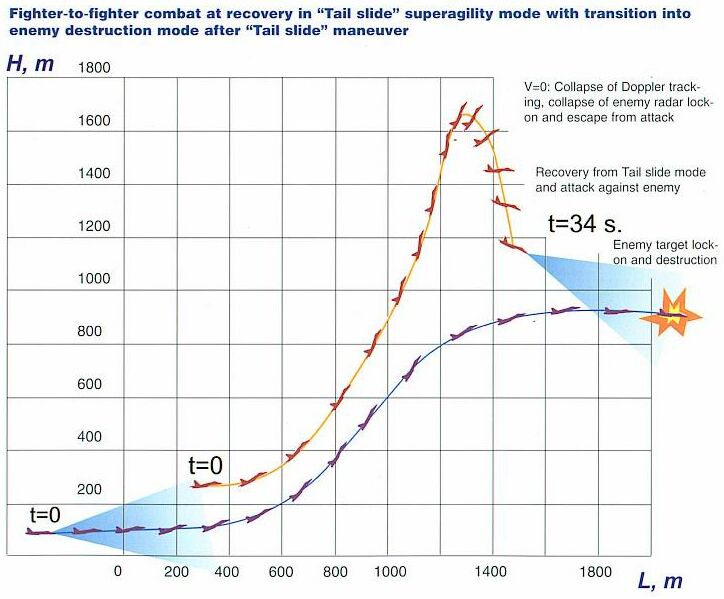
MiG-23MLDI had read the entire thread before engaging into the discussion and I’m well aware about affects pros/cons of canards, LERX etc..
No one of the 3 european 4th gen fighters depends on flaps. They achieve similar if not lower takeoff & approach speeds than MiG-29, F-15 etc. without flaps.
Proves nothing in terms of overall agility and manoeuvreability from aerodynamical performance.
Prove it!
Of course they do not use flaps because they can not use them as well as a tailplaned aircraft, you just avoid a true reality the Cobra, kulbit, double Kulbit and boomerang show that thrust vectoring is the best solution your answers are just excuses to a real fact the F-22 and MiG-29OVT will beat any eurocanard fighter in agility in fact the only way you can design a superior Eurofighter is to make it like the MiG-1.42 with thrust vectoring and additional aerodynamic control surfaces

See that the MiG-1.42 had two twin fins instead of one, thrust vectoring nozzles, hinged ventral fins and two flaperators between the tailbooms and the fuselage this give a really better agility than the Eurocanards and make it similar to a triplane like the S-47 Berkut

MiG-23MLDEF has better acceleration than F-16. F-16 has better acceleration than the MiG-29.
The F-16 is superior to the MiG-29 in most areas incl. rate of climb and turn rates or at least about equal. The EF on the other hand is known to beat the F-16 in every way.
Those nice big LERX on the MiG-29 not only produce lift, but add some drag too, which is the reason why the Viper with less or about the same TWR out accelerates the MiG.About the TVC: TVC is most effective at low speeds (airshow manouvers like) or at high/supersonic speeds. At typical fighting speeds, the gain from TVC often does not justify the penalties.
That data is uncorrect. the MiG-29 has a rate of climb of 330m/s, the F-16C even won`t out accelerate the MiG-23ML niether out climb the MiG-29; the F-16C at 1000m won`t out accelerate the MiG-29 from 600km/h to 1000km/h, the MiG-29 has excess power, in fact i can say to you the only true rival of the MiG-29 in terms of agility and performance is the Eurofighter
MiG-23MLDAs it is as senseless to speak with you as to discuss with Star49, this is my last reply to you for now.
I will simply give you some straight facts.
I do not believe that the Eurofighter is superior to the MiG-29, I KNOW it. Unlike the Russians who had never ever the ability to fly, test and evaluate the Eurofighter, the West had the oportunity to fly and even operate the Fulcrum, though these are the oldest examples. The Eurofighter has been flown against various types in service by now and the aircraft performed significantly better than legacy types including F/A-18, F-15, F-16 and MiG-29. The Rafale did so either and even the TWR handicaped Gripen was highly sucessful.
What the Russians claim for marketing reasons doesn’t matter. ANY manufacturer anywhere in the world hypes its own product and bashes the opposites one. This is called marketing. If some really takes it serious, then can’t help him.You should ask your self how someone could define proven facts as personal speculation.
Lol it is really funny that russian whoevers should know better what the Europeans decided and why, than the Europeans themself.
There were numerous reasons to select the Eurofighter, not to say the Eurofighter was the only solution for them!
The reasons are:
1.) It was back in the 1980s and the only alternatives were US types
2.) Developing your own fighter allows you to optimize it for your needs insead of taking an aircraft which isn’t optimized for your needs.
3.) Independence from the US.
4.) Own economecal benefits
5.) In the reevaluation in the early 90s it was found that no aircraft could fulfill the needs of the airforces as the Eurofighter would do, even Su-27 and MiG-29 were evaluated.You seem to lack any knowledge about the Eurofighter’s roots and background and it looks like you aren’t aware of the conditions at that time. Eurofighter partners were not countries with an open competition as it is the case for India nowadays. The Europeans defined their requirements and tasked the manufacturer to develope an aircraft which fullfils that requirement. In fighter competitions such as India’s MMRCA the airforce defines a requirement and evaluates different types and looks at which would fullfil the requirements best. That’s a completly different situation!
I’m afraid you are mixing things up again and again. We’re speaking about aerodynamics and associated flight performance, not about the entire aircraft as a weapons platform. It’s interesting that you suddenly refer to the Gripen which is in a different class to Rafale or Typhoon in terms of performance as it is much smaller and single engined.
You should exclude the “in fact”. Yefim Gordon is someone with great knowledge about russian combat aircraft, but he is for sure not known as an expert about european fighters.
Some thoughts about this:1.) Why of all Fulcrum’s should the MiG-29S should perform better? The “S” is a bit heavier than the normal MiG-29, while keeping the same aerodynamics and engines. Only FCS was improved to higher the AoA by 2°. It is out of any logic that particularly the MiG-29S should perform better.
2.) There are pilots out there who have flown both aircraft and who have flown them against each other. They all came to the same conclusion that the Eurofighter outperforms the MiG-29, be it in terms of acceleration or agility! This is a fact unlike the thoughts of someone who has probably not even seen the Eurofighter in reality.
3.) Many people have the Eurofighter mid 90’s airshow performance in mind, when the aircraft was using the much weaker RB-199 turbofans and had a much restricted FCS. At that time many people said the MiG-29 or Su-27 would be way better in terms of agility based on what they have seen in the airshow. That the restrictions were there for safety reasons and that the envelope would be continously extended in the developement process was widely ignored and many people still have this old picture!
4.) Yefim Gordon’s books are not the very newest and at the time they were released the Eurofighter was even more unknown than nowadays. And even today many details of the Typhoon are unknown because they are classified. It’s highly unlikely that someone like Yefim Gordon knows more about the Eurofighter’s performance than what is officially published or has been unofficially disclosed in interviews, with pilots and people involved into the project.TVC is as mentioned before a technology which has nothing to do whether the aircraft has a conventionel wing/tailplane configuration or a delta/canard configuration. TVC will provide advantages to both configurations, but says nothing about the aerodynamics. It’s funny how you want to compare the aerodynamical layout, but you mention again and again TVC. It is internationally accepted that types like Rafale or Typhoon outturn teen series and teenski series fighters and that they outperform them more or less good in many/most other regimes of flight performance too. It’s interestingly only people who have never ever the opportunity to fly the ECDs or had been able to fly against them who doesn’t accept such figures. Maybe it is also wrong pride who knows.
If you are unwilled to accept the opinions from various fighter pilots who are able to judge about the topic and if you prefer to believe in what marketing guys or people tell you who doesn’t know much about the european fighters then its your own decision. But don’t wonder if no one takes it serious and if people start to ignore you.
The cobra is a nice airshow manoeuvre not more. Of course it demonstrates the excellent aerodynamics of the Flanker or Fulcrum, but the aircraft are hardly “controlled” at such AoA. And flying a cobra is not turning in a dogfight. As mentioned before Eurofighter has proven its superiorty during operational test and evaluation. This being said for the last time.
To speak about the aircraft as a weapons platform one has to consider all factors, as an aircraft is the sum of its parts. Suggesting that new MiGs or Sus are “better” is fine, proving it is another topic and beyond the topic of this thread either. Let alone what “better” means. Yes for sure Flankers and Fulcrums are looking better than the Typhoon:D
Man the typical threat of i know better than you, yeah my last reply to you:rolleyes:
If you read the first page and the begining of the thread, you would had noticed the advantages and disadvantage canards have:
A)The canards have the advantages of giving lift ahead of the center of gravity then giving a positive extra lift to counter act the nose down force product of the aerodynamic shift of the center of lift
B) canards produce low presure vortices and can work as control surfaces
C) canards are a safety net to the aircraft since the canards stall first prevent the nose from leting the wing stall
Yeah buddy those are the real factors however
LERXes also produce low presure vortices and extra lift ahead of the main wing center of lift and in conjuction with tailplanes help the aircraft to have excellent high AoA behavior
Canards also affect negatively the wing with a turbulance wake that reduces the wing max potential lift, canards have several potential center of gravity positions and do not produce a nose up movement as the wing deploys flaps, making difficult the design of the wing with flaps
Thrust vectoring also has the advantge that produces less drag than control surfaces, canards produce more drag than thrust vectoring and reduce range and power.
Proof well the MiG-29 can make the Cobra, the MiG-29OVT can make the Boomerang, Kulbit and double kulbit, and all MiG-29s have better sustained turn rates therefore buddy you have no proves the Eurofighter is better.
MiG-23MLDHow can the RMAF be inept, eh? They fly both Hornet and Fulcrum, and you bet they have far more experience with the Fulcrum than the Canadians. From the RMAF exercises, the Fulcrums don’t try to turn with Hornets in close in fights. The RMAF happens to be a very well trained and professional force, which exercises with the RAAF and other Commonwealth air forces.
Yeah buddy but Canada has a scientific and technological level that allows them to have better overview of an aircraft, remember Canada is the third largest aircraft maker in the world after the US and Europe in terms of civil aircraft and the Canadians and Americans have flown aagainst the Fulcrum in RED FLAG, so that assement you give is totally simplistic.
The Hornet is one of the worst fourth generation fighters in the terms of fighter skills, despite it is probably one of the best multirole aircraft but not the best dogfighter
MiG-23MLDMust be complete nonsense. There is no 4000 hour life engien for the Flanker and Fulcrum. And in the IAF, the MiG-29 does not beat the M2K, which was the original front runner, and the plane the MRCA specification was originally concieved for.
Maybe one should ask the RMAF. In their own exercises, their Fulcrums try to stay away from a close turn in dogfight against Hornets because they know which plane can turn tighter.
Pilot ineptitude or different tactics do not mean the Fulcrum is less agile, the canadians who flew in the MiG-29 said the MiG-29 is not inferior to the F-18, in fact it is more agile, the only thing they said the MiG-29 in the 1980s was inferior in avionics
MiG-23MLDSo show me a single high tech product developed and made with China own intellectual property in Communist times before 1978 that is comparable to what is atleast consider acceptable to western standards.
However STAR49 i would say probably China in 2007 has good quality standards because they have mixed the high standards of Japan, Europe the US and even Russia with their high productivity, i guess the J-10 must be a quit demanding aircraft and sloppy manufacturing must be out of the question


 Sign In







