MiG-23MLDMiG-23MLD
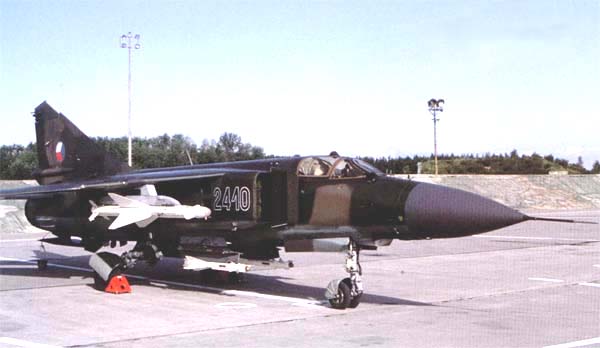
Looking for photos and supplemental info on Mig-23MFs in service with the Warsaw Pact nations (not Soviet). Much searching has produec only basic info and photos typically of post-WP breakup with camo schemes and new insignia in place of the old (typically) stars and air superiority grey schemes.
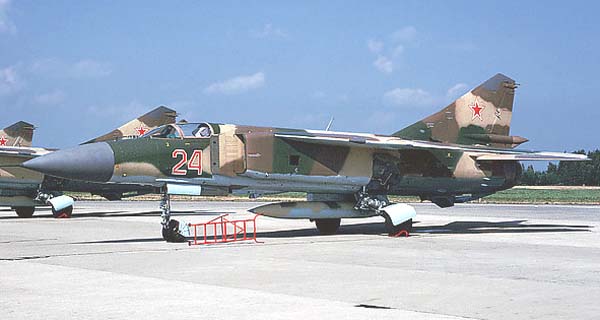
Here are some russian MiG-23s excellent pictures
http://forums.airforce.ru/showthread.php?t=936&page=2
http://perso.orange.fr/jets.for.ever/Pages%20du%20Site/mig%2023.htm
Soviet MiG-23s are the best later i get you some Warsaw pact ones
MiG-23MLDAs I exspected.
Some details for better understanding.
Both engines have an airflow of 144 kg/s and 150 kg/s.
Frontal area versus thrust or drag versus thrust ratio is an issue. Weight is of minor importance except for climb-rate really.
When a MiG-25 became a “sitting duck” below 30000 feet, the MiG-31 is much different, when it comes to speed below 30000 feet.
To reach the given range data both have to cruise high up.
When a MiG-25 spring into live it could reach 60000 feet in ~8 min.
The heavier MiG-31 took ~8 min to reach 33000 feet.Different “animals” with different materials and flight envelope in mind.
The refuelling probe added to the MiG-31 is an indication, that even with much better sfc of engine, range is an issue at lower flight levels.
The MiG-25 and MiG-31 with operational warload will have almost the same climb rate, both aircraft will reach 20km at around the same time 8 minutes, of course if you mix up recods the Ye-155 (MiG-25 prototypes) climbed 20km in 50 seconds, but operational MiG-25 and MiG-31 aircraft will take the same time to climb to 20km.
In fact Russian books say the MiG-31 climbs to 19km in 7.9 minutes and from that altitude can cruise at Mach 2.35; see that the MiG-25 climbs to 20km in 8 minutes 54 sec, so by no means the MiG-31 can reach operational climb of rates different to the MiG-25`s

MiG-23MLDDo not exspect an real answere about. Most of our “experts” are net aware, that most of thrust came from the inlet and outlet system then.
Expert or not experts, the MiG-25 and MiG-31 achieve the same operational max speed, the same cruise speed and the almost same range at Mach 2.3, basicly these two aircraft achieve the same with different engines, the only big difference is the MiG-25 is lighter and has less powerful engines.
The MiG-25 has R-15 turbojets and the MiG-31 has a pair of D-30F6 Turbofans, both aircraft have similar inlets

MiG-23MLDI think maybe we’re talking past each other. A turbojet is ALWAYS going to be better than a turbofan at high Mach numbers. All around? No. But then that’s not what I said. As far as pressure ratio at the combustion section goes you have to take the whole propulsion system into account, from intake to afterburner you can’t just look an the engine by itself. Ask yourself why a Mig-25 which is much heavier than an Eagle and has less static thrust is so much faster.
That is not totally correct, the R-33 is also a turbofan and the MiG-29 is slower than the MiG-31 that also is powered by turbofans, the TWR of the MiG-29 is close to 1:1.2 and the MiG-31 TWR is less than the unit.
Aerodynamics are also important and inlet design plays a vital part in the speed an aircraft can achieve.
MiG-23MLDWrong !
The F-4 was first a naval plane. The F-35 was concieved from the start for both roles + VTOL in mind, and the Rafale was also planned from the start as a carrierborne aircraft. Those aircraft have decent performance onboard a ship.
The Su & Mig were navalised later, and can take off without a catapult just thanks to their very high T/W ratio, and for the Su-27 also because of the added canards. And as Tomcat Territory mentionned, they can do it but only with limited payloads.
A plane that isn’t designed from the start for carrier ops will most likely have serious limitations. On the other hand, a naval airplane derivative stripped down for land use will perform way better due to the weight advantage.
The Rafale, MiG-29 and the Su-27 were also planned from the start as naval aircraft, what you are not visualizing is the fact that the MiG-29, Rafale or Su-27 were just navalized because the USSR and France considered that building a specialized naval fighter without a land version would had been prohibitively expensive.
They decided that turning a land aircraft from the begining into a naval aircraft made more sense than building as the US did two different specialized aircraft like the F-14 and F-15 are and that basicly overlapped niches and in many ways would had done the job of each other respectively.
The F-15 could had been navalized and the F-14 deployed in the USAF.;)
In fact see that the Su-33 and MiG-29K flew several years before the Yak-141, but in many ways turning the F-15 into the F-15N would had not been more difficult than turning the MiG-29 into the MiG-29K or the Su-27B into the SU-33
MiG-23MLDMig-23MLD, the F-4 was designed for the USN FIRST and then adopted by the USAF. A navalized F-15 would not have been able to perform as well as the F-14. The F-15N would no be anywhere near Flanker capability. The F-14 was flying and in deveopment 2 full years before the Eagle so if anything it made more sense for the USAF to adopt the F-14 rather than the other way round. Also the fact that the Su-27 can launch without a catapult is a not an advantage – the actual load that can be carried by the Flanker is nowhere near what it is capable of. F-14 or any other aircraft would not be able to take-off with a useful load of fuel and weapons without a catapault. This is why USN and French carriers are fitted with them and why the USN is developing the electro-magnetic catapault. Work was done with the F-14 and ski-jumps but the USN never showed much interest in them. The Russian aircraft carrier program was intended to have a catapault but time and cost constraints prevented this. Lastly your continued contention that the F-14 is completely obsolete and that it’s only reson for existence was the Phoenix is not accurate. If by your rules, the F-14 is obsolete then so is the F-15 and Su-27 as their job can also be done by newer smaller fighters – but you are entitled to your opinion. Also that model F-15 you posted is not based on act at all – I’ve read the article by the guy who built it and it’s a pure thumb suck.
TOMCAT TERRTORY
Let us see several aspects you are not seeing
The F-15 has a TWR as high as the Su-27`s TWR
This would had allowed to the F-15 a good carring capacity, it is true it would had added weight as it would had been navalized, but it would had also take off with the aid of a catapult, the F-14A has a very low TWR and a very slow rate of climb, the F-15N would had been more like a Su-33 in that sense since the land F-15 has a TWR of 1.2 at normal take off, contrary to the F-14A that has really a very low TWR even worst than the MiG-23MF in fact it only has a 1:0.9 TWR empty, fully loaded, it gets as bad as 1:0.5, so the F-14 is a really overweight and obese aircraft even compare to the F-15.
The F-15 has a better wing loading than the F-14A while the F-14A has a pancake fuselage generated lift, it also has a smaller wing, and it is heavier, also the Wing Pivots limit the G overload permitted and the F-14 was even limited to 6.5Gs due to the complexity and fragility associated with swing wings
F-14 Phoenix realities The F-14 can not land on the deck of an aircraft carrier with a load of six AIM-54 and it is restricted to a Max G load factor of 6Gs while carrying the AIM-54, so the F-14 armed with AIM-54 is not agile in fact is so limited that in agility it would be comparable to the MiG-31.
So i do not think the Naval F-15 would had been worst than the F-14, in fact i think it would had been better why? The F-14 empty weight is 18 tonns, the weight of the F-15N would had been less than 14tonns, the reality the VG wing imposes a weight penalty that is even noticeable just looking at the empty weight of the F-15A and the F-14A, the F-15A is 5 tonns lighter than the F-14A;)
So then why the F-15 never was purchased by the US navy? simply politics and enough money to burn, simply like that, Grumman needed the program, the US Navy could not back down since the future of Grumman was at stake and the US Government would had been resposible for Grumman`s bankarupcy.
The F-14A is inferior to the F-15A simply because as a whole the F-14 has two aspects that makes it more primitive than the F-15, one is older and less advanced engines and the other is weight penalty due to the VG wing

MiG-23MLDThe F-15N was just a paper proposal. Defense contracts mean lots of money, so normally all companies apply for any RFP. The F-15N would have some problems especially with landing speed. Considerable reqork of landing gear and addition of leading edge flaps are necessary. Note that the F-15N was considered as replacement of the F-14 after it was in service. This alternative was not cheaper and not better performing (the edge of the F-15 in some performance aspects are equalized by lower range). After all, the F-15N was for me just a cheap hit of McDD to atract some funds.
Schorsch
The F-15 and F-14 competed in the very early 1970s, there were proposals to navalized the F-15 or sell F-14s to the USAF, since both services were asking for two different aircraft trying to avoid the disaster the F-111 had when it was proposed to both the USAF and the US navy both services kept their custom built fighters.
Navalize an aircraft is not as difficult as it seems, the F-4, Su-27, MiG-29, F-35, Su-25, Rafale, Harrier show that turning a land based aircraft into a naval one is not impossible, in fact it might be even cheaper.
The Su-27 is an excellent example, the aircraft has better TWR than the F-14A, so it dispensed of catapults, the MiG-29 basicly remain the same aircraft when it was navalized, of course they were modified but still are the same airplane, the Rafale is the same.
Why did Russia navalize the Su-27 and MiG-29, and France the Rafale? well simply economic factors played an important role, the F-15 could had also been navalized if the US navy would had been really limited economically as was Russia and France is up to a degree.

France won`t built a second 4.5 generation naval fighter due to economic limitations, the Rafale M is a more practical solution rather than build a second specialized naval fighter.
The US could financed 4 fourth generation aircraft that basicly duplicated the F-15 and F-16 in naval variants
Inflation has limited the number of aircraft a nation can finance, the US could finance 4 fourth generation fighters, the former Soviet Union only 3, France only 2 and England 3 but all are international programs in partnership with the US, Germany, Italy or Spain.
The F-15 is the USAF equivalent of the F-14, however they decided economic woes were up to a level unimportant since the US had enough money to finace both.
MiG-23MLDartistic impression of the F-15N
despite it is thought the F-15N could not fire the AIM-54, the reality is there was a variant of the F-15N named F-15N-PHX that could had fired the AIM-54
source http://www.afwing.com/intro/f15/5.htm
The Sea Flanker was indeed the solution the US navy rejected in the form of the F-15N
But today the F-18 and the MiG-29 have taken revenge with the Super Hornet F-18E and the MiG-35
MiG-23MLDMiG
Just for you to know that you have totally missed the point of the F-14 and its multi role capability.
As designed, envisaged and flight tested the 14 was both an A2A platform and an A2G platform with a long reach.. in terms of taking the missile far from the carrier group with minimal tanker support, being able to carry a heavy missile and being able to carry a heavy bomb load to the beach…
The requirement for ‘dgofighting’ with other fighters was limited as its two prime areas of operation were either blue water against bombers…or in operations such a Vietnam where interdiction against defended targets meant avoiding A2A or having cover from other assets.. like fighter configured BVR toting 14s on a CAP….the A2A capability at the time of conception was in excess of any realistic opponent…the ones which had a clear parity or were better only appear in the form of the MiG 29 and the Flanker. The USN didn’t give monkeys about the F-15’s A2A ‘superiority’, it couldn’t, as designed, carry 6 Phoenixes, it was not carrier compatible and their actions with regard to the F-15 were justifed when the McAir proposal came back with very similar figures to the then flying F-14. An F-15N would not have been an F-15A or C….
(PS the Iranians purchased the F-14 because in their words… ‘its agility and performance in the low speed manoeuvering demonstrations exceed the performance demonstrated by the F-15’. McAir protested that Grumman cheated in that demo…no, they stretched the rules as McAir had done for themselves earlier with the Streak Eagle, making implications that this was the ‘Eagle’ rather than a suitably modified version destined for records alone…..;) )
Remember also that at the time twin engines were viewed as essential for a blue water air group..so lightweight single engined comparisons are irrelevant.
The only fragment of reasonable arguement you put forward is that there are alternatives to the F-14 currently on the international market place which can take on some of the roles the F-14 was able to perform some 30 years ago….but that does not equate to the arguement that the F-14 was in some way lacking or deficient….
Bager,
Thanks for the heads up.. I meant Tomcat; Intruder and Hawkeye..not Sentry.
As for your listing of the actual CAG it is correct…but the intended Air Wing for the planned big deck carriers proposed additional F-14s tasked with A2G rather than additional A-7s (scrapped when the F-14 unit price increased after the bankrupcy issues and the B model was scrapped) a Hawkeye/ Greyhound derivative in the ASW role rather than the Lockheed Viking (it would still ahve been called Viking…This common airframe was the evolution of the S-2 Tracer/ C-1 Trader/ WF-2 line which had inhabited carrier decks previously.
This left the Sea Kings as the only non Grumman product….As you pointed out it didn’t come true but it was the intention.
Remember at the time the US operated two distinct carrier types.. the Essex (no F-4s) and Midway classes which were unable to have the F-14..and the ‘super carriers’ Forrestal/ Nimitz classes (Enterprise being a single ship class) which were intended to have all the whistles and bells. The retirement of the Essexes was delayed by the Ops required in support of the Vietnam War and in the end the speed of procurement of the nuclear ‘Forrestal class’ was slowed down such that the Midways had to remain in service much longer than expected.
The mix of 4s and 14s was never intented, it was a result of the financial issues in the 14 programme.
With an all supercarrier fleet all CAGs would have been equiped with an all Grumman Air Wing….
But in the late 60s/ early 70s when the F-14 was the centre of so much attention that was the overall paradigm that prevailed….and it gives the perspective in which to try to understand the importance of the F-14 programme to the overall US military picture, and why when the ‘Admirals Revolted’ they were listened to and when Grumman went back to the DoD asking for more money to remain solvent they actually got what they needed…but they ended up paying a very heavy price for that action…one which had nothing to do with the performance of their products.
michelf
Before everybody thinks i am an F-14 hater i have to say i do love VG wing fighters, the F-14 is more much beatiful than the F-15, i do really like the F-14, it is my favorite american aircraft, i am an F-14 fan, and i miss the F-14
After i said that i want to analize this factor, the former Soviet Union only built 3 fourth generation fighters, the MiG-29, the Su-27 and the MiG-31, this contrasts with the americans who built four fourth generation types.
The MiG-29 basicly was the Soviet counter part for the F-16 and F-18 and the Su-27 was the counter part of the F-14 and F-15; the MiG-31 filled niches similar to the F-14, it was designed to kill bombers and cruise missiles, but never it was intented to design it as a naval fighter.
The Su-27 was navalized as the F-15 could have been, the MiG-29 was also navalized to be the Soviet counter part of the F-18.
The R-37 can be deployed by the Su-27 derivatives and basicly it is an AIM-54 counterpart.
The Soviet Union was never as wealthy as the USA, the US could built the F-14 only because their naval officcers wanted it, but in reality if the F-15 would had been navalized it would had had a better price than the F-14, the F-15 already has surpassed the 1500 aircraft built, would had it been navalized today we would say there would be close to 2500 F-15s deployed and operational.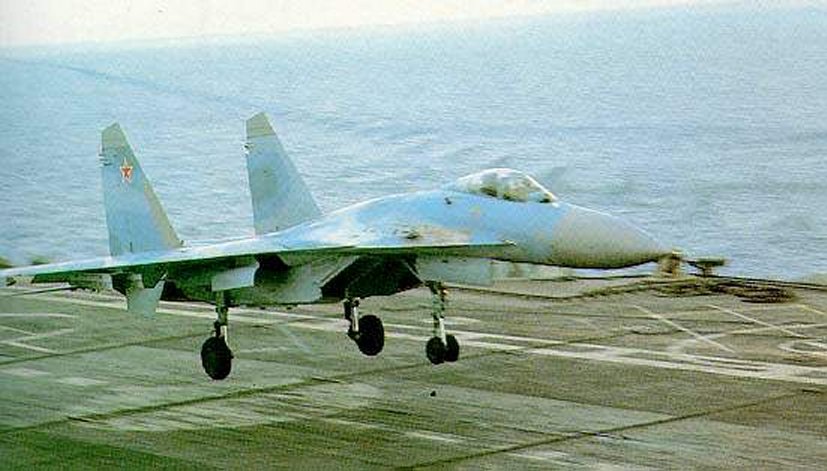
I mean its unit priced would had been cheapened, however it never happened because contrary to Russia where the F-15 counter part was navalized, the F-15 was not, there was enough money in the US to justify the F-14 existence.
However see that the F-18 replaced the F-14 only because it also was cheaper than the F-15, so it was more logic to design an F-14 replacement from the F-18 than from the F-15.
Missiles like the Meteor are making cheap fighters like the SAAB JAS-39 great multirole aircraft as good as an F-14 at BVR combat or as good as the Panavia Tornado or F-15E in terms of the arsenal carried
The AIM-54 as the R-33 are heavy weapons that impose great drag and weight penalty to the carrier aircraft.
The 1960s and early 1970s technology forced aircraft designers to build large aircraft to carry them with relatively large radars and a second man crew, these missiles were intended to be used against mainly bombers such as the Tu-22M, B-1B and B-52 and their cruise missiles.
However in todays world that does not happen, the Meteor can be fire by smaller jets, modern technology has given great processing power enough to dispense of a second man crew in the JAS-39, the F-14 in fact has become obsolete, because now cheaper and smaller fighters can do its job.
MiG-23MLDTomcat T,
Interesting post…I do not however agree with you about Grumman not having the political clout of others…I think they had vast amounts of it, being the main supplier of NavAir products since WW2…beating MacAir.
They used up the vast majority of that support in getting the 14 to the deck….a not inconsiderable achievement.
But from all the material I have read I still believe that the inherent capabilties of the airframe were never exploited purely for political reasons. The overturning of a SecDef and DoD sponsired programme (F-111B) by the users was always going to haunt the F-14 programme and it ensured that NavAir were always going to be pitted against the DoD…and when the NavAir supporters were removed (as you say Tailhook) the programme was pretty much on the skids.
Nothing to do with capability and everything to do with power…
One of the factors that killed the F-14 was it was over specialized and basicly was only purchased due to the fact the US navy wanted their own fighter, The F-15 was better as a dogfighter and also had AIM-7, it could had been navalized, even carry AIM-54s but since the whole reason the F-14 remained a need was the AIM-54, once the AIM-54 became obsolete, the F-14 also became obsolete and unwanted
MiG-23MLDPlease don’t make it the notorious F-18E vs. F-14 debate. We have had all this s__t.
Schorsch
man please first do not tell me what i can or can not say, second what i said its true, why you need the F-14 in an age even the Gripen can be armed with Meteors and IRIS-Ts?
The american as the Europeans will arm their new fighters with air breathing missiles like the Meteor that have long range like the AIM-54 but that are lighter into newer and stealthier platforms like the F-35 and F-18E, also range is no problem with inflight refuelling so if you have air refuelling, Meteors or AIM-120D and AIM-9X who needs the F-14? the answer only fans, the US needs to develop and deploy better weapons and the F-14 can not be put it into production now, the F-14 in the 1970s and 1980s was good because it was needed it had capabilities no other fighters had but in 2007 it is obsolete
the question you have asked it is easy to understand, and always you will end up mentioning the F-18E, why because the US strategists know and knew the F-14 shortcomings and knew a cheaper weapon or newer weapons could replace the ageing F-14, in fact look once the F-18 was deployed the versatility the F-18 had proved enough to replace the F-14.
Here all the F-14 fans want to workship the F-14 in an altar, but see the reality, in 2007 there are better weapons, the F-14 never was a perfect machine, niether special, it was a good aircraft and in the 1970s was good but in 2007 it is old, could it had been upgraded? yes it could had but the US Navy saw more future to the F-18 because it is cheaper and more versatile.
MiG-23MLDBasically, what Grumman gave the Navy was a very good starting point with F-14A. True the aircraft was expensive but then again the F-22 and the Super Hornet are also more expensive aircraft today. I think there was a 10 million dollar difference between the F-15 and the F-14 back then. Unfortunately Grumman and the F-14 never had the political clout that other companies had and as a result whilst alot was envisioned for the Tomcat when it started service little was accomplished. I mean the Basic F-14A was the main variant and served until 2003 without major modification – name another U.S aircraft that has been so neglected. To say the F-14 was a single role aircraft is in no way true Grumman had originally designed the aircraft as an air superiority fighter and then to screw six Phoenix on it without messing it up, they also designed plenty of growth potential into the aircraft and envisioned a ground attack role as well. However that was the job of the A-6 and A-7 and would have intruded on their territory. Furthermore Navy fighter jocks in those days saw dropping bombs as unglamorous. Had Grumman been able to sell the F-14 to the USAF over the F-15 – yet another Sparrow armed fighter – (which seemed likely at one stage) then we would have had commonality, a lower unit cost and the clout that USAF brings to a program. This would have resulted in continued devlopement of the F-14 instead of stagnation allowing the aicraft to be at the cutting edge right up to now. The F-14 really could have been as widely used as the F-4 was. Indead in the ACEVAL/AIMVAL simultation the F-14 on average achieved two times the kill ratio of the F-15. But this did not happen and the F-14A stayed as the main variant instead of the F-14B with the F-401 engine and even worse the F-14C (envisioned to enter service in the mid-80s didn’t happen). The Navy wanted a single seat version of the F-14 to replace the A-7/F-4 but this was not to be and the Navy was told to look at one of the LWF contenders ie the YF-17, developed into the F/A-18. Basically the USN wanted this jet at all costs as the A-7 and F-4 were aging rapidly even though one of the F/A-18 test pilots (Brian Fitzpatrick) testified that the USN should not procure this machine. Therein lies the thorn in the F-14s side – the Hornet – which took away most of the Navy’s meagre budget to make a half decent aircraft out of this machine. This combined with the money used for the A-12 and A-6F and NATF left nothing for the F-14. After the Tailhook 91′ fiasco several F-14 supporters were forced into premature retirment which allowed some pro-Hornet mafia into power – one was notably a buddy of Dick Cheney. The infamous Dick Cheney’s move to get rid of the F-14 and handicap the USN with Hornet 2000 closed the door not only F-14D production (a program fought very hard for and also already paid for) but also on further F-14 development and even production of F-14 spares! This despite lobbying by Grumman and a letter written by senior naval aviators read in congress by the Hon. Randy ‘Duke Cunningham to keep the F-14 in production. It’s a testiment to the capability of the F-14 that a ground attack capability was able to be added to the aircraft on a shoe-string budget and indeed making the aircraft the prefered striker over the Hornet. The F-14D is no slouch in air to air either and with thrust vectoring as proposed on the ST21 it could have been in the league of the Rafale and other 4.5 gen aircraft. Many say the F-14 is too big and heavy, remember the aircraft is of similar size to the F-15 and smaller and lighter than the SU-27 – the present standard to be measured against pending major F-22 production. Also the swing wing is not obsolete either as the envisioned F-22N (NATF) was also to have swing wings. Remember the Hornet did not take over any fighter capability from the F-14, it was a point defence aircraft meant to deal with any leakers that got past the initial F-14 BARCAP. The USN of today is not exactly replacing the F-14, it is merely surrending the role of the F-14 and resigned itself to rely on USAF support for all future activities – even so far as changing its doctrine to littoral operations and therefore not requiring a long range machine like the F-14 simply because admitting that they are operating at a disadvantage is not an option and would be highly scandalous. All in all the F-14 served well but could have still been serving probably at the same level of the F-15 had there not been so many obstacles, mainly political in it’s path. Unfortunately politics count more in military aquisition than actual capability – until a proper war starts and hard lessons are learned!
I do not thuink the F-14 is a need in 2007, first there are new longer range versions in design of the well proven AIM-120 and second the F-18E armed with AIM-9X canbeat even the Su-30MKI, as long as the US gets a Meteor or the AIM-120D
MiG-23MLDWhich has what to do with anything? We were talking about the F-15 and Mig-25.
It has to do because even with turbofans the MiG-31 can reach Mach 2.83 and cruise at Mach 2.3
MiG-23MLDNo intention to compare something. I want to find out if why the Navy went for the F-14 and remained loyal to the design even after many problems surfaced. From today’s perpective, the F-14 has some major shortcomings even for its time (weight, reliability, engine, accidient rate), which would have justified a bail out from the program. But it looks like the Navy was well aware of shortcomings and saw them solved in the evolution of the aircraft (as I said, the A-version of an aircraft never performs outstanding; in Russia anything before the M-version was extended prototyping :diablo: ). But the evolution was cut due to budget constraints.
Schorsch
Without comparing it is impossible to know the answer, first the specifications were laid, Grumman satisfied the navy requirements so they won the bid and could supply their design to the US navy, once the aircraft flew for the first time in 1970, there was not real enemy fighter that could dogfight with it or beat it at BVR combat, the F-15 was in reality the only real competition it had, but this was a land fighter, the US Navy wanted to remain independent from the USAF, so the aircraft remained for them the only real option, The reason why the F-15N never became a reality, niether the F-14 an USAF fighter was simply the US is a wealthy country, if we remember the Russian experience the MiG-29K was an amazing fighter but lack of funds killed the program for the Russian navy and only the Su-33 ended as the operational aircraft, in few words when money is available politics are less important, in the 1970s no Russian fighter (Soviet in old terms) was capable of beating the F-14, there were MiG-25s and MiG-23s available but these aircraft were not capable of beating it, the Tu-128 and the Su-15 were much much less capable and the Yak-38 well was totally outclassed by the F-14 and even the Harrier was better.
However once the competition got better they needed to upgrade the F-14 so they fielded a few F-14B/Ds but in reality in terms of capabilities the F-14 did get obsolete only in the late 1990s.
Why did the F-14 got obsolete, well first it is later aircraft designers got better technology available, so the F-18 turned a better dogfighter and later new SA missiles competed with the F-14 in many ways.
Another important reason is as a wealthy nation the USA retires aircraft that in other nations would remain operational longer time due in part to a real need and in part because the US military complex demands new weapons to be purchased by the US armed forces
Technically speaking the F-14 remained a need due to the AIM-54 and AWG-9 radar system, but beyond that the F-15 was the better fighter and it easy to prove that simple because Israel and Japan chose the F-15 over the F-14.
In terms of which fighter is better killing MiGs, the F-15 proved that can kill the MiG-25, and the only reason the F-14 remained as a NAVAL fighter was simply because of the Tu-22M threat.


 Sign In