 MiG-23MLD
BTW, your posts don’t become more intelligent by varying the font size. :p
I do not need personal attacks Rocky, the question is simply the degree of veracity of both accounst we have presented is not to a level we can know the truth, that is the reason they say:
HISTORY IS A LIE WRITTEN BY THOSE WHO WERE NOT THERE AND THEN NEVERTHELESS THEY WRITE ABOUT THE THINGS THEY WANTED TO HAVE HAPPENED
Prove your account is veridict and do not base your defences in personal attacks i am bored of that style of chatting
MiG-23MLD:rolleyes:
For a defence of your sources it is a little bit poor, the likelihood of an F-16 been destroyed by a combination of SAMs and AA-7 Apex is not as unlikely as you think, specailly when you do not question a single official account, the F-14, F-16s and F-18 were indeed killed the only question here is what killed them? the Russian sources say aircraft and the amercian sources say SAMs
MiG-23MLDSome may have been able to then, but only if they HAD AIM-7 or AIM-120. You wrote below that the AIM-7 was first tested on the F-16 in June 1991. That was months after the war was over. Full scale production of the AIM-120 began in April 1991 – after the war was over. I have a dim memory that a few AIM-120 were issued to F-15Cs late in the war, but ALL the missile kills were made by AIM-7 and a few AIM-9. All but a couple of the kills were made by F-15Cs. They had the air superiority mission.
There were no F-16ADF deployed to the Gulf War.
Sure, the F-16 could have killed lots of Iraqi aircraft, but thats not what they were sent there to do. The F-15C is a far better fighter, so why would you assign an inferior fighter for the job?
FYI, all the F-16s were downed by SAMs and ground fire.
“No Viper air combat victories were recorded in Desert Storm, primarily due to lack of opportunity. In what few chances arose, the USAF F-15C Eagles assigned to gaining air superiority simply elbowed everyone else out of the way, including the USN Tomcats.
In any case, the F-16 was mainly used as a bomb truck, and for defence suppression…
In all, F-16s delivered about 20,000 tons of ordnanceduring the conflict; about one fifth of the total.”The Great Book of Modern Warplanes, edited by Mike Spick c. 2003
Rocky
First let us see what are the facts:
Official US sources claim five F-16s were shot down and no F-16 shot down an enemy fighter
The F-16 losses are atributed to SAMs, the offical US sources claim SAMs did the damage.
Now we have contradictions, In 1982 the F-16A shot down 40 MiGs and Sukhois, the F-16 can carry short range AIM-9 for self defence or to kill aerial threats, the F-16 is a fighter bomber so it can carry both offensive and defensive external stores among them, AIM-9s and Bombs, so by logic it can shot down enemy fighters
The Russian account claims the F-16 indeed is an air superioty with secondary attack capability, it is not an F-117 or a B-52, even if the first F-16s did not have AIM-7s or AIM-120 (despite Lockheed started delivery of them to the National guard in 1989) the Iraqis were flying almost the same aircraft Syria did in 1982.
The conclusion is easy you can bring your sources and and i can quote the Russian reports see that basicly both have the same probability to be veridict because the F-16s were destroyed in combat and were in the battle zone, the chances they could had shot down enemy fighters was high and in fact the Iraqis claimed they vectored aircraft at the attacking forces and a MiG-23 shot down one F-16, see that they claimed one of those F-16s was destroyed by a MiG-23
The rest is only what account fits more what you want to hear, the russians claim their aircraft were good if the MiG-23 shot down the F-16 or the Russian SAMs were good if you believe the american reports;)
MiG-23MLDSo? The Tomcat didn’t get any fixed-wing kills either. Know why? Because the F-15s were tasked with the job in the locations there was a chance of meeting them. The Iraqi’s would run anytime they detected an AWG-9. The F-15Cs had LPI capability. At least one account comes to mind wherein some Tomcats had been escorting A-6s on a mission and they were outbound and AWACS told them they had some Mig-29s on their tails. The Tomcats were waiting until they got close enough that the Migs couldn’t run and “two F-15s blew past us going the other way” and got the Migs. The pilots were disciplined enough not to just abandon the A-6s so they could take a shot at the Migs.
On the second day of war a MiG-25 interceptor shot down a naval F-18C fighter even despite the MiG-25 was basicly 1970 vintage and used 1970s tactics, and the Iraqi jets returned safely to their base. Shortly after that an F-14B, another US naval aircraft , was shot down in combat by a MiG-29
На второй день войны шальной перехватчик МиГ-25 над морем столкнулся с палубным истребителем ВМС США F/A-18C “Шершень”. “Орлов” по близости не оказалось, а “Шершень” с МиГом, даже “двадцать пятым”, сделанным под стандарты семидесятых годов, тягаться не может. “Восемнадцатый” был сбит, а МиГ благополучно вернулся к себе на базу. Вскоре F-14B, еще один палубный истребитель США, погиб в бою против МиГа-29
So you here have a F-14 killed by a MiG-29 official AMERICAN sources claimed the F-14 was killed by a SAM but unoficial there were reports of a MiG-25 killing the F-14 but in this account the killer was a MiG-29
Officially the only victim for the F-14 according to american reports was only a Mi-8 😉
MiG-23MLDWhat is the market-price of a barrel crude oil right now?! ~50$ right now. When you demand less for that, your economy will suffer. That had happened to the SU and led to its economical crumble.
Today it is cheap labour and do not pricing the related development cost. The poor Russian taxpayer did that before and present Russia is more intrested to keep its weapons-industry alive at first through most competive prices.
Do not think so, Russia`s economy main trouble was first all the social institutions were weakened by the privatization of the economy and second was the fact the russian economy was not ready to compete in the world markets in terms of manufactured goods they did not have the quality niether the markets in 1990
By 1990 the Soviet economy was relying too much inold technology and in a corrupted burocracy.
However Russian weapons were different they were always competing so they had good quality therefore the only goods that could remain competing with the west were Russian weapons
MiG-23MLDDo you have the name of the pilot of the MiG, of the F-117?
What happened to the F-117 pilot?
What happened to the remains of the Nighthawk?When that F-117 got shot down over Serbia in 1999, it was all over Serb TV the next day.
In the case of the Iraqi Nighthawk, it would seem that it has truly gained the status of ‘invisible aircraft’…Neither the MiG-23, nor any of the following generations of Soviet combat aircraft were never ever cheap to design, produce, or to maintain in military service. The Flogger in particular, has a bad reputation for maintaining in service, and it may explain why it has been removed from service in nearly every Eastern European and former Soviet republics. The previous generation MiG-21 has outlived the MiG-23 in military service, in many air forces of the former Warsaw Pact.
Soviet aircraft were never cheap for the Soviets themselves to produce.
I doubt if a single MiG-23 needed less ‘man hours’ to produce, compared to say, a single Mirage F1, SAAB JA37 Viggen or even a single F-16. Especially when you consider how inefficient and inflexible Soviet industry was at that time.
Weapons are not cheap in General but undoutedly all soviet aircraft were simplier therefore the technologies applied were much cheaper in the Former Soviet Union, because even without the PPP dollars applied all Soviet aircraft were much cheaper to build than any Western aircraft even the French ones.
See that in 1980 a MiG-23MS costed 3 to 5 times cheaper than an F-16 and the F-16 was the cheapest western fighter of the fourth generation we are not talking about the F-14 or F-15 which costed around USD $25-USD $30 million dollars a piece
MiG-23MLDYeah, yeah. We have seen endless numbers of posts by you quoting disreputable sources.
Thats because the F-16 wasn’t tasked for the air superiority mission. It was a bomb hauler. The only aircraft devoted to clearing the sky of Iraqi aircraft was the F-15C. The F-16 is an excellent dogfighter, but it never had the radar to be “a full-fledged fighter aircraft”. In the air-to-air role, it would be more apt to call it a low-end, poor man’s fighter aircraft.
Rocky
Your explanation about the F-16 lack of success is not totally acurate, there are a few questions you have to answer.
Can not the F-16 fire the AIM-7 and AIM-120?

See that since 1989 they could carry AIM-7 and AIM-120 in USAf service
total of 271 F-16A/B airframes were to be modified to ADF configuration at the Ogden Air Logistics Center in Utah. Modifications included the installation of a HF radio and an improved APG-66 radar that was compatible with the AIM-7 Sparrow and AIM-120 AMRAAM radar-guided missiles. A spotlight, similar to the one found on Danish and Norwegian aircraft, was to be installed on the port side of the nose to aid in the identification of nighttime intruders. The first rebuilt F-16A/B block 15 ADF aircraft was delivered in early 1989, with the program continuing into 1991. The 114th Tactical Fighter Training Squadron of the Oregon Air National Guard was the first unit to receive the new ADF aircraft. It was followed by the 194th Fighter Interceptor Squadron of the California ANG. F-16s of the Florida ANG fired live AIM-7 missiles for the first time in tests at Tyndall AFB in Florida in June of 1991.
http://www.f-16.net/f-16_users_article32.html
Did not the F-16 shot down 40 aircraft over the Bekka Valley?
consider that in 1982 the F-16A shot down according to Israeli sources 40 MiGs and Sukhois only armed with AIM-9s
The F-16 can jetisson all the air to ground and become an agile fighter
consider that the F-16s were shot down in combat and therefore they were in contact with the enemy forces including Iraqi fighter aircraft therefore the super agile star of the Bekka Valley should had done as good as it did in 1982, i mean are not the Russian AAM so bad that barely shot down only one aircraft? so it means only armed with AIM-9s the F-16s could have shot down more aircraft
but the only thing we find is excuses to appologize for the zero kills it achieved and the five F-16s shot down in GWI
MiG-23MLDCongratulations. With translation and source named.
I do not agree in all claims from the Russian side, but is no surprise for you.
But I am looking into the rumors of a single F-4E claim from 11th June seriously. Maybe in some weeks I have first hand details about that.Comparing political prices are a joke. What was the price in Rubels? What was the exchange rate for that and many other questions more?
At least we can agree that the Russian weaponary was much cheaper to “buy”. Cheaper to operate, maybe in countries with low labour-costs.
Sens
Usually the Russians differ in what respect the combat records the West claims for their MiGs and Sukhois, this is one example, check and see this is a common perspective in Russia about aerial warfare involving Russian aircraft
Однако куда больший удар ждал американцев впереди. F-16C “Сражающийся сокол”, истребитель завоевания господства в воздухе, был сбит с допотопного МиГа-23 ракетой ближнего боя на встречном курсе.
С F-16 вообще получилась история, достойная отдельного упоминания. Этот самолет создавался, как полноценный истребитель, но в ходе “Бури в пустыне” не смог сбить НИ ОДНОГО летательного аппарата иракцев. Перепрофилированный на решение ударных задач, “Сокол” вновь показал крайне низкую результативность. Всего за войну ВВС США потеряли пять этих машин, если верить официальным данным. По неофициальным их число в несколько раз выше. Арабские источники называли цифру в 15 и даже 20 самолетов
However, which is much bigger than the impact of Americans waited ahead for their aircraft. In the case of the F-16C Fighting Falcon it was expected that it could achieve air superiority, nevertheless An F-16 was shot down by a missile fired by a MiG-23 at close combat dogfight.
The F-16 had arrived history worthy of special mention. This aircraft was designed as a full-fledged fighter aircraft, but during Desert Storm it has failed to kill any Iraqi aircraft.
The United States Air Force lost five of these machines during Desert Storm, according to official figures. The unofficial number is several times higher.
Arab sources cited the figure of 15 and even 20 F-16 shot down during Desert Storm.
а 20 января получили тяжелейший удар. Восемь “Торнадо” поднялись в воздух, чтобы атаковать авиабазу Мухаррак. До цели долетели семь. Восьмой разбился по дороге. Сброшенные на авиабазу бомбы в цель не попали. При уходе на свой аэродром англичане подверглись нападению МиГов-29, которые сбили еще один истребитель-бомбардировщик
On 20 January was a terrible blow. Eight Tornado took off to attack the Mukharrak air field however only seven went ahead to attack it, one had to abort the mission. once in their way back to base they were intercepted by MiG-29s, and then a MiG-29 shot down another Panavia Tornado
Source http://www.duel.ru/200012/?12_6_1
However this source claims a F-117 was shot down in Desert Storm
The strong point for this account are basicly indeed several F-16s and Tornado were shot down they only differ in the way they were shot down, the F-117 however is a little bit harder fact to prove because this involves a cover up by the USAF
One F -117 was shot down by fire from the earth, one more, according to unofficial reports, it was anihilated in combat with a MiG-25.
Один F-117 был сбит огнем с земли, еще один, по неофициальным данным, погиб в бою с МиГом-25.
About prices consider is not only the exchange rate but also design philosophy the Soviets built simple aircraft that had cheaper and easier manufacture than what the West usually had, you can not have both world either is cheap and simple or complex and expensive;)
MiG-23MLDThe F-1C and the MiG-23M are the same generation and had similar performances. The F-4 was a decade before.
The F-4E had entered service 5 years ahead before the first MiG-23M entered service.
At that time scale the F-106A served as intercepter in the USA similar the PVO.
Neither the F-106A nor the MiG-23M had the range to clash somewhere through the mid 70s to mid 80s really.
The German evaluation of the MiG-23ML showed, that it was even to the F-4F at low and medium heights, where most of all air-combat took place most of the time in reality.
The Flogger ML had high flight performances and a capable radar, but that advantages were offset to a high degree by a high-workload of the single pilot, even when limited to the fighter role only. Such workload did matter less, when the pilot had good CGI support to ease the workload for the pilot in combat and the pilot is informed in advance about things to come. The MiG-23ML was not very difficult to fly, but to operate the weaponsystem at the same time was a very demanding task. So none was surprised to learn, that the avionik upgrades offered would have more than doubled the combat effectiviness alone. Even without that , the MiG-23ML is still a usefull tool for hit and run tactics with AAMs from the 80s at least.
According to Russian magazines, books and web sites the MiG-23 was comparable to the F-4, in some areas it was better in others was slightly inferior but in general as a fighter aircraft was a fighter that could deal with the F-4 in even terms.
However it is considered as slightly better aircraft than the F-4.
When this two fighters clashed according to Russian sources the results were mixed.
этот же день открыли боевой счет и фронтовые истребители МиГ-23МС: два самолета этого типа, пилотируемые летчиками Томи и Али, атаковали ракетами Р-13М и Р-3С группу израильских «Фантомов» и сбили один F-4E, однако при выходе из атаки сами были сбиты противником (скорее всего, вновь сработал «великолепный тандем» – F-15/Е-2С).
On the same day two MiG-23MS manned by the pilots Tomi and Ali attacked with missiles R-13M and R-3S a group of Israeli F-4s and shot one F4E, but at the end of the attacks themselves were shot down enemy (most likely once again were shot down by the excellent tandem of F-15/E-2S).
11 июня пара МиГ-23МС (летчики Хейрат и Заби) перехватила и уничтожила залпом ракет Р-2С и Р-13М самолет F-4E, однако и в этот раз оба МиГа-23МС после успешно проведенной атаки не сумели выйти из боя и были сбиты (сирийским летчикам удалось успешно катапультироваться). Всего в этот день сирийцы сбили три F-4, потеряв при этом два МиГ-23МС и четыре МиГ-21МФ (израильтяне объявили об уничтожении «18 сирийских самолетов различных типов»).
On June 11 a pair of MiG-23MS (Khairat pilots and Zabih) intercepted and destroyed with R-2S and R-13Ms missiles an F4Es, but this time both MiG-23MS following a successful attack failed to withdraw from the battle and were shot down (both Syrian pilots successfully ejected). That day the Syrians shot down three F-4 losing the two Mig-23ms and four MiG-21MF (the Israelis announced the destruction of 18 Syrian aircraft of various types “).
However the MiG-23 was quit cheap for an aircraft of its time
МиГ-23МС и МиГ-23БH широко поставлялись на экспорт и в страны «третьего мира», чему способствовала, кроме высоких ЛТХ, относительно низкая стоимость истребителей. Так, в ценах 1980 г. один МиГ-23МС «отпускался» за 3,6-6,6 млн.долл. (в зависимости от степени «дружеского расположения» к стране-покупателю). Для сравнения, самолет IAI «Кфир”С.2, уступающий по боевым возможностям МиГ-23, по курсу 1978 г. стоил 4,5 млн.долл., «Мираж»III – 6,5-7,5 млн.долл. (курс 1983 г.), F-16A – 14 млн.долл. (курс 1980 г.), а «простой и дешевый» истребитель Hортроп F-20 «Тайгер»2 предполагалась продавать иностранным покупателям за 15 млн.долл. (курс 1985 г.).
However its price was quit competitive
The relatively low cost of the fighters:
by the year 1980 one МIG-23МS was priced from USD $3,6 to $6,6 million dollars, depending in the costomer; other contemporary aircraft had higher prices among them we see that the IAI Кfir С.2 was the closest western competitor in 1978 this aircraft costed USD $4,5million dollars, the Mirage III -was valued in the range of USD $6,5 to 7,5 million dollars in the year of 1983, F-16A had a price in 1980 of USD $14 million dollars even in 1985 the low cost light weight fighter F-20 Tigershark had a much higher price tag of USD $ 15 million dollars.
source:http://www.airwar.ru/history/locwar/bv/mig23/mig23.html
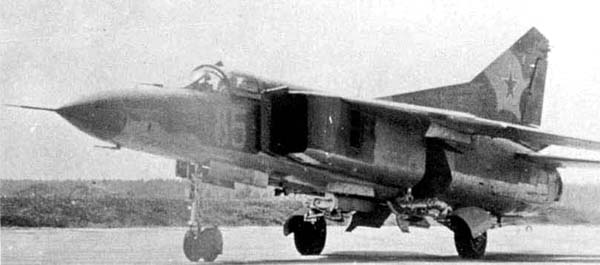
source of the picture http://forum.airforce.ru/viewtopic.php?t=1104
MiG-23MLDI am still astonished to read how fighters were compared here.
The century ones entered service in the late 50s, when the MiGs did so a decade later.
Looking into OKB MiG:
The MiG-23S (23/11) “… only fifty copies were built between mid-1969 and the end of 1970.” (p362)
Max speed in clean confi. 72° sweep 2405 km/h or Mach 2,27 at 12800 m (1298 kt at 42000 feet), max speed with four R-3S AAM (72° sweep) 2100 km/h or Mach 1,98 (1133 kt), max operating Mach number , 2,27; service ceiling in clean confi. 18000 m (59040 ft); service ceiling with four R-3S AAM 16500 m (54120 ft).
Ferry range clean confi. 2090 km (1300 mi)
Ferry range with four R-3S , 1800 km (970 mi)
Ferry range with 800 l drop tank clean, 2500 km (1350 mi)
The M entered service in the 70s at the same time as the F-15A.
The refined ML entered service in the late 70s at the same time as the F-16A.Non claimed, that the Flogger was a bad aircraft. But comparing technology from the 50s with such from the 70s is a joke.
To give an idea, we can compare that century fighters with a Spitfire from the 30s by that. Reducing the time-scale to the first Flogger development to a decade, the distance is still to the Me-262 or first Meteors at all.
Usually the Russians never compare the MiG-23 to other aircraft beyond the F-4E and the Mirage F1, these two aircraft are consider by the Russians as the aircraft in the same generation and capabilities.
The F-106 was basicly a second generation aircraft and the MiG-23 one of the third generation jet fighter, however in war there are moments when different generations clash.
MiG-23MLDI had a look at the Joe Baugher web page that you misquoted, he was in fact referring to pre-production aircraft used for testing. If you had read further you might have seen what else Joe had to say…
http://home.att.net/~jbaugher1/f106_1.html
Having said that, I do agree that the MiG-23 was probably the faster airplane (as you would expect from a variable geometry wing design). The question is though, whether this discrepancy in speed would have made any substantial difference in the outcome of any air intercept or air combat mission.
The F-106 was after all, still one of the fastest fighters in its day.
I always thought Thud was very highly thought of by its pilots! The chief problem for the F-105 and for the F-106 was the fact that both aircraft was never developed any further to cure any deficiencies that were found in early versions of each type. The F-105 was only in production for only 6 years, the F-106 for only 3. Both the MiG-23 and F-4 on the other hand, remained in production for over 16 years and were developed into many different improved versions, and you would judge both aircraft by examining the capabilities of early versions of these planes (MiG-23S/M, F-4B,) which left a lot to be desired.
As Flex297 just said (beating me to it), any later versions of the Thud could have introduced a redesigned and duplicated hydraulic system and maybe even some armour plating if desired, to improve survivability. Later versions of the F-106 could have been retrofitted with the AIM-7.
Sure, it may have increased weights somewhat, but this is fairly typical for most follow-on developments of aircraft.
Both century series fighters could have been fitted with uprated versions of the J75 engine, (up to 29,000lb) which were available, which would have rectified the weight matter somewhat, as well as improving performance.
I did not misquoted, the early F-106 had deficiencies in acceleration and the improvement of later verision was not not enough to cure them, the F-106 has an unimpressive climb rate and that reflects also a poor acceleration.
MiG-23MLD“MiG-23M (Type 23-11M, izdeliye 2M, ‘Flogger-B)…
The initial mass production of the wing pivots and no. 2 centre-fuselage steel tank – the MiG-23’s principal airframe load-bearing structural elements – was of low quality, and cracks occurred often on the MiG-23S/M/UBs produced in the early and mid-1970s. In addition, there were many wing sweep mechanism failures (mostly pivot structural failures), which prompted VVS command authorities to impose a temporary 5-g restriction that effectively prevented combat squadrons from practising basic figher manuvers until 1977. Until clearance was received for high-g manoeuvring, the main combat tactic of the MiG-23M- equipped VVS regiments for almost four years was all-aspect BVR intercepts.”
international AIR POWER REVIEW, volume 14, c 2004, p. 96 😎
The MiG-23MS was produced from 1973 to 1978. Note that in my earlier post, I said the “early” MiG-23MS was restricted to 5g. I am assuming that they didn’t build the export MiG-23MS any better than they built MiG-23M.
While it is possible early MiG-23 suffered from cracks, the only MiG-23s to my knowledge that were restricted to 5.5Gs, were the MiG-23S and MiG-23 Etalon 1971.
The late MiG-23M were cleared for 8Gs in fact there are two in house denomination for the MiG-23M aircraft 23-11M and 23-11M2 so we have two subvariants of the main MiG-23M, remember the Russians built from 1971 to 1972 the MiG-23 etalon 1971 or an early MiG-23M subvariant, late MiG-23Ms were cleared for 8Gs due to modifications .
If you noticed the MiG-23S Flogger A and the MiG-23 Etalon 1971 or Flogger B (subvariant of the MiG-23M) since the Etalon is called a Flogger B are the only MiG-23s restricted to 5.5Gs, therefore we can deduce the early 1971 was the aircraft limited to 5.5Gs
The MiG-23M prototype was test flown by Aleksandr Fedotov in June 1972. The aircraft was series-produced from 1972 to 1978 reaching a total of more than 1,300 planes. The MiG-23M became the first mass-produced MiG-23 version for the USSR Air Force and later Air Defence.
Since i do not know if the MiG-23M (23-11M2 and 23-11M aircraft) suffered from cracks operationally i can not assure you if the information you gave is acurate or not but to my knowledge the early MiG-23Ms or etalon 1971 were indeed restricted to 5.5Gs and i believe those were the MiG-23Ms limited to 5.5Gs since th rest of MiG-23s have a design limit of 8Gs
MiG-23MLDThe MiG-23MLD was clearly better than the F-106 in the air superiority role. The MiG had better rates of acceleration, climb, and sustained turn rate. The MiG’s thrust to weight ratio was better. Most importantly, the MiG-23MLD is going to get the first shot in with a BVR R-23R. Closer in, either the R-60 or the R-3 is much better against fighter type targets than an AIM-4.
At very high altitudes, the big wing of the F-106 would give that fighter the advantage in a gun fight.
The F-106A would fair better against the early MiG-23MS. The radar in the F-106A was superior, and the F-106A could shoot the MiG-23MS in the face with an AIM-4F Falcon SARH missile, while the MiG-23MS had no radar homing missile capability. Manuverability of the MiG-23MS was very poor, and the structure was weak. It was restricted to 5g after a test plane disintegrated while in a 7.3g turn. Handling at high AoA has been described as “vicious”, and the MIG-23MS (or MiG-23M) was “prone to enter an unrecoverable flat spin in such condidtions.” In short, the MiG-23MS was awful, but again, the missiles in the F-106A were not suited to dogfights, so I think gun kills would have been more likely.
Rocky
You are wrong, the MiG-23MS and MiG-23M were rated at 8Gs and could operate safely at those Gs, the only MiG-23 variants that were restricted to 5.5Gs were the MiG-23S Flogger A and the MiG-23 etalon 1972, these aircraft never were produced in quantity.
The MiG-23MS is basicly a MiG-23M with a very simple radar weapons system.
The F-106 would not have it easy, in fact the situation is a difficult one for the F-106, its rate of climb and acceleration means the MiG-23MS will rule the engagement and engage and disengage at will.
However the radar system fitted to the MiG-23MS limited it to only short range AA-2 Atolls.
In fact when the MiG-23M faced the F-4E in an air battle at the speeds of 800-1100 km/h at low and medium altitudes with the overloads at their max limits and close to the maximum of the thrust, MiG-23M in the horizontal maneuver exceeded the F-4E, however the MiG-23 was inferior to The F-4E in the vertical maneuver.
source При ведении воздушного боя с F-4E на скоростях 800-1100 км/ч на малых и средних высотах при перегрузках, близких к предельным по тяге, МиГ-23М в горизонтальном маневре превосходил противника, уступая ему в вертикальном маневре.
against the Mirage F1
Practically in the entire altitude range at the speeds of 700-1100 km/h, the MiG-23M surpassed the Mirage F-1 on maneuverability and rates of climb. At speeds more than 1100 km/h at average and high altitudes, the MiG-23M had lower sustained turn rates than the Mirage F1.
Практически во всем диапазоне высот на скоростях 700-1100 км/ч МиГ-23М превосходил “Мираж” F-1 по маневренности и скороподъемности. При скоростях более 1100 км/ч на средних и больших высотах летчику МиГ-23М было невыгодно вести бой с “Миражом” на установившихся виражах.
http://www.airwar.ru/enc/fighter/mig23m.html
MiG-23MLDhere is some data for teh acceleration for the F-106 and the MiG-23
In addition, the F-106A’s acceleration was significantly below Convair’s estimates, and it took almost 4 1/2 minutes to accelerate from Mach 1 to Mach 1.7 and another 2 1/2 minutes to accelerate to Mach 1.8. With such poor acceleration, it was felt that Mach numbers above 1.7 would not be tactically usable.
http://home.att.net/~jbaugher1/f106_1.html
these is for the MiG-23
According to the Mig-23 manual
The MiG-23ML accelerates from 600 km/h (373 mph) to 900 km/h (559 mph) in just 12 seconds at the altitude of 1000 meters. The MiG-23 accelerates at the altitude of 1 km from the speed of 630 km/h (391 mph) to 1300 km/h (808 mph) in just 30 seconds and at the altitude of 10-12 km will accelerate from Mach 1 to Mach 2 in just 160 seconds.
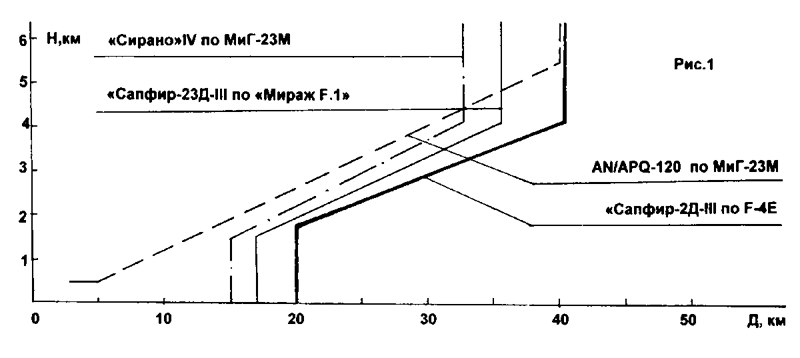
here we have a figure where are displayed the Saphir, APQ-120 and the Cyrano IV radars, as we can see it shows the detection range of each aircraft by each radar, the APQ-120 and Cyrano detecting the MiG-23 and the Saphir detecting the Mirage F1 and the F-4 as we can see the MiG-23 surpassed its rivals
however the R-23 was inferior in range to the AIM-7F 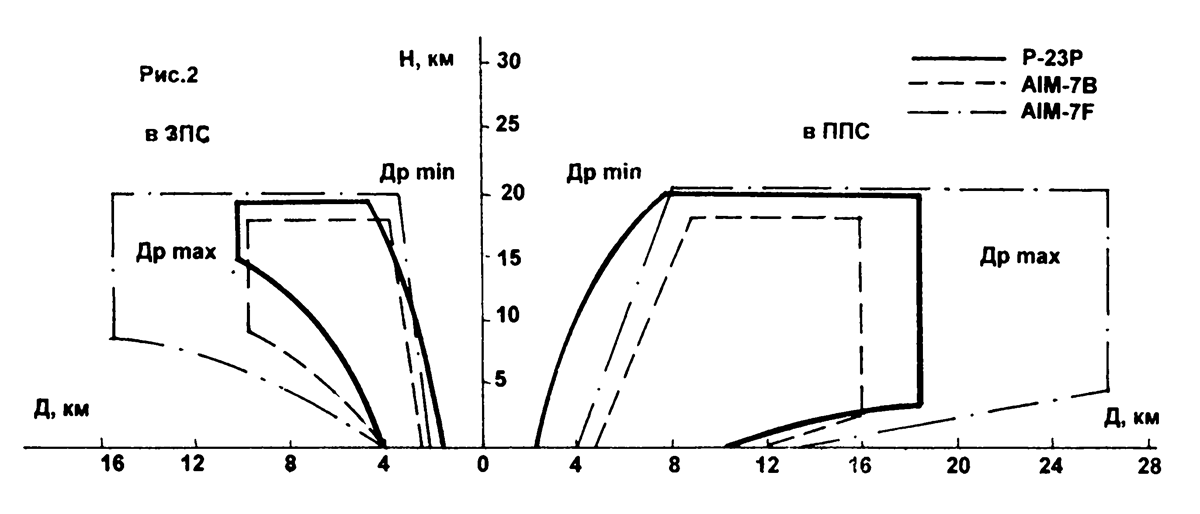
MiG-23MLDThe MiG-21 was second (at best) in every category. But it was second in some key categorys, and the number ones normally lost on other fields. The MiG-21 was exactly what could be built in time and budget and number in the late 1950s in the Soviet Union. The MiG-21 has seen a lot of action with mixed results. It is a prefect example that an aircraft (especially an early supersonic fighter) performs just as good as its pilots, air force commanders and boundary conditions allow. Once again, the aircraft versus aircraft comparison is crap, from bow to stern.
Although I don’t want to make the comparison (because it would mean to give the North Vietnamese American aircraft with similar Dollar value of their MiG fleet, which would have left the NV with 5 Phantoms or 15 F-5), I think it is fair to say that in 1965 the Soviet did not posses an aircraft of similar striking power (payload, range, speed, avionics), which still could with a reasonable chance survive an engagement against a fighter.
I do not agree with your theory, the MiG as any MiG or Sukhoi have been as good as their contemporary western counterparts, however these are simplier and less complex and were easier to build, a Su-24 for example was a complex machine and they built more than the americans, did build F-111s.
The aircraft in question the F-106 can not compete with the MiG-23 simply because the same price a F-106 had in 1960 was the same a MiG-23 had in 1980, that is the reason the MiG-23 was built in the thousends and the F-106 in the hundreds.
F-106 “Delta Dart”
Specifications
Wing Span 38 feet, 3.5 inches
Length 70 feet, 8.75 inches
Height 20 feet, 3.5 inches
Weight 35,000 lbs. maximum
Armament One Douglas AIR-2A Genie rocket with nuclear warhead, plus four AIM-4 Falcon missiles
Engine One Pratt & Whitney J75-P-17 engine with 24,500 lbs. of thrust, with afterburner
Cost $3,310,000
Maximum speed 1,525 mph
The 277th and last F-106A was delivered on July 20, 1961. The production run also included 63 F-106B two-seaters, for a total of 340 aircraft.
In the early 1980s, the MiG-23MS was priced between US$3.6 million and US$6.6 million depending on the customer
source
http://www.africana.ru/konkurs/raboti/Brylevsky/Angola.htm
source http://www.globalsecurity.org/military/systems/aircraft/f-106-specs.htm
Now the Mirage III probably was not very different from the F-106 in design concept and still having inferior agility to the MiG-21 achieved good results because the Israelies knew better the Mirage III than the Arabs the MiG-21.
The MiGs are good aircraft that have only the necesary equipment, only what is deemed economically and technically needed, the Western aircraft to the contrary usually had more sophistication that increased production costs.
contrary to what you are saying any aircraft has flying characteristics that in different parts of the flight envelop make it superior to its rivals but at the same time in others inferior, the F-4 for example at different speeds was better than both the MiG-21 and MiG-23 but in other speeds and altitudes was definitively less capable than the MiGs
Aircraft are destroyed even the F-15 has been shot down and the countries that have fought against claimed victories over it.
In general when two aircraft fight each other they have to see in what conditions they can prevail and in what conditions they can be defeated, in this case what altitudes and speeds avoid and if possible nulify the radar and weaponry its rival uses


 Sign In







