 MiG-23MLD
A former MiG-pilot noted, that the allowed Gs did differ considerably related to weight conditions and flight envelope.
Both quoted were tailored to the strongest axial-fighter engine available.
The Su-9/11 had to field the new Orel radar with 900 kg weight alone.
So two different weapon-systems and mission envelopes for both.
ANy aircraft can be upgrade, upgrades can give you several improved characteristics, for example this is a very interesting article:
Exactly at this time there on the official mission was located the key personnel of the Moscow state technical university of civil aviation in the aircraft engines docent v.V.Dvornichenko. According to the results of work the specialists came to conclusions, which is today possible to substantially increase the maneuverability of aircraft MiG-23ML and to re-engine the machine with a thrust vectoring nozzle, or by increasing the thrust TRDF (turbojet engine with afterburner) of the R-35-300, after replacing the regular engine and increasing the level of thrust and specific parameters
по окончании эритрейской войны. Как раз в это время там в служебной командировке находился ведущий специалист Московского Государственного технического университета гражданской авиации по авиадвигателям доцент В.В.Дворниченко. По результатам работы специалисты пришли к выводам, что сегодня возможно существенно увеличить маневренность самолета МиГ-23МЛ и ремото-ризировать машину либо применив многоракурсное сопло с изменяемым вектором тяги, либо путем форсирования тяги ТРДФ Р-35-300, либо заменив штатный двигатель истребителя перспективным с повышенным уровнем тяги и удельных параметров:
this study says that is possible by retrofitting a MiG-23 with an AL-41 it can achieve flying characteristics close to an F-22
The development of an computer programs from which were calculated the characteristics of TRDF (turbojet engine with afterburner) such as the R-35-300, were executed at [MGTU] GA in the department of engines LA, that in the past certified many domestic civil aviation aircraft engines and military jet engines.
For example, were calculated the characteristics of the Russian [TRDDF] AL-31F, AL-37F, AL-41F, NK-44, RD-36-51A, the American [TRDDF] Pratt & Whitney F-100PW-119, and also TRDF (turbojet engine with afterburner) PW-2037 for its aplication on civil aviation
The computer porgrams calculated the characteristics with augmented thrust TRDF (turbojet engine with afterburner) of the R-35-300 in all stages of the flight envelope of MiG-23ML or its remotorization by the installation of an AL-41F that improves the maneuvering characteristics of this third generation aircraft to the maneuvering characteristics of the newest American destroyer of the 5th generation F -22 Of raptor. The latter possesses vector thrust control only in the pitching plane for F -100PW-119,
Программа для ЭВМ, по которой рассчитывали характеристики ТРДФ Р35-300, была «российским продуктом», выполненным в МГТУ ГА на кафедре двигателей ЛА. Она прошла апробацию на многих отечественных ТРДФ и ТРДДФ для самолетов гражданской авиации и для двигателей маневренной авиации. К примеру, были рассчитаны российские ТРДДФ АЛ-31Ф, АЛ-37Ф, АЛ-41Ф, Н К-44, РД-36-51А, американские ТРДДФ Pratt & Whitney F-100PW-119, а также ТРДФ PW-2037 для са¬молетов гражданской авиации
Форсирование тяги ТРДФ Р35-300 на всех этапах полета истребителя Ми Г-23 МЛ или его ремоторизация путем установки ТРДДФ АЛ-41Ф улучшает характеристики маневренности этого самолета 3-го поколения до характеристик маневренности новейшего американского истребителя 5-го поколения F-22 Raptor. Последний обладает векторным регулированием тяги лишь в плоскости тангажа для ТРДДФ F-100PW-119,
http://www.be-and-co.com/ako/dvigatelestroenie/i-v-aviatsii-vsyo-genialnoe-ne-stol-uzh-slozhno/
however in the case of the Su-11 and MiG-21 in the 1960s the MiG-21 to my point of view was a more capable aircraft in fact only 100 Su-11 were ever produced nothing in comparation to the more than 10000 MiG-21 built, check the Russian can modernize a MiG-23 by retrofiting an Al-41F and making it as good as an F-22 in terms of performance, this is important because the Su-11 in that respect never evolved further and therefore we can see the MiG-21 offered characteristics it never could surpass, this limitation in development limited too much the future upgrading of the Su-11 and therefore operational future, same happened to the F-106 which simply faded away and was forgotten
The AL -41F will ensure also the modernization of the single-engined MiG-23ML.
The results of calculations satisfied our requirements, they are reliable and completely compared with the data of firm Mikoyan.
Именно такой ТРДДФ (например, АЛ-41Ф) обеспечит также и модернизацию одномоторного истребителя Ми Г-23 МЛ. Результаты расчетов удовлетворили нашим требованиям, достоверны и вполне сопоставимы с данными фирм-разработчиков.
Now let us examine a question about the maneuverability characteristics of this machine, using a procedure of German professor K Heineker, and by the Russian development of the author of this article (published in the collection of the works of defense of the University of Debrezeite in 2001.). With respect to it we compare horizontal turn rate with the use of a nozzle with variable thrust vectoring and without it.
We calculated the turn radius while this maneuvering. Which is interesting, if we compared to the F-22
We assume, that the turning of the nozzle is achieved in the pitching plane to the angles +- 20° as in F -22, so in MiG-23ML. The ratio of the parameters of angular rate of rotation MiG-23ML to F -22 composes 0,963.
Теперь рассмотрим вопрос о маневренных характеристиках этой машины, используя методику немецкого профессора К.Хайнека,дополненную российской разработкой автора этой статьи (опубликована в сборнике трудов Оборонного университета в Деб-ре-Зейте в 2001 г.). По ней мы сравниваем скорость вращения самолета на вираже в горизонтальной плоскости с применением многоракурсного сопла с изменяемым вектором тяги и без такового. Или рассчитываем радиус виража, который описывает самолет при этом маневре. Что любопытно, сравнивать будем с истребителем F-22 Raptor.Принимаем, что поворот многоракурсного сопла осуществляется в плоскости тангажа на углы +/- 20° как у F-22, так и у МиГ-23МЛ. Отношение параметров угловой скорости вращения МиГ-23 к F-22 составляет 0,963. То есть, старенький советский истребитель .
the parameters, identical for both engines [TRDDF]) it is obtained by 1550,7 m, and it is identical in both machines. Thus, [re-engine of domestic fighter aircraft is capable of drawing nearer and of even making even the parameters of maneuverability of the MiG-23ML with the F-22 Raptor. The angular velocity of turn in this case corresponds 12° per second.
параметрах, идентичных для обоих ТРДДФ) получается 1550,7 м, и у обеих машин одинаков. Таким образом, ремоторизация отечественных истребителей способна приблизить и даже уравнять параметры маневренности МиГ-23МЛ с F-22 Raptor. Угловая скорость виража при этом соответствует 12° в секунду.
MiG-23MLDA cop-out answer?? You’re kidding me right?
Basically you’re theorizing that an Su-7 optimized for air superiority (i.e. meaning some probably pretty serious changes to the airframe that we all identify as the Fitter-A) is better than a MiG-21. THEORIZING is the key word here. You have no proof other than the fact that the airframe is stronger….of course who’s to say that if an interceptor variant was built that it would have the exact same airframe strength?
You have to base conclusions on what was available at the time. You can always theorize and make up what-ifs for any situation? What if the Germans had had the Me-262 during the Battle of Britain. What if the P-26 Peashooter had entered service during World War I? The list goes on and on.
The Su-7 has a rugged airframe that is not in doubt, but that durability comes at a price. An aircraft with that type of structural strength is not going to be as agile as the MiG-21. Likewise, an airplane with the agility of the MiG-21 isn’t going to be as strong as something like an Su-7. There are trade-offs for both designs.
Regarding the Su-11, I don’t really see why you think it would all of a sudden make an effective dogfighter. It had a bit more range than the Fishbed and certainly a better radar, but how much better. I’d be willing to bet that it still wouldn’t have been better than the radar in any F-4, and the AA-3 Anab didn’t have the range to be a BVR weapon in the class of the AIM-7. With that being said, as you pointed out, air-to-air missile design was in its infancy and I can promise you that if an American weapon such as the AIM-7 wasn’t very good, then neither was its Russian counterpart. The Atoll & AIM-9B are prime examples. Neither were very good although both did have some success.
The Anab, like the original AIM-7, wasn’t designed to deal with mauevering targets like fighters and likely would have had a very low success rate just as the Sparrow did. Furthermore, a radar-guided weapon (yes I know it came in IR-versions as well) like the Anab requires a lock-on throughout the missile’s flight time. A ambush against, say, a flight of bomb-laden F-105’s would possibly have netted a kill or two (provided the targets in question didn’t manuever too much when the AA-3 was fired), but it would have left the firing Fishpot in a very vulnerable situation, and with all of the prowling Phantoms (or Crusaders in some case) escorting the strikers, the Su-11 needs to make a quick kill and bug out of he’s history. A weapon like the AA-3 at the time didn’t allow that. An Atoll equipped MiG-21 has roughly similar chances of scoring a kill, and once his missile is fired, he is free to manuever to avoid any counter attacks, if he has been seen.
Additionally, the Su-11’s only weapon besides the two Anab missiles was a pair of UPK-23 cannon pods under the fuselage. Not one, but two….which means double the drag, and likely jsut as difficult to get success with as the SUU-16 & -23 pods carried by the F-4C & F-4D. If these cannon pods are fitted, there is no room for external tanks, which means range is even less.
All in all aside from its better radar, I see little reason why the Su-11 would have been that much more successful than the MiG-21. It should also be noted that the Su-11 was a much larger airplane than any of the MiG types operated by the VPAF, so the advantage of small size and being hard to see goes out the window. This particular quality often led to MiG’s having success when otherwise they might have been seen early enough in their ambushes for the target aircraft to take evasive action.
So you see….I’m not copping out on anything. I’m simply explaining the reasons that I feel you are incorrect in your assessment of how the Su-11 or a fictitous version of the Su-7 would have performed instead of the aformentioned MiG-21 (or MiG-17 & J-6 for that matter).
If you can make up an airplane for a conflict and say that it might have been better then can I do the same? Afterall, fair is fair…….right?
I think the Su-9 and MiG-21 are little bit the same type of aircraft, however i think the MiG-21 has two main advantages over the Su-11: one it was probably cheaper and second its latest variant could sustain higher overloads than the 7Gs limit the Su-9 had.
Probably the Su-11 was not different from the Su-9 in that respect so i would say the MiG-21 from my humble point of view was a better aircraft
With respect the MiG-23 different capabilities and characteristics i have to mention that the MiG-23MLD had AOA limit of 26-28 degrees:
The MiG-23 could fly at the angles of attack to 24-26 deg., which ensured it the definite advantages over the western fighter aircraft of the 2nd and 3erd generations. But with the advent of the aircraft of the 4th generation this superiority was lost (F-16 of different modifications they had a limitation on the angle of attack of 26-28 deg; a F-15c could leave to the angles of attack to 30 deg.)
МиГ-23 могли летать на углах атаки до 24-26 град., что обеспечивало им определенные преимущества над западными истребителями 2-го и 3-го поколений. Но с появлением самолетов 4-го поколения это превосходство было утрачено (F-16 различных модификаций имели ограничение по углу атаки 26-28 град., a F-15C мог выходить на углы атаки до 30 град.)
At the high angles of attack the MiG-23MLD creators attained the stability parameters and controllability, comparable with the flight AoA characteristics of the F-16
На больших углах атаки создатели МиГ-23МЛД добились характеристик устойчивости и управляемости, сопоставимых с характеристиками F-16
source:http://www.airwar.ru/enc/fighter/mig23mld.html
MiG-23MLD – most perfect modification in the MiG-23 family. This aircraft had an optimum aerodynamic configuration, ensuring an essential improvement in maneuverability with a minimum modification of glider aerodynamic configuraton. The fighter control radar Saphir MLA (008) is capable of a search and track of up to six aerial targets.
МиГ-23МЛД — наиболее совершенная модификация в семействе МиГ-23. Самолет имел оптимальную компоновку, обеспечивающую существенное улучшение маневренности
при минимальной модификации планера. РЛС истребителя способна обнаруживать и сопровождать до шести воздушных целей
http://www.kummolovo.ru/aircraft/mig_23.htm
MiG-23MLD has improved maneuverability in comparison with previous MiG-23 variants and a new fire control weapons system radar, capable of simultaneously search and track several aerial targets (The radar weapons system of American fighter F -15 does not possess this capability).
МиГ-23МЛД имеет улучшенную маневренность по сравнению с предыдущей модификацией и новую БРЛС, способную одновременно сопровождать несколько воздушных целей (БРЛС американского истребителя F-15 такой способностью не обладает).
http://mega.km.ru/weaponry/encyclop.asp?TopicNumber=3355

MiG-23MLDHere you have an advantage. You had revealed, that you speak Russian and you have the link to the source. So it is no problem for you to send an e-mail there or go into a forum of that, if there and ask for the missing details. That may be for the benefit of all of us. If your source is ok, they will not have problems to give that few details missing. Good luck. (None asked for a picture, but time and location is no secret!)
After that I will give you the details from the Netz pilots from Ramat David about that.Moscow’s lessons from the 1982 Lebanon air war
Cover ImageBy: Benjamin S. Lambeth
This report reviews Soviet impressions of Israeli air operations during the 1982 Lebanon war. It evaluates a 1983 article published in Soviet Air Force Monthly (whose audience includes Soviet aircrews), that assesses the implications of the Israeli-Syrian air battles. For Western audiences, the article provides insights into how the Soviets have interpreted the Beka’a Valley experience. It appears that the Soviets have either deliberately misrepresented Israel’s air combat results to their own pilots or else failed to comprehend the tactical lessons suggested by Israeli combat performance.
http://stinet.dtic.mil/cgi-bin/GetTRDoc?AD=ADA148310&Location=U2&doc=GetTRDoc.pdf
Sens
IF i get the information i will get it for you but the only information i have gotten for you is about the Israeli F-4 losses according to Israeli sources:
. In 2000, after the withdrawal of AOI from Lebanon, published data on the loss of the Air Force for the period 06.06.82-24.05.00 (No. 235, August 2000, p. 6). Сообщается, что за 18 лет потеряно:Reported that for 18 years lost :
5 боевых самолётов; 5 combat aircraft; Two IAI Kfirs, one A-4 , two F-4Es
2 боевых вертолёта; 2 combat helicopters;
2 транспортных вертолёта; two transport helicopters;
7 членов лётных экипажей и 2 бойца 669 погибли; seven of the crews and 2 soldier killed 669 dead ;
3 лётчика попали в плен и вернулись в Израиль, 1 (штурман Рон Арад) – не вернулся. three pilots were captured and returned to Israel, 1 (navigator Ron Arad) is not returned.
With respect to losses flight personnel and aircraft, the figures completely agree : 9 dead is the crews of two helicopters (five people on June 6, 1982 and June 16, 1982 3) and the navigator July 24, 1982. Вместе с экипажем «Кобры» 05.06.82 – 11 человек.Together with the crew June 5, 1982-11 people. Трое вернувшихся из плена – это лётчики «Скайхока» 06.06.82, «Фантома» 24.07.82 и «Кфира» 20.11.83.Three returned from captivity is the pilots June 6, 1982, July 24, 1982 and November 20, 1983. Рон Арад из плена не вернулся.Ron Arad was in captivity he never returned.
http://www.waronline.org/IDF/Articles/lebanon-losses.htm
On July 24 1982 a F-4E Phantom II was shot down, on November 20 1983 an IAI Kfir C2 was also shot down
You might think it is easy but getting detailed information is hard specially when a nation tries to prove it beated an enemy
MiG-23MLDI had a simple question about the June 7th incident from 1982. It seems you did not question your source or did not get any answer from, when done. It is more intresting to learn the true answer from that, than further wild guesses.
Sens
Believe me, if i had the answer i would tell you, but i would need to read again the source and translate it, any way i feel it will be a very difficult one to give you such detailed information, not because it might not exist, but because in reality i do not have such detailed information is like if i ask you give us each an every kill achieved by western aircraft with a picture and place.
This topic gives you an assessment of an aircraft based upon what people consider it is capable of doing, some might say, well the F-106 is similar to the Su-15 in capabilities and design concept.
Honestly when i consider the real capabilities of the MiG-23 i consider this:
As a fighter the MiG-23 was a fighter slightly better than the F-4 but it is not unlikely i can battle with an F-16 and beat it, in the Soviet air base of Marii the MiG-23 defeated the MiG-29 in BVR mock combat
The MiG-23 as far as BVR combat in the early 1980s was a relatively good aircraft and as such i do not think an R-23 or R-24 would not be able of shooting down F-16s armed soely with AIM-9s or Python III
After saying that i can tell you as far as likeliness i guess both accounts are more less probable in terms veracity but if you ask me such information you should ask the same degree of rigurosity from western sources and you will see you won`t find so much evidence either.
MiG-23MLDRocky, I don’t know why you and Sens even bother debating with Flogger. He’s always right…..didn’t you know that? 🙂
I get all the most accurate and vital air combat reporting from him.
I am not always right but at least i present you what the other side claims, what do you prefer only one sided history or at least a different version of the same event claimed by the other warring side?
MiG-23MLDThe F-105 was designed for low level flight at high speed, and consequently had a high wing loading. I doubt very much that either one had a significantly better ride than the other at low altitude. That said, the VG configuration of the MiG-27 is better for the high speed, low level mission than the fixed wing of the F-105. VG gives a better combination of short field performance, speed and range. The F-105 just happens to be a bigger jet, so it has better range and payload. The empty weight of the F-105 was 28,000 lbs, and the MiG-27 was 18,075 lbs. As has been written here, the MiG-27 was more like a Jaguar, and the MiG-23 was more like an F-4. The F-106A was more like a Su-15, although more contemporanious to the Su-11.
This doesn’t mean much. Any jet flying into intense AAA and SAMs is going to get shot down in great numbers. I doubt the MiG-27 would have survived any better or worse than the F-105. It just didn’t have the range/payload that the F-105 had. It seems the safest tactic is to fly at high altitude with good ECM and drop PGMs.
I agree the Su-15 and the F-106 are much more a match, the Su-15 carried even very short range AA-3s
MiG-23MLDWe don’t have to remember. You keep reposting the same bogus claims.
lol! I’m “Western sources”! 😀
Another my milkshake is better than your style answer.
Rocky
here in reality if we are strict is not a matter of i am pro Western or pro Russian it only shows you are judging an account upon nationality, simply like that, you are a nationalist not a Historian.
Sens
Now you pretend to be the extrict historian but how many kills have pictues and google earth style pictures come on Sens do not make me laugh.
The Reason why you reply is simply because either account has little evidence and you feel your accounts have some gaps that are illogic.
For example in 1981 the Russians claimed the Israelies lost an F-15 to a MiG-25, there is one F-15 Accident in 1981s a few months after the MiG-25 and F-15 clashes some have claimed this F-15 accident is a cover up of the F-15 killed of course this in part a conspiracy theory however not unlikely to be possible.
In GWI one of the F-15 i watched a Modern Marvel documentary from the History Channel that claims they were not sure what killed one of their F-15Es, they never discarded an aircraft shot it down however it appears many take it as a SAM kill
One of the Pakistani F-16 lost was claimed killed and shot down by a MiG-23 by the Russians and lost by the pakistani, the first time the Pakistanies announced the kill, they claimed it was lost to enemy fire from an enemy fighter and later they claimed it was killed in a fraticide incident:rolleyes:
One of the funny aspects about the so called Bekka Valley turkey shot mysteries is according to the Western account many of the F-15 and F-16 kills are MiGs of UNKOWN type? can you believe that unkown type even when they claimed they killed mostly all their enemies at WVR and with Python III and AIM-9s:rolleyes:
Any western account claims also things that barely proves, i have never seen so many kills on pictures in fact i have seen more wreck pictures on russian webpages than in western ones.
Now the question i asked is why the R-23 will have less chances to kill a F-16 than a a AIM-9L or Python III a MIG-23?
At any moment missiles fired have a kill rate see that even in one account the MiG-23MS killed a F-4E with two AA-2s and both fired by two different aircraft.
The R-23 and AIM-9 once fired will have a similar kill probability rate, so in few words a fighter fitted with an IRST and that can accelerate fast and fly faster and lower than the F-15 or F-16 will be able to do fast attacks and later just run away and if it fires R-23s very likely some of the R-23s will kill some F-4s, F-15s and F-16s
MiG-23MLDIsn’t it funny how all MiG-23s that allegedly killed F-16s got shot down themselves? :rolleyes:
Is not funny all the Western losses are SAM kills?:rolleyes:
MiG-23MLDBVR did not work under Bekaa conditions. All combat was in WR conditions.
Even the AIM-9L could not be fired several times. IFF was the main problem.
When not shure if the seekerhead tracked the real target, it was not fired and the off-bore-sight capbility of little use too. Speeds and distances in mind, just a few seconds were left for a firing opportunity at all.
The limited view from the Flogger was a true disadvantake under that conditions.
IRST may work fine at medium or high-up, when supported by CGI for first vectoring under European conditions. In central Europe there was a clear FLOT and multiple defences. The Russian did know the prime targets of the NATO and the other way around. Looking into the personal battle reports of the pilots involved seriously show the limitations both sides did face under that special circumstances. Range did not matter, but was an obstacle. In a few instances a medium AAM got a firing opportunity of an egressing foe.
Even most short-range AAMs were fired at gun-range nearly. Non is surprised about that, because the combat range was no more than 2 km under G-forces and low level at all.
Sens
You are just giving expeculations, according to the Rusians accounts i have read this were more less the condition in which the MiG-23MF fought:
On 7 June 1982, three MiG-23MFs flown by the pilots Hallyak, Said, Merza engaged a formation of Israeli F-16s. Captain Merza detected the F-16s at a distance of 25 km and shot down two F-16s with R-23 missiles, one from a distance of 9 km, and another within the distance of 7 km or 8 km, before himself was shot down. On June 8, 1982, two MiG-23MFs again met with F-16s. Major Hau’s MiG-23 detected an F-16 at a distance of 21km and shot it down with an R-23 from a distance of 7km. Again, the Syrian pilot was himself shot down by an AIM-9 Sidewinder, fired from another F-16. On June 9 1982, two MiG-23MFs, piloted by Dib and Said, engaged a group of F-16s. Dib shot down an F-16 from a distance of 6km with an R-23, but was then shot down, most likely by a Sidewinder.
Later that day a pair of MiG-23MFs manned by the Syrian pilots Nahaz and Zeno, shot down an additional F-16, Nahaz detected the F-16 at the distance of 9 km and fired an AAM at the distance of 5 km however this time, Nahaz got involved in a dogfight with another F-16 and was shot down.
After detecting the MiG-23 formation, the Israeli E-2 Hawkeye operators did not vector the F -15s to intercept the MiG-23s but the lighter F -16s armed with short range AIM-9 Sidewinders.
The F-16 flew in groups of two aircraft flying at low altitude, these pairs were vectored out into the MiG-23s formations, then the first pair dispersed and attacked the MiG-23s from both flanks, threatening the MiG-23 formation with a stern attack (the method is known as “sandwich”). Only two unfavorable options were left out to the Syrians; one was to leave the battle and return to friendly airspace or engage the F-16s at close combat range where the F-16s surpass the MiG-23s in maneuverability. In the case of continuing with the interception of the Israeli fighter bombers echelons, it was basicly to continue under the threat of frontal attack by the F -15s armed with long range air to air missiles.
This tactic proved to be successful for the Israelies specially if proper jamming was applied, even despite the MiG-23s carried out successful attacks, the Saphir-23 radar had its practical range of detection reduced and the MiG-23s usually detected the F-16s from within the ranges of 25 to 9 km, it tracked the F-16s within the ranges of 21 to 7 km and fired air to air missiles at the F-16s from within the distances of 9 to 5 km, this was the main reason why four Syrian MiG-23 were shot down even after the Syrian pilots had already carried out successful attacks at the Israeli F-16s.
Thus, in the course of the air combats over Lebanon. from 1982 through 1985, the Syrian MiG-23 destroyed 12 enemy aircraft (including a minimum of five F -16 and three F -15) while twelve MiG-23MF and MiG-23MS were lost to enemy fire, This is a relatively good kill rate, if one considers that the majority of Syrian MiG-23s were early models that lacked the most advanced features of late MiG-23 models, and in spite of that, they managed to shot down the more advanced contemporary American fourth generation fighter aircraft, which were flown by perhaps the best trained pilots in the world.
During the course of the 1982 air battles over Lebanon, the MiG-23 displayed both its strengths and deficiencies.
High-speed and quick acceleration were the MiG-23 main strengths which allowed it, the ability to carry out swift attacks and to withdrawn from the melee of the air battle at high speed (in the opinion of a number of western specialists, if the MiG-23 was flown by a skillful pilot it was capable of successfully attack and break off the encounter with any other less speedier fighter at will).
The MiG-23 can be flown for a relatively prolonged time on a high-speed low-altitude flight with its wings swept back at the maximum swept angle of 72 deg; the F -15 and F -16 with their low specific wing loads experienced near to the ground very strong aircraft turbulence and in flight fuselage vibration, and as if “they were riding on a cobblestone bridge” , this type of low flight at high speed could not be endured even by well trained F-15 or F-16 pilots.
At the same time the MiG-23 was somewhat inferior to the F -15 at both the maximum and minimum flight envelope characteristics, despite the F-15 was faster than the MiG-23 and could achieve the speed of Mach 2.5 in operational practice the F -15 could not exceed Mach 2.
The MiG-23 had worse horizontal maneuverability than the American F-15. At around the speed of 1200 km/h, the MiG-23 had lower load factor G limits than the F-15, consequently, also lower angular velocities, and longer turning time; the MiG-23 had inferior sustained angular velocity at the speed of 900 km/h. therefore the turn rate difference was at different heights in the range within 2 to 6 deg/s. However, as speed increased and beyond 1200 km/h the advantage gradually passed to the MiG-23.
The MiG-23 with its wings set at the swept angle of 45 deg, had inferior acceleration characteristics and was less maneuvrable close to the maximum operationally permitted overload G limits than the F-15.
This allowed that to an F -15 in the progress of an air combat to gradually accumulate superior kinetic energy in speed and height.
The required entry speed into the vertical maneuver was also somewhat higher in the MiG-23 than in F -15. the maximum altitude to enter into the Nesterov’s loop for the MiG-23 was 4000 m, and for F-15 was 7000 m, in this case at the upper point of vertical maneuvres the MiG-23 had lower speed than the F-15.
The radar complex that the American aircraft possessed had definite advantages over airborne radar aboard the MiG-23MF, this was more acute in the case of the MiG-23MS. However, the radar capabilities displayed by the MiG-23ML and F -15 proved to be approximately equal. The AN/APG-63 was able to detect the MiG-23 at the maximum range within 100-110 km (with heading angle of 90°), and MiG-23ML detected the enemy at the same conditions within the range of 90-95 km; both aircraft radar had the capability to detect targets against the background of the earth clutter (look down shoot down capability). Although the zone of survey for the AN/APG-63 along the azimuth exceeded twice the surveyed air space zone, it was respectively, + -60 °for the more modern AN/APG-63 and + -30°for the Saphir;
The Saphir-23 radar was 1,5 times better descriminating group target clutter than the American made AN/APG-63, this fact, in particular, allowed MiG-23 formations to hide from the enemy the true number of aircraft flying in a dense radar clutter system.
Таким образом, в ходе воздушных боев на Ближнем Востоке с 1982 по 1985 гг. МиГ-23 уничтожили 12 самолетов противника (в том числе, как минимум, пять F-16 и три F-15), при своих потерях в 11-13 машин. Не такой уж плохой баланс, если учесть, что большинство “двадцать третьих” относились к далеко не самым последним модификациям, а противостояли им наиболее современные в то время американские истребители четвертого поколения, в кабинах которых сидели летчики, имевшие, пожалуй, лучшую в мире профессиональную подготовку. В боях над Ливаном были продемонстрированы как сильные, так и слабые стороны МиГ-23. К первым относились высокие скоростные и разгонные характеристики, дававшие возможность выполнять стремительную атаку и выходить из боя с высокой скоростью (по мнению ряда западных специалистов, МиГ-23 при умелом пилотировании был способен успешно атаковать и выходить из атаки при встрече с любым другим истребителем). Определенные шансы на победу давала МиГу и способность к относительно длительному скоростному полету на малой высоте с крылом, установленным в положение максимальной стреловидности: F-15 и F-16 с низкой удельной нагрузкой на крыло испытывали у земли слишком сильную тряску, и такую “езду по булыжной мостовой” не могли долго выдерживать даже хорошо тренированные летчики.
В то же время МиГ-23 несколько уступал F-15 как по максимальной, так и по минимальной скоростям (впрочем, превосходство “Игла” по скорости было скорее теоретическим: на практике “2,5-маховый” F-15 не мог превышать М=2,3). Слабой стороной “двадцать третьего” явилась худшая горизонтальная маневренность по сравнению с новейшими американскими машинами. До скорости 1200 км/ч МиГ-23 имел меньшую располагаемую перегрузку, чем F-15, а следовательно, и меньшие угловые скорости разворота, а также большее время виража (проигрыш МиГа по установившейся угловой скорости разворота на скорости 900 км/ч составлял для различных высот 2-6°/с). Однако при скоростях свыше 1200 км/ч преимущество постепенно переходило к МиГу. Несколько уступал МиГ-23 американской машине в разгонных характеристиках при угле стреловидности 45° и маневрировании с перегрузками, близкими к предельным. Это позволяло F-15 в ходе боя постепенно накапливать превосходство в энергии (по скорости и высоте). Потребная скорость ввода МиГ-23 в вертикальный маневр была также несколько выше, чем у F-15. Максимальная высота ввода в петлю Нестерова для МиГа составляла 4000 м, а для F-15 – 7000 м, при этом в верхней точке вертикальных маневров МиГ-23 имел меньшую скорость, чем “Игл”.
Радиолокационный комплекс американского самолета обладал определенными преимуществами перед РЛС МиГ-23МФ, и особенно МиГ-23МС. Однако возможности усовершенствованных МиГ-23МЛ и F-15A оказались примерно равными. Установленная на “Игле” РЛС AN/APG-63 была в состоянии обнаружить МиГ-23 на максимальной дальности до 100-110 км (при курсовом угле 90°), а МиГ-23МЛ “видел” противника при тех же условиях на удалении 90-95 км. Радары обоих самолетов имели возможность обнаруживать цели на фоне земли. Хотя зона обзора AN/APG-63 по азимуту вдвое превосходила зону обзора РП-23 (соответственно, +/-60 и +/-30°), разрешение по угловым координатам у советской станции было в 1,5 раза лучше, чем у американской, что позволяло, в частности, скрывать от противника истинное число самолетов, летящих в плотном строю.
http://www.airwar.ru/history/locwar/bv/mig23liv/mig23liv.html
дальность обнаружения цели бортовыми РЛС – от 9 до 25 км, дальность захвата – от 7 до 21 км, дальность пуска ракет – от 5 до 9 км. Характерно, что четыре сирийских самолета были сбиты уже после того, как летчики сами провели результативные атаки. Очень важно заметить, что летчики Хау, Мерза и Диб сбили четыре F-16 и беспилотный разведчик, применив заранее разработанные и усвоенные при прохождении специальной программы подготовки тактические приемы.
http://www.airwar.ru/history/locwar/bv/mig23mf/mig23mf.html
MiG-23MLDEurofighter Typhoon at Aero India 2007.
BANGALORE, India/HALLBERGMOOS, Germany — After a successful 2006, the Eurofighter partnership starts the new year with a strong presence at this year’s Aero India in Bangalore. The Eurofighter consortium and the EUROJET engine consortium present the programme to the Indian military and aerospace leadership as well as the public for the first time.
The capabilities of Eurofighter Typhoon can be assessed by professional visitors at the Eurofighter stand in Hall C, Stand C4,6 by flying the unique Cockpit Demonstrator with air-to-air and air-to-ground capabilities fully integrated. Air Force and Industry pilots will present first hand information.
Additional features on display at the Eurofighter stand include the EJ200 engine and the electronic scanning antenna developed by the Euroradar consortium, which is soon to be flown on a Eurofighter Typhoon Development Aircraft in Germany.
A press briefing with senior customer and industry officials is scheduled for 7 February at 1400 in Hall 1 of the press centre on show site. Media are invited to attend.
According to Eurofighter GmbH CEO, Aloysius Rauen, Eurofighter Typhoon is set to continue delivering value for decades to come.
“Already the air forces of Germany, Italy Spain and the UK have a formidable air-to-air fighter in Eurofighter Typhoon and as we now have moved towards full swing-role capability we will see Eurofighter Typhoon distance itself from the competition on a number of levels.
“With firm orders for 638 units from the four nations and Austria we are proud of the fact that we are offering potential partners the chance to join us in producing the world’s biggest selling new generation swing role aircraft.
“So far more than 110 aircraft have been delivered to the air forces of the four partner nations Germany, Italy, Spain and the United Kingdom. The four air forces and industry have amassed more than 14,000 flight hours in seven units that operate the Eurofighter Typhoon.
“We have achieved certification for unlimited air-to-air carefree handling with the available air-to-air missiles AMRAAM including the latest C5 version in service with the Royal Air Force, ASRAAM, IRIS-T, and the proven AIM-9L plus external fuel tanks. We continue by delivering the air-to surface capability demanded by the customer.
Air-to-surface carefree handling trials are underway and are progressing successfully.”Three air-to-ground configuration have flown with up to six Laser Guided Bombs plus six Air-to-Air Missiles and external fuel tanks.
Paveway II and GBU-16 have been successfully dropped. Flight tests with a Laser Designator Pod have begun at EADS Military Air Systems in Germany with the four Paveway II, four AMRAAM, two AIM-9L, two external, 1,000 ltr fuel tanks and the LDP on the centre fuselage station. The Royal Air Force wants to introduce this capability already with Tranche 1 aircraft in the next year.
Aloysius Rauen confirms: “We are well on our way to achieving Full Operational Capability (FOC) for the system at Block 5 in line with our customer requirement. The first Block 5 aircraft, SS011, has flown in Spain three days before Christmas. Delivery of Block 5 aircraft will begin with the next weeks.”
Hartmut J. Tenter, Managing Director of EUROJET states for the EJ200 engine powering Eurofighter Typhoon: “The EJ200 production programme is contracted to produce 1400+ engines for Eurofighter Typhoon. It is the largest military engine production programme under contract in the world today.
Eurofighter In-Service experience in the four core Nations (Germany, Italy, Spain and UK) has demonstrated excellent engine results. All pilots who have flown the Eurofighter are impressed by the superior levels of performance of the EJ200 engine. Compared to other engines in the same class, the EJ200 delivers an outstanding thrust-to-weight ratio and specific fuel consumption.
With unprecedented performance, multi-mission capability and reliability, the EJ200 is the best choice for next generation combat and trainer applications. EUROJET offers a wide range of integrated logistic engine support concepts”.
Aloysius Rauen concludes: “It is a challenging and demanding programme for our people but they prove consistently that they are equal to the task. I think that this is because they recognize that by delivering Eurofighter Typhoon today, they are delivering operational capability, national security, technology and industrial partnerships for tomorrow and for decades to come.
Based on those facts, the Eurofighter Typhoon is the optimum solution for the air defence needs of India and the best candidate in the up-coming procurement programme for next generation multi-role fighter aircraft of the Indian Air Force.”
this are great news
MiG-23MLDWishfull thinking aside. The Russian standard MiG-23M fielded type 2 wings and were later refitted with type 3 wings, but not all! Hereby I speak about the Russian variant. Even not all Russian standard MiG-23M received the Saphir-radar, because the introduction was delayed through technical problems, when the full production-run of thr MiG-23M had started already.
Even when introduced the Saphir was limited at first and upgraded step by step to the capabilities published. The MiG-23s were not built to a common standard, but in Blocks similiar Western fighters. Some received upgrades later during service time. That was done, when the fighter was send back to MiG to rework it for a new lease of life. The MiG-23s were flown in a single role only and did not accumulate more than 100 hours per year in general. The producer set a flying-hour limit and a time limit, what ever was reached first. So it took several years of service-time, before a MiG-23 returned for upgrade. Sometimes it became a mantainance nightmare, when units did operate its MiG-23s with different standards.
The MiG-23MLs from Kubinka were the first ones, which showed the advertised capabilities. The same year 1978 they visited Finland.
The Syrian Ms were a failure and Russia was in a hurry to correct that in 1982/83, when it did send standard MLs. Even that was not enough and the MLDs were in need to keep the Flogger a first line fighter, before the Fulcrum and Flanker will take-over in the late 80s.
It is that MLD, what justified the Russian claims about the F-4, Kfir and some others mentioned. The Israeli reaction did show it too. From the mid 80s the Kfir was used in the ground attack mainly. The look-down/shot down capability of the Flogger had matured to a level, which gave it an edge about the F-4 and Kfir. The GAF reaction was the ICE upgrade of itse F-4F to keep the Phantom in service, when other AFs limited its to the strike-role or withdrew it from service, like the USAF.
MLs and Ms upgraded in the 80s became comparable as weapon-systems.
But that did last a few years only, when most MiG-23s faced early retirement
from 1990!
I have no problem to agree, that most Floggers were operated by the wrong countries and stayed behind its capabilities by that. To “doctor” history to give the Flogger a better view afterwards will not work. It is more intresting to learn, what were the problems, which caused that limited results. One part are the operaters, who may have ignored the shortcomings of that design and seemed unable to exploit the strong points of that design. An Israeli general claimed, when asked about the performances of the MiG-21F13 compared to the Mirage IIIC. They are close in air/air, when the Mirage offers more overall performances. Change the pilot in both and you will get different results, so it is the pilot and the way it is operated, what makes the difference in general. India is a good example how MiGs can be operated in an usefull manner, despite the problems, India had to face throgh the same shortcomings from that design. To compare datas from the edge of the performance enelope of a fighter is very misleading. A fighter is not a flying maschineat first, but a weaponssytem and has to be operated clever to get the most from. The CPU alone says nothing about the capabilities of a PC, but still the most important selling argument. People are eager into easy answers to avoid harder thinking themselves.
Well Sens the MiG-23 Etalon 1971 is a MiG-23M
This is a MiG-23 etalon 1971 or MiG-23M the Etalon 1971 has a wing type 2 and is limited to 5.5Gs so up to my knowledge this variant is still consider a MiG-23M, yes it is an early block but still a MiG-23M, the other two blocks are the 23-11M and the 23-11M2, these last two versions are fitted with a wing type 3 and also are called MiG-23Ms
What i feel it is little bit ilogic about the israeli source about the MiG-23M is this block has an IRST system, all the acounts i heard from the western side forget that the IRST system can be used to detect and fire missiles and ECMs or electronic jamming won`t affect it since is a passive system, beside that according to the Russian account the F-16 had no BVR missiles and were vectored first even before the F-15s could attack flanking the MiG-23Ms and attacking before the F-15s that carried AIM-7s
this makes me feel the Russian account has some degree of likeliness, also the Russian accounts also claim the Israeli jamming only reduced the Saphir range but still the managed to fire the AA-7/R-23s and kill some F-16s.
the average range they fired the R-23s was 9 km nonetheless the F-16 could also counter attack and fire their AIM-9s and kills some MiG-23Ms
In few words what the Russian account says is the electronic jamming the Israelies used made the R-23 a short range missile with the same range of an AIM-9 instead of its original longer range of BVR combat.
The question is once fired the R-23 is not capable of destroying an F-16? and why the Python III and AIM-9 are more likely to hit the MiG-23 than the R-23 the F-16?
MiG-23MLDMixing carelessly different variants with different capabilities and keep related timescale out of view do contradict your claims in general.
Just a simple example, not all MiG-23ML, where refitted with more capable wing-3 and stayed with its less advanced wing-2. But that did not prevent you to post wing-3 flight datas and claim it for all MiG-23MLs in the 80s in general.
Similar thing with the F-16, without block-number or for the F-4 without.
The “rather old” GAF F-4F are no longer that ones built after several upgrades over the years.
I am shure that most posters and producers are aware about that, but do not so to get “better” results to impress less informed readers.
Sens
First i think you are confused, the wing-3 or wing 1972 was fitted from the MiG-23M onwards not from the MiG-23ML onwards.
It is true that the MiG-23ML had a modified wing, this wing had two of its inboard trailing edge flaps combined and the leading edge flaps lightened but beyond that it was a wing type 1972.
The MiG-23 etalon 1971 had a wing type 2 or already the typical MiG-23 wing with dogtooth
The MiG-23ML modifications were basicly the engine and the lightening of the airframe besides newer avionics.
The MIG-23MLD had the wing modified too but more drastically on the wing glove
This a MiG-23 prototype with wing type 1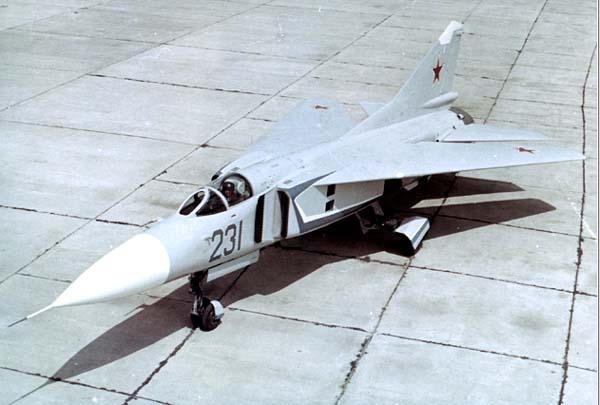
wing type 3
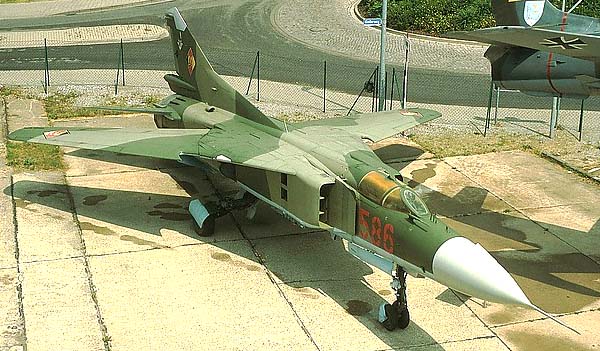
Now Sens the data i have given for the MiG-23ML is at least the stadard data for that variant and most likely it is for the Russian MiG-23MLs.
The MiG-23 in general was rated by the Russians as follow:
MiG-23M as good as the F-4E just inferior in vertical agility or doing loops in that regard the F-4 has been considered better than the MiG-21 and MiG-23M however the Russians claimed the Saphir was better than the AQP-120 despite the Sparrow has better range than the Apex.
The MiG-23ML was a version considered in some areas as good as the F-16s such as in terms of acceleration but still yielding to the F-15 but not as much specially in terms of radar detection range.
The MiG-23MLD was regarded in some terms capable to dealing with the F-15 to some degree at BVR combat and it was much better armed at WVR combat.
Now the F-106 never had the weapons niether the performance to be a real threat to early MiG-23s except only the MiG-23A.
Now if you remember well the Russians claim even the MiG-23M shot down at least five F-16s over the Bekka Valley, the MiG-23ML shot down three F-15s and a F-4 in 1983 over the Bekka Valley, the MiG-23MLD an F-16 in 1987 over the skies of Afghanistan, and unspecified variant an F-16 in 1991 over the GWI skies
The F-16 had no BVR weapons until 1992 according to Western sources, it was only armed with AIM-9s until 1992 and lacked an IRST system., in that sense even early MiG-23Ms had the advantage of longer range weapons than the F-16.
In 1982 the Israeli threw the F-15 and F-16s in the following way, the F-15 were facing the MiG-23 head on at long range and the F-16 flanked the MiG-23s, the F-16 attacked first but some were shot down because contrary to what has been written in the West the Israeli jamming only reduced the range of the MiG-23M radar but still the MiG-23 managed to launch R-23s at the F-16 and shot down some.
Remember the F-16 had no BVR weapon and the MiG-23 had an IRST.
MiG-23MLDIt was quit obvious, the MiG-23 was a third generation fighter that was in a generation ahead of the F-106, the F-105 was also less capable than the more modern MiG-27.
The MiG-23 as a fighter was a good one in 1972 and it only was surpassed by aircraft of the fourth generation like the F-16, F-18, F-15 and F-14.
The Russians usually claim the MiG-23 had only real threats in the F-14, F-18 and F-15 in the early 1980s, the F-16 was only superior to the MiG-23 in agility but not in BVR combat.
The F-106 to the contrary was not in the class of the F-15 and the F-105 was not in the class of the F-18.
The F-4 and Kfir were much more capable than the F-105 and F-106 and these aircraft are barely a match for the MiG-23
Would you PLEASE stop saying the same thing over and over and over again???
All of your posts are just about the same thing. How many times can you beat a dead horse with a stick before it becomes pointless?? The answer is once!
I’m begging you to stop Flogger….your posts are SO REPETITIVE. WE GET THE POINT!
Phantom II
I have the right to write what ever i want and i am respectful, you can not say to people what to write specially when i am respectful to you and i donot engage in personal attacks.
Any way Phantom II undoutedly the topic has been milked enough, we can more less agree the MiG-23 is in a higher class than the F-106:cool:, the F-105 is not a fighter-attack aircraft as good as the MiG-27 specially when the MiG-27 VG wing will give it better low altitude rides at relatively high speeds.
But there is someting i can say
The MiG-23BN and MiG-27 have been the most shot down variants of the MiG-23 family so i am not sure it would had made a better job in Vietnam, however in Afghanistan did a good job, but in the Bekka Valley, the MiG-23BN suffered so many losses
Many MiG-23BN have been shot down in fact the vast majority of MiG-23 Flogger losses are MiG-23BNs
http://www.rustrana.ru/articles/3595/mig-27m_1.jpg

MiG-23MLDI think it was pretty well proven that the comparison of the F-105 & F-106 to the MiG-23 & MiG-27 is pretty much a pointless one….
It was quit obvious, the MiG-23 was a third generation fighter that was in a generation ahead of the F-106, the F-105 was also less capable than the more modern MiG-27.
The MiG-23 as a fighter was a good one in 1972 and it only was surpassed by aircraft of the fourth generation like the F-16, F-18, F-15 and F-14.
The Russians usually claim the MiG-23 had only real threats in the F-14, F-18 and F-15 in the early 1980s, the F-16 was only superior to the MiG-23 in agility but not in BVR combat.
The F-106 to the contrary was not in the class of the F-15 and the F-105 was not in the class of the F-18.
The F-4 and Kfir were much more capable than the F-105 and F-106 and these aircraft are barely a match for the MiG-23;)
MiG-23MLDLet me remember now, were those hundreds of aircraft and AWACS over Iraq flown by Russians, or Americans???? 😉
disreputable sources are those which do not fit a world view, in few words disreputable sources is to propaganda counter propaganda.
Prove your sources better i do not want to hear things like “my Milk shake is better than yours”:D


 Sign In







