 MiG-23MLD
But it has Z-E-R-O to do with manueverability.
it is maneouvrability, why do you think newer aircraft have thrust vectoring nozzles, because pointing the nose with out changing your flight path is called super maneouvrability and the Su-35 achieves that even without thrust vectoring 😉
MiG-23MLDPoint of reference. The F-16 and MiG-29 set the benchmark for fast jets in the so-called modern “missile age.”
While both were immensely more maneuverable than high performance missileers from the 1960s like the F-4, F-101, F-106 and the rest of the interceptors group, they were not more “maneuverable” than the dedicated small gun-armed dog-fighters like the MiG-17, MiG-19/J-6 or the F-5.
The A-4 wasn’t even a dedicated gunfighter but had phenomenal maneuverability on top of its ability to carry a massive load for its size. A remarkable design.
The A-4 can not keep up on a vertical climb with the F-14, the F-16 has better rate of climb, this tactic serves to shake you off a pursuer,
vertical agility is as important as horizontal agility, both the F-5 and A-4 were not as good doing loops as the F-14 or F-15, being under power has its price.
The F-15 had so good vertical agility that the Syrian MiG-23s could not keep up with it during the Bekka Valley air combats in 1982, the only option the MiG-23 had, was swifts attacks and use its fast speed and disengage as fast as it could before getting involved into a dog fight with a fighter like the F-15
MiG-23MLDWho cares about the Cobra? It’s not changing your flight path is it? No. It’s as assinine as saying “I think the Harrier is the most manueverable cuz it can do a vertical take off” :rolleyes:
The pointing the nose of an aircraft independently of flight path directions is very important, is like the AH-64 sight, the aircraft is flying in one direction but still you can aim the missile into another, in few words this increases the reach of the R-73 and its target engagement angle sight.
MiG-23MLDGlad to finally get confirmation of this from someone who actually worked extensively with MiG-29s. From what I’ve seen, the MiG-29s have a hard time keeping up with the Su-30K and dont turn or handle as well at all!
I have a question what version of the MiG-29? the later MiG-29 variants that were not exported to foreign countries such as the MiG-29 Fulcrum C can sustain a turn rate of 23.5 deg/sec way ahead of the Flanker that has a sustained turn rate of 21.5 deg/sec, also has better instantaneous turn rate with 28 deg/sec.
MiG-23MLDI think the most maneuvrable aircraft is the Su-35 why?
The Su-35 when it performs the Cobra turn will have a nose sustained turn rate of around 40 deg/sec for 2 or 3 seconds independently of its flight path direction until disaccelerates and returns back to straight flight after few secs, the Su-35 will point the nose independently of its flight path direction with the cobra turn
Other aircraft such as the Rafale of Eurofighter have instantaneous turn rates of 30 deg/sec however their noses will continue in the same flight path direction and they will rapidly bleed energy sustaining turn rates even lower than those of the MiG-29
MiG-23MLDJesus not this again… those where the RVV_AE or R-77 test planes.. for christ … there are a handfull of mig 29 and very few Su-27 that can actually carring theose damn missiles. At one point in time RuAF had fewer R-77 than Chinese AF.
Jesus what? are you aware of how many aircraft have been upgraded in the Russian air force?
MiG-23MLDPhantomII, the belly of that Iraqi MiG-23ML was modified in order to take the Exocet – the gun was removed and the centerline pylon replaced by one taken from a Mirage F1 EQ-5/6.
MiG-23MLD wrote:There were other MLDs equipped with R-73 (AA-11) apart from the MiG-23-98 bort 36 white picture posted by PhantomII.
I did know the MiG-23MLD can fire the AA-11, in fact with few radar upgrades to the firing system the old Saphir can even fire the AA-12 and the AA-10.
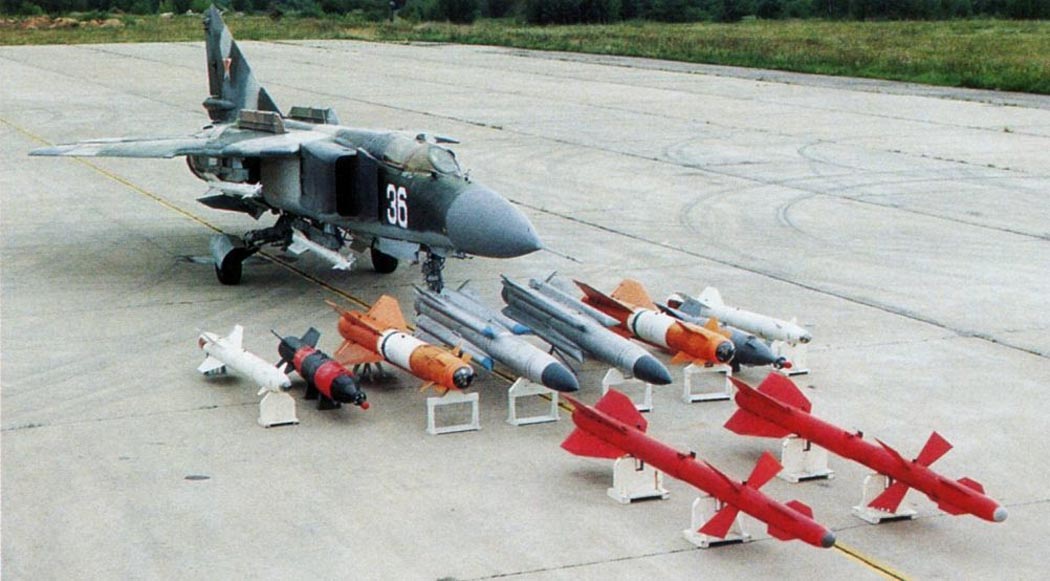
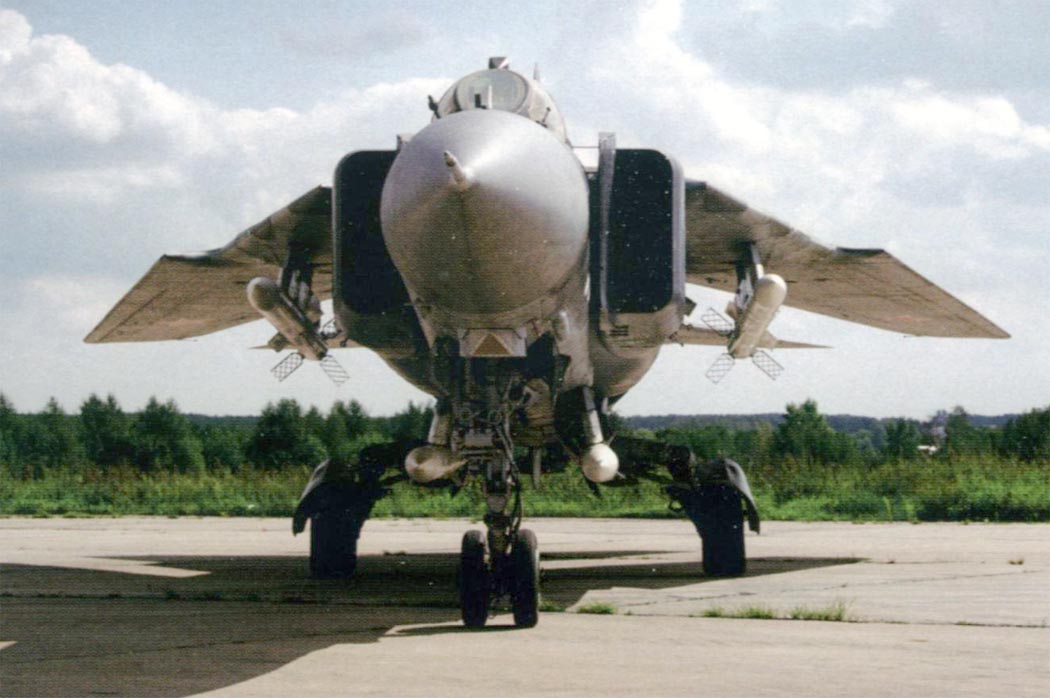
I have not seen a picture of a MiG-23MLD carrying the AA-11 on the wing gloves hardpoints but only on the inlet hardpoints, however the MiG-23-98 can carry four AA-11s, two on the wing gloves hardpoints and two on the inlet hardpoints under the fuselage; probably the Soviets and the Russian did the same to their MiG-23MLDs and i guess the MiG-23MLD can carry four R-73s .The AA-12 is carried on those harpoints too
MiG-23MLDSuch claims show behind doubt, that you have still no real idea about the nature of arial combat.
Those clashes were very time limited. Most of the fighters inside the Bekaa (Bekaa = word for valley) never get an eyesight of each other during most missions. High subsonic at low level the engagements were skirmishes of minutes utmost. So no time left for more than one kill per mission or up to two AAMs fired most of the time! [Importance of high AAM-loads is very questionable under such conditions, just to note!] No more than 100 fighters shared the space over Bekaa at the same time. So it does not matter how many fighters a nation had. In modern air-combat you loose the control, when the related space was crowded. AAM-fights are no longer gunfights with tailchases from the past! Why that constant mixing of former experiences with modern technology. Every mission and time is unique. Experiences from that can not be transformed in general claims.
The Bekka Valley combats have many figures and results, for example i have read scores where the Russians claim 12 Kfirs and 20 F-4 Phantoms shot down over the Bekka Valley combats, they claim air to air combat beween Mi-24s and AH-1 Cobras, the Russians claim also the main weapons used in the Bekka Valley were short range air to air missiles among them Python 3 and AA-8 Aphid, both sides claim their best missiles were short range air to air missiles.
This gives you an open question, is super manoeuvrability still useful in modern combat and the answer is yes, the Bekka valley aerial warfare was not total war as WWII, neither was a war of survival for the Syrians or Israelies because both nations knew an scalation of the war could lead to a direct intervention of the Soviet Union and the US, in fact the US and France sent forces to Lebanon, and US aircraft were shot down but both sides fought a moderate war over a foreign country.
Now a real war were you have two sides fighting as the Soviet Union and nazy Germany fought in the Russian and Ukranian steppes never happened in the Bekka Valley because both sides were directly supplied weaponry by the former USSR and the US so both super powers had in fact a real control of the war in Lebanon.
A modern total war means each aircraft will tried to defend its side as much as possible and that includes the use of a gun and the depletion of its warload.
If your theory was right modern aircraft would had already eliminated the gun from the fighter aircraft weaponry however all modern aircraft are equipped with a gun independently of the AIM-9X or other advanced weapons and that includes the F-22, Rafale, Eurofighter and Su-37
The following links give you a wider view http://www.btvt.narod.ru/2/syria1.html this give you proof that Israel lost tanks (be patient it might take time to down load) and this shows you the dogfights between the israeli F-16s and F-15s against the Syrian fighters and it proves you they saw each other
http://www.patricksaviation.com/videos/i_iaf/352/
Check that according to this link Israel admits the lost of five aircraft during the period of 1982-1983 and among them are one A-4, two F-4s and two Kfirs besides the lost of an AH-1 Cobra
http://www.waronline.org/IDF/Articles/lebanon-losses.htm#syrian
MiG-23MLDSaw a program on The Military Channel today about Soviet swept-wing fighter/attack aircraft, and while I figure it was an older program from the 90’s, it did cause some questions to pop into my head.
I’ve never been quite clear on a few things regarding the MiG-23 and -27.
First of all, how many different sizes of drop tanks do/did they carry? 210 US-gallons seems to be the size I know of (800 litre maybe?), and I assume they were carried on the centerline and on two wing hardpoints which are fitted under the moveable portion of the wing?
Could the tanks be carried underneath the gloves as well for a total of five in a ferry configuration?
On another note I’m curious about the hardpoints on the MiG-23B and MiG-27 series. They had nine as opposed to seven on the MiG-23M variants right?
On the two rear-mounted fuselage hardpoints, could anything other than bombs be carried there, and could smaller bombs be carried on triple or multiple ejector racks?
Also, what about AAM’s? You generally hear that a maximum of six AAM’s could be carried by the MiG-23, but could the R-60 be carried in pairs on the glove pylons as well?
What about the MiG-27? Is two AAM’s under the engine intakes the maximum it could carry?
Oh, and the centerline hardpoint on both variants……was it always just limited to carrying a fuel tank? Any other stores carried?
I know these all seem very random, but with all of the Russian airplane buffs on here I figure this is a good place to start.
Phantom II
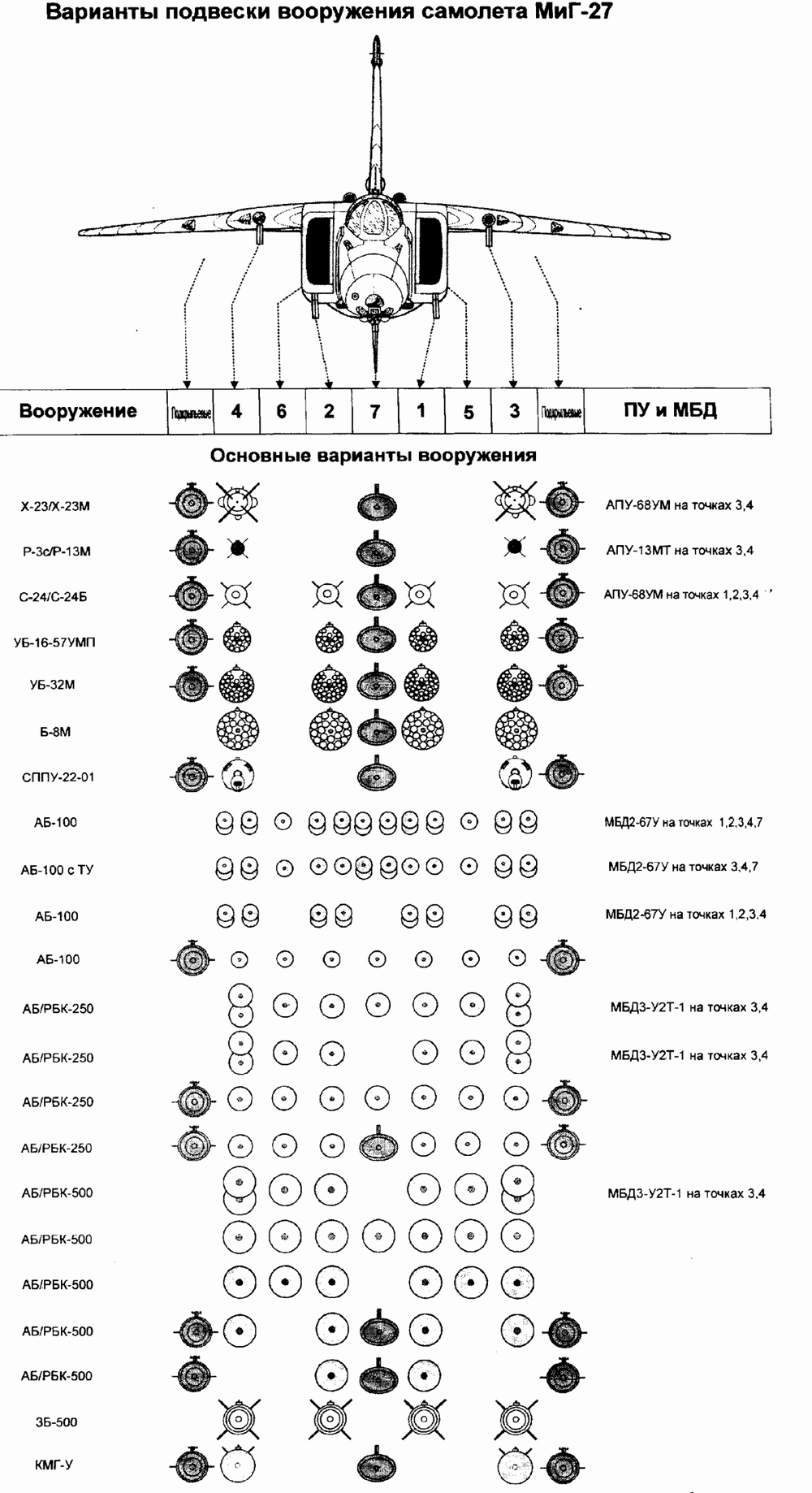
A very easy and fast look at the chart i gave you will give you the answers to you questions
The MiG-23 fighter variants have 4 weapons hardpoint stations and 3 extra hardpoints for fuel tanks this gives a total of 7 hardpoint stations; the MiG-27 variants have two extra and it gives us a total nine hardpoints, they have the usual 2 only for fuel tanks six hardpoints only for weapons and one for weapons or a fuel tank because the MiG-27 can use the center axis line hardpoint that only carries fuel in the MiG-23 fighter variants to carry weapons
Both MiG-23 and MiG-27 could carry AAMs but the MiG-27 usually only uses the wing gloves hardpoints to carry AAMs however can carry AA-11s on the under inlet hardpoints that usually carry AAMs but not under the back fuselage hardpoints.
The MiG-23 fighter variants can carry AA-2 or AA-8s on the wing glove pylons but sems they never used AA-11s on that hard point pylon position.
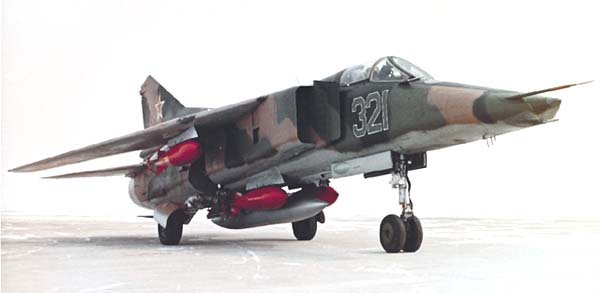
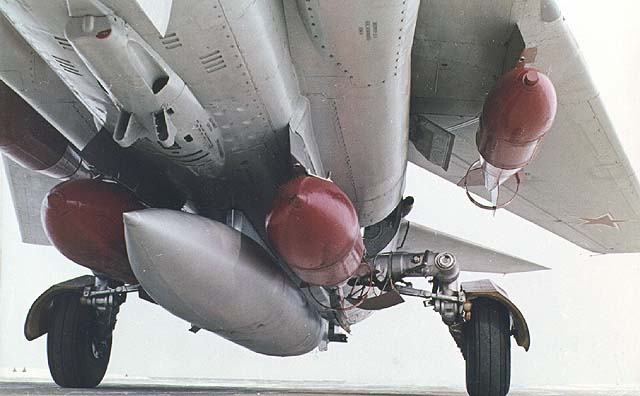
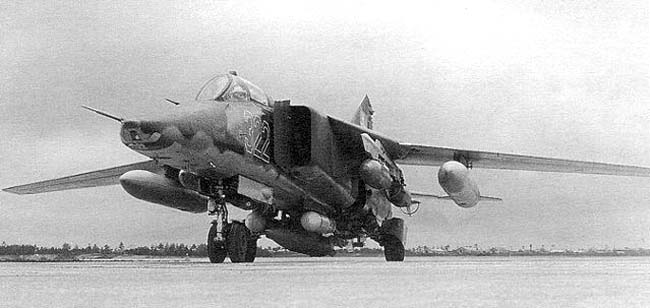
Usually the MiG-23 and MiG-27 carry 800 liters tanks under the wings and one in the center axis line fuselage but the charts suggest never on the wing gloves

MiG-23MLDGreat charts MLD! Thanks. I don’t know Russian, but I know enough to be able to translate most of those charts anyway….
Nice pictures as well.
As far as MiG-23BN/MiG-27 differences, I think another key difference is the gun. I believe beginning with either the MiG-27K or MiG-27M, the gun was changed from the twin-barreled GSh-23L with 200 rounds to the six-barreled GSh-6-30 with 260 rounds. Someone correct me if I’m wrong.
I guess this thread now indicates that bombs can be carried on the centerline hardpoint as well?
Also, I could’ve sworn I’d seen a picture of a Flogger of some sort with tanks on the glove pylons. I’ll see if I can find it.
Is 800 liters the only size tanks the Flogger carries?
If you want to know each type of weapons and bomb picture and to know in specific more less what system it is just click in the link and look at the bottom of the page
http://www.take-off.ru/asp/akhtuba1
БПЛА “Крыло Rocket laucher
авиабомба ОДАБ-500ПМВ Bomb
ракета Х-35 Guided Rocket X-31
ПТБ-800 are external fuel tanks подвесные топливные баки in russian, these usually are carried on wing pylons or one in the middle fuselage pylon or number seven in the MiG-27 chart
Авиабомба ФАБ-250 this is one of the bombs used by MiG-23s, the АБ-100 is a much smaller bomb
MiG-23MLDSaw a program on The Military Channel today about Soviet swept-wing fighter/attack aircraft, and while I figure it was an older program from the 90’s, it did cause some questions to pop into my head.
I’ve never been quite clear on a few things regarding the MiG-23 and -27.
First of all, how many different sizes of drop tanks do/did they carry? 210 US-gallons seems to be the size I know of (800 litre maybe?), and I assume they were carried on the centerline and on two wing hardpoints which are fitted under the moveable portion of the wing?
Could the tanks be carried underneath the gloves as well for a total of five in a ferry configuration?
On another note I’m curious about the hardpoints on the MiG-23B and MiG-27 series. They had nine as opposed to seven on the MiG-23M variants right?
On the two rear-mounted fuselage hardpoints, could anything other than bombs be carried there, and could smaller bombs be carried on triple or multiple ejector racks?
Also, what about AAM’s? You generally hear that a maximum of six AAM’s could be carried by the MiG-23, but could the R-60 be carried in pairs on the glove pylons as well?
What about the MiG-27? Is two AAM’s under the engine intakes the maximum it could carry?
Oh, and the centerline hardpoint on both variants……was it always just limited to carrying a fuel tank? Any other stores carried?
I know these all seem very random, but with all of the Russian airplane buffs on here I figure this is a good place to start.
This will help you a lot
MiG-23BN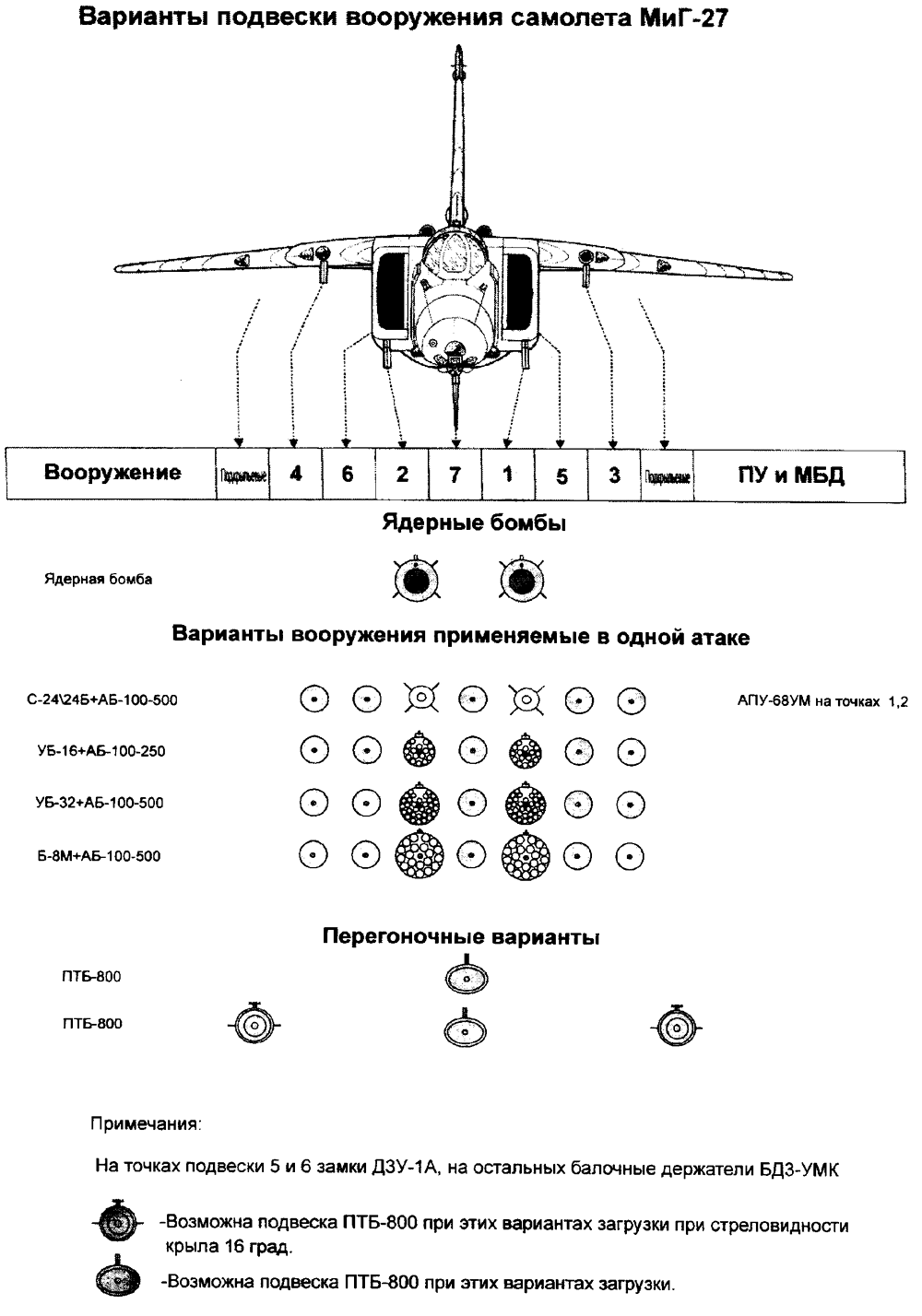

MiG-23MLDAAM-3 isn’t that new. The specs are roughly similar to the TK-1’s. What’s unique about it is the sawtooth fins used for front control surfaces, which is also used in the AIM-9X…and used in the PL-12/SD-10. The idea is that sawtoothing reduces the effort you need to turn the surface at high speeds.
F-2 currently has no plans to upgrade to the AAM-4 and XAAM-5. The upgrades are focused on the F-15Js now.
J-10 will turn things up a notch when TVC is added to the plane, along with a more powerful engine. TVC + active delta canard configuration, and you’re looking at “super maneuverability”, which is the phrase coined by the X-31 project that tested such a configuration. It may reach to the point only the JSF can match it.
I quite agree with the assesement on the ROCAF Block 20 F-16s. The plane is based on the lighter Block 15OCW airframe, which is more of a “dogfighter” airframe than the current F-16Cs. The Block 20 probably might have better acceleration and immediete climbs, but the J-10 is more negatively unstable, and along with the canards, so it instantly turns quicker, has a better L/D ratio, still lower wing loading, better high AoA, so it may turn tighter. Add the HMS, and you’re done.
Mirage 2000-5 would be more interesting though. Has low wing loading and great instantaneous turn rates. But sustained turn rates is the weakness of planes like these, I think it goes like Block 20 > J-10 > Mirage 2000-5. Great BVR matchup though, it can engage 4 targets while the Block 20, the MKK, the IDF can only engage 2. I don’t know how many targets the improved IDF-2 can simultaneously engage. J-10 is also unknown, though it’s believed to be 2 or 4. But Matra Magic 2 isn’t going to hold a candle to the J-10 with HMS+PL-8 improved.
Basically the drift is the same theme; the PLAAF has the largest inventory of planes with HMS (do note that HMS also allows you to use radar guided missiles like PL-11, PL-12, R-77, R-27 outside of your HUD’s point of view, so it’s not just an IR missile enhancement) and without some HMS of your own, you’re in a disadvantage in close combat. Even though the SD-10 is quite agile for a BVRAAM, you still have the best chances by keeping the PLAAF fighters at arms length.
Talking about DACT, I think the FC-1 has great potential for such to be used as aggressors for the PLAAF.
The AAM-5 is a missile that is sipoosedly poised to enter service this year, it will arm the F-2 too, this missile is is in the class of the IRIS-T and AIM-9X Sidewinder.
MiG-23MLDI’m not trying to claim victory over anyone. You have done this before in other threads MiG.
I’m not opposing your opinions. You came in here explictly stating what was wrong with the Raptor off the bat. What you think about the F-22 is different than the facts. Others gave you the facts and you refused to acknowledge them just like in the MiG-31 vs F-22 and MiG-23 vs F-14 threads.
I give up on this thread. Do as you want.
Do as you wish, exchanging ideas is the point of the entire thread and the last word are not you or me, because everybody has different opinions but the important is we can share different opinions and others can have a wider view and facts to choose what is the most realistic version.
I have not done any thing incorrect, the only thing i do is express my opinions.
MiG-23MLDMods, I think it’s time to lock this thread. It’s gone way beyond it’s usefulness. Once again, the MiG-23MLD and Firebar have managed to stretch this thread way beyond where it should be.
MiG and Firebar have managed to, as usual, tell about their incorrect assumptions on the Raptor and its capabilities, aerodynamics, and other factors. While many of us have tried to back our claims with facts, those two just keep ignoring them and putting their uneducated guesses out there to keep the thread going.
I’m pretty tired of repeating the same thing over and over. I don’t know what else I can say. MiG and Firebar did this with the F-14 vs MiG-23(proven wrong then), F-22 vs MiG-31(proven wrong again), and SR-71 vs MiG-25(proven wrong one more time). MiG is trying to do the same with this thread and I’m done trying to disprove everything that comes through their computers.
You know it is a ridiculous statement and plea, so ridiculous it sickens me, you are trying to claim victory and being right and blaiming others only because every body has different opinions and because me and firebar have a different opinion than yours, be a gentleman and learn to respect other people`s opinions closing a tread only because others have a different opinion is not the democratic way, it is a dictatorial way of thinking
MiG-23MLDHey, it’s unfair to compare a fighter entered service a dozen years earlier than J10, even, J10 wins there’s nothing too much cheerful IMHO.
I totally agree in performance the J-10 seems to be the best fighter in Asia but remember Japan is building its latest AAMs such as the AAM-3, AAM-4 and the Mica looking AAM-5.
So if the IDF like the F-2 are armed with better weapons and upgraded with HMS and new radars still can beat the J-10, the F-2 is going in that direction


 Sign In







