 MiG-23MLD
I’m not really very convinced of the Gripen actually. I see it more of a light fighter class FC-1/F-CK-1/F-50/F-20 type that has a delta wing, canards and some impressive networking technology. Every country that developed this type of fighter (PRC/ROC/ROK/USA respectively) have serious doubts about the viability of this genus of fighter.
Considering that the IDF does a lot of ground pounding, you know, against Hezbollah and so on, I’m not convinced that the Lavi’s configuration, construction and design is more suited for that task compared to F-16s. Wings are a pretty swept, not really good for low speeds. Engines definitely not as powerful and you need that for the loads. A lighter structure may also mean less reinforcement for higher payloads and so on.
The IAI lavi has to be seen in its respective time frame, in 1986 little information was known about the MiG-29 and Su-27, the Lavi for it`s time frame was good consider this little detail
Would had the IAI lavi program continued the IAI Lavi would had had the best short air to air weapon in the world the Python V and very advanced Helmet mounted sights and displays, even the J-10 has not a weapon like it and still relies on early Python III
Very likely the IAI Lavi would had grown into a better fighter after been re engined, and China would not had a J-10 😀 because the J-10 as SIBNIA has said is basicly an modernized variant of the Lavi further developed in China after its program was terminate in Israel.
You are thinking the israelies would have not upgraded the IAI Lavi something that is unrealistic, further more for the 1986 time frame the Lavi had one of the best man-machine interfaces and very advanced avionics and is very likely that if it would had entered operational service its avionics would had outgrown the 1980s standards
MiG-23MLDWOW!!
Why wow? think in this, the radome of the F-22 has to scatter away enemy radar emissions means to be stealthy to other aircraft radar emissions, but has allow its own radar emissions to come back, it cannot absorb them completly with RAM or scatter them away from the radar with its own faceting.
MiG-23MLDHardly. You know why? Because a traitor within NATO gave the serbs secrets of allied flight plans, including F-117’s flight plans, specifically.
Read this:
http://www.freerepublic.com/forum/a38cadeef089b.htm
It had to be translated into English, so be patient.
NORTHAX
I think we do not need to get embroided into those discussions where we are not going to get anything, i can tell you what i have read.
A) The Russian military top brass state this year that the F-117 shot down over Serbia was shot down because the F-117 is not totally invisible and some radars can detect it
This is logic because even knowing at what time it might pass the F-117 you still need to detect it, aim a anti-aircraft weapon at the F-117, launch the weapon at the F-117 and hope it can hit it.
B) The F-22 also uses radar and it does not scatter it`s own radar emmissions away from it`s own radar it means up to a degree some frecuencies won`t be scattered, that shows the F-22 is detectable
the F-117 and the F-22 reflect any way any radar radiation away from their airframes, this means it still is detectable.
several nations are working in that, in detecting stealth aircraft either by radar signature or IR signature, stealthiness means that from some distances an aircraft will return very little radiation back to the emiting radar that there is very low likeliness the radar will be detect the F-117, F-22 or F-35.
The F-117 was detected and shot down, the whole question is how often will be detectable, same will be the F-22.
The Serbian Air defence forces also had to move all their assets all the time, this means the F-117 will always have to be careful of staying out of the detectable range where its signature can give away its exact position.
MiG-23MLD“For information on how to link to our photos, please read http://www.airliners.net/usephotos/ “
😉Anyway, I vote for beast. If its about looks, theres only the Rafale. 😎
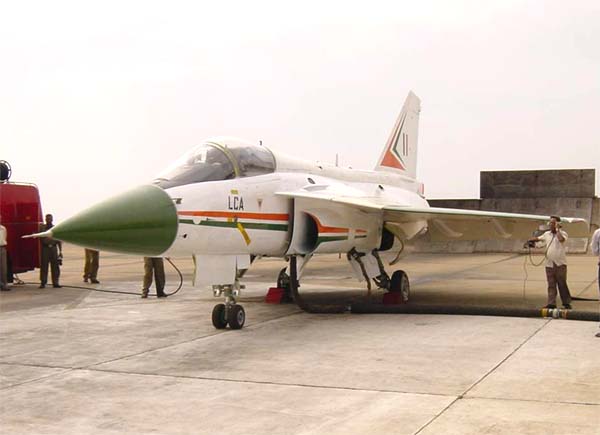
No doubt the Rafale is the nicest looking delta canard ever created but the nicest delta wing tailess aircraft is the LCA
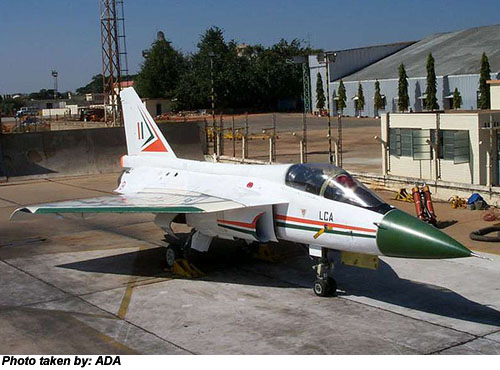
better than the Mirage III/V or the F-102/F-106 or the Ugly F-92

MiG-23MLDHe’s got even less wiggle room here as we’re talking about aircraft downed by enemy aircraft. :diablo:
I am not wiggling Sferrin, Western sources acknowledge losses in any war, i wonder how do you think the US will fair with rivals like India, France, Russia or China?
See the Soviet Union when they invaded afghanistan have very few losses of fixed wing aircraft, same when they invaded Hungary or Czekoslovakia.
The NATO victories over Serbia or Iraq are not really a proof of the excellence of the Western aircraft just a proof that when several nuclear powers invade a poor developing country can bull it without any opposition.
When you have fleets in the same number of similar aircraft like China, India or Russia can field the Western powers are not as great as when the invaded Iraq or Bombed Serbia, in fact it is a shame a tiny nation like Serbia humilated the US shooting down one F-117 and a nation like Iraq shot down the same number of aircraft the NATO forces did in 1991.
The F-22 in general has been designed to defeat air forces armed with large fleets of MiG-29s and Su-27 but already Russia, China and up to a degree Europe and India are building up a new generation of fighter to defeat the F-22
MiG-23MLDYeah, it shows up the most while they’re out there littering the landscape with enemy aircraft. Damn crappy American aircraft. :rolleyes:
Sferrin
The American built aircraft are not the best niether the worst, the Americans have suffered losses, fans of american aviation usually forget that, third usually american reports like any other country make up their losses, usually they claim less losses and accept more victories, the pictorial evidence will show you to the contrary, usually in war both sides sustain losses.
When the american capture enemy aircraft they know that aircraft like the MiG-25 or MiG-29 are excellent aircraft if flown by good pilots and with superiority in strategic and tactical assets as usually the american aircraft fly versus third world nation adversaries
here are some pictures of american and western aircraft either shot down or that show clearly battle damage
Source
http://www.waronline.org/IDF/Articles/lebanon-losses.htm#syrian
MiG-23MLDJust more proof that MiG-23MLD doesn’t know what he’s talking about.
Up to what i know the F-22 airframe is not designed exclusively for speed and agility.
The MiG-25 and SR-71 are the best example of Speed, the F-16 and Su-27 are the best example of agility in the four generation fighters made in 1970s with the tailplane and wing configuration, the Eurofighter is the best example of an agile and simple delta canard configuration.
The F-16 for example has a nose with a flattened ojive shaped radome, that resembles an oval semicircle in cross section, this also has similarities with wings in the fact the forebody ventral part of the F-16 just ahead of the inlet and where the cockpit and radome is housed, is flat and the dorsal part of the F-16 forebody is more curved this is very similar to an airfoil and goes well with the pilot`s front view, the wing fuselage blending and the LERXes, besides this keeps the nose cross section small, the nose forebody in the F-16 fits well with the inlet that also is a oval semicircle but up side down keeping the circularity of the whole F-16 cross section and allowing the upper inlet lip to work as a shock creator.

This configuration exhibits excellent fuselage blending and therefore increases substantialy lift
In the F-22 the Diamond cross section is a faceting product, it is not like in the Su-27 or MiG-29 a ogive with circular cross section to reduce drag, niether resembles a wing like cross section like in the F-16.
The closest designs in that respect to the F-22 are the Rafale, S-37 Berkut Yak-130. L-15 and the Ching Kuo.
All of this design by exception of the Rafale have LERXes or vestigial LERXes like in the S-37 Berkut, the Rafale has no LERXes in the extrict sense however the inlet and forebody fuselage shaping in the Rafale do work as LERXes and help the Rafale at AoA, this is very obvious since the Ching Kuo already shows that early tendency of LERXes blending the lower part of the LERXes into the fuselage as we can see in the YAK-130 and L-15, this is also to feed the air inlets at high AoA.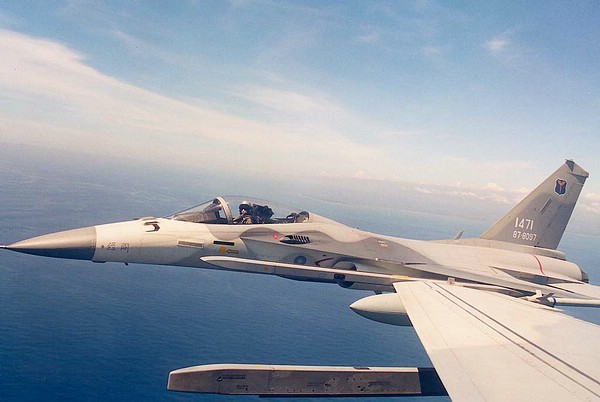
In the F-22 you see that up to a degree but it is more a stealth requirement than an aerodynamic requirement since in the S-37 you see very clearly the Russians opted to add a vestigial LERX on top of each inlet, see that also in the S-37 the radome is flattened and blunt and as the MiG-29 this design of radome generate vortex for AoA

MiG-23MLDIrrelevant; 1700 SR-71As weren’t needed, and 1700 F-12Bs wouldn’t have been needed either, so there was no point in taking the time and money to set up a more economical (over the long-run) assembly-line manufacturing process.
Again, irrelevant. 21 B-2s were produced. More Tu-160s were produced, but the Tu-160 is not the better strategic bomber just because there are more of them.
Irrelevant, that wasn’t the point of the F-12B, and is not the point of the MiG-31 or MiG-25.
By that logic it has to be better than the MiG-29 because all they are is meat for “the might of NATO” right?
And have you ever heard of the F-4?
The F-22A uses more than just faceting, in fact there is very little actual faceting on the airframe. The F-117A was never intended to be a fighter and as such didn’t need maneuverability.
Lets start by this fact SOC
Low observability is achieved by a range of measures. The F-22 employs planform shaping and faceting with blended facet boundaries, the latter a necessary concession to high performance aerodynamics. This is apparent in the shape of the nose, the fuselage sides about the inlets and engines, and the upper forward fuselage. Lockheed/B/GD used serrated edges extensively, as with the F-117A, to control the returns from panel boundaries,
The F-22 diamond shaped cross section is faceting, the rhombus shaped inlet uses faceting angles too
The leading and trailing edges of the wing and tail have identical sweep angles (a design technique called planform alignment
This angles are also faceted to minimized radar return
http://www.globalsecurity.org/military/systems/aircraft/f-22-stealth.htm
The F-117 is a prime example of scattering. The entire plane is one, large system of triangles. It has all flat surfaces, angled to deflect radar waves away from enemy base. The F-22 also does this, but in a different manner. It is fairly rounded, yet on closer observation, the over-all shape has angles to it that scrambles the radar all over, everywhere but back to the radar’s origin.
In the YF-22 faceting was quit obvious
The F-22A has more rounded shaped nose due to aerodynamic requirements

MiG-23MLDAgain, MLD you simplify complex things, showing that you do not know much about the design of the F-22.
No there isn’t anything the F-22 can do that the Su-37 can’t and vice versa. That’s not the point. The point is that the F-22 combines the agility of the Flankers with supercruise and stealth. Period. If you do not understand that then there is no hope for you.
The faceting on the F-117 is nowhere near the same as the stealth features employed on the F-22. The F-22’s stealth was designed with aerodynamic requirements involved. You cannot just simply say that the faceting makes it worse than the Flanker because you have no proof.
The F-15 ACTIVE uses 3D nozzles similar to the OVT, not flattened nozzles. There is almost no aerodynamic relation between the F-15, F-117, and F-22.
Sorry the F-15 ACTIVE used both 2D and 3D thrust vectorig nozzles but 3D vectoring nozzles generate more problems when you want them to reduce IR signature than 2D thrust vectoring nozzles and is far more simple to design 2D thrust vectoring nozzles with reduced IR signature than 3D thrust vectoring nozzles
MiG-23MLDAnd how do you know that a Non-TVC F-22 wont be as manuverable as a non-TVC su-27??
See that the Europeans, Chinese, Russians have prefered canards even the triplane configuration to get agile fighters, the Eurofighter shows very well the best configuration for an agile and simple aircraft, the MiG 1.44 repeated that configuration and the J-10 has the same configuration, the IAI Lavi used that configuration too, the F-22 used a rather old configuration of a big wing with tailplanes because they have confidence thrust vectoring will rectify any short coming the tailplane wing configuration has.
The F-22 has two factors that make it to have a good configuration, one factor is a huge wing and the other is excess thrust.
In any aircraft the airframe either reduces drag or increases drag, An airframe also generates drag or generates lift
The Su-27 family has an ogive radome that reduces drag, fast missiles use also ojives too to reduce drag, also the Su-27 family uses wing fuselage blending to increase lift.
Fighters like the IAI Lavi, MiG 1.44 and F-16s also use ogives but flattened a lot, depending in the canopy bulge and inlet nose relation and to a degree their radomes and forebodies generate lift too.
The F-22 also has an ogive shaped radome but the wing fuselage blending is minimal except in the wing root and the engine nacelle that thanks to stealth requirements, the F-22 forebody is not the best shape to generate either lift or decrease drag.
The MiG-29 for example uses an ogive as a radome but also has vortex generators flanking the radome pitot tube
In General you can see the Su-27 has excellent AoA and that is proven in the Pugachev cobra, a feat displayed without thrust vectoring.
MiG-23MLDMore effective in what? In general, the 3D TVC system allows for greater yaw inputs than 2D.
Again, where did I say the Raptor has the best aerodynamics? I said that has more advanced concepts employed in its design than the Flanker and Fulcrum. Is there something wrong with having a stealthy but manueverable airframe? Obviously, the Raptor engineers had more than enough money and time to do it.
The F-22 is advanced but not as you are thinking, the Su-37 proves that in agility the Su-35 family is on par to the F-22, proof see any video of the Su-37 and in superagility there is nothing that the F-22 pilot can boast his plane can do that the Su-37 won`t do.
However the F-22 has quit a lot of thrust, the F-15 ACTIVE relied on canards and flattened thrust nozzles.
Canards are like any other surface in a plane either give you lift or give you drag, this applied will give you change of direction or stability
The F-22 has excess thrust power, it could also delete the canards seen in the F-15 active but basicly the F-22 is an F-15 design concept faceted is like you breed this
with this.jpg)
In few words faceting will impact negatively on aerodynamics so we can not say the F-22 is utterly superior to the Su-27 family in aerodynamics because the the Su-27 family has super manoevrability and the F-22 uses thrust vectoring too to achieve many feats.
in fact if you will design something agile the Eurofighter is the best type of configuration fitted with thrust vectoring nozzle 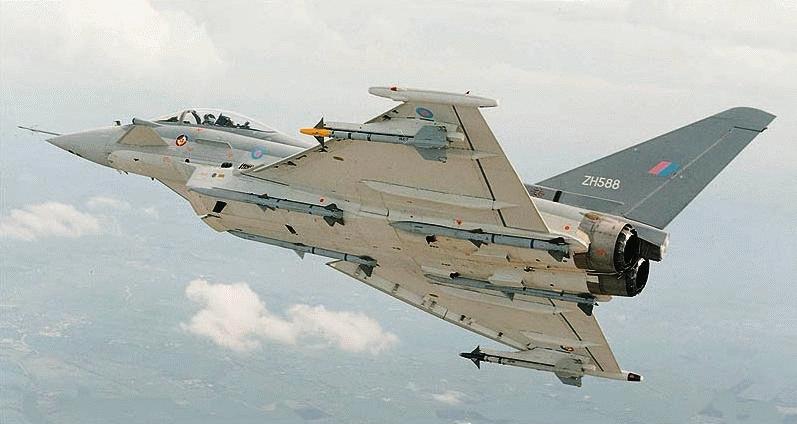
If you can get systems that detect the F-22 the Eurofighter with meteor and ASRAAMs and thrust vectoring is the ebst option in MHO
MiG-23MLDBecause we all know how canards help with yaw huh? :rolleyes:
In general while doing complex manoeuvres a SU-37 will need its wing controls, taiplanes, rudders and canards working in conjuction but with 3D thrust vectoring nozzles the aircraft has control at yaw and pitch, this fact will allow the MiG-29OBT and Su-35BM to rely less in aerodynamic surface plane controls, it will behave more like a air to air missile than an aircraft, a missile with thrust vectoring rely less in aerodynamic control surfaces to change its flight path direction, same is with the MiG-29OBT.
http://www.youtube.com/watch?v=PWLYTAYG-9U&mode=related&search=
Belyakov said that because if the MiG-29OBT could be fitted with 3D thrust vectoring it could delete the canards seen in the Su-37; the Su-37 was a triplane but the Su-35BM deleted the canards and returned to the original tailplane configuration thanks to 3D nozzles.
The F-22 has only 2D thrust vectoring nozzles and no canards, this requieres different ways of controling the aircraft.
question wich aircraft will be more efective the F-22 using 2D thrust vectoring nozzles or the MiG-29OBT fitted with 3D vectoring nozzles?
You are creating an urban myth that the F-22 is so great because it is stealthy and has the best aerodynamics and thrust vectoring nozzles.
The F-22 settled with 2D thrust vectoring because it was cheaper, 2D thrust vectoring flattened nozzles help to reduce its IR signature and the F-22 is armed with AIM-9X so it is enough with these features to deal with unstealthy Su-37s and MiG-29s that also lack supercruise.
Remember the flattened nozzle helps the F-22 because the Russian MiG-29s and Su-27s rely also in IRST systems and are quit agile fighters so the F-22 needs to be quit stealthy to avoid a direct hit by a Air to Air missile cued by the IRST systems fitted on the MiG-29OBT or Su-35BM
MiG-23MLDWhat are you talking about? We already know that most all of the fighters with thrust vectoring use them in conjunction with control surfaces. What myths are you talking about?
The difference with the Raptor is that it uses it’s control surfaces in all manuevers. Again, I have not seen a fighter use its control surfaces like the Raptor.
OK but the MiG is not in production and really has nothing to do with this thread. I am sure that MiG probably had a very good design drawn up but we’ll never see it in action.
Belyakov once said that if you had good thrust vectoring you could get rid of the canards, good thrust vectoring nozzles, that means the F-22 uses in a different way its control surfaces because it has 2D thrust vectoring and no canards unlike the Su-37, the MiG-29OBT uses its control surfaces different because it has 3D thrust vectoring nozzles at pitch and yaw
You make a urban myth because the F-22 has different arragement and different type of thrust vectoring nozzles, see the nozzles of the MiG-29OBT.
The MiG-29OBT has 3D thrust vectoring like the Su-35BM they do not need canards, the Su-37 had 2D thrust vectoring nozzles it needs canards
MiG-23MLDLots of aircraft use elevons. The thing that makes the F-22 and F-35 (and possibly others) different is they use everything. Take a look at the F-35 video I linked to in the other thread and you see aileron, flaps, and elevons working on conjunction. There’s a video of an F-22 in a slow vertical climb where everything is flapping all over the place to keep it pointed nose vertical. You’ve got flaps, ailerons, elevons, nozzles, and rudders all working. Very interesting to watch as it’s a close up.
http://semperapollo.com/Media/Video/Aviation/AC2006/F-22A_AC06.mpg
About 30 seconds in.
Please do not infer mirages and urban myths, look a Video of the Su-37 or MiG-29OBT. thrust vectoring usually works in conjuction with the aircraft surface planes, it works in the same way in Su-37 and in the F-22, it will be the same in the MiG-29OBT or in the F-16VISTA/MATV, the reason is thrust vectoring control have to work in conjunction with all the aircraft planes to get best results.
The MiG 1.44 had more controls surfaces than even the F-22 and was suposed to be powered by engines with thrust vectoring nozzles, the MiG 1.44 or MFI have to use all its surface planes in sincrony with the thrust vectoring nozzles.
Look how many control surfaces has the MFI Mikoyan prototype

add to that thrust vectoring and you will see this aircraft was very complex to control
See the Su-37 video http://www.youtube.com/watch?v=Uu_qQMhqdHA
MiG-23MLDNo, it didn’t. It had a large number of stand-off sensors and SLAR to ensure that it didn’t need to directly overfly any target anyway.
They were actually both derivatives of the A-12. Was the F-12 expensive? Yes. Did that stop Congress from allocating production money for 93 aircraft? No.
Prove that the F-12B wouldn’t have been just as effective. Regardless, the F-12B was a CONUS air defense interceptor; it wouldn’t have been flying around overseas hunting enemy aircraft anyway.
The MiG-25 had and advantage the YF-12 did not have price and easy manufacture, this is already proven if you consider at least 1700 MiG-25 and MiG-31 were built in total.
The SR-71/YF-12 production numbers won`t be comparable at any point.
That tells you everything, a mass produced fighter at least can overwhelm the enemy just by the numbers fielded and deployed.
The MiG-25 is undoutedly the best third generation aircraft. So good that even four generation aircraft struggled too much to shoot it down and has one of the best records for an aircraft that was operated by third world countries and faced all the might of NATO.


 Sign In







