MiG-23MLD
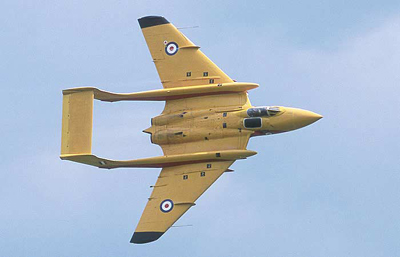
The F-7 Cutlass wasn’t all that unique. Kind of followed in the lines of the F5D Skylancer.
Which followed in the footsteps of the F4D SkyrayAnd its really not that far off the Sea Vixen’s layout.
The cutlass was a really beautiful aircraft
MiG-23MLDNo problem MadRat…just was a bit confused on what you were talking about.
Arthur, where are you? What are your thoughts on this R-60/MiG-25RB business?
This can solve some of your doubts
I know probably you will give me another lecture about my english or say you can not understand me.
But i will explaing you, in the first chapter of the MiG-25RB manual, they mention the basic description of the aircraft, the variants it has, well basicly its different missions, when they talk about the attack version, they only mention the following
the strike variant (mission) can carry up to eight bombs or a total of 4000kg, the aircraft will fly at 2500km/h and bomb at 20-21km of altitude, they say the aircraft has all weather capability and an operational range to the target of 580km
MiG-23MLDFlogger as usual your English is making it hard for me to understand what you are even saying. I wasn’t replying to anything you said. My last post was in regards to what MadRat said.
I don’t mean to sound rude as your English is much better than the only other foreign language I know anything about and that is French, but I just have a hard time understanding you most of the time.
I will make it simple.
Airwar.ru has an internet article where you can download the MiG-25RB manual and see its basic specifications and development history, they do not mention the R-60 among the weapons it can carry.
So in few words the MiG-25RB does not carry the R-60, however the MiG-25BM does.
If you do not believe me download the manual into your computer and with a Russian english dictionary translate it.
You will see why airwar.ru says what they say.
MiG-23MLDIsn’t that a BM? Doesn’t really prove the MiG-25RB’s with the slar and reconn gear up front carries the R-60.
Looks like somebody needs to learn his Foxbat models a little better….
The picture I posted is either an RB or BM, but it doesn’t have any R-60’s in the pic so I’m not sure why you’d be referring to my pic.
As for the other pic, it’s a MiG-25PD…..the huge R-40’s on the inboard pylons and the massive nose radar should be the clues for that one. 🙂
You are completly looking for a data that does not exist, the MiG-25BM does carry the Kh-58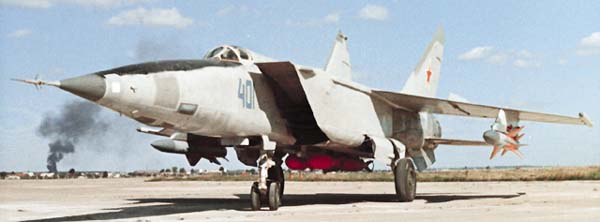
but that is not a MiG-25RB, its based upon it but it is not.
If you open the page i gave you for the MiG-25RB manual you can read it and look for your self, but there is nothing that says it has R-60s, airwar.ru having the manual knows better and the say the MiG-25RB only has bombs as weapons and the MiG-25BM has KH-58s, Bombs and R-60s

MiG-23MLDIsn’t that a BM? Doesn’t really prove the MiG-25RB’s with the slar and reconn gear up front carries the R-60. 🙂
But there was some literature some time ago that talked about it. I wish Google retained their old search look ups better. And the old dogpile.org multi-engine look up is pretty well dead these days. Google’s algorithms are basically worthless for finding older/little used web data in searches. Sure wish we still had more than a few unique search engines competing for web lusers.
NO the MiG-25 is a MiG-25PD, however as he suggested there is no reason whya MiG-25RB might carry the R-60, some sources do claim it does, however some do not mention anything examples
airwar.ru says the MiG-25BM can carry the R-60
Вооружение: Боевая нагрузка – до 5000 кг
2-4 УР воздух-воздух Р-60М
2-4 УР воздух-РЛС Х-58У
до 4000 кг бомб различного калибра
http://www.airwar.ru/enc/fighter/mig25bm.html
however for the MiG-25RB it does not mention any R-60, and if you go to the bottom of the page it has the aerodynamic manual for the MiG-25RB, so obviously they know from very good soruces the MiG-25RB does not carry any R-60
MiG-23MLD😮
huh, what a madness to put a short-range “dogfight” tail-on only missile like the R-60 on the almost Mach3 recce Mig-25. Where did it happen? Not to mention the Mig-25 is fast as the R-60 missile which had uncooled Komar seeker,thus launch limited to Mach 1,85. When flying at subsonic Migs-25 had escorts equipped with R-60 missiles.
This prove you there is no reason why a MiG-25RB can not carry the R-60, however i have not seen any pictures with the launchers for R-60, some sources say some MiG-23RBTs can carry it but as you comented there is little practicality in that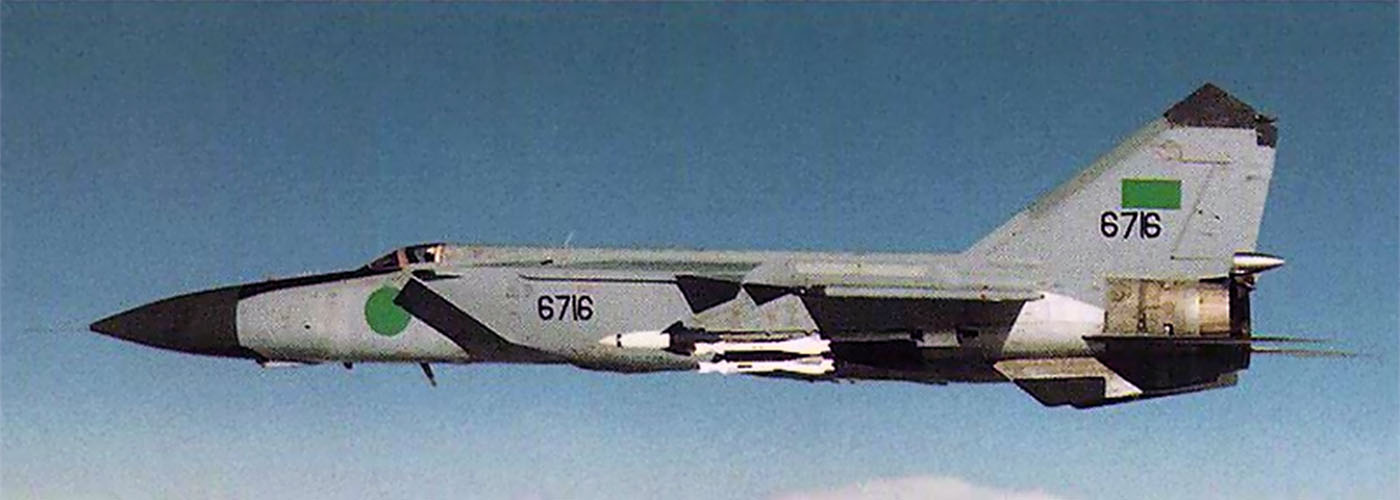
MiG-23MLDSome RB’s were wired for R-60.
Some russians sources say it but the manual does not, however there are several recce versions not only one, but the MiG-25RB manual does not mention any R-60.
With these technical specifications you see the weight of the MiG-25RB.
Its empty weight is 20000kg, the recce versions weight at normal take off weight 34700kg and in bomber guise 35000kg without fuelt tanks; the rest are 36000kg with two bombs, 37000kg with 4 bombs and 38000kg with 6 bombs and it has a max weight of 39600.
MiG-23MLDNo MiG-25RB ever shot anything down, did it? A reconaissance airplane used as a bomber in some cases that didn’t carry AAM’s and had no gun……how could it shoot something down?
The MiG-25 had different versions and each one was optimised to different missions, however some Azeri MiG-25PDs used R-60s AAM to kill tanks
А вот к утверждениям о том, что перехватчики МиГ-25ПД лихо крошили армянские танки тепловыми ракетами Р-60 класса “воздух-воздух”,
http://www.airwar.ru/history/locwar/xussr/karabah/karabah.html
MiG-23MLDI asked in another thread that got closed whether or not the MiG-25RB (or any other MiG-25R model) ever carried any type of AAM. I’m pretty sure they didn’t, but can anyone confirm whether weapons like R-60 could or were ever carried?
I didn’t think the EF-111 Raven ever carried any weapons until I saw photos of them with AIM-9’s on the outboard underwing pylons, so I’m wondering if the same is true of the MiG-25R series.
(Please no huge debates about turn performance or comparisons against other airplanes or anything of that nature. I’d like debate to focus strictly on the recce versions of the Foxbat.)
It did not carry missiles, the RB verison never carried air to air missiles.
MiG-23MLDYou do claims, which I never did. For the benefit of the other I will not even try to figure out the behaviors of that. 😀
The website in question is no official one. It is as reliable as ACIG for example.
Its purpose is to show the Russian view about the own military assets at first.
There is nothing wrong about that in general. But some claims are limited or questional, because some important details are missing.
I remember well, that in the former GDR a lot publications did become available about the MiG-23. The main purpose were to restore the damaged reputation of the MiG-23 in Lebanon. Just one Wing, the JG-9 did convert to MiG-23. From 1978 – 12 MF and from 1984 – 32 ML. The GDR postphoned further buys of the MiG-23 and did decide to wait for the MiG-29 to replace the MiG-21s. When all military did highlight the performances of the MiG-23s, their procurement number was cut. Compared to the MiG-21s it was a jump in capabilities, but at the time scale the MiG-21 was overdue for replacement at all. The 16th air army in the GDR did not field MiG-21s any longer.
Of cause the will be not a topic on a Russian website.:diablo:
Limits are set for every fighter to conserve life-time or to enhance safety limits. I do remember about the F-104G, which was temporary reduced to Mach 1,7, when the nominal limit of Mach 2 was restored. Practical that F-104G could reach Mach 2,2-2,4 related to conditions. The first J-79 had a TET, which did set the safety limit to around Mach 2,1 [750 kt IAS), when the later built J-79 were not, but the limit was kept, because there was no need of such high-speeds. The F-104G had to operate low at subsonic to transsonic speeds.
G limits do help to prevent overloads, when AoA limits are introduced to lower the possibilties of departure. None pilot has stick to the artificial limits, except he does enjoy to live on the save side and not being punished, when the G-meter was in the red-zone. 😉
Back to the 80s. The Russians had figured out, that at limited part of the flying envelope the MiG-23 pilot could make the best from his fighter. Nothing new really, because every pilot is trained to choose the right manouvre and tactic or he will be killed in short time. Similar to the F-104 the MiG-23s did hit and run tactics against fighter of higher agility, when a well flown MiG-23 could even mix it with a F-4. But with similar capable pilots on the controls and everyone try to force the opponent to mix it his best corner of envelope, the outcome will end in an disengagement. The F-4E is not outclassed by the MiG-23MLD, but the MiG-23MLD did offer a similar pilot some advantages. 😉
Something about Gs in combat.
… The third time they ( two EAF MiG-21s) entered a steep dive, 60 degrees or so, a crazy supersonic dive. I launched a missile (AIM-9B) at their leader; they flew very close to each other. As the missile exploded their leader rolled over to a split S: 60 degrees, 10,000 feet, Mach 1,4. His wingman rolled right after him and I started to roll but I realized that I wouldn’t be able to recover. It all happened over Lake Manzala. (10th July 1970) I decided that it was too dangerous so I rolled back. I could see the wingman also roll back but I could no longer see the leader. I recovered with my G meter at maximum, 10G, at 2,000 feet. I lost my generator and alternator and I had to revive the systems. Then I saw the eingman recover underneath and his leader crash. I then started a long chase after the wingman with Sharon trailing me. There were very low clouds over the Nile Delta and he flew to his home base at Mansura. I didn’t let him get into the clouds, but at a certain point … achieved a gun kill and pilot ejected. (to cut the personal report of Israel Baharav in Mirage IIIC No 59, named Shahak in Israeli service or Thunder, and still with ATAR 9B):cool:
The nominal G-limit of Mirage IIIC was 7,5 G, when the nominal G-limit of the MiG-21s were similar 7-8 G. 😉
Even in that years there was no time to do a turning contest, which one has the higher nominal G. In combat none does care about that. By the way, that Mirage No 59 had twenty years of service in Israel, before it was sold to Argentina. The same aircraft did suffer a severe take-off accident at Hatzor AB 7th October 1973, before rebuilt in 1974 with ATAR 9C.
But in the widest sense still about ‘MiGs in Combat’. :D:D:D
Sens
All aircraft have such problems, however to know how good was the F-14 in real combat we have to see some facts.
The AIM-54 was very rarely carried by the F-14 in a six AIM-54s configuration for several reasons, one it could not land back in the aircraft carrier, and if it flew a peace time mission it would had needed to drop some of the AIM-54 to make it back so no one was willing to do it since the AIM-54 was a very expensive missile.
So usually a F-14 had no chance to test a six almost simultaneous firing of AIM-54s.
Even some books claim the F-14 only once fired six AIM-54s due to weight facts in part and price in the other hand however these test were not done even in land based aircraft.
Now a fighter like the F-14 which is limited to peace operation and has manual pages saying it can not be flown beyond 6.5Gs then has to be considered it won`t be more agile than the F-4 once outflew in test demostrations.
Then we can conclude the F-14 is indeed a MiG-31 equivalent, not an agile F-16 and only had a relative advantge if it did have it, in agility over the F-4 and MiG-23 types.
MiG-23MLDThat claim does show for all to see, that you do not stay serious.
That data given by you are peak values at a given speed, given height and given load-condition. It does not make it better, when you do point to a lack of data about that, but do avoid to go into that even at hand. It does speak volumes, that you give not the correct variant of a fighter, the data are related to. At least you do reveal by that, that the claims are of dubious value. Did you?
You do ask for sources always,when you do general claims most of the time.
“I read many books …”.
No problem, to give the title, author and page. 😉For the benefit of the others.
The max sust. turn rate is reached close to the lowest speed with enough lift to do so. Two things are in need of that, low-load to all lifting devices and control of airflow or AoA capability. Lifting devices do generate drag, which had to be overcome by force. The bank capability can be given in G.
To have the smallest turn radius you have to pull Gs, but that is limited by lift.
So fighter pilots do not make horizontal turns, but do use the vertical too.
All have heard about the “power-egg” and how does it work.
1 G does give a bank angel of 10°
2 G does give a bank angel of 60°
3 G does give a bank angle of 71°
4 G does give a bank angle of 76°
5 G does give a bank angle of 79°
6 G does give a bank angle of 80°
7 G does give a bank angle of 82°
8 G does give a bank angle of 83°Everone can draw his conclusions from that. For brief moments higher G could be pulled, but your SA do suffer from a given load and time as your system does, when the real gains are limit except a last ditch attemped to avoid a crash.
I did add two innocent examples from Hünecke, Technic and Function, The present fighters, 1984.
Small translation help:
Fluggeschwindigkeit = flight speed
F-4 ohne Klappen = F-4 without slats
Schüttelbeginn = some shaking or buffeting do start
Optimaler Anstellwinkel = optimum AoA
Ausbrechen departureThe A-7 is added to show a wing optimised for subsonic and high lift
Some graphs shown from “handbooks” do show limits only and the related control forces and the true behavior is ignored. 😉
Sens
who do you want to cheat? the F-4E manual from airforce.ru shows you very well the sustained turn rate and max overload, of course you want to pretend the information given by airforce.ru is a lie.
First in the airforce.ru thread, the Russians admitted the MiG-23 was not as good as the F-16, it was not a dedicated dogfighter as the MiG-21 and showed all the information with manual pages.
All the information you give is vague, simply because i can show you the max sustained turn rates and max G overloads with the F-4E manual page that was posted in airforce.ru
as i showed you before the F-5 was found a better fighter than both the MiG-23M and the MiG-21Bis, however is well known the F-14 is the less agile of all the american fourth generation fighters since its swing wing is difficult to design to hold high overloads, the wing glove was the reason the F-14 as well as the MiG-23 were kept flying with low overload limits, in the F-14 6.5Gs and the early MG-23s 5.5Gs
in this two webpages you can see the F-5 was tested in the Soviet Union and found better than the MiG-23M and MiG-21Bishttp://www.testpilot.ru/review/runway/volga/volga_xvi.htm
and in this the Russians admitted the MiG-23MLD was less agile than the F-16 and F-15 and advised their pilots to use the beaming maneouvre to fight the F-15
http://krilebg.net/main/index.php?option=com_content&task=view&id=12&Itemid=34
However the F-14 was not the most agile of the fourth generation fighters built in the 1970s
MiG-23MLDFor an unknown reason you do not prefer to look into that graphs seriously.
What does make such behavior worse is, that some details given are ignored by you in a constant way. 😮For the benefit of the others the corner velocity of the F-14 is <300 kt.
Sens
I do not think you have given the max instantaneous turn rate for the F-14 which basicly gives the corner velocity and the max sustained turn rate which shows how good it is turning.
Sincerely i can show you data for the MiG but not for the F-14, Firebar showed manual pages for the F-14, you have not shown a single manual page to prove your points. No problem but the vast majority of sources are contradictory however i have read in several books that the F-14 is less agile than the F-18.
Here some dat according to this book http://books.google.com/books?id=XCcLAAAAIAAJ&pg=PA30&lpg=PA30&dq=turn+rate+F-18+sustained&source=web&ots=VBNnguILZn&sig=AeUYXrYACJ54lq1CcrQAkDn_I5E&hl=en&sa=X&oi=book_result&resnum=10&ct=result#PPA30,M1
The F-18E has a max sustained turn rate of 18deg/s and the F-18C one of 19.2deg/s.
The F-14 has to be something in between the F-4E and the F-18C, however without precise data is dificult to determine.
It can be 16 deg/s or 17 deg/s or even 18 deg/s
The F-4E has something between 13.5 deg/s at 1000m.
http://forums.airforce.ru/attachment.php?attachmentid=7569&d=1183809027
however both the MiG-23 and F-4 will pull around 6.9Gs to get those numbers and the F-14 has an overload limit of 6.5Gs
MiG-23MLDMiG, the diagrame was made by Russ themselves, so it is more likely overestimated because it is a Russian fighter. If you have the same diagram to show how US fighter would be with fair comparision and give us the source where you got these diagram, which could be convinced.
The diagram was made by the russians as a technical manual where the pilot could have a reference of what his plane could do nothing else.
Here many will complaign and say the F-14 was more maneuvrable, but just by looking at its aerodynamics i do not think the MiG-23ML was less agile in my opinion the early MiG-23M was not very agile more o less a F-4 equivalent and the MiG-23ML a slightly better version.
But judging by the F-14 data it has been presented i just think the main advantages of the F-14 was in avionics and weaponry.
The F-14 was flown versus the F-4 and outmaneouvred it and outflew it, but it seems its 6.5G limits at the end showed the aircraft can not be flown all the time at 9Gs.
A MiG-23MS was basicly no opponent due to its limited weaponry and radar.
But if you do not think the MiG-23ML can be flown to 9Gs or 11 Gs see this attached page where it shows it can be flown to that overload limits.
Of course its regular limits are 8.5Gs and those are the regular limits set by its flight instruments
MiG-23MLDThe problem is that neither of those guys have any grasp of NATOPs limits are or what they or SLE means as it relates to combat and capability. While the jet is nominally limited to 6.5G during peace time ops, there is no over-G inspection due until 7.3 G is exceeded. Further, an over-G inspection is quick and mild up to about 8G. Over this they become much more complex requiring internal inspection, engine drops etc.
Either way it isn’t material as when talking to real tomcat pilots (tomcat sunset boards for instance) where the response is the same, ‘win the fight then let the MX guys fix ’em up’. Finally G limits are but one small part of the overall maneuverability equation and for that matter the overall A-A capability. Looking at G-limits is a very simplistic view point IMO.
BDF
The real operational overload factor given for the F-14 was 6.5Gs however the aircraft was once puit to the max overload of 9Gs, true but operationally is another thing the jet is not a dogfighter.
All the aircraft have such limits, in fact you can see it in the MiG-23ML its max speed is Mach 2.6 in the stratosphere at full afterburner armed with two R-24s and with its wing swept at an angle of 72 degrees.
However the MiG-23ML has also operational limits and it will not pass Mach 2.3 on the daily basis.
The MiG-23ML can be forced to fly at 11Gs or 9Gs too, but operationally it won`t be flown in that way
see by your self
MiG-23MLDHope that chart makes you happy Mig. Don’t open this thread with a view to continue in the same vein as Firebar did in the last one – because it was a dreadful. I would personally remove him from the forum if I had my way – and perhaps star49 – people don’t generally come here to see rubbish about how a Mig-25 shot down alien UFOs. There are other forums for that.
Independently of the UFO post the rest of the manual pages were excellent, the UFO post i do not care, however he did post some nice F-14 manual pages.
Once in airforce.ru, several russians posted several manual pages and they showed the F-16 was better than the MiG-23 and the F-4 more or less an equivalent however i have never seen what they said about the relation with the F-14, i know the F-14 was not as good as the F-16 and F-18
here is the thread


 Sign In